

CVE-2026-46090, published by NVD on May 27, 2026, is a Linux kernel flaw in ALSA’s
The affected component is ALSA’s loopback PCM driver, commonly known as
CVE-2026-46090 lives in the kind of code path that administrators rarely think about until it breaks: stream setup, format negotiation, stop handling, and teardown. When playback starts with parameters that no longer match a running capture stream,
That is a classic use-after-free shape. One path believes it still has a valid object. Another path has already made that object invalid. The kernel, unlike a user-space application, does not get to crash politely when this goes wrong.
That distinction is the core lesson. Locking protects a moment; lifetime management protects a relationship. If the code takes a pointer under a lock, drops the lock, and then performs meaningful work with that pointer, the real question becomes: what prevents the pointed-to object from disappearing?
In this case, the answer was not strong enough. A concurrent close could clear the capture entry from
That is not glamorous security engineering. It is better: it is the dull correctness work that prevents a local race from turning into a kernel memory safety bug.
Security teams sometimes overfit their triage queues to CVSS scores because the score is easy to automate. CVE-2026-46090 is a good example of why that shortcut is risky. The absence of a score is not a severity rating; it is a workflow state.
The practical severity depends on deployment context. A desktop Linux user with
That is where administrators need to be careful. “No CVSS yet” is not the same sentence as “no action required.”
That matters in 2026 because audio plumbing is no longer just a desktop concern. Linux audio stacks sit under browser sandboxes, remote desktop systems, media services, AI transcription pipelines, containerized meeting bots, test harnesses, streaming appliances, and developer environments. The virtual loopback device is exactly the kind of utility module that appears in automation because it makes awkward audio workflows scriptable.
A local kernel use-after-free generally deserves more attention on shared systems than on single-user workstations. If local users, containers, or constrained services can open and manipulate the loopback PCM device, then a race that can destabilize kernel memory belongs in the patch queue. If the module is absent, blocked, or not reachable by untrusted users, the operational urgency drops.
The uncomfortable middle ground is the common one: administrators may not know whether the module is present, loadable, or used indirectly by an application. That uncertainty is why inventory still beats speculation.
This is the kind of patch that looks small in a diff but large in consequence. It does not redesign ALSA. It does not change the intended behavior of loopback audio. It teaches the driver to remember that an object involved in an operation cannot be safely dismantled just because the lookup phase is over.
Kernel maintainers favor these narrowly scoped fixes because stable trees need correctness without collateral damage. A sweeping rewrite might be prettier, but it is harder to backport and riskier to ship across supported kernels. The references attached to the CVE show multiple stable commits, which is the usual sign that the fix is being carried into maintained kernel branches rather than left only in mainline development.
For sysadmins, that means the right remedy is boring and conventional: take the vendor kernel update when it lands. Do not hand-edit kernel audio code. Do not assume a package update to user-space ALSA tools fixes a kernel module bug.
That is not an indictment of the earlier fix. It is how kernel hardening often proceeds. Fuzzers and reviewers find a crash, maintainers narrow the unsafe window, and then another edge case demonstrates that the object lifetime model still needs tightening.
The pattern is familiar across subsystems. Networking, filesystems, USB, GPU drivers, Bluetooth, and sound code all contain callback-heavy state machines that were designed for performance and hardware realities long before today’s fuzzing scale. When fuzzers hammer those paths with open, close, trigger, reconfigure, and teardown sequences, assumptions that were “obviously safe” become test cases.
The important part is that the kernel process is absorbing those findings into stable fixes. The frustrating part is that defenders rarely get a neat exploitability answer on day one.
CVE-2026-46090 is not a Windows kernel vulnerability. It does not implicate Windows audio, WASAPI, or the Windows driver model. But it may matter to Windows shops running Linux workloads under virtualization or in mixed fleets, especially where Linux hosts support media processing, remote access, test automation, or developer sandboxes.
The most likely enterprise impact is not a dramatic internet-wide exploit wave. It is the quieter risk of a local kernel bug on systems where multiple users or workloads have access to audio devices. That includes lab machines, build runners, shared desktops, and service hosts that were never threat-modeled as audio systems but nevertheless have virtual audio modules installed.
The defensive move is to treat this as part of Linux kernel hygiene, not as an emergency Windows incident.
Most well-confined containers will not have arbitrary access to ALSA devices. Many production containers do not need audio at all. But media, browser automation, conferencing, transcription, and testing containers often punch deliberate holes through the device layer. That is where a virtual loopback driver can become relevant.
The question for administrators is not whether Docker or Kubernetes uses ALSA by default. The question is whether any workload has been handed
CVE-2026-46090 is therefore a useful prompt to audit device passthrough. A kernel bug in a niche module is much less interesting when untrusted workloads cannot reach the module.
There is no public CVSS score from NVD at the time of writing, and the supplied CVE text does not claim remote exploitation. That should temper the response. It should not eliminate it.
A local attacker is not a hypothetical category. On shared Linux systems, “local” can mean a shell user, a compromised service account, a malicious build job, a hostile container, or an application sandbox escape chain looking for the next step. The kernel is the prize because it collapses those boundaries.
The right security posture is proportional. Patch through normal kernel channels. Restrict module exposure where practical. Do not panic. Do not ignore it because “audio” sounds harmless.
The Most Useful Mitigation May Be Knowing Whether
Before the patched kernel arrives, exposure reduction is mainly about reachability. If
On many systems, the module name is
For fleets, the harder part is dependency discovery. A developer may have added loopback audio for browser tests. A media service may use it for capture routing. A remote desktop stack may rely on virtual audio. Removing the module blindly can cause operational breakage.
That is why the best interim mitigation is not theatrical hardening. It is an inventory pass followed by targeted restriction.
This is especially true in Red Hat, Ubuntu, Debian, SUSE, Oracle, AlmaLinux, Rocky Linux, Arch, Fedora, and cloud-provider kernels. Each has its own cadence, backporting practice, and advisory language. Some will publish CVE-specific notes. Others will fold the patch into a broader kernel update.
The presence of several stable commit references in the CVE record is encouraging because it suggests the fix is intended for maintained branches. But the actionable question is local: has your vendor shipped a kernel that includes the fix for CVE-2026-46090, or an equivalent backport?
Until that answer is yes, exposure control remains the fallback.
That pressure has changed the Linux security landscape. Vulnerability records now routinely appear for bugs in drivers and subsystems that most users have never heard of. Some are severe. Some are obscure. Many are both technically real and operationally niche.
This creates fatigue for administrators. Every week brings another kernel CVE in a subsystem that sounds irrelevant until someone discovers it is compiled into a fleet image. The temptation is to dismiss the stream as noise.
That is the wrong lesson. The better lesson is to classify by reachability and privilege boundary. A local UAF in an unused optional module is lower priority than a remotely reachable network flaw, but it is still part of the kernel attack surface if untrusted code can exercise it.
Engineers see a kernel UAF and ask whether the code is reachable, whether the object lifetime is now fixed, and which branches need the patch. Governance systems ask for a CVSS number, a CWE mapping, a product list, and a due date. The former can move faster than the latter.
Mature teams bridge that gap with internal rules. A newly published Linux kernel memory safety bug in a reachable local component should enter triage even without a CVSS score. A module that is not present can be documented as not affected. A module that is present but restricted can be handled through normal patch windows unless other intelligence changes the picture.
Waiting for a score is not risk management. It is queue management.
The new approach counts in-flight peer stops and makes teardown wait. That is a different kind of synchronization. It says, in effect, “We cannot hold this lock for the whole operation, so we need a separate lifetime contract.”
That distinction matters beyond ALSA. Kernel code is full of places where locks protect data structure consistency, but object lifetime requires reference counts, wait queues, RCU, completion mechanisms, or other patterns. The art is not merely locking more; it is locking the right thing and making lifetime explicit where locks cannot span the whole operation.
This is why small kernel fixes deserve respect. They encode hard-won knowledge about which operations can sleep, which locks can be held, and which objects may vanish under pressure.
snd-aloop loopback audio driver where a race during format-change stopping can leave the playback path holding a stale capture-stream pointer. The bug is not a headline-grabbing remote-code-execution story, and that is precisely why it matters. It is another reminder that modern kernel risk often hides in ordinary subsystem plumbing: a virtual audio device, a lifecycle edge case, and a timing window that only becomes obvious when concurrency is treated as an attack surface.
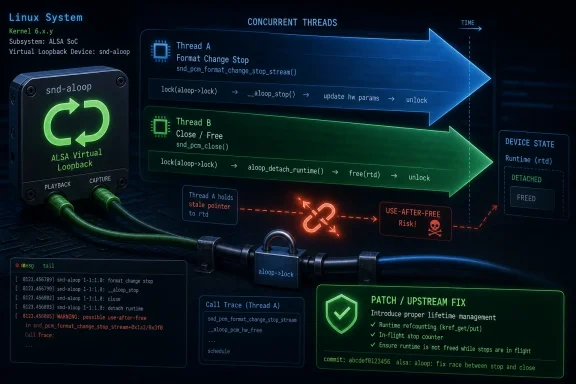 A Small Audio Driver Exposes a Big Kernel Truth
The affected component is ALSA’s loopback PCM driver, commonly known as snd-aloop. It is not a sound card driver in the consumer sense; it is a virtual device that routes audio played into one side back out through a capture side. That makes it useful for testing, audio routing, recording pipelines, browser and conferencing workarounds, containerized audio setups, and automated systems that need an ALSA endpoint without physical hardware.CVE-2026-46090 lives in the kind of code path that administrators rarely think about until it breaks: stream setup, format negotiation, stop handling, and teardown. When playback starts with parameters that no longer match a running capture stream,
loopback_check_format() may stop the capture side. The vulnerability appears when that stop operation crosses paths with another thread closing the capture side and freeing or detaching runtime state.That is a classic use-after-free shape. One path believes it still has a valid object. Another path has already made that object invalid. The kernel, unlike a user-space application, does not get to crash politely when this goes wrong.
The Vulnerability Is Really About Ownership, Not Audio
The NVD description points to an earlier fix, commit826af7fa62e3, which addressed racy access in the PCM trigger path by moving the peer lookup under cable->lock. That was a sensible improvement, but CVE-2026-46090 shows the limit of merely protecting the lookup. The peer could be found safely and still become unsafe by the time the stop operation actually ran.That distinction is the core lesson. Locking protects a moment; lifetime management protects a relationship. If the code takes a pointer under a lock, drops the lock, and then performs meaningful work with that pointer, the real question becomes: what prevents the pointed-to object from disappearing?
In this case, the answer was not strong enough. A concurrent close could clear the capture entry from
cable->streams[], detach or free the runtime, and leave the playback trigger path holding a stale peer substream pointer. The fix keeps a per-cable count of in-flight peer stops before dropping cable->lock, then makes free_cable() wait before detaching runtime state.That is not glamorous security engineering. It is better: it is the dull correctness work that prevents a local race from turning into a kernel memory safety bug.
NVD’s “Awaiting Enrichment” Label Should Not Be Mistaken for Safety
At publication, NVD lists CVE-2026-46090 as “Awaiting Enrichment,” with no NIST CVSS v4.0, v3.x, or v2.0 score assigned. That does not mean the issue is theoretical, harmless, or unimportant. It means the record has not yet been fully scored and categorized by NVD.Security teams sometimes overfit their triage queues to CVSS scores because the score is easy to automate. CVE-2026-46090 is a good example of why that shortcut is risky. The absence of a score is not a severity rating; it is a workflow state.
The practical severity depends on deployment context. A desktop Linux user with
snd-aloop unavailable or unloaded has a different exposure profile from a multi-user system, audio-processing host, CI runner, media workstation, container host, or virtual desktop environment where untrusted users can exercise ALSA devices. The bug is in kernel space, but the reachable surface depends on configuration and permissions.That is where administrators need to be careful. “No CVSS yet” is not the same sentence as “no action required.”
The Attack Surface Is Narrower Than the Kernel, Wider Than Most People Think
Thesnd-aloop driver is optional. Many systems will not have it loaded. Some kernels build it as a module, and many distributions ship the module even if it is not active by default. The exposure question is therefore not “Do we run Linux?” but “Can an untrusted local workload reach this driver?”That matters in 2026 because audio plumbing is no longer just a desktop concern. Linux audio stacks sit under browser sandboxes, remote desktop systems, media services, AI transcription pipelines, containerized meeting bots, test harnesses, streaming appliances, and developer environments. The virtual loopback device is exactly the kind of utility module that appears in automation because it makes awkward audio workflows scriptable.
A local kernel use-after-free generally deserves more attention on shared systems than on single-user workstations. If local users, containers, or constrained services can open and manipulate the loopback PCM device, then a race that can destabilize kernel memory belongs in the patch queue. If the module is absent, blocked, or not reachable by untrusted users, the operational urgency drops.
The uncomfortable middle ground is the common one: administrators may not know whether the module is present, loadable, or used indirectly by an application. That uncertainty is why inventory still beats speculation.
The Fix Is a Refcounting Story in Disguise
The upstream fix introduces a per-cable count of in-flight peer stops. In plain English, the driver now records that a stop operation is underway before it releases the lock, and the cable-freeing path waits for those operations to finish before detaching runtime state. That makes the lifetime of the peer runtime explicit rather than accidental.This is the kind of patch that looks small in a diff but large in consequence. It does not redesign ALSA. It does not change the intended behavior of loopback audio. It teaches the driver to remember that an object involved in an operation cannot be safely dismantled just because the lookup phase is over.
Kernel maintainers favor these narrowly scoped fixes because stable trees need correctness without collateral damage. A sweeping rewrite might be prettier, but it is harder to backport and riskier to ship across supported kernels. The references attached to the CVE show multiple stable commits, which is the usual sign that the fix is being carried into maintained kernel branches rather than left only in mainline development.
For sysadmins, that means the right remedy is boring and conventional: take the vendor kernel update when it lands. Do not hand-edit kernel audio code. Do not assume a package update to user-space ALSA tools fixes a kernel module bug.
The Earlier ALSA Race Was Not the End of the Story
CVE-2026-46090 follows an earlier related ALSA loopback race, CVE-2026-23191, which dealt with racy access at PCM trigger time. That earlier issue already moved important work undercable->lock and added checks around peer access. The new CVE shows that fixing a race can expose the next layer of lifecycle ambiguity.That is not an indictment of the earlier fix. It is how kernel hardening often proceeds. Fuzzers and reviewers find a crash, maintainers narrow the unsafe window, and then another edge case demonstrates that the object lifetime model still needs tightening.
The pattern is familiar across subsystems. Networking, filesystems, USB, GPU drivers, Bluetooth, and sound code all contain callback-heavy state machines that were designed for performance and hardware realities long before today’s fuzzing scale. When fuzzers hammer those paths with open, close, trigger, reconfigure, and teardown sequences, assumptions that were “obviously safe” become test cases.
The important part is that the kernel process is absorbing those findings into stable fixes. The frustrating part is that defenders rarely get a neat exploitability answer on day one.
WindowsForum Readers Should Care Even If They Boot Windows First
This is WindowsForum, so it is fair to ask why a Linux ALSA bug deserves attention here. The answer is that Windows professionals increasingly administer Linux whether or not their primary workstation runs Windows. WSL, Hyper-V guests, Azure Linux workloads, Linux-based appliances, container hosts, security tooling, CI systems, and developer environments all sit inside the modern Windows-adjacent estate.CVE-2026-46090 is not a Windows kernel vulnerability. It does not implicate Windows audio, WASAPI, or the Windows driver model. But it may matter to Windows shops running Linux workloads under virtualization or in mixed fleets, especially where Linux hosts support media processing, remote access, test automation, or developer sandboxes.
The most likely enterprise impact is not a dramatic internet-wide exploit wave. It is the quieter risk of a local kernel bug on systems where multiple users or workloads have access to audio devices. That includes lab machines, build runners, shared desktops, and service hosts that were never threat-modeled as audio systems but nevertheless have virtual audio modules installed.
The defensive move is to treat this as part of Linux kernel hygiene, not as an emergency Windows incident.
Containers Do Not Magically Make Kernel Audio Bugs Harmless
One of the more dangerous assumptions in mixed environments is that containers turn kernel bugs into application bugs. They do not. Containers share the host kernel. If a container is granted access to host audio devices or enough privilege to load or interact with relevant modules, the boundary becomes much thinner than the diagram on the architecture slide suggests.Most well-confined containers will not have arbitrary access to ALSA devices. Many production containers do not need audio at all. But media, browser automation, conferencing, transcription, and testing containers often punch deliberate holes through the device layer. That is where a virtual loopback driver can become relevant.
The question for administrators is not whether Docker or Kubernetes uses ALSA by default. The question is whether any workload has been handed
/dev/snd, elevated device permissions, or host-level access for convenience. In development environments, that convenience is common.CVE-2026-46090 is therefore a useful prompt to audit device passthrough. A kernel bug in a niche module is much less interesting when untrusted workloads cannot reach the module.
The Risk Is Local, but Local Is Not Low-Value
Kernel use-after-free bugs often begin as local denial-of-service concerns. A crash is the easiest visible outcome, and it may be the only practical outcome in many environments. But memory safety bugs in kernel space are treated seriously because they can sometimes be shaped into privilege escalation, information disclosure, or broader compromise depending on allocator behavior, mitigations, object layout, timing, and attacker control.There is no public CVSS score from NVD at the time of writing, and the supplied CVE text does not claim remote exploitation. That should temper the response. It should not eliminate it.
A local attacker is not a hypothetical category. On shared Linux systems, “local” can mean a shell user, a compromised service account, a malicious build job, a hostile container, or an application sandbox escape chain looking for the next step. The kernel is the prize because it collapses those boundaries.
The right security posture is proportional. Patch through normal kernel channels. Restrict module exposure where practical. Do not panic. Do not ignore it because “audio” sounds harmless.
The Most Useful Mitigation May Be Knowing Whether snd-aloop Exists
Before the patched kernel arrives, exposure reduction is mainly about reachability. If snd-aloop is not needed, administrators can keep it unloaded or block it from being loaded. If it is needed, they can restrict which users and workloads can access ALSA devices and avoid passing sound devices into untrusted containers.On many systems, the module name is
snd-aloop. Administrators can check whether it is loaded, whether it exists in the installed kernel module tree, and whether any audio workflows depend on it. The exact commands and policy mechanisms vary by distribution, but the decision is simple: if you do not need virtual ALSA loopback, do not expose it unnecessarily.For fleets, the harder part is dependency discovery. A developer may have added loopback audio for browser tests. A media service may use it for capture routing. A remote desktop stack may rely on virtual audio. Removing the module blindly can cause operational breakage.
That is why the best interim mitigation is not theatrical hardening. It is an inventory pass followed by targeted restriction.
Distribution Timing Will Decide the Operational Clock
Upstream stable commits are important, but most administrators should not run directly from kernel.org. They should watch their distribution’s security advisories and kernel package updates. Enterprise distributions may backport the fix without changing the visible upstream version number, which is why checking onlyuname -r against mainline versions can mislead.This is especially true in Red Hat, Ubuntu, Debian, SUSE, Oracle, AlmaLinux, Rocky Linux, Arch, Fedora, and cloud-provider kernels. Each has its own cadence, backporting practice, and advisory language. Some will publish CVE-specific notes. Others will fold the patch into a broader kernel update.
The presence of several stable commit references in the CVE record is encouraging because it suggests the fix is intended for maintained branches. But the actionable question is local: has your vendor shipped a kernel that includes the fix for CVE-2026-46090, or an equivalent backport?
Until that answer is yes, exposure control remains the fallback.
The Real Story Is Kernel Maintenance Under Constant Fuzzing Pressure
CVE-2026-46090 has the feel of a fuzzing-era vulnerability even when the CVE text does not dwell on exploit drama. The trigger involves concurrency, stream state, open and close timing, and a stale pointer that appears only when operations interleave just so. Humans can reason about these paths, but fuzzers are relentless at finding state-machine collisions humans do not naturally test.That pressure has changed the Linux security landscape. Vulnerability records now routinely appear for bugs in drivers and subsystems that most users have never heard of. Some are severe. Some are obscure. Many are both technically real and operationally niche.
This creates fatigue for administrators. Every week brings another kernel CVE in a subsystem that sounds irrelevant until someone discovers it is compiled into a fleet image. The temptation is to dismiss the stream as noise.
That is the wrong lesson. The better lesson is to classify by reachability and privilege boundary. A local UAF in an unused optional module is lower priority than a remotely reachable network flaw, but it is still part of the kernel attack surface if untrusted code can exercise it.
Security Scoring Still Lags Behind Engineering Reality
NVD’s enrichment process is useful, but it is not instantaneous. CVE-2026-46090 reached public tracking before NVD assigned a severity score. That is normal enough, but it exposes a mismatch between engineering and governance.Engineers see a kernel UAF and ask whether the code is reachable, whether the object lifetime is now fixed, and which branches need the patch. Governance systems ask for a CVSS number, a CWE mapping, a product list, and a due date. The former can move faster than the latter.
Mature teams bridge that gap with internal rules. A newly published Linux kernel memory safety bug in a reachable local component should enter triage even without a CVSS score. A module that is not present can be documented as not affected. A module that is present but restricted can be handled through normal patch windows unless other intelligence changes the picture.
Waiting for a score is not risk management. It is queue management.
The Patch Also Shows Why “Just Add a Lock” Is Not Enough
There is a common outsider view of race conditions that imagines every fix as simply putting more code under a lock. CVE-2026-46090 is more subtle. The previous work moved peer lookup under the cable lock, but the stop operation still had to run after dropping that lock. Holding a spinlock across arbitrary stop work may not be safe or desirable.The new approach counts in-flight peer stops and makes teardown wait. That is a different kind of synchronization. It says, in effect, “We cannot hold this lock for the whole operation, so we need a separate lifetime contract.”
That distinction matters beyond ALSA. Kernel code is full of places where locks protect data structure consistency, but object lifetime requires reference counts, wait queues, RCU, completion mechanisms, or other patterns. The art is not merely locking more; it is locking the right thing and making lifetime explicit where locks cannot span the whole operation.
This is why small kernel fixes deserve respect. They encode hard-won knowledge about which operations can sleep, which locks can be held, and which objects may vanish under pressure.
The Practical Signal Hidden in the ALSA Noise
For all the kernel internals, the operational message is straightforward. CVE-2026-46090 is a local Linux kernel memory safety issue in an optional ALSA loopback module, fixed upstream by making peer-stop lifetime explicit during format-change stop handling. It deserves attention wheresnd-aloop is available to untrusted users or workloads, but it does not justify treating every Linux desktop as if it were remotely exposed.- Administrators should identify systems where the
snd-aloopmodule is present, loaded, or required by audio-routing, testing, media, or remote desktop workflows. - Systems that do not need ALSA loopback should avoid loading the module and should restrict untrusted workloads from accessing sound devices.
- Shared Linux hosts, CI runners, developer sandboxes, and container hosts with audio device passthrough deserve faster review than single-user machines with no loopback use.
- Kernel updates from the relevant distribution or vendor are the durable fix, and enterprise kernels may receive a backport without an obvious upstream version jump.
- The lack of an NVD CVSS score on May 27, 2026 should be treated as missing metadata, not as evidence that the vulnerability is low risk.
- Windows-focused shops should include this in Linux fleet hygiene where WSL-adjacent tooling, Hyper-V guests, Azure workloads, or mixed infrastructure rely on Linux audio components.
References
- Primary source: NVD / Linux Kernel
Published: 2026-05-28T01:11:37-07:00
NVD - CVE-2026-46090
 nvd.nist.gov
- Security advisory: MSRC
Published: 2026-05-28T01:11:37-07:00
Original feed URL
Security Update Guide - Microsoft Security Response Center
 msrc.microsoft.com
- Related coverage: cateee.net
- Related coverage: alsa-project.org
Matrix:Module-aloop - AlsaProject
www.alsa-project.org
- Related coverage: windowsforum.com
CVE-2026-23191: ALSA snd-aloop Race Leads to Use-After-Free in PCM Trigger | Windows Forum
The page for CVE-2026-23191 is currently unavailable on Microsoft’s update guide, but the underlying Linux kernel issue is identifiable: ALSA: aloop: Fix...windowsforum.com - Related coverage: stackoverflow.com
audio - ALSA-loop (aloop kernel module) send and receive hook points - Stack Overflow
I'm exploring some sample code of Aloop in the kernel-dir:

https://elixir.bootlin.com/linux/latest/source/sound/drivers/aloop.c
I want to put there my own function which gets as parameter a pointe...stackoverflow.com

- Related coverage: cve.imfht.com
CVE-2026-43279: ALSA: usb-audio: Add sanity check for OOB writes at silencing - Vulnerability Platform
[HIGH 7.8] Overview A out-of-bounds (OOB) write vulnerability exists in the Linux kernel's ALSA usb-audio driver. In implicit feedback mode, the consistency betw cve.imfht.com
- Related coverage: security.snyk.io
Use After Free in kernel-rt-debug-core | CVE-2026-23191 | Snyk
High severity (7) Use After Free in kernel-rt-debug-core | CVE-2026-23191security.snyk.io - Related coverage: kernel.org
- Related coverage: gstreamer.freedesktop.org
