

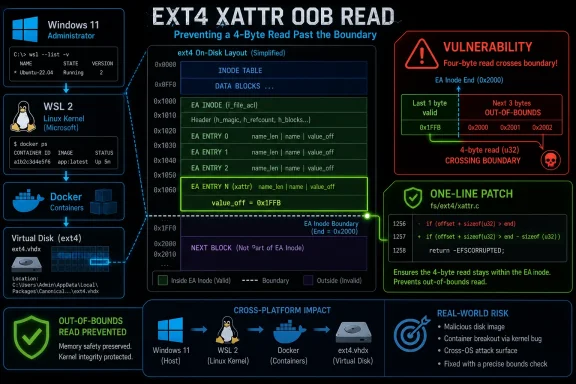
CVE-2026-46094 is a newly published Linux kernel ext4 vulnerability, disclosed by NVD on May 27, 2026, in which a faulty extended-attribute bounds check could allow a four-byte read past the valid xattr region during filesystem metadata validation. The fix is almost comically small: one changed comparison in
The vulnerable code lives in ext4, the default or near-default filesystem for a vast amount of Linux infrastructure. Ext4 is not glamorous infrastructure, which is precisely why it matters. It is the kind of subsystem administrators stop thinking about when it works, and the kind they remember instantly when a corrupted disk image, malformed volume, or unexpected kernel crash ruins a maintenance window.
CVE-2026-46094 concerns extended attributes, or xattrs, the metadata fields used by Linux filesystems for security labels, access-control data, capabilities, and other name-value metadata attached to files. The vulnerable function,
That sounds microscopic because it is microscopic. If
The patch changes the condition from “is the next pointer at or past the end?” to “is there enough room for the four-byte read that follows?” In C, and especially in kernel C, that distinction is the difference between a plausible invariant and a real one.
That is why this CVE deserves attention even without an NVD score. An ext4 image can arrive from a disk, a USB stick, a VM image, a cloud volume, a container layer, a backup archive, or a forensic artifact. The kernel must assume that the metadata it reads could be malformed, stale, truncated, crafted, or damaged.
In that world, the phrase “out-of-bounds access” is not automatically synonymous with remote code execution or privilege escalation. CVE-2026-46094, as published, describes an out-of-bounds read condition during xattr checking, not a public exploit chain. But security teams should resist the opposite mistake too: dismissing it because the overread is small. Small out-of-bounds reads can still produce kernel faults, leak adjacent data in some contexts, or become useful primitives when paired with other bugs.
The responsible reading is narrower and more practical. This is a kernel hardening fix in a high-value parser for on-disk metadata. It should be patched through normal kernel-update channels, prioritized higher on systems that ingest untrusted filesystems, and treated as part of the steady drumbeat of memory-safety maintenance that keeps Linux storage boring.
This is especially common with Linux kernel CVEs, where upstream may publish a concise vulnerability record tied to stable commits before distribution advisories and third-party scanners fully converge. The result is a gap between engineering reality and dashboard reality. The patch exists, the vulnerable code path exists, and the CVE exists, but the severity number that many risk systems depend on is not yet present.
That creates an awkward moment for enterprise IT. Patch teams want a score. Vulnerability managers want affected package names. Security leadership wants a clean severity label. Kernel maintainers, meanwhile, have already done the practical thing: identify the unsafe boundary check and land a fix across stable trees.
This is where mature organizations separate triage from theater. A CVSS score is useful for prioritization, but it is not a substitute for understanding exposure. A desktop that never mounts untrusted ext4 media sits in a different risk category from a virtualization host, a CI system unpacking filesystem images, a backup server handling customer volumes, or a forensic workstation intentionally mounting suspect disks.
Modern Windows environments are no longer Windows-only environments. WSL has made Linux filesystems part of developer workstations. Hyper-V, VMware, VirtualBox, and cloud-hosted Linux guests are routine. Docker Desktop and Kubernetes workflows put Linux kernels, Linux filesystems, and Linux images into places where Windows admins are still accountable for uptime and incident response.
The practical question is not “does Windows have ext4?” It is “where does my organization run Linux kernels that might parse ext4 metadata?” The answer may include WSL distributions, Linux virtual machines, NAS devices, backup appliances, security tools, build agents, embedded systems, cloud instances, and containers backed by Linux hosts.
This is the modern mixed-platform reality: a vulnerability in ext4 can show up in a Windows administrator’s queue because the business depends on Linux beneath, beside, or inside the Windows estate. The OS boundary is no longer the management boundary.
For many users, WSL updates are invisible until something breaks. Developers install distributions, clone repositories, mount project folders, use package managers, and build containers without thinking about kernel provenance. That convenience is the point, but it also means Linux kernel vulnerabilities can exist in environments that traditional Windows patch reporting may not describe clearly.
CVE-2026-46094 is not a reason to panic about WSL. There is no public indication from the CVE record alone that ordinary WSL use exposes a straightforward attack path. But WSL systems that handle ext4-formatted virtual disks, imported distributions, or filesystem artifacts should be kept current like any other Linux host.
The wider issue is inventory. Many enterprises can report Windows build numbers with precision but have only a fuzzy view of WSL kernel versions, developer-created Linux VMs, or ephemeral build infrastructure. That gap matters more than this specific CVE.
That matters for ext4 because ext4 is everywhere. A cloud team may attach a Linux volume for recovery. A security team may mount a suspicious disk image. A developer may import a VM appliance. A backup product may process Linux filesystems. A lab machine may handle removable media from unknown sources.
In those workflows, the attacker does not necessarily need login access to the target machine. The delivery mechanism may be an image, volume, disk, or artifact that a privileged process later parses. That does not automatically make CVE-2026-46094 remotely exploitable, but it does make exposure more subtle than a simple “is ext4 installed?” checklist.
This is why filesystem parser bugs have a long tail. They sit at the intersection of trust and convenience. Administrators routinely mount things because mounting things is how recovery, migration, and analysis work.
Almost is the problem. In C, pointer comparisons say where an address lies; they do not automatically prove that a future dereference of a particular width is safe. A pointer can be inside a region while the object read through that pointer extends outside it. That is the bug in one sentence.
The fix is therefore not conceptually exotic. It aligns the check with the actual access: before the next iteration can read a 32-bit value, there must be at least four bytes left. The patch makes the code test the read footprint, not just the pointer position.
This is the kind of flaw memory-safe language advocates point to as evidence, and they are not wrong. But the kernel cannot be rewritten overnight, ext4 is not going away, and C remains the operating language of much critical infrastructure. Until that changes, the security posture depends on relentless review, fuzzing, stable backports, and conservative parsing.
It also means version identification matters. Linux fleet owners rarely run a single upstream kernel. They run distribution kernels, cloud provider kernels, vendor kernels, appliance kernels, and long-term support kernels with their own backport policies. A vulnerable-looking version number may already contain the fix, while a seemingly recent custom kernel may not.
That is why the correct operational question is not merely “what kernel version am I running?” It is “does my vendor kernel include the specific ext4 xattr bounds-check patch?” For mainstream distributions, the answer will usually arrive through security advisories and kernel package changelogs. For custom builds, embedded appliances, or pinned CI images, someone has to check.
Windows-heavy organizations often discover this complexity late. Their Linux exposure may be indirect, outsourced, or hidden in appliances. But when a storage parser CVE lands, those hidden kernels still need owners.
Consider a forensic workstation. Its job is to examine disk images, some of which may be hostile. Consider a backup validation server that mounts restored Linux volumes to verify integrity. Consider a migration tool that imports customer ext4 images into a cloud environment. These are not hypothetical workflows; they are normal IT operations.
The paradox is that the systems most likely to parse malformed filesystems are not always the systems with the strongest patch discipline. Production web servers get maintenance windows. A dusty recovery VM may not. A developer’s local WSL setup may update only when the developer notices.
CVE-2026-46094 is therefore less a five-alarm fire than a useful audit prompt. Find the machines that mount ext4 content from outside their own trust boundary. Make sure they are patched first.
That creates an uncomfortable path for parser bugs. A malicious or corrupted artifact can sit inert in a repository until a build agent, scanner, or migration tool mounts it. The vulnerable code may execute not when the artifact is downloaded, but when automation later decides to inspect it.
Security teams have grown accustomed to scanning packages, dependencies, and container manifests. They are less consistent about treating filesystem images as active attack inputs. CVE-2026-46094 is a reminder that “just metadata” is still data consumed by privileged code.
The safer pattern is isolation. Systems that must mount untrusted images should do so in constrained environments, preferably disposable VMs or sandboxes, with patched kernels and minimal privileges. The goal is not to invent drama around this particular CVE. The goal is to stop treating filesystem parsing as harmless clerical work.
That can produce a false calm. A security dashboard with no score attached may fail to escalate the item, even though upstream maintainers have already issued a fix. Conversely, once enrichment arrives, the same CVE can suddenly appear urgent, creating the illusion that the vulnerability became more dangerous overnight.
For CVE-2026-46094, the public record is clear enough to act on even before scoring arrives. The affected component is the Linux kernel’s ext4 xattr checker. The failure mode is an out-of-bounds read caused by an insufficient bounds check. The fix has been committed into stable lines. That is enough to begin reasonable triage.
The broader lesson is that vulnerability management cannot be outsourced entirely to numeric severity. Scores are useful, but timelines, code paths, and exposure models are often more useful.
That kind of patch is usually low-risk compared with invasive fixes. It is also easier for maintainers to backport because it touches a single line and preserves the existing control flow. For administrators, that matters. Security updates that are narrowly scoped tend to be easier to justify in conservative environments.
But “simple patch” should not be confused with “optional patch.” The simplicity cuts both ways. If the fix is small, clear, and already in the stable pipeline, there is little reason to avoid it on systems that may encounter untrusted or malformed ext4 metadata.
The operational challenge is not the code change. It is the unevenness of kernel delivery across the places Linux now runs.
Azure customers run vast Linux fleets. Windows developers use WSL. Enterprise security teams analyze Linux images from Windows desktops. Hybrid identity, monitoring, backup, and DevOps platforms routinely straddle both worlds. The old binary of “Windows shop” versus “Linux shop” no longer describes how infrastructure is actually assembled.
This matters because accountability still has to land somewhere. If a Windows endpoint hosts WSL workloads, if a Hyper-V server runs Linux guests, or if a Windows-administered backup product handles ext4 volumes, then Linux kernel patching becomes part of the Windows operational story.
CVE-2026-46094 is not the most dramatic example of that convergence. It is better than dramatic: it is ordinary. Ordinary Linux kernel maintenance now belongs in the Windows administrator’s peripheral vision.
For most organizations, remediation will arrive through normal kernel updates from Linux distributions, cloud vendors, WSL servicing, appliance vendors, and managed platform providers. The work is to make sure those channels actually cover the systems that matter. The awkward machines outside standard patch rings deserve special attention.
Admins should also review workflows that mount ext4 images from untrusted sources. If those workflows run on unpatched kernels or privileged shared systems, the risk model is worse than it needs to be. Isolation, disposable analysis environments, and timely kernel updates are cheap compared with debugging a kernel crash during incident response.
The security story here is refreshingly concrete. A pointer could be inside a boundary while a four-byte read crossed it. The fix makes the boundary check match the read. Everything else is fleet hygiene.
fs/ext4/xattr.c. But the lesson is not small at all. In 2026, even a one-line filesystem patch can become a fleet-management problem for Windows shops running WSL, Linux VMs, containers, appliances, backup servers, and mixed-OS storage workflows.
 A One-Line Patch Lands in One of Linux’s Most Trusted Places
The vulnerable code lives in ext4, the default or near-default filesystem for a vast amount of Linux infrastructure. Ext4 is not glamorous infrastructure, which is precisely why it matters. It is the kind of subsystem administrators stop thinking about when it works, and the kind they remember instantly when a corrupted disk image, malformed volume, or unexpected kernel crash ruins a maintenance window.CVE-2026-46094 concerns extended attributes, or xattrs, the metadata fields used by Linux filesystems for security labels, access-control data, capabilities, and other name-value metadata attached to files. The vulnerable function,
check_xattrs(), walks ext4 extended-attribute entries and verifies that each next entry remains inside the valid metadata region. The bug was that the old check rejected a pointer only when the next xattr entry was at or beyond the end of the region, but did not require enough remaining space for the next four-byte IS_LAST_ENTRY() read.That sounds microscopic because it is microscopic. If
next landed at end - 1, the prior test still allowed it because the pointer was technically before the end. The next loop iteration could then read four bytes starting one byte before the boundary, crossing three bytes outside the valid xattr area.The patch changes the condition from “is the next pointer at or past the end?” to “is there enough room for the four-byte read that follows?” In C, and especially in kernel C, that distinction is the difference between a plausible invariant and a real one.
Filesystem Bugs Are Boundary Bugs Wearing Work Boots
The kernel has many classes of security flaws, but filesystem bugs have a particular flavor: they often arise where untrusted bytes are being treated as structure. A mounted filesystem is not just storage. It is a serialized database being parsed by privileged kernel code.That is why this CVE deserves attention even without an NVD score. An ext4 image can arrive from a disk, a USB stick, a VM image, a cloud volume, a container layer, a backup archive, or a forensic artifact. The kernel must assume that the metadata it reads could be malformed, stale, truncated, crafted, or damaged.
In that world, the phrase “out-of-bounds access” is not automatically synonymous with remote code execution or privilege escalation. CVE-2026-46094, as published, describes an out-of-bounds read condition during xattr checking, not a public exploit chain. But security teams should resist the opposite mistake too: dismissing it because the overread is small. Small out-of-bounds reads can still produce kernel faults, leak adjacent data in some contexts, or become useful primitives when paired with other bugs.
The responsible reading is narrower and more practical. This is a kernel hardening fix in a high-value parser for on-disk metadata. It should be patched through normal kernel-update channels, prioritized higher on systems that ingest untrusted filesystems, and treated as part of the steady drumbeat of memory-safety maintenance that keeps Linux storage boring.
The Missing CVSS Score Is a Signal, Not a Reprieve
NVD currently lists CVE-2026-46094 as awaiting enrichment, with no CVSS 4.0, 3.x, or 2.0 score assigned by NIST. That absence is easy to misread. A missing score does not mean a vulnerability is harmless; it means the central database has not yet completed its scoring and product-mapping work.This is especially common with Linux kernel CVEs, where upstream may publish a concise vulnerability record tied to stable commits before distribution advisories and third-party scanners fully converge. The result is a gap between engineering reality and dashboard reality. The patch exists, the vulnerable code path exists, and the CVE exists, but the severity number that many risk systems depend on is not yet present.
That creates an awkward moment for enterprise IT. Patch teams want a score. Vulnerability managers want affected package names. Security leadership wants a clean severity label. Kernel maintainers, meanwhile, have already done the practical thing: identify the unsafe boundary check and land a fix across stable trees.
This is where mature organizations separate triage from theater. A CVSS score is useful for prioritization, but it is not a substitute for understanding exposure. A desktop that never mounts untrusted ext4 media sits in a different risk category from a virtualization host, a CI system unpacking filesystem images, a backup server handling customer volumes, or a forensic workstation intentionally mounting suspect disks.
Why Windows Administrators Should Care About an ext4 CVE
At first glance, CVE-2026-46094 looks like a Linux-only issue. Windows does not use ext4 as its native filesystem, and most Windows endpoints will never directly mount an ext4 volume in the Windows kernel. That should narrow the blast radius, but it should not end the discussion for WindowsForum readers.Modern Windows environments are no longer Windows-only environments. WSL has made Linux filesystems part of developer workstations. Hyper-V, VMware, VirtualBox, and cloud-hosted Linux guests are routine. Docker Desktop and Kubernetes workflows put Linux kernels, Linux filesystems, and Linux images into places where Windows admins are still accountable for uptime and incident response.
The practical question is not “does Windows have ext4?” It is “where does my organization run Linux kernels that might parse ext4 metadata?” The answer may include WSL distributions, Linux virtual machines, NAS devices, backup appliances, security tools, build agents, embedded systems, cloud instances, and containers backed by Linux hosts.
This is the modern mixed-platform reality: a vulnerability in ext4 can show up in a Windows administrator’s queue because the business depends on Linux beneath, beside, or inside the Windows estate. The OS boundary is no longer the management boundary.
WSL Complicates the Comforting Story
Windows Subsystem for Linux deserves special mention because it has changed the psychology of Linux exposure on Windows desktops. WSL makes Linux feel like a feature of Windows, but WSL 2 uses a real Linux kernel inside a lightweight virtualized environment. Kernel servicing therefore matters.For many users, WSL updates are invisible until something breaks. Developers install distributions, clone repositories, mount project folders, use package managers, and build containers without thinking about kernel provenance. That convenience is the point, but it also means Linux kernel vulnerabilities can exist in environments that traditional Windows patch reporting may not describe clearly.
CVE-2026-46094 is not a reason to panic about WSL. There is no public indication from the CVE record alone that ordinary WSL use exposes a straightforward attack path. But WSL systems that handle ext4-formatted virtual disks, imported distributions, or filesystem artifacts should be kept current like any other Linux host.
The wider issue is inventory. Many enterprises can report Windows build numbers with precision but have only a fuzzy view of WSL kernel versions, developer-created Linux VMs, or ephemeral build infrastructure. That gap matters more than this specific CVE.
The Attack Surface Is Not the Filesystem You Boot From
Filesystem vulnerabilities often get described as though they affect only machines that use the vulnerable filesystem as their root volume. That framing is too narrow. A kernel filesystem parser becomes exposed whenever it is asked to mount, inspect, repair, or otherwise parse a crafted filesystem image.That matters for ext4 because ext4 is everywhere. A cloud team may attach a Linux volume for recovery. A security team may mount a suspicious disk image. A developer may import a VM appliance. A backup product may process Linux filesystems. A lab machine may handle removable media from unknown sources.
In those workflows, the attacker does not necessarily need login access to the target machine. The delivery mechanism may be an image, volume, disk, or artifact that a privileged process later parses. That does not automatically make CVE-2026-46094 remotely exploitable, but it does make exposure more subtle than a simple “is ext4 installed?” checklist.
This is why filesystem parser bugs have a long tail. They sit at the intersection of trust and convenience. Administrators routinely mount things because mounting things is how recovery, migration, and analysis work.
The Four-Byte Read Shows Why C Still Dominates Kernel Risk
There is a particular cruelty in bugs like this: the code was already trying to be careful.check_xattrs() existed to validate xattr consistency and report errors. The vulnerable logic was not a reckless copy into a buffer or an obviously missing length check. It was a boundary check that almost expressed the right invariant.Almost is the problem. In C, pointer comparisons say where an address lies; they do not automatically prove that a future dereference of a particular width is safe. A pointer can be inside a region while the object read through that pointer extends outside it. That is the bug in one sentence.
The fix is therefore not conceptually exotic. It aligns the check with the actual access: before the next iteration can read a 32-bit value, there must be at least four bytes left. The patch makes the code test the read footprint, not just the pointer position.
This is the kind of flaw memory-safe language advocates point to as evidence, and they are not wrong. But the kernel cannot be rewritten overnight, ext4 is not going away, and C remains the operating language of much critical infrastructure. Until that changes, the security posture depends on relentless review, fuzzing, stable backports, and conservative parsing.
Stable Backports Turn a Tiny Fix Into a Real Patch Campaign
The CVE references multiple stable kernel commits, reflecting the kernel community’s usual practice of carrying important fixes into supported stable lines. That is good news for administrators because it means the fix is not stranded in a future development branch. It is being propagated into kernels people actually run.It also means version identification matters. Linux fleet owners rarely run a single upstream kernel. They run distribution kernels, cloud provider kernels, vendor kernels, appliance kernels, and long-term support kernels with their own backport policies. A vulnerable-looking version number may already contain the fix, while a seemingly recent custom kernel may not.
That is why the correct operational question is not merely “what kernel version am I running?” It is “does my vendor kernel include the specific ext4 xattr bounds-check patch?” For mainstream distributions, the answer will usually arrive through security advisories and kernel package changelogs. For custom builds, embedded appliances, or pinned CI images, someone has to check.
Windows-heavy organizations often discover this complexity late. Their Linux exposure may be indirect, outsourced, or hidden in appliances. But when a storage parser CVE lands, those hidden kernels still need owners.
The Real Risk Lives in the Edges of the Fleet
Most well-managed Linux servers will absorb this patch as part of routine kernel maintenance. The more interesting risk lives at the edges: lab systems, developer workstations, appliances, old VMs, offline images, and one-off recovery boxes. These systems are often exactly the ones that handle untrusted media.Consider a forensic workstation. Its job is to examine disk images, some of which may be hostile. Consider a backup validation server that mounts restored Linux volumes to verify integrity. Consider a migration tool that imports customer ext4 images into a cloud environment. These are not hypothetical workflows; they are normal IT operations.
The paradox is that the systems most likely to parse malformed filesystems are not always the systems with the strongest patch discipline. Production web servers get maintenance windows. A dusty recovery VM may not. A developer’s local WSL setup may update only when the developer notices.
CVE-2026-46094 is therefore less a five-alarm fire than a useful audit prompt. Find the machines that mount ext4 content from outside their own trust boundary. Make sure they are patched first.
This Is Also a Supply Chain Story
The modern software supply chain is full of filesystem images. Container layers, VM templates, cloud snapshots, development images, test fixtures, firmware bundles, and appliance exports all move structured storage across organizational boundaries. They are treated as artifacts, but many of them are also mountable filesystems.That creates an uncomfortable path for parser bugs. A malicious or corrupted artifact can sit inert in a repository until a build agent, scanner, or migration tool mounts it. The vulnerable code may execute not when the artifact is downloaded, but when automation later decides to inspect it.
Security teams have grown accustomed to scanning packages, dependencies, and container manifests. They are less consistent about treating filesystem images as active attack inputs. CVE-2026-46094 is a reminder that “just metadata” is still data consumed by privileged code.
The safer pattern is isolation. Systems that must mount untrusted images should do so in constrained environments, preferably disposable VMs or sandboxes, with patched kernels and minimal privileges. The goal is not to invent drama around this particular CVE. The goal is to stop treating filesystem parsing as harmless clerical work.
NVD’s Delay Exposes a Weakness in Vulnerability Automation
NVD enrichment lag has become a recurring operational irritant. Vulnerability scanners and dashboards often depend on NVD metadata for severity, affected configurations, and CPE mapping. When a CVE is published without those details, tools may underreport, misclassify, or simply wait.That can produce a false calm. A security dashboard with no score attached may fail to escalate the item, even though upstream maintainers have already issued a fix. Conversely, once enrichment arrives, the same CVE can suddenly appear urgent, creating the illusion that the vulnerability became more dangerous overnight.
For CVE-2026-46094, the public record is clear enough to act on even before scoring arrives. The affected component is the Linux kernel’s ext4 xattr checker. The failure mode is an out-of-bounds read caused by an insufficient bounds check. The fix has been committed into stable lines. That is enough to begin reasonable triage.
The broader lesson is that vulnerability management cannot be outsourced entirely to numeric severity. Scores are useful, but timelines, code paths, and exposure models are often more useful.
The Patch Is Simple Because the Invariant Is Simple
The most reassuring part of CVE-2026-46094 is the patch itself. It does not redesign ext4. It does not introduce a large behavioral change. It changes the check so the code confirms that a future four-byte read fits within the xattr region.That kind of patch is usually low-risk compared with invasive fixes. It is also easier for maintainers to backport because it touches a single line and preserves the existing control flow. For administrators, that matters. Security updates that are narrowly scoped tend to be easier to justify in conservative environments.
But “simple patch” should not be confused with “optional patch.” The simplicity cuts both ways. If the fix is small, clear, and already in the stable pipeline, there is little reason to avoid it on systems that may encounter untrusted or malformed ext4 metadata.
The operational challenge is not the code change. It is the unevenness of kernel delivery across the places Linux now runs.
Microsoft’s World Runs on Linux More Than It Likes to Admit
For a Windows-focused audience, Linux kernel CVEs can feel like someone else’s weather. That view is increasingly obsolete. Microsoft’s own cloud, developer tooling, container ecosystem, and cross-platform story all assume Linux as a first-class substrate.Azure customers run vast Linux fleets. Windows developers use WSL. Enterprise security teams analyze Linux images from Windows desktops. Hybrid identity, monitoring, backup, and DevOps platforms routinely straddle both worlds. The old binary of “Windows shop” versus “Linux shop” no longer describes how infrastructure is actually assembled.
This matters because accountability still has to land somewhere. If a Windows endpoint hosts WSL workloads, if a Hyper-V server runs Linux guests, or if a Windows-administered backup product handles ext4 volumes, then Linux kernel patching becomes part of the Windows operational story.
CVE-2026-46094 is not the most dramatic example of that convergence. It is better than dramatic: it is ordinary. Ordinary Linux kernel maintenance now belongs in the Windows administrator’s peripheral vision.
The Sensible Response Is Boring, Which Is the Point
The correct reaction to CVE-2026-46094 is neither panic nor indifference. There is no need to invent a catastrophic exploit scenario beyond the published facts. There is also no wisdom in ignoring a kernel filesystem bounds-check flaw just because NVD has not assigned a score.For most organizations, remediation will arrive through normal kernel updates from Linux distributions, cloud vendors, WSL servicing, appliance vendors, and managed platform providers. The work is to make sure those channels actually cover the systems that matter. The awkward machines outside standard patch rings deserve special attention.
Admins should also review workflows that mount ext4 images from untrusted sources. If those workflows run on unpatched kernels or privileged shared systems, the risk model is worse than it needs to be. Isolation, disposable analysis environments, and timely kernel updates are cheap compared with debugging a kernel crash during incident response.
The security story here is refreshingly concrete. A pointer could be inside a boundary while a four-byte read crossed it. The fix makes the boundary check match the read. Everything else is fleet hygiene.
The Ext4 Bug’s Message to Mixed Windows-Linux Shops
CVE-2026-46094 will probably not be remembered as a marquee vulnerability, and that is exactly why it is useful. It illustrates the kind of low-level flaw that can disappear into a patch Tuesday-like rhythm unless someone owns the Linux side of the estate with the same seriousness as the Windows side.- Systems that mount or inspect ext4 filesystems from outside their trust boundary should receive the fixed kernel before ordinary low-exposure hosts.
- Windows environments using WSL, Linux VMs, Docker Desktop, Hyper-V guests, or Linux-based appliances should treat Linux kernel servicing as part of endpoint and infrastructure hygiene.
- The absence of an NVD CVSS score should not delay triage when the vulnerable component, failure mode, and upstream fix are already public.
- Version checks should account for vendor backports, because distribution kernels may contain the fix without matching an upstream version number exactly.
- Untrusted filesystem images should be mounted in isolated, disposable environments rather than on shared administrative workstations or production-adjacent servers.
References
- Primary source: NVD / Linux Kernel
Published: 2026-05-28T01:13:02-07:00
NVD - CVE-2026-46094
 nvd.nist.gov
- Security advisory: MSRC
Published: 2026-05-28T01:13:02-07:00
Original feed URL
Security Update Guide - Microsoft Security Response Center
 msrc.microsoft.com
- Related coverage: kernel.googlesource.com
- Related coverage: windowsforum.com
CVE-2026-31449 Ext4 Bounds Check Fix: Prevent Slab OOB Reads | Windows Forum
CVE-2026-31449 is a reminder that some of the most consequential Linux kernel bugs are not flashy exploit chains, but narrow trust failures inside core...windowsforum.com - Related coverage: vuldb.com
CVE-2026-23260 Linux Kernel regmap mas_store_gfp allocation of resources
A vulnerability was determined in Linux Kernel up to 6.6.123/6.12.69/6.18.9. This vulnerability is tracked as CVE-2026-23260. You should upgrade the affected component.vuldb.com - Related coverage: labs.cloudsecurityalliance.org
CSA research note dirty frag linux lpe container 20260509 csa styled
PDF documentlabs.cloudsecurityalliance.org
