

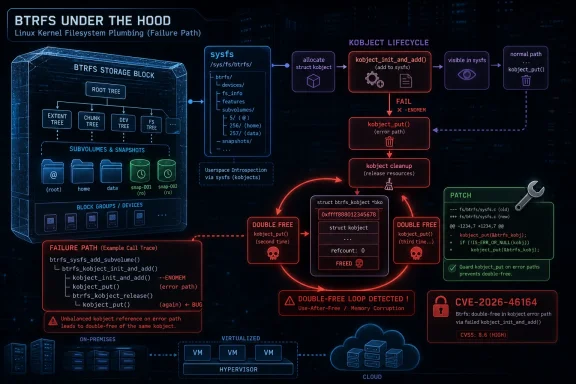
kobject_init_and_add() fails during a specific filesystem initialization error path. That is a dry sentence for a bug that lives in a very particular corner of kernel plumbing, but the lesson is broader than Btrfs alone. The flaw is not yet scored by NVD, and there is no public evidence in the supplied record of active exploitation, but it is exactly the sort of memory-management mistake that security teams cannot wave away merely because it requires an error path. Modern infrastructure is full of rarely visited paths that suddenly matter when storage, virtual machines, containers, and recovery workflows collide.
A One-Line Fix With Kernel-Sized Implications
The patch behind CVE-2026-46164 removes a single explicit kfree(sub_group) from the Btrfs space-info sub-group creation path. That sounds almost comically small, the kind of diff that disappears in a weekly stable update. But kernel security history is littered with one-line changes that mark the difference between “cleanup completed” and “memory corruption possible.”
The affected code path sits in Btrfs, the copy-on-write filesystem used by several Linux distributions and frequently chosen by users who want snapshots, checksumming, send/receive replication, and flexible subvolume layouts. Btrfs is not the default Linux filesystem everywhere, but it is prominent enough that a kernel CVE in its mount and initialization machinery matters to desktop Linux users, NAS builders, backup appliance vendors, and administrators running mixed Windows-and-Linux fleets.
The bug appears when create_space_info_sub_group() allocates a sub_group object and then hands it to the sysfs-facing setup code. If kobject_init_and_add() fails, the kernel object machinery calls kobject_put(), which ultimately reaches the release callback and frees the object. Control then returns to the caller, which—before the fix—attempted to free the same object again.
That is the classic double-free pattern: ownership changes hands, cleanup happens once, and then an older assumption causes cleanup to happen again. In userspace, that can be bad. In kernel space, where the allocator is shared by privileged subsystems and where memory corruption can have system-wide consequences, it is more than a tidy programming error.
The CVE Is Awaiting Enrichment, but the Bug Is Not Awaiting Meaning
NVD currently marks CVE-2026-46164 as awaiting enrichment, with no CVSS 4.0, 3.x, or 2.0 score assigned. That absence will tempt some dashboards to bury the issue under a neutral “N/A” severity field. It should not tempt administrators to pretend the bug does not exist.
A missing CVSS score does not mean low risk. It means NVD has not yet finished turning the public kernel information into a formal vector. For fast-moving Linux kernel CVEs, especially those sourced from kernel.org, the public record often begins with a commit message and a stable-tree reference long before every scanner, distribution tracker, and enterprise vulnerability platform has converged on the same severity language.
That gap is especially awkward for WindowsForum’s audience because many Windows shops now run Linux as part of the Windows estate whether or not they think of themselves as Linux shops. Hyper-V hosts, WSL environments, Azure workloads, container build systems, backup targets, security appliances, and developer workstations can all bring Linux kernels into organizations whose patch vocabulary is still dominated by Patch Tuesday.
CVE-2026-46164 is a reminder that the kernel’s own CVE stream does not move on Microsoft’s cadence. If your asset inventory treats Linux as “that thing in the corner that runs the appliance,” you are already behind.
Btrfs Makes Metadata a Feature, and That Makes Metadata Bugs Matter
Btrfs is ambitious by design. It is not just a place to put files; it is a storage engine with checksums, snapshots, subvolumes, transparent compression, multi-device profiles, and an internal accounting model that tracks how space is allocated and consumed across different block group types. That feature set is precisely why many users choose it.
The same ambition increases the number of internal states the filesystem must represent correctly. Space accounting is not cosmetic. A filesystem needs to know whether blocks belong to data, metadata, or system allocations, and Btrfs has to expose enough information through sysfs and internal structures for administrators and tools to reason about that allocation.
The vulnerable path involves Btrfs space-info sub-groups and sysfs registration. Sysfs is the kernel’s window into device and subsystem state, and kobjects are the kernel’s reference-counted building blocks for representing that state. A bug in this area does not mean “someone can read your files through sysfs.” It means the kernel was juggling object lifetime across Btrfs and kobject code and dropped the ownership model in an error branch.
That distinction matters because storage bugs are often judged by the wrong question. The first instinct is to ask whether a filesystem flaw corrupts data. Here, the more precise question is whether an attacker or a local trigger can push the kernel into a failed initialization path and then profit from the memory allocator seeing the same object freed twice. The supplied record does not establish exploitability, but the primitive is serious enough to deserve prompt patching.
Error Paths Are Where Kernel Assumptions Go to Die
Most code review attention naturally flows toward the happy path. A filesystem mounts, objects initialize, sysfs entries appear, and the machine goes on with its life. The error path receives less real-world exercise because it depends on a failure at exactly the right point.
That is why this bug is so instructive. The vulnerable sequence does not require the main Btrfs logic to be conceptually wrong. It requires a helper to fail after ownership has effectively shifted to the kobject lifecycle, while the caller still behaves as though it owns the allocation outright. The patch resolves the conflict by trusting the kobject release callback to perform cleanup after kobject_put() has been called.
This is not exotic by kernel standards. Reference counting, release callbacks, and staged initialization are everywhere in the Linux kernel. They are necessary because the kernel is a long-lived, concurrent system where objects are visible to multiple subsystems. But they also create subtle contracts: after a subsystem takes ownership, callers must stop treating a pointer as theirs to destroy.
Double-free vulnerabilities often expose a mismatch between code that says “I am cleaning up what I allocated” and code that says “the object lifetime is now managed elsewhere.” CVE-2026-46164 lives exactly at that boundary.
The Fix Says More Than the Diff
The actual patch is small: remove the second free and leave the sub-group pointer reset to NULL on failure. In editorial terms, the fix is less a dramatic rescue than a clarification of responsibility. Once btrfs_sysfs_add_space_info_type() has called into kobject handling and kobject_put() has triggered the release path, Btrfs should not manually free the same allocation.
That makes this vulnerability a good example of how kernel fixes can look underwhelming while addressing a class of bug that security engineers take seriously. The patch is not a new mitigation framework. It does not add complicated validation. It simply stops doing the wrong thing twice.
The “Fixes” tag in the patch points back to the commit that introduced Btrfs space-info sub-groups. That matters because stable maintainers use those tags to identify which supported kernel branches need backports. It also tells administrators that this is not necessarily confined to bleeding-edge kernels if the underlying feature has been carried into stable series used by distributions.
For a production administrator, the actionable question is not whether the diff is elegant. It is whether your distribution kernel has absorbed the stable fix. Kernel.org references are useful, but most enterprise fleets do not run vanilla upstream kernels. They run Red Hat, Ubuntu, Debian, SUSE, Oracle, Amazon, Android-derived, NAS-vendor, appliance-vendor, or cloud-provider kernels with their own backport policies.
The Exploit Story Is Still Thin, and That Is the Point
There is no CVSS vector in the NVD entry yet, no weakness enumeration attached in the provided record, and no distribution advisory in the supplied material spelling out a practical attack chain. That uncertainty should shape the response. It should not produce either panic or dismissal.
A double-free in kernel code can sometimes be weaponized into denial of service. In harder cases, it can contribute to privilege escalation if an attacker can control allocator behavior, reclaim the freed memory with chosen data, and steer execution or object interpretation. But those are conditional statements, not conclusions. A serious article should not pretend every double-free automatically becomes remote code execution.
The public description points to a failure during kobject_init_and_add(), which suggests a narrow trigger condition. That may reduce exposure compared with a bug reachable by unprivileged packet input or ordinary file reads. It may also mean the easiest real-world outcome is a crash under unusual mount or initialization conditions rather than a reliable privilege escalation.
Still, kernel bugs do not have to be glamorous to matter. Systems fail during boot, storage repair, low-memory conditions, device enumeration, test harnesses, container image handling, and backup restoration. Attackers and fuzzers both love code paths that defenders assume are too rare to prioritize.
The Windows Angle Is Not WSL Alone
For Windows readers, the easy instinct is to file CVE-2026-46164 under “Linux problem” and move on. That would be a mistake. Windows estates are increasingly hybrid at the kernel boundary, not merely at the application layer.
WSL is the most obvious bridge. WSL 2 runs a real Linux kernel in a lightweight virtual machine, and Microsoft services that kernel through its own update mechanisms. Most WSL users are not mounting Btrfs filesystems inside WSL, so the practical risk for a typical developer laptop may be limited. But the larger lesson is that Windows users now routinely depend on Linux kernels without thinking like Linux kernel administrators.
The bigger exposure may be in infrastructure adjacent to Windows rather than inside Windows itself. A backup appliance storing Windows images on a Btrfs volume, a Linux-based NAS serving SMB shares to Windows clients, a Proxmox host running Windows VMs, a CI runner building Windows software in Linux containers, or a security sensor deployed into a Microsoft-heavy enterprise can all bring Btrfs into the operational picture.
In those environments, a Linux filesystem CVE becomes a Windows business-continuity concern. If the storage layer falls over, the fact that the endpoint fleet runs Windows 11 does not make restores faster.
Sysfs Is the Quiet Interface Behind the Curtain
Sysfs rarely gets the attention lavished on new desktop features or cloud APIs, but it is one of the quiet reasons Linux administration is scriptable and inspectable. It exposes kernel objects and attributes in a filesystem-like hierarchy, allowing tools and users to observe hardware, drivers, block devices, and subsystem state.
Kobjects are the infrastructure beneath that interface. They bring naming, reference counting, hierarchy, and release semantics into a kernel that has to coordinate many subsystems at once. When Btrfs registers space-info objects through sysfs, it is not merely printing diagnostics. It is participating in the kernel object model.
That is why kobject_init_and_add() failure has special consequences. If initialization fails after the kobject machinery has been engaged, cleanup must follow the kobject lifecycle. Calling kobject_put() is not a polite suggestion; it can invoke the release path that frees the containing structure. Manual cleanup after that point is dangerous unless the code is written with precise ownership guarantees.
This is also why static analysis and review of error paths remain so important. The code that handles failed registration must be just as rigorous as the code that handles success, because the kernel’s object model does not become simpler when something goes wrong.
The Stable Kernel Machine Is Doing Its Job, but Slowly for Everyone Else
The record lists multiple stable kernel commit references, indicating the fix has been propagated across more than one maintained branch. That is the Linux stable process operating as intended: identify a bug, tag it for stable, backport the minimal fix, and let distributions incorporate it into their kernels.
The lag comes afterward. NVD enrichment, vendor advisories, package repositories, scanner plugins, cloud images, appliance firmware, and enterprise maintenance windows all move at different speeds. The vulnerability may be fixed upstream while still appearing unresolved on real machines. Or it may be backported by a vendor without the visible kernel version changing in the way users expect.
This is a perennial frustration in Linux patch management. A fixed enterprise kernel may still report an older upstream version number because the vendor backported the patch. Conversely, a system tracking an upstream-ish kernel may need a newer point release rather than waiting for a vendor advisory. Version strings alone can mislead.
Administrators should therefore check their distribution’s security tracker or changelog, not just uname -r. For appliance users, the relevant authority is the vendor firmware advisory, even when the underlying issue is a mainline kernel CVE. For cloud images, the question is whether the provider’s image stream has incorporated the fixed kernel and whether instances have actually rebooted into it.
Low Drama Does Not Mean Low Priority
Security teams are conditioned to prioritize the loudest incidents: remote unauthenticated bugs, ransomware-active vulnerabilities, browser zero-days, and Microsoft monthly rollups with exploitability flags. CVE-2026-46164 does not arrive with that kind of theater. It arrives as a kernel.org-sourced Btrfs fix, a missing NVD score, and a small patch.
That is exactly why it is useful as a test of operational maturity. Mature patch programs do not only chase headlines. They distinguish between “drop everything” and “do not ignore,” then route each issue into a maintenance process that reflects asset exposure.
For a laptop with no Btrfs filesystems and no unusual Linux workloads, the right answer may simply be to take normal kernel updates. For a Linux storage server using Btrfs snapshots as part of backup retention, the priority rises. For a fleet of virtualization hosts or appliances where local users, tenants, or automated workflows can trigger filesystem mounts, the issue deserves closer review.
The absence of a score also means internal risk teams may need to write their own temporary assessment. That assessment should say what is known: kernel-space double-free, Btrfs, error path during sysfs/kobject initialization, fixed upstream and in stable commits, NVD awaiting enrichment. It should also say what is not known: reliable exploitability, practical attacker prerequisites, and final vendor severity.
Btrfs Users Should Patch, Not Panic
Btrfs has spent years moving from “interesting but scary” to mainstream enough for serious use. Fedora, openSUSE, NAS products, and enthusiast systems have all helped normalize it. A CVE like this should not be turned into a referendum on whether Btrfs is trustworthy.
Filesystems are among the most complex pieces of an operating system. Ext4, XFS, NTFS, APFS, ZFS, and Btrfs all carry long histories of bugs, fixes, regressions, and hard-earned design tradeoffs. The presence of a kernel CVE says less about a filesystem’s worth than the speed and clarity with which maintainers fix and backport the issue.
The practical guidance for Btrfs users is conventional but important: keep kernels current, monitor distribution advisories, reboot into patched kernels, and avoid treating snapshot capability as a replacement for offline backups. A filesystem can be resilient against disk corruption and still be subject to kernel memory-safety bugs. Those are different failure domains.
Users running Btrfs for root filesystems should also be careful with rescue media and rollback plans. If the production kernel is patched but the recovery ISO or boot environment is stale, the operational risk may survive in the tools you reach for during an outage.
The Patch Also Shows Why C Still Dominates Kernel Risk
CVE-2026-46164 is another entry in the long ledger of memory lifetime bugs in C code. The Linux kernel’s ongoing Rust work exists partly because entire categories of ownership mistakes are harder to express in memory-safe languages. But the kernel is not going to be rewritten overnight, and filesystems are among the most difficult subsystems to migrate.
That leaves maintainers with the familiar toolkit: code review, fuzzing, static analysis, sanitizers, stable backports, and conservative error-path fixes. None of those is glamorous. All of them matter. The bug here is not a missing bounds check in a fashionable parser; it is a lifetime mismatch between Btrfs and kobject cleanup.
The one-line deletion is an argument for humility. Even expert kernel developers working in mature subsystems can misjudge ownership during failure handling. The right response is not to sneer at the mistake. It is to build processes that assume such mistakes will happen and catch them before they become durable attack surface.
For enterprise buyers, this is also a reminder to ask vendors about kernel provenance. Appliances often advertise features—deduplication, snapshots, SMB integration, immutable backup repositories—while burying kernel maintenance details. When the appliance is Linux underneath, the vendor’s kernel update discipline is part of the product.
Scanners Will Lag the Reality on the Ground
Because NVD has not assigned metrics yet, vulnerability scanners may produce inconsistent results. Some will flag CVE-2026-46164 as informational. Some may not detect it until distribution metadata lands. Others may mark broad kernel version ranges as vulnerable even when a vendor has backported the fix.
That inconsistency is not a reason to distrust scanners. It is a reason to understand what they are actually measuring. A scanner sees packages, version strings, CPE mappings, and advisory feeds. It does not always know whether a particular downstream kernel has a specific one-line patch unless the vendor exposes that relationship cleanly.
This is especially true for custom kernels and embedded products. A NAS vendor may ship a heavily patched kernel with a version string that looks ancient by upstream standards. A cloud image may receive live patches for some issues but still require a reboot for others. A developer workstation may have multiple Linux kernels installed, only one of which is actually booted.
The operational discipline is simple: identify where Btrfs is actually in use, identify which kernel builds are actually running, and verify whether the fix is present through vendor advisories or changelogs. Do not let a dashboard’s missing score become your risk assessment.
The Practical Window for Administrators Is Narrow but Real
For administrators, CVE-2026-46164 should trigger a targeted sweep rather than an emergency bridge call. Start with systems that actually use Btrfs: storage nodes, backup servers, Linux desktops with Btrfs root volumes, virtualization hosts, container hosts with Btrfs-backed storage, and appliances known to rely on it. Then map those systems to kernel update channels.
The most important operational step after installing a kernel update is rebooting into it. Linux teams know this, but mixed Windows/Linux shops often underestimate how often patched kernels sit unused because services were updated without a restart. A fixed package on disk does not protect a running kernel in memory.
For Windows-heavy organizations, include WSL and Linux virtual machines in the inventory conversation, but do not overstate the WSL angle. The typical WSL developer environment is unlikely to be the primary Btrfs exposure unless users have deliberately configured unusual storage scenarios. The more plausible risk sits with Linux systems serving Windows workflows.
Security teams should also watch for distribution-specific advisories over the next few days. Once vendors classify the issue, internal severity can be adjusted. Until then, “kernel double-free in Btrfs, patch during the next appropriate maintenance window” is a defensible default for exposed systems.
The One-Line Deletion That Should Shape This Week’s Kernel Hygiene
This is not a vulnerability that needs theatrical language. It is a kernel memory-management bug in a filesystem many serious Linux users rely on, and the fix is already moving through the stable ecosystem. The right response is measured, but it is not passive.
- Systems using Btrfs should be prioritized for kernel update verification rather than waiting for NVD to assign a final score.
- Administrators should confirm whether their distribution or appliance vendor has backported the stable fix instead of relying only on upstream kernel version numbers.
- Windows-centric IT teams should include Linux storage appliances, virtualization hosts, WSL kernels, backup targets, and CI infrastructure in their exposure review.
- A patched kernel package is not enough unless the machine has rebooted into the corrected kernel.
- The current public record supports concern about kernel memory corruption, but it does not yet establish a practical exploit chain or active exploitation.
- Recovery media, golden images, and offline maintenance environments should be checked if they include Btrfs-capable Linux kernels.
CVE-2026-46164 will probably not be remembered as the vulnerability that defined 2026. Its importance is more prosaic and more useful: it shows how a single ownership mistake in an error path can travel from a kernel mailing list to a national vulnerability database to the patch queues of real systems. The future of Windows administration is already hybrid, and that means the quiet Linux kernel fixes now deserve a place beside the louder Microsoft advisories on every serious maintenance calendar.
References
- CVE-2026-46164 btrfs: fix double free in create_space_info_sub_group() error path NVD / Linux Kernel · 2026-05-29T01:05:44-07:00