

CVE-2026-46180 is a newly published Linux kernel vulnerability disclosed by kernel.org and listed by NVD on May 28, 2026, affecting the Broadcom
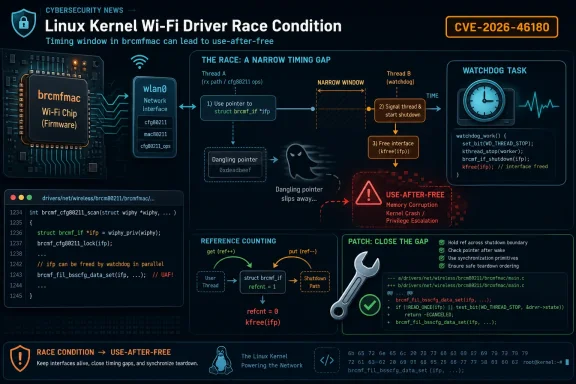
The vulnerability description is terse even by kernel CVE standards. A watchdog task in the Broadcom FullMAC Wi-Fi driver may exit in the window between a signal being sent to it and the kernel later calling the stop routine. If the task disappears in that gap, the remaining cleanup path can touch memory that is no longer valid.
That is the essence of a use-after-free: code keeps a pointer to an object after the object’s lifetime has ended. In ordinary application code, this class of bug is already dangerous. In kernel space, it carries extra weight because the failure happens inside the privileged core of the operating system, where memory corruption can mean anything from a crash to a potential exploit primitive.
The fix described by kernel.org is equally compact. The kernel now takes an extra reference to the watchdog task before sending the signal, then drops that reference through
There is a temptation to dismiss a bug like this because the description does not scream remote compromise, wormability, or ransomware. That would be the wrong lesson. The Linux kernel’s CVE stream increasingly captures these small concurrency repairs because modern systems are built from exactly this kind of low-level code, and small lifetime mistakes in drivers are where reliability and security often meet.
For IT teams, this is an awkward middle state. Vulnerability scanners will begin seeing the CVE identifier before policy engines necessarily know what to do with it. Dashboards may show an unscored finding, while compliance workflows may still demand a triage decision.
The most defensible reading is that CVE-2026-46180 is a kernel driver correctness bug with security implications, not yet a confirmed high-impact emergency. It should be tracked and patched through normal kernel update channels. It should not be inflated into a crisis without evidence of practical exploitation or a vendor severity rating that supports that claim.
That nuance matters because security teams already operate under CVE fatigue. Every unscored kernel issue cannot become a red-alert incident. But every memory-lifetime bug in a network-adjacent driver also deserves more respect than a routine cosmetic defect.
That last point is important. A Linux system is not meaningfully exposed to a driver bug if it does not use the driver. Servers without Broadcom wireless hardware are unlikely to care. A laptop, kiosk, edge gateway, Raspberry Pi-class device, or custom appliance with Broadcom Wi-Fi is much more relevant.
The Windows angle is indirect but practical. Many WindowsForum readers manage heterogeneous environments where Windows desktops sit beside Linux build hosts, appliances, WSL-adjacent development machines, dual-boot laptops, or Linux-based network devices. The weakest endpoint in such a fleet is not always the one running Windows.
This is also why “Linux vulnerability” is too blunt a label. In practice, this is a hardware-path vulnerability. The risk follows a combination of silicon, driver, kernel branch, and workload timing. Administrators who inventory only operating system names but not kernel modules and device classes will miss that distinction.
That distinction should shape expectations. This does not read like a simple “malicious packet hits Wi-Fi card and owns the box” story. The public description points instead to a timing problem during task termination: a kernel thread can finish at just the wrong moment, and the driver’s cleanup code can lose track of the object lifetime.
Still, shutdown-path bugs are not automatically harmless. Hardware resets, interface down events, suspend and resume cycles, module unloads, device removal, network namespace churn, and error recovery can all exercise code that ordinary users rarely think about. In driver land, the paths that run only occasionally are often the paths least tested under hostile timing.
That is the uncomfortable part of this CVE. The bug likely depends on a race window, and race windows are hard to reason about from a one-paragraph advisory. They may be difficult to trigger deliberately, or they may appear under specific stress conditions that a determined researcher can reproduce.
CVE-2026-46180 fits that modern pattern. It is a real bug, with a real fix, in privileged code. But the public advisory does not yet say whether it is locally exploitable, remotely triggerable, denial-of-service only, or merely a hardening correction that closes a theoretical race.
That uncertainty is not a failure of disclosure; it is a feature of early disclosure. Kernel maintainers often fix the bug first and let downstream distributions, security teams, and NVD enrichment catch up. The alternative would be to delay public tracking until every severity field is polished, which would leave defenders blind to the existence of the patch.
The operational challenge is that enterprise tooling prefers crisp labels. “Critical,” “high,” “medium,” or “low” are easy to route. “A potential use-after-free in a Wi-Fi watchdog stop path, awaiting enrichment” is not. The latter is messier, but it is closer to how kernel security actually works.
That is not glamorous security engineering. It is lifetime management. The kernel is full of objects whose validity depends on careful reference counting, locks, task state, and teardown order. When one of those assumptions is wrong, the system can end up using memory after it has been freed.
The interesting part is that the bug happens between two operations that both sound reasonable: send a signal, then stop the kernel thread. The problem is that concurrency lives between reasonable operations. A task can exit after the signal but before the stop routine gets a stable hold on it.
This is why driver security often looks like plumbing. There is no dramatic cryptographic failure, no compromised certificate authority, and no splashy supply-chain implant. There is a race, a pointer, and a missing lifetime guarantee. Yet that is enough to justify a CVE.
The story changes for Linux laptops, lab machines, point-of-sale devices, digital signage, classroom fleets, industrial gateways, and embedded systems with Broadcom wireless adapters. These systems often run long-lived kernels, vendor-modified images, or distributions where kernel updates are delayed because the device is treated as an appliance rather than a general-purpose computer.
That is where the risk management gets more serious. The longer a device sits outside routine kernel maintenance, the more these small driver CVEs accumulate. Any one bug may be hard to exploit. A stale kernel full of memory-safety fixes not yet applied is a different proposition.
For administrators, the immediate task is not panic patching. It is identifying where
That is especially true in small and midsize environments, where Linux devices often enter through convenience rather than central procurement. A developer installs a Linux workstation. A team buys a device with a vendor image. A branch office deploys a wireless appliance. Years later, nobody can say which kernel it runs.
CVE-2026-46180 is a useful reminder that hardware-specific Linux drivers belong in asset management. Not every organization needs module-level inventory for every machine, but organizations that depend on Linux endpoints should know which systems have Wi-Fi, which chipsets they use, and how kernel updates reach them.
The uncomfortable comparison is with Windows Update. Microsoft’s model is centralized, noisy, and sometimes frustrating, but administrators usually know where patches come from. Linux patching is more flexible and often faster, but it is fragmented across distributions, vendors, custom kernels, and embedded images. That flexibility becomes a liability when nobody owns the update chain.
That absence should be stated plainly because security coverage often rewards exaggeration. A use-after-free in kernel space can be serious, but “can be” is doing real work. Exploitability depends on whether an attacker can trigger the vulnerable sequence, shape memory reuse, bypass mitigations, and do so from a meaningful security boundary.
For Wi-Fi drivers, the boundary question is especially sensitive. Some wireless bugs can be triggered by nearby radio activity or crafted frames. Others require local control over the interface, device teardown, or privileged operations. The current public description of CVE-2026-46180 does not provide enough detail to place it confidently in either bucket.
The conservative position is to patch without assuming catastrophe. Treat the bug as a legitimate kernel memory-safety issue, prioritize exposed Linux wireless devices, and wait for distribution advisories or researcher analysis before assigning it a severity story the public facts do not yet support.
This is where Linux vulnerability handling becomes both powerful and messy. A distribution may fix the issue without changing to the newest upstream kernel version, so version-number comparisons can mislead. The relevant question is whether the specific patch, or an equivalent backport, is present in the kernel package running on the device.
For mainstream distributions, security trackers and package changelogs will usually provide the answer. For appliances, the answer may be buried in vendor release notes or unavailable until a firmware update appears. For custom kernels, the answer belongs to whoever owns the build pipeline.
Administrators should resist the urge to solve this by raw kernel version alone. A system running an older-looking enterprise kernel may already have the fix backported. A system running a newer custom kernel may not. Patch presence matters more than branding.
Wireless drivers sit at a hostile intersection. They interact with firmware blobs, asynchronous hardware events, power management, suspend and resume, packet queues, timers, workqueues, and kernel threads. Their state machines are complicated because real hardware is complicated.
The industry’s broader answer to memory-safety problems has increasingly been Rust, hardened allocators, sanitizers, fuzzing, and better static analysis. Those tools help, but they do not instantly rewrite the long tail of C drivers that keep existing hardware alive. For years to come, many of the most important fixes will still look like this one: careful reference counting in old, important code.
That is why kernel patch notes can feel both mundane and profound. The individual bug may be small. The accumulated engineering story is that operating systems remain secure only when thousands of these small lifetime assumptions are continuously audited and corrected.
If the system is a server without wireless hardware, this CVE probably belongs low in the queue. If it is a Linux laptop fleet with Broadcom Wi-Fi, it deserves more attention. If it is an embedded appliance with no clear update path, it deserves a conversation with the vendor.
Temporary mitigation is not especially elegant. Disabling the affected Wi-Fi hardware or unloading the driver may reduce exposure, but that is only practical where wireless connectivity is not required. For most real systems, the durable fix is a patched kernel.
This is also a good moment to check reboot discipline. Kernel fixes do not protect a running system until the patched kernel is booted. Many Linux fleets install updates but defer reboots indefinitely, creating a false sense of closure that vulnerability scanners eventually expose.
The clearest next steps are simple, even if the underlying kernel code is not.
brcmfmac Wi-Fi driver through a potential use-after-free race while stopping a watchdog kernel task. It is not a Windows vulnerability, but it matters to WindowsForum readers because the affected code sits in the kind of hardware-adjacent networking layer that increasingly defines endpoint reliability across mixed fleets. The bug is narrow, the public record is still thin, and NVD has not yet assigned a severity score. That combination should make administrators cautious, not complacent.
 A Small Driver Race Lands in the Big CVE Machine
The vulnerability description is terse even by kernel CVE standards. A watchdog task in the Broadcom FullMAC Wi-Fi driver may exit in the window between a signal being sent to it and the kernel later calling the stop routine. If the task disappears in that gap, the remaining cleanup path can touch memory that is no longer valid.That is the essence of a use-after-free: code keeps a pointer to an object after the object’s lifetime has ended. In ordinary application code, this class of bug is already dangerous. In kernel space, it carries extra weight because the failure happens inside the privileged core of the operating system, where memory corruption can mean anything from a crash to a potential exploit primitive.
The fix described by kernel.org is equally compact. The kernel now takes an extra reference to the watchdog task before sending the signal, then drops that reference through
kthread_stop_put(). In plain English, the patch makes the task’s lifetime explicit so the cleanup code cannot race against the task’s disappearance.There is a temptation to dismiss a bug like this because the description does not scream remote compromise, wormability, or ransomware. That would be the wrong lesson. The Linux kernel’s CVE stream increasingly captures these small concurrency repairs because modern systems are built from exactly this kind of low-level code, and small lifetime mistakes in drivers are where reliability and security often meet.
The Missing Score Is Not the Same as Missing Risk
NVD currently marks CVE-2026-46180 as awaiting enrichment. That means there is no NVD CVSS score, no completed weakness classification, and no official NVD severity label at the time of publication. The public record contains the kernel.org description and several stable-kernel patch references, but not a fully developed exploitability analysis.For IT teams, this is an awkward middle state. Vulnerability scanners will begin seeing the CVE identifier before policy engines necessarily know what to do with it. Dashboards may show an unscored finding, while compliance workflows may still demand a triage decision.
The most defensible reading is that CVE-2026-46180 is a kernel driver correctness bug with security implications, not yet a confirmed high-impact emergency. It should be tracked and patched through normal kernel update channels. It should not be inflated into a crisis without evidence of practical exploitation or a vendor severity rating that supports that claim.
That nuance matters because security teams already operate under CVE fatigue. Every unscored kernel issue cannot become a red-alert incident. But every memory-lifetime bug in a network-adjacent driver also deserves more respect than a routine cosmetic defect.
Broadcom Wi-Fi Is the Real-World Multiplier
The affected driver,brcmfmac, supports Broadcom FullMAC wireless chips used across a wide range of Linux-capable systems. These include laptops, embedded boards, appliances, and developer hardware where Broadcom Wi-Fi has long been common. The affected population depends on kernel version, distribution backports, hardware configuration, and whether the driver is actually loaded.That last point is important. A Linux system is not meaningfully exposed to a driver bug if it does not use the driver. Servers without Broadcom wireless hardware are unlikely to care. A laptop, kiosk, edge gateway, Raspberry Pi-class device, or custom appliance with Broadcom Wi-Fi is much more relevant.
The Windows angle is indirect but practical. Many WindowsForum readers manage heterogeneous environments where Windows desktops sit beside Linux build hosts, appliances, WSL-adjacent development machines, dual-boot laptops, or Linux-based network devices. The weakest endpoint in such a fleet is not always the one running Windows.
This is also why “Linux vulnerability” is too blunt a label. In practice, this is a hardware-path vulnerability. The risk follows a combination of silicon, driver, kernel branch, and workload timing. Administrators who inventory only operating system names but not kernel modules and device classes will miss that distinction.
The Watchdog Detail Tells Us the Bug Is About Shutdown, Not Throughput
The reported race occurs while stopping a watchdog task. Watchdog logic usually exists to monitor device state, recover from hangs, or keep a driver honest when hardware or firmware misbehaves. That places the vulnerable path in lifecycle management rather than the ordinary fast path of sending and receiving packets.That distinction should shape expectations. This does not read like a simple “malicious packet hits Wi-Fi card and owns the box” story. The public description points instead to a timing problem during task termination: a kernel thread can finish at just the wrong moment, and the driver’s cleanup code can lose track of the object lifetime.
Still, shutdown-path bugs are not automatically harmless. Hardware resets, interface down events, suspend and resume cycles, module unloads, device removal, network namespace churn, and error recovery can all exercise code that ordinary users rarely think about. In driver land, the paths that run only occasionally are often the paths least tested under hostile timing.
That is the uncomfortable part of this CVE. The bug likely depends on a race window, and race windows are hard to reason about from a one-paragraph advisory. They may be difficult to trigger deliberately, or they may appear under specific stress conditions that a determined researcher can reproduce.
Kernel CVEs Are Becoming More Honest, and More Annoying
The Linux kernel project’s newer CVE handling has changed the texture of vulnerability feeds. More kernel fixes now receive CVE identifiers, including bugs that previously might have appeared only as stable-tree patches with security-adjacent wording. The upside is transparency. The downside is a flood of records whose practical severity is not immediately clear.CVE-2026-46180 fits that modern pattern. It is a real bug, with a real fix, in privileged code. But the public advisory does not yet say whether it is locally exploitable, remotely triggerable, denial-of-service only, or merely a hardening correction that closes a theoretical race.
That uncertainty is not a failure of disclosure; it is a feature of early disclosure. Kernel maintainers often fix the bug first and let downstream distributions, security teams, and NVD enrichment catch up. The alternative would be to delay public tracking until every severity field is polished, which would leave defenders blind to the existence of the patch.
The operational challenge is that enterprise tooling prefers crisp labels. “Critical,” “high,” “medium,” or “low” are easy to route. “A potential use-after-free in a Wi-Fi watchdog stop path, awaiting enrichment” is not. The latter is messier, but it is closer to how kernel security actually works.
The Patch Is a Lesson in Reference Counting
The described fix is small but conceptually important. Before signaling the watchdog task, the driver increments the task’s reference count. It later useskthread_stop_put() so stopping the thread and releasing that reference are tied together.That is not glamorous security engineering. It is lifetime management. The kernel is full of objects whose validity depends on careful reference counting, locks, task state, and teardown order. When one of those assumptions is wrong, the system can end up using memory after it has been freed.
The interesting part is that the bug happens between two operations that both sound reasonable: send a signal, then stop the kernel thread. The problem is that concurrency lives between reasonable operations. A task can exit after the signal but before the stop routine gets a stable hold on it.
This is why driver security often looks like plumbing. There is no dramatic cryptographic failure, no compromised certificate authority, and no splashy supply-chain implant. There is a race, a pointer, and a missing lifetime guarantee. Yet that is enough to justify a CVE.
The Systems Most Likely to Care Are Not the Ones With the Loudest Dashboards
A typical Windows-first desktop environment may barely notice CVE-2026-46180. If the organization’s Linux footprint is mostly cloud servers without Wi-Fi hardware, the practical exposure may be close to zero. A vulnerability management tool may still flag kernel packages, but the driver path may never be active.The story changes for Linux laptops, lab machines, point-of-sale devices, digital signage, classroom fleets, industrial gateways, and embedded systems with Broadcom wireless adapters. These systems often run long-lived kernels, vendor-modified images, or distributions where kernel updates are delayed because the device is treated as an appliance rather than a general-purpose computer.
That is where the risk management gets more serious. The longer a device sits outside routine kernel maintenance, the more these small driver CVEs accumulate. Any one bug may be hard to exploit. A stale kernel full of memory-safety fixes not yet applied is a different proposition.
For administrators, the immediate task is not panic patching. It is identifying where
brcmfmac exists, whether the relevant kernel branches have received the fix, and whether the device class has a realistic update path. If the answer is “we do not know,” the CVE has already exposed a process problem.Windows Shops Should Read This as an Inventory Story
Windows administrators do not need to become Linux wireless-driver specialists overnight. They do need to understand that endpoint security is no longer neatly divided by operating system family. The printer, wireless bridge, build appliance, classroom Chromebook-like device, NAS, lab controller, or Linux laptop may share the same asset network and identity perimeter as Windows systems.That is especially true in small and midsize environments, where Linux devices often enter through convenience rather than central procurement. A developer installs a Linux workstation. A team buys a device with a vendor image. A branch office deploys a wireless appliance. Years later, nobody can say which kernel it runs.
CVE-2026-46180 is a useful reminder that hardware-specific Linux drivers belong in asset management. Not every organization needs module-level inventory for every machine, but organizations that depend on Linux endpoints should know which systems have Wi-Fi, which chipsets they use, and how kernel updates reach them.
The uncomfortable comparison is with Windows Update. Microsoft’s model is centralized, noisy, and sometimes frustrating, but administrators usually know where patches come from. Linux patching is more flexible and often faster, but it is fragmented across distributions, vendors, custom kernels, and embedded images. That flexibility becomes a liability when nobody owns the update chain.
The Exploit Story Is Still Unwritten
At this stage, there is no public NVD severity score and no public exploit narrative attached to the record. The description does not establish remote exploitation, privilege escalation, or arbitrary code execution. It establishes a potential use-after-free condition in a specific kernel driver path.That absence should be stated plainly because security coverage often rewards exaggeration. A use-after-free in kernel space can be serious, but “can be” is doing real work. Exploitability depends on whether an attacker can trigger the vulnerable sequence, shape memory reuse, bypass mitigations, and do so from a meaningful security boundary.
For Wi-Fi drivers, the boundary question is especially sensitive. Some wireless bugs can be triggered by nearby radio activity or crafted frames. Others require local control over the interface, device teardown, or privileged operations. The current public description of CVE-2026-46180 does not provide enough detail to place it confidently in either bucket.
The conservative position is to patch without assuming catastrophe. Treat the bug as a legitimate kernel memory-safety issue, prioritize exposed Linux wireless devices, and wait for distribution advisories or researcher analysis before assigning it a severity story the public facts do not yet support.
Distribution Backports Will Decide the Practical Timeline
The kernel.org references indicate that the fix has been applied across stable kernel branches. That does not automatically mean every downstream system is fixed. Distributions backport patches on their own schedules, and embedded vendors may lag further behind.This is where Linux vulnerability handling becomes both powerful and messy. A distribution may fix the issue without changing to the newest upstream kernel version, so version-number comparisons can mislead. The relevant question is whether the specific patch, or an equivalent backport, is present in the kernel package running on the device.
For mainstream distributions, security trackers and package changelogs will usually provide the answer. For appliances, the answer may be buried in vendor release notes or unavailable until a firmware update appears. For custom kernels, the answer belongs to whoever owns the build pipeline.
Administrators should resist the urge to solve this by raw kernel version alone. A system running an older-looking enterprise kernel may already have the fix backported. A system running a newer custom kernel may not. Patch presence matters more than branding.
The Bigger Pattern Is Driver Memory Safety, Again
CVE-2026-46180 is not the firstbrcmfmac use-after-free class issue to appear in recent kernel security records. Broadcom Wi-Fi driver fixes have surfaced before around teardown, transmission, configuration detach paths, and work rescheduling. That does not mean this driver is uniquely broken; it means wireless drivers are difficult.Wireless drivers sit at a hostile intersection. They interact with firmware blobs, asynchronous hardware events, power management, suspend and resume, packet queues, timers, workqueues, and kernel threads. Their state machines are complicated because real hardware is complicated.
The industry’s broader answer to memory-safety problems has increasingly been Rust, hardened allocators, sanitizers, fuzzing, and better static analysis. Those tools help, but they do not instantly rewrite the long tail of C drivers that keep existing hardware alive. For years to come, many of the most important fixes will still look like this one: careful reference counting in old, important code.
That is why kernel patch notes can feel both mundane and profound. The individual bug may be small. The accumulated engineering story is that operating systems remain secure only when thousands of these small lifetime assumptions are continuously audited and corrected.
The Practical Triage Is Narrower Than the CVE Feed Suggests
For most WindowsForum readers, the response should be disciplined. First, determine whether any managed Linux systems actually loadbrcmfmac. Second, check distribution advisories or kernel changelogs for a fix corresponding to the watchdog task lifetime issue. Third, update affected systems through the normal kernel or firmware channel.If the system is a server without wireless hardware, this CVE probably belongs low in the queue. If it is a Linux laptop fleet with Broadcom Wi-Fi, it deserves more attention. If it is an embedded appliance with no clear update path, it deserves a conversation with the vendor.
Temporary mitigation is not especially elegant. Disabling the affected Wi-Fi hardware or unloading the driver may reduce exposure, but that is only practical where wireless connectivity is not required. For most real systems, the durable fix is a patched kernel.
This is also a good moment to check reboot discipline. Kernel fixes do not protect a running system until the patched kernel is booted. Many Linux fleets install updates but defer reboots indefinitely, creating a false sense of closure that vulnerability scanners eventually expose.
The Broadcom Bug Teaches a Bigger Fleet Lesson
CVE-2026-46180 is concrete enough to act on, but small enough to reveal process quality. The organizations that handle it well will be the ones that already know where Linux Wi-Fi exists, how kernel updates are delivered, and which systems are exempt from ordinary patch cycles. The organizations that struggle will not struggle because the bug is complicated; they will struggle because their inventory is incomplete.The clearest next steps are simple, even if the underlying kernel code is not.
- Administrators should identify Linux systems using Broadcom FullMAC Wi-Fi hardware and confirm whether the
brcmfmacdriver is loaded. - Security teams should treat the absence of an NVD score as an incomplete data point, not as evidence that the bug is harmless.
- Patch managers should verify the presence of the upstream fix or a downstream backport rather than relying only on headline kernel version numbers.
- Embedded and appliance owners should ask vendors whether their firmware images include the stable-kernel fix for the watchdog task use-after-free.
- Teams should remember that kernel updates usually require a reboot before the running system is actually protected.
References
- Primary source: NVD / Linux Kernel
Published: 2026-05-29T01:04:16-07:00
NVD - CVE-2026-46180
 nvd.nist.gov
- Security advisory: MSRC
Published: 2026-05-29T01:04:16-07:00
Original feed URL
Security Update Guide - Microsoft Security Response Center
 msrc.microsoft.com
- Related coverage: cvefeed.io
CVE-2025-39863 - wifi: brcmfmac: fix use-after-free when rescheduling brcmf_btcoex_info work
In the Linux kernel, the following vulnerability has been resolved: wifi: brcmfmac: fix use-after-free when rescheduling brcmf_btcoex_info work The brcmf_btcoex_detach() only shuts down the btcoex timer, if the flag timer_on is false. However, the brcmf_btcoex_timerfunc(), which runs as timer...cvefeed.io - Related coverage: vulert.com
Use-After-Free Vulnerability in Linux Kernel's brcmfmac Package
Learn about the use-after-free vulnerability in the Linux kernel's brcmfmac driver, its implications, and how to fix it. Stay secure with timely updates and monitoring.vulert.com - Related coverage: lists.linaro.org
- Related coverage: lists.openwall.net
- Related coverage: lore-kernel.gnuweeb.org
