

CVE-2026-46209 is a Linux kernel graphics vulnerability published by NVD on May 28, 2026, after kernel.org reported a DRM/GEM framebuffer validation bug that can let an undersized graphics buffer pass checks and later be accessed out of bounds by the GPU. The bug is not in some glamorous remote attack surface, and that is precisely why it is easy to underestimate. It lives in the mundane arithmetic that decides how large a framebuffer plane ought to be. For administrators and security teams, the lesson is familiar: kernel graphics code is still kernel attack surface, even when the trigger looks like a strange one-pixel video format corner case.
The fix for CVE-2026-46209 is almost comically small. In
That sounds like a cleanup, not a vulnerability. But the difference between rounding down and rounding up is the difference between “this object is too small” and “this object looks acceptable.” In kernel memory-management code, arithmetic consistency is not style; it is a security boundary.
The affected area sits in the Direct Rendering Manager stack, specifically the GEM-backed framebuffer helper path. GEM, the Graphics Execution Manager, is one of the pieces Linux uses to manage graphics buffers shared between user space, kernel drivers, and GPUs. When that machinery misjudges the size of an object, the kernel can end up blessing a buffer that cannot safely hold what later hardware access expects.
The reported example uses NV12, a common multi-plane pixel format used heavily in video pipelines. With a one-pixel-tall framebuffer and vertical subsampling, one path sees the chroma plane as having zero height while another correctly treats it as one line. That disagreement is enough to let a tiny GEM object sneak past a size check before the GPU later reads or writes beyond the intended object.
This is the kind of vulnerability that makes kernel developers allergic to duplicated logic. If two call sites independently compute the same security-sensitive value, they are almost guaranteed to drift over time. In this case, the drift was not caused by a feature explosion or a spectacular refactor; it was caused by a small difference in how subsampled planes were measured.
Subsampled formats are especially good at finding these mistakes. A full-resolution luma plane and lower-resolution chroma planes are normal in video formats, but “lower resolution” does not mean “round down to zero.” If a plane has to represent a sliver of image data, its storage requirements do not vanish simply because integer division says so.
The overflow path described in the CVE is classic C: a height of zero feeds an expression that subtracts one, and an unsigned integer wraps to a very large value. That value then participates in size arithmetic that can wrap again into something small enough to pass validation. The result is a security check that looks present in code review but fails in the pathological case it most needed to catch.
The most obvious place is virtualization. Linux guests running on Windows hosts, Linux VMs in Hyper-V, GPU-enabled workloads, and developer machines using pass-through or accelerated graphics all depend on kernel graphics stacks behaving correctly. A vulnerability in a guest kernel does not automatically compromise the Windows host, but it can matter inside the guest, inside containers, and anywhere untrusted workloads can reach graphics ioctls.
WSL is a more nuanced case. Windows Subsystem for Linux 2 uses a Microsoft-managed Linux kernel, and graphics acceleration in WSLg involves a carefully designed path between Linux user space and the Windows display stack. That does not mean this particular CVE maps cleanly onto every WSL deployment. It does mean that users who treat WSL as “just an app” should remember that it includes a real kernel with real kernel update obligations.
The same logic applies to appliances. Security cameras, thin clients, kiosk systems, embedded boards, Android-adjacent devices, media boxes, and industrial panels often run Linux with display or video pipelines enabled. A bug in DRM/GEM is more relevant to those systems than to a headless database server, but asset owners often do not have a neat inventory field that says “uses multi-plane framebuffer ioctls.”
That gap should not be confused with low severity. It means NVD had not yet supplied its enrichment metadata. The actual risk depends on exploitability, reachable attack surface, kernel configuration, driver behavior, and whether local untrusted users or sandboxed workloads can exercise the relevant DRM paths.
Kernel.org’s description gives enough technical substance to justify attention. A tiny GEM object can pass the size guard, and GPU access to the chroma plane can go out of bounds. That is a memory-safety failure in kernel-adjacent graphics infrastructure, not a cosmetic validation mismatch.
Still, this is not the same category as a remotely reachable network daemon bug with a public exploit. The practical risk is likely highest on systems where untrusted local code can create framebuffers, use DRM devices, or interact with GPU/video paths. Multi-user Linux workstations, shared GPU servers, CI runners with graphics devices, container hosts with exposed render nodes, and embedded devices with broad local app ecosystems deserve more scrutiny than a locked-down headless VM with no relevant device access.
That speed is good for security and awkward for process. Traditional vulnerability management wants a clean sequence: advisory, score, affected versions, vendor bulletin, patch package, compliance deadline. Kernel development often gives administrators something messier but more useful: a commit, a stable backport trail, and a terse explanation from the people who fixed the code.
For Linux distributions, the key question is not whether the NVD page has a complete enrichment block. It is whether the distribution kernel has pulled in the relevant stable patch. Enterprise distributions may backport fixes without changing the apparent kernel version in the way upstream users expect, so version-string guessing is a poor substitute for vendor advisory tracking.
For Windows-heavy shops, this is where Linux exposure tends to hide. The security team may have excellent coverage for Windows Update, Microsoft Defender, Intune, WSUS, and monthly Patch Tuesday reporting, but much weaker visibility into Ubuntu images in developer laptops, Debian containers in build systems, appliance firmware, or GPU-enabled Linux VMs used by engineering teams.
This is exactly the kind of change that looks obvious after the fact. If one layer of the subsystem already has canonical logic for calculating plane dimensions, later layers should not recompute the value differently. The patch removes a private interpretation of a shared rule.
The deeper lesson is that security bugs often emerge from almost duplicated logic. The code was not missing validation entirely. It was validating using a slightly different model of the framebuffer than the earlier check used. Attackers love those seams because developers and reviewers tend to reason about the intended invariant, not every arithmetic expression that claims to enforce it.
There is also a hardware angle. GPUs are not passive recipients of kernel abstractions; they perform DMA and access memory according to commands and buffers the software stack prepares. If the kernel tells itself a buffer is adequately sized when it is not, the eventual out-of-bounds access may be performed by hardware following an otherwise valid path. That makes the initial size check especially important.
On many desktop Linux systems, local users can access DRM render nodes for graphics acceleration. On hardened servers, those devices may not exist, may be permission-restricted, or may be irrelevant to installed workloads. On container platforms, the answer depends on whether GPU devices are passed into containers and whether untrusted code can reach them.
That nuance matters because security teams are under constant pressure to flatten every CVE into a patch-now-or-ignore binary. CVE-2026-46209 resists that simplification. It is a real kernel memory-safety issue, but the blast radius is shaped by deployment context.
For shared systems, the conservative assumption should be that local attack surface matters. A bug that requires local access is still meaningful on developer workstations, university lab machines, VDI pools, build runners, media-processing servers, and multi-tenant GPU hosts. Local does not mean harmless when “local” includes arbitrary code from users, plugins, containers, notebooks, browser-adjacent media stacks, or build jobs.
Kernel maintainers increasingly have to evaluate patches in a world where contributors may use AI tools for orientation, explanation, or drafting. The security concern is not that AI touched the workflow in some abstract moral sense. The concern is whether maintainers can still trust that a patch has been understood, tested, and integrated into subsystem rules rather than mechanically produced.
In this case, the patch is small, reviewable, and tied to a concrete inconsistency. The maintainer discussion did what it should do: ask about provenance, examine the code, and focus on whether the change is correct. That is a healthier model than pretending AI-assisted learning will not happen or, conversely, accepting machine-shaped patches without human accountability.
The irony is that this vulnerability is precisely the sort of issue automated tools may become better at finding: inconsistent calculations across related validation paths. But finding such mismatches is only half the job. The fix still has to respect kernel conventions, stable backport rules, and the subtle behavior of real drivers.
Desktop Linux users should apply normal kernel updates from their distribution. Developers using Linux VMs, WSL environments, or GPU-enabled containers should update base images and host kernels according to their vendor channels. Appliance owners should watch firmware advisories, because embedded Linux vendors often absorb upstream kernel fixes on a different timetable.
For Windows administrators, the inventory challenge is organizational. Linux may enter the estate through dev tooling, cloud images, NAS devices, security appliances, hypervisors, media systems, and edge hardware. Those systems may not be patched by the same team that handles Windows Update, which means a kernel CVE can be “not our platform” right up until it is part of the incident report.
The best mitigation is boring and effective: restrict access to GPU device nodes where they are unnecessary, avoid passing render devices into containers by default, keep distribution kernels current, and treat vendor kernel advisories as authoritative even when NVD metadata is incomplete.
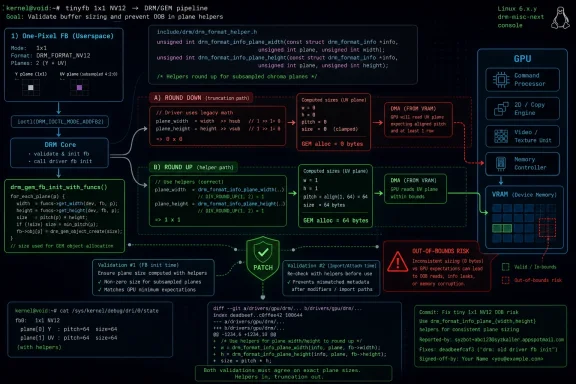 A Two-Line Patch Exposes a Bigger Kernel Truth
The fix for CVE-2026-46209 is almost comically small. In drm_gem_fb_init_with_funcs(), the kernel previously calculated subsampled framebuffer plane dimensions with ordinary integer division. The patch replaces those hand-rolled calculations with DRM helper functions that round up in the same way as the earlier ioctl-level framebuffer validation path.That sounds like a cleanup, not a vulnerability. But the difference between rounding down and rounding up is the difference between “this object is too small” and “this object looks acceptable.” In kernel memory-management code, arithmetic consistency is not style; it is a security boundary.
The affected area sits in the Direct Rendering Manager stack, specifically the GEM-backed framebuffer helper path. GEM, the Graphics Execution Manager, is one of the pieces Linux uses to manage graphics buffers shared between user space, kernel drivers, and GPUs. When that machinery misjudges the size of an object, the kernel can end up blessing a buffer that cannot safely hold what later hardware access expects.
The reported example uses NV12, a common multi-plane pixel format used heavily in video pipelines. With a one-pixel-tall framebuffer and vertical subsampling, one path sees the chroma plane as having zero height while another correctly treats it as one line. That disagreement is enough to let a tiny GEM object sneak past a size check before the GPU later reads or writes beyond the intended object.
The Bug Is Arithmetic, but the Risk Is Trust
The important phrase in this CVE is not “NV12” or even “GPU.” It is inconsistent validation. One part of the DRM stack performed plane-dimension checks using helper functions that round up. A later GEM framebuffer initialization path used plain division, which truncates. The two pieces of code were trying to describe the same object but could disagree at the boundary.This is the kind of vulnerability that makes kernel developers allergic to duplicated logic. If two call sites independently compute the same security-sensitive value, they are almost guaranteed to drift over time. In this case, the drift was not caused by a feature explosion or a spectacular refactor; it was caused by a small difference in how subsampled planes were measured.
Subsampled formats are especially good at finding these mistakes. A full-resolution luma plane and lower-resolution chroma planes are normal in video formats, but “lower resolution” does not mean “round down to zero.” If a plane has to represent a sliver of image data, its storage requirements do not vanish simply because integer division says so.
The overflow path described in the CVE is classic C: a height of zero feeds an expression that subtracts one, and an unsigned integer wraps to a very large value. That value then participates in size arithmetic that can wrap again into something small enough to pass validation. The result is a security check that looks present in code review but fails in the pathological case it most needed to catch.
This Is Not a Windows Bug, but Windows People Should Still Care
WindowsForum readers are not, by default, Linux kernel maintainers. Many are Windows desktop users, Windows Server administrators, hybrid-cloud operators, WSL users, virtualization admins, or people who run Linux appliances without thinking of themselves as Linux users. CVE-2026-46209 matters to that audience because modern Windows environments are full of Linux kernels in places that do not look like traditional Linux desktops.The most obvious place is virtualization. Linux guests running on Windows hosts, Linux VMs in Hyper-V, GPU-enabled workloads, and developer machines using pass-through or accelerated graphics all depend on kernel graphics stacks behaving correctly. A vulnerability in a guest kernel does not automatically compromise the Windows host, but it can matter inside the guest, inside containers, and anywhere untrusted workloads can reach graphics ioctls.
WSL is a more nuanced case. Windows Subsystem for Linux 2 uses a Microsoft-managed Linux kernel, and graphics acceleration in WSLg involves a carefully designed path between Linux user space and the Windows display stack. That does not mean this particular CVE maps cleanly onto every WSL deployment. It does mean that users who treat WSL as “just an app” should remember that it includes a real kernel with real kernel update obligations.
The same logic applies to appliances. Security cameras, thin clients, kiosk systems, embedded boards, Android-adjacent devices, media boxes, and industrial panels often run Linux with display or video pipelines enabled. A bug in DRM/GEM is more relevant to those systems than to a headless database server, but asset owners often do not have a neat inventory field that says “uses multi-plane framebuffer ioctls.”
The Absence of a CVSS Score Is Not Reassurance
At publication, the NVD entry for CVE-2026-46209 was marked as awaiting enrichment, with no NIST CVSS v4.0, v3.x, or v2.0 score assigned. That is now a common operational headache: the identifier exists, the upstream description is detailed, the references point to kernel commits, but the vulnerability-management dashboards may still show a blank score or an unknown severity.That gap should not be confused with low severity. It means NVD had not yet supplied its enrichment metadata. The actual risk depends on exploitability, reachable attack surface, kernel configuration, driver behavior, and whether local untrusted users or sandboxed workloads can exercise the relevant DRM paths.
Kernel.org’s description gives enough technical substance to justify attention. A tiny GEM object can pass the size guard, and GPU access to the chroma plane can go out of bounds. That is a memory-safety failure in kernel-adjacent graphics infrastructure, not a cosmetic validation mismatch.
Still, this is not the same category as a remotely reachable network daemon bug with a public exploit. The practical risk is likely highest on systems where untrusted local code can create framebuffers, use DRM devices, or interact with GPU/video paths. Multi-user Linux workstations, shared GPU servers, CI runners with graphics devices, container hosts with exposed render nodes, and embedded devices with broad local app ecosystems deserve more scrutiny than a locked-down headless VM with no relevant device access.
Kernel CVEs Have Become Faster Than Enterprise Triage
CVE-2026-46209 also illustrates the current rhythm of Linux kernel vulnerability handling. A patch appears on the mailing lists, gets reviewed, is tagged for stable, lands across maintained branches, and then later emerges in vulnerability feeds as a CVE. By the time many enterprise tools surface the item, upstream may already have supplied the fix.That speed is good for security and awkward for process. Traditional vulnerability management wants a clean sequence: advisory, score, affected versions, vendor bulletin, patch package, compliance deadline. Kernel development often gives administrators something messier but more useful: a commit, a stable backport trail, and a terse explanation from the people who fixed the code.
For Linux distributions, the key question is not whether the NVD page has a complete enrichment block. It is whether the distribution kernel has pulled in the relevant stable patch. Enterprise distributions may backport fixes without changing the apparent kernel version in the way upstream users expect, so version-string guessing is a poor substitute for vendor advisory tracking.
For Windows-heavy shops, this is where Linux exposure tends to hide. The security team may have excellent coverage for Windows Update, Microsoft Defender, Intune, WSUS, and monthly Patch Tuesday reporting, but much weaker visibility into Ubuntu images in developer laptops, Debian containers in build systems, appliance firmware, or GPU-enabled Linux VMs used by engineering teams.
The Patch Says “Use the Helper,” and That Is the Real Fix
The technical fix is simple: usedrm_format_info_plane_width() and drm_format_info_plane_height() instead of open-coded division. Those helper functions already embody the correct rounding behavior for subsampled planes. More importantly, they make the initialization path agree with framebuffer_check().This is exactly the kind of change that looks obvious after the fact. If one layer of the subsystem already has canonical logic for calculating plane dimensions, later layers should not recompute the value differently. The patch removes a private interpretation of a shared rule.
The deeper lesson is that security bugs often emerge from almost duplicated logic. The code was not missing validation entirely. It was validating using a slightly different model of the framebuffer than the earlier check used. Attackers love those seams because developers and reviewers tend to reason about the intended invariant, not every arithmetic expression that claims to enforce it.
There is also a hardware angle. GPUs are not passive recipients of kernel abstractions; they perform DMA and access memory according to commands and buffers the software stack prepares. If the kernel tells itself a buffer is adequately sized when it is not, the eventual out-of-bounds access may be performed by hardware following an otherwise valid path. That makes the initial size check especially important.
Exploitability Depends on the Boring Details
The CVE description does not, by itself, prove a universal privilege-escalation path. Out-of-bounds GPU memory access can be serious, but practical exploitation depends heavily on driver behavior, memory placement, isolation, IOMMU configuration, device-node permissions, and what an attacker can cause the GPU to read or write.On many desktop Linux systems, local users can access DRM render nodes for graphics acceleration. On hardened servers, those devices may not exist, may be permission-restricted, or may be irrelevant to installed workloads. On container platforms, the answer depends on whether GPU devices are passed into containers and whether untrusted code can reach them.
That nuance matters because security teams are under constant pressure to flatten every CVE into a patch-now-or-ignore binary. CVE-2026-46209 resists that simplification. It is a real kernel memory-safety issue, but the blast radius is shaped by deployment context.
For shared systems, the conservative assumption should be that local attack surface matters. A bug that requires local access is still meaningful on developer workstations, university lab machines, VDI pools, build runners, media-processing servers, and multi-tenant GPU hosts. Local does not mean harmless when “local” includes arbitrary code from users, plugins, containers, notebooks, browser-adjacent media stacks, or build jobs.
The AI Footnote Is Awkward but Worth Noticing
One small wrinkle in the public patch discussion is that the author acknowledged using AI to a limited extent to understand the subsystem, while saying it was not used to identify the bug or generate the patch. That exchange is less important than the vulnerability itself, but it is a useful snapshot of where open-source maintenance now lives.Kernel maintainers increasingly have to evaluate patches in a world where contributors may use AI tools for orientation, explanation, or drafting. The security concern is not that AI touched the workflow in some abstract moral sense. The concern is whether maintainers can still trust that a patch has been understood, tested, and integrated into subsystem rules rather than mechanically produced.
In this case, the patch is small, reviewable, and tied to a concrete inconsistency. The maintainer discussion did what it should do: ask about provenance, examine the code, and focus on whether the change is correct. That is a healthier model than pretending AI-assisted learning will not happen or, conversely, accepting machine-shaped patches without human accountability.
The irony is that this vulnerability is precisely the sort of issue automated tools may become better at finding: inconsistent calculations across related validation paths. But finding such mismatches is only half the job. The fix still has to respect kernel conventions, stable backport rules, and the subtle behavior of real drivers.
For Administrators, the Right Question Is Exposure
The practical response to CVE-2026-46209 should start with inventory, not panic. Determine where Linux kernels with DRM/GEM framebuffer support are running, whether untrusted local users or workloads can access graphics devices, and whether your distribution has shipped the stable backport.Desktop Linux users should apply normal kernel updates from their distribution. Developers using Linux VMs, WSL environments, or GPU-enabled containers should update base images and host kernels according to their vendor channels. Appliance owners should watch firmware advisories, because embedded Linux vendors often absorb upstream kernel fixes on a different timetable.
For Windows administrators, the inventory challenge is organizational. Linux may enter the estate through dev tooling, cloud images, NAS devices, security appliances, hypervisors, media systems, and edge hardware. Those systems may not be patched by the same team that handles Windows Update, which means a kernel CVE can be “not our platform” right up until it is part of the incident report.
The best mitigation is boring and effective: restrict access to GPU device nodes where they are unnecessary, avoid passing render devices into containers by default, keep distribution kernels current, and treat vendor kernel advisories as authoritative even when NVD metadata is incomplete.
The One-Pixel Framebuffer Is the Part Security Teams Should Remember
The most useful reading of CVE-2026-46209 is not that every Linux graphics system is on fire. It is that a one-pixel edge case can invalidate a security assumption in code that sits between user-controlled inputs and GPU memory access.- CVE-2026-46209 was published on May 28, 2026, and was still awaiting NVD enrichment at the time of review.
- The vulnerability comes from inconsistent plane-dimension calculations in Linux DRM/GEM framebuffer initialization.
- The fix replaces open-coded integer division with DRM helper functions that round up subsampled plane dimensions consistently.
- Systems with exposed DRM devices, GPU acceleration, media pipelines, or untrusted local workloads deserve the closest attention.
- Distribution kernel advisories and stable backports matter more than raw upstream version strings.
- Windows-centric environments should check Linux exposure in WSL, VMs, containers, appliances, and GPU-enabled development infrastructure.
References
- Primary source: NVD / Linux Kernel
Published: 2026-05-29T01:02:09-07:00
NVD - CVE-2026-46209
 nvd.nist.gov
- Security advisory: MSRC
Published: 2026-05-29T01:02:09-07:00
Original feed URL
Security Update Guide - Microsoft Security Response Center
 msrc.microsoft.com
- Official source: nist.gov
National Vulnerability Database
NIST maintains the National Vulnerability Database (NVD), a repository of information on software and hardware flaws that can compromise computer security. This is a key piece of the nation’s cybersecurity infrastructure.www.nist.gov - Related coverage: labs.cloudsecurityalliance.org
NVD Enrichment Triage: Guidance for AI Security Programs
PDF documentlabs.cloudsecurityalliance.org
- Related coverage: opennet.ru
- Related coverage: kernel.org
- Related coverage: erofs.docs.kernel.org
