

On May 28, 2026, kernel.org assigned CVE-2026-46220 to an AMDGPU flaw in the Linux kernel’s SDMA 4.0 fence-emission path, where crafted unprivileged command submissions could hit
CVE-2026-46220 sits in
That behavior is defensible only if the condition is genuinely unreachable in production. The CVE description says it was reachable from unprivileged userspace through crafted
The fix replaces the fatal assertion with a warning, allowing the kernel to log the unexpected condition without detonating the entire system. Some patch discussions describe the safer pattern as
That is why this CVE is more interesting than its likely eventual score. It exposes the old tension in kernel programming between assertions that help developers catch impossible states and production paths where “impossible” often means “insufficiently validated earlier.”
The impact described so far is a local denial of service. An unprivileged user can reportedly craft AMDGPU command submission input that reaches the vulnerable assertion and causes a fatal kernel panic in a scheduler worker thread. That does not read like a privilege escalation, data leak, or remote code execution path. But on a multi-user Linux workstation, render node host, lab machine, or shared desktop system, a local panic is not a theoretical annoyance.
A crash in the graphics stack can mean interrupted jobs, lost desktop sessions, corrupted unsaved work, and downtime for systems that were not supposed to be fragile. For administrators, the problem is less “can an attacker own the box?” and more “can any local account reliably knock the box over?” In classrooms, labs, kiosks, GPU workstations, CI machines, and remote desktops, that answer matters.
The vulnerability also cuts against a common instinct in desktop security triage. GPU driver bugs are often mentally filed under “stability” unless they come with proof of code execution. CVE-2026-46220 is a reminder that stability failures inside privileged code paths can cross the line into security when the crash can be intentionally triggered by an unprivileged caller.
That matters because modern GPU drivers expose large, complex interfaces to userspace. Games, compositors, compute workloads, media frameworks, browser GPU processes, and desktop shells all pass work into the kernel DRM stack. The kernel cannot simply trust that every command buffer, fence, address, flag, and synchronization primitive has been well behaved because the entire design depends on unprivileged clients submitting work.
The AMDGPU CS IOCTL is part of that contract. It is supposed to parse, validate, and marshal userspace requests before low-level hardware emission code sees them. If malformed input survives long enough to trip a
This is the subtlety that makes the patch meaningful. Replacing
A kernel panic is not a localized exception. It is a system-wide event. The process that supplied the bad input does not merely fail; the operating system stops. That makes
The Linux kernel has been moving for years toward replacing reachable
The most telling sentence in the CVE description is not the one about AMDGPU or SDMA. It is the one that says crashing the kernel is never the correct response when the assertion is reachable from userspace. That is a general rule disguised as a driver-specific fix.
Fences are part of the synchronization infrastructure that lets the CPU, GPU, scheduler, and userspace coordinate work. A fence writeback address needs to meet alignment expectations because the hardware and command processor expect data in particular forms. The driver’s mistake was not caring about alignment; the mistake was handling an alignment violation as if it proved the universe had broken.
SDMA itself is not some decorative corner of the driver. The System DMA engine is used for copy and memory operations that help move data efficiently without tying everything to graphics queues. Low-level ring emission code like
Those assumptions are dangerous when they are reachable from unprivileged paths. A compositor should not be able to panic the machine because a command submission manages to produce an unexpected fence address. Neither should a local test program, a malicious sandbox escape attempt that fails upward into denial of service, or a disgruntled account on a shared workstation.
Backports are important because many users do not run Linus’ latest mainline kernel. Enterprise distributions, long-term-support kernels, distro-stable branches, and vendor kernels all carry their own timelines. A fix landing in upstream stable is the beginning of the remediation chain, not the end.
For rolling distributions, the fix may arrive quickly through normal kernel updates. For enterprise fleets, appliance-like deployments, and long-lived workstation images, the answer depends on the vendor’s kernel cadence and whether the AMDGPU driver in use contains the vulnerable SDMA 4.0 code. Administrators should watch distribution advisories rather than assuming that the existence of an upstream stable commit means their deployed kernel is already safe.
The patch also shows why vulnerability records can look underwhelming while still deserving attention. There is no dramatic exploit write-up in the NVD entry. There is no score yet. There is no long list of named products. But the anatomy is clear enough: unprivileged userspace can reach a fatal kernel assertion in a GPU driver.
This particular CVE does not imply a flaw in Windows’ AMD display driver stack. It is a Linux kernel DRM/AMDGPU issue. But mixed estates make clean platform boundaries less meaningful than they used to be. A vulnerable Linux box with an AMD GPU can still be part of the same identity domain, file workflow, source-code environment, or remote-access story as the rest of the organization.
There is also a more general Windows lesson here. Graphics drivers remain one of the most exposed and complicated parts of modern operating systems. They parse untrusted content from browsers, games, media frameworks, machine-learning workloads, remote desktops, and sandboxed processes. Whether the kernel is Linux or Windows, the rule is the same: driver code that treats user-influenced state as impossible can turn validation mistakes into system compromise or denial of service.
For IT teams, the practical implication is not to panic about every GPU CVE. It is to stop treating GPU driver updates as optional cosmetics. Graphics stacks are no longer just about frame rates and monitor detection. They are part of the attack surface.
A local denial-of-service bug may not clear the same emergency bar as a network worm or a browser zero-day. It should still move through normal kernel update channels, especially on systems where untrusted users can execute local code. The systems most exposed are not necessarily gaming desktops; they are shared Linux machines, GPU compute hosts, developer workstations, lab environments, and any host where local users are not fully trusted.
The risk calculus changes by deployment model. A single-user home desktop is exposed mainly to code that user runs, which does not make the bug irrelevant but does lower the priority compared with remotely reachable vulnerabilities. A multi-user compute server or remote-access workstation has a different profile because one account’s ability to panic the host affects everyone else.
Security teams should also remember that denial-of-service bugs are often useful in chains. A local panic may be used to disrupt monitoring, interrupt services, force failover, erase volatile state, or create pressure during another incident. Not every DoS is just vandalism.
That is the difference between not crashing and being correct. A warning in ring emission code is a safer last line of defense, not the ideal first line. The driver should reject malformed inputs before they are translated into low-level ring commands.
The patch history around AMDGPU ring emission suggests maintainers have been looking at a broader class of similar assertions across graphics and SDMA paths. That is exactly what should happen after a CVE like this. Once one reachable
This is also where distro maintainers play an important role. Upstream stable fixes need to be pulled, built, tested, and shipped into kernels that real users run. Because AMDGPU changes can interact with display stability, suspend/resume behavior, and compute workloads, vendors may be cautious. But caution should not become inertia.
Administrators should identify AMDGPU-equipped Linux systems first. That includes desktops with Radeon cards, Ryzen APUs using integrated AMD graphics, some laptops, handhelds, and workstations used for graphics or compute. Servers without AMDGPU loaded are unlikely to be affected in practice, even if their source tree contains the vulnerable code.
The next step is to distinguish installed kernels from booted kernels. Linux hosts often accumulate kernel packages, and compliance tools can report that a fixed kernel is present even though the machine is still running the older vulnerable one. After patching, rebooting is not bureaucracy; it is the moment the mitigation becomes real.
Logs may show warnings rather than panics after the fix if malformed submissions reach the path. That should not be treated as a clean bill of health. A warning means the catastrophic failure mode has been removed, but it may also signal that earlier validation is still worth improving or that a workload is exercising an unusual driver path.
BUG_ON() assertions and panic the system. The patch is small, but the lesson is not. This is not the story of an exotic graphics exploit or a dramatic memory-corruption chain; it is the story of a kernel subsystem treating reachable bad input as an impossible state. For Linux desktop users, workstation owners, and administrators running AMD graphics, that distinction matters because denial of service is still security when the crash is the whole machine.
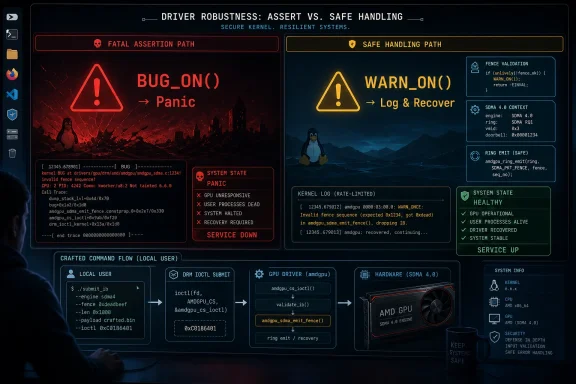 A Two-Line Assertion Became a System-Wide Kill Switch
CVE-2026-46220 sits in drm/amdgpu/sdma4, specifically in sdma_v4_0_ring_emit_fence(), a low-level part of the AMDGPU driver that emits commands to the GPU’s System DMA engine. The vulnerable code used two BUG_ON(addr & 0x3) checks to assert that fence writeback addresses were DWORD-aligned. If the assertion failed, the kernel did what BUG_ON() is designed to do: it treated the condition as fatal.That behavior is defensible only if the condition is genuinely unreachable in production. The CVE description says it was reachable from unprivileged userspace through crafted
DRM_IOCTL_AMDGPU_CS submissions. In other words, the driver placed a crash-only assertion downstream of a path that normal userspace could influence.The fix replaces the fatal assertion with a warning, allowing the kernel to log the unexpected condition without detonating the entire system. Some patch discussions describe the safer pattern as
WARN_ON_ONCE() plus address sanitization, while the CVE summary frames the resolved change as replacing BUG_ON() with WARN_ON(). Either way, the security boundary is the same: user-triggerable driver mistakes should not become kernel panics.That is why this CVE is more interesting than its likely eventual score. It exposes the old tension in kernel programming between assertions that help developers catch impossible states and production paths where “impossible” often means “insufficiently validated earlier.”
The Vulnerability Is Boring in Exactly the Way Security Teams Fear
There is no public CVSS score from NVD yet. The record is marked as awaiting enrichment, and the NVD entry does not yet provide CVSS 4.0, CVSS 3.x, or CVSS 2.0 vectors. That leaves defenders with the uncomfortable but familiar task of prioritizing a vulnerability before the scoring machinery has caught up.The impact described so far is a local denial of service. An unprivileged user can reportedly craft AMDGPU command submission input that reaches the vulnerable assertion and causes a fatal kernel panic in a scheduler worker thread. That does not read like a privilege escalation, data leak, or remote code execution path. But on a multi-user Linux workstation, render node host, lab machine, or shared desktop system, a local panic is not a theoretical annoyance.
A crash in the graphics stack can mean interrupted jobs, lost desktop sessions, corrupted unsaved work, and downtime for systems that were not supposed to be fragile. For administrators, the problem is less “can an attacker own the box?” and more “can any local account reliably knock the box over?” In classrooms, labs, kiosks, GPU workstations, CI machines, and remote desktops, that answer matters.
The vulnerability also cuts against a common instinct in desktop security triage. GPU driver bugs are often mentally filed under “stability” unless they come with proof of code execution. CVE-2026-46220 is a reminder that stability failures inside privileged code paths can cross the line into security when the crash can be intentionally triggered by an unprivileged caller.
The AMDGPU Command Submission Path Is Where Trust Should End
The CVE text is unusually plain about where the real validation should happen: the command submission IOCTL path is the correct place to filter invalid submissions. By the time execution reaches the ring emission callback, the driver is already too deep in the machinery to treat bad input as recoverable policy.That matters because modern GPU drivers expose large, complex interfaces to userspace. Games, compositors, compute workloads, media frameworks, browser GPU processes, and desktop shells all pass work into the kernel DRM stack. The kernel cannot simply trust that every command buffer, fence, address, flag, and synchronization primitive has been well behaved because the entire design depends on unprivileged clients submitting work.
The AMDGPU CS IOCTL is part of that contract. It is supposed to parse, validate, and marshal userspace requests before low-level hardware emission code sees them. If malformed input survives long enough to trip a
BUG_ON(), the bug is not merely that a macro was too aggressive. The bug is that an internal invariant was enforced at the wrong layer, using the wrong failure mode.This is the subtlety that makes the patch meaningful. Replacing
BUG_ON() with WARN_ON() does not magically make malformed input correct. It changes the system’s response from “kill the kernel” to “record the anomaly and keep control.” That is the difference between a defensive driver and a driver that hands attackers a panic button.The Kernel’s BUG_ON Habit Keeps Aging Badly
BUG_ON() has a long history in Linux as a blunt instrument for catching conditions that should never happen. In development, that can be useful. In production, especially on paths influenced by userspace, it is increasingly hard to justify.A kernel panic is not a localized exception. It is a system-wide event. The process that supplied the bad input does not merely fail; the operating system stops. That makes
BUG_ON() inappropriate for many classes of driver validation, particularly in subsystems like DRM where userspace input is central to normal operation.The Linux kernel has been moving for years toward replacing reachable
BUG_ON() calls with less catastrophic handling. Sometimes that means returning an error. Sometimes it means warning once and continuing. Sometimes it means adding validation earlier so the lower layer never sees the invalid state. CVE-2026-46220 belongs to that pattern.The most telling sentence in the CVE description is not the one about AMDGPU or SDMA. It is the one that says crashing the kernel is never the correct response when the assertion is reachable from userspace. That is a general rule disguised as a driver-specific fix.
This Is a GPU Security Bug, Not a GPU Spectacle
The AMDGPU stack has become a critical piece of Linux’s mainstream desktop and workstation story. AMD graphics are common in consumer desktops, handheld PCs, laptops, workstations, and compute nodes. The open kernel driver is one reason AMD hardware has been attractive to Linux users, but openness does not reduce complexity.Fences are part of the synchronization infrastructure that lets the CPU, GPU, scheduler, and userspace coordinate work. A fence writeback address needs to meet alignment expectations because the hardware and command processor expect data in particular forms. The driver’s mistake was not caring about alignment; the mistake was handling an alignment violation as if it proved the universe had broken.
SDMA itself is not some decorative corner of the driver. The System DMA engine is used for copy and memory operations that help move data efficiently without tying everything to graphics queues. Low-level ring emission code like
sdma_v4_0_ring_emit_fence() lives close to the hardware contract, which is exactly why it tends to accumulate assumptions.Those assumptions are dangerous when they are reachable from unprivileged paths. A compositor should not be able to panic the machine because a command submission manages to produce an unexpected fence address. Neither should a local test program, a malicious sandbox escape attempt that fails upward into denial of service, or a disgruntled account on a shared workstation.
The Patch Is Small Because the Design Lesson Is Large
The actual code change is not the kind that fills conference slides. It replaces fatal assertions with warnings in a fence emission path and is being propagated through stable kernel branches. The referenced stable commits indicate that maintainers considered the issue backportable, which is the practical signal administrators should care about.Backports are important because many users do not run Linus’ latest mainline kernel. Enterprise distributions, long-term-support kernels, distro-stable branches, and vendor kernels all carry their own timelines. A fix landing in upstream stable is the beginning of the remediation chain, not the end.
For rolling distributions, the fix may arrive quickly through normal kernel updates. For enterprise fleets, appliance-like deployments, and long-lived workstation images, the answer depends on the vendor’s kernel cadence and whether the AMDGPU driver in use contains the vulnerable SDMA 4.0 code. Administrators should watch distribution advisories rather than assuming that the existence of an upstream stable commit means their deployed kernel is already safe.
The patch also shows why vulnerability records can look underwhelming while still deserving attention. There is no dramatic exploit write-up in the NVD entry. There is no score yet. There is no long list of named products. But the anatomy is clear enough: unprivileged userspace can reach a fatal kernel assertion in a GPU driver.
Windows Admins Should Still Care About a Linux AMDGPU CVE
WindowsForum.com readers may reasonably ask why a Linux kernel AMDGPU bug belongs in their threat radar. The answer is that Windows environments increasingly contain Linux whether or not the desktop standard image is Windows. WSL, developer workstations, dual-boot systems, Linux build machines, SteamOS-like devices, container hosts, AI workstations, and lab boxes all sit near Windows infrastructure.This particular CVE does not imply a flaw in Windows’ AMD display driver stack. It is a Linux kernel DRM/AMDGPU issue. But mixed estates make clean platform boundaries less meaningful than they used to be. A vulnerable Linux box with an AMD GPU can still be part of the same identity domain, file workflow, source-code environment, or remote-access story as the rest of the organization.
There is also a more general Windows lesson here. Graphics drivers remain one of the most exposed and complicated parts of modern operating systems. They parse untrusted content from browsers, games, media frameworks, machine-learning workloads, remote desktops, and sandboxed processes. Whether the kernel is Linux or Windows, the rule is the same: driver code that treats user-influenced state as impossible can turn validation mistakes into system compromise or denial of service.
For IT teams, the practical implication is not to panic about every GPU CVE. It is to stop treating GPU driver updates as optional cosmetics. Graphics stacks are no longer just about frame rates and monitor detection. They are part of the attack surface.
The Missing CVSS Score Should Not Freeze Patch Planning
NVD’s lack of enrichment is not unusual for a new kernel CVE, especially one received from kernel.org and published only recently. But the absence of a score can create a dangerous pause in organizations that use CVSS thresholds as the first gate for action. CVE-2026-46220 is a good example of why that model is brittle.A local denial-of-service bug may not clear the same emergency bar as a network worm or a browser zero-day. It should still move through normal kernel update channels, especially on systems where untrusted users can execute local code. The systems most exposed are not necessarily gaming desktops; they are shared Linux machines, GPU compute hosts, developer workstations, lab environments, and any host where local users are not fully trusted.
The risk calculus changes by deployment model. A single-user home desktop is exposed mainly to code that user runs, which does not make the bug irrelevant but does lower the priority compared with remotely reachable vulnerabilities. A multi-user compute server or remote-access workstation has a different profile because one account’s ability to panic the host affects everyone else.
Security teams should also remember that denial-of-service bugs are often useful in chains. A local panic may be used to disrupt monitoring, interrupt services, force failover, erase volatile state, or create pressure during another incident. Not every DoS is just vandalism.
The Real Fix Is Earlier Rejection, Not Later Forgiveness
ReplacingBUG_ON() with WARN_ON() is a containment fix. It prevents a reachable bad state from taking down the machine. But the CVE description itself points to a deeper correction: invalid command submissions should be filtered in the CS IOCTL path.That is the difference between not crashing and being correct. A warning in ring emission code is a safer last line of defense, not the ideal first line. The driver should reject malformed inputs before they are translated into low-level ring commands.
The patch history around AMDGPU ring emission suggests maintainers have been looking at a broader class of similar assertions across graphics and SDMA paths. That is exactly what should happen after a CVE like this. Once one reachable
BUG_ON() is found in a user-influenced GPU path, the responsible response is to audit nearby assumptions rather than treat the instance as isolated.This is also where distro maintainers play an important role. Upstream stable fixes need to be pulled, built, tested, and shipped into kernels that real users run. Because AMDGPU changes can interact with display stability, suspend/resume behavior, and compute workloads, vendors may be cautious. But caution should not become inertia.
The Operational Answer Is Patch, Then Verify the Kernel You Actually Boot
For users, the remediation path is simple in concept and messy in practice: update to a kernel that includes the stable fix for CVE-2026-46220. The exact version will depend on distribution, kernel branch, and vendor packaging. Users running stock distro kernels should rely on their distribution’s security and kernel updates rather than manually transplanting commits.Administrators should identify AMDGPU-equipped Linux systems first. That includes desktops with Radeon cards, Ryzen APUs using integrated AMD graphics, some laptops, handhelds, and workstations used for graphics or compute. Servers without AMDGPU loaded are unlikely to be affected in practice, even if their source tree contains the vulnerable code.
The next step is to distinguish installed kernels from booted kernels. Linux hosts often accumulate kernel packages, and compliance tools can report that a fixed kernel is present even though the machine is still running the older vulnerable one. After patching, rebooting is not bureaucracy; it is the moment the mitigation becomes real.
Logs may show warnings rather than panics after the fix if malformed submissions reach the path. That should not be treated as a clean bill of health. A warning means the catastrophic failure mode has been removed, but it may also signal that earlier validation is still worth improving or that a workload is exercising an unusual driver path.
A Small AMDGPU CVE Carries a Larger Kernel Message
The concrete guidance is short, but the implications stretch beyond this one function. CVE-2026-46220 is about a driver assertion, a GPU fence address, and a denial-of-service condition. It is also about how production kernels should behave when untrusted input violates an internal assumption.- Systems running Linux with AMDGPU hardware should receive kernel updates that include the stable fix for CVE-2026-46220.
- Administrators should prioritize shared, remote-access, lab, developer, and GPU compute systems ahead of single-user desktops.
- The absence of an NVD CVSS score as of publication should not be interpreted as evidence that the bug is harmless.
- The vulnerable behavior is a local kernel panic path, not a known remote exploit or confirmed privilege-escalation chain.
- The deeper engineering lesson is that user-reachable driver paths should reject invalid input early rather than rely on fatal assertions late.
References
- Primary source: NVD / Linux Kernel
Published: 2026-05-29T01:04:59-07:00
NVD - CVE-2026-46220
 nvd.nist.gov
- Security advisory: MSRC
Published: 2026-05-29T01:04:59-07:00
Original feed URL
Security Update Guide - Microsoft Security Response Center
 msrc.microsoft.com
- Related coverage: opennet.ru
- Related coverage: cve.imfht.com
CVE-2026-31566: drm/amdgpu: Fix fence put before wait in amdgpu_amdkfd_submit_ib - Vulnerability Platform
[HIGH 7.8] Overview A vulnerability exists in in the Linux kernel where releasing the fence reference too early leads to a use-after-free issue. The fix is to wa cve.imfht.com
- Related coverage: cvefeed.io
CVE-2026-23034 - drm/amdgpu/userq: Fix fence reference leak on queue teardown v2
In the Linux kernel, the following vulnerability has been resolved: drm/amdgpu/userq: Fix fence reference leak on queue teardown v2 The user mode queue keeps a pointer to the most recent fence in userq->last_fence. This pointer holds an extra dma_fence reference. When the queue is destroyed...cvefeed.io - Related coverage: amdgpu-install.readthedocs.io
- Related coverage: support.bull.com
