CVE-2026-46307 is a newly published Linux kernel vulnerability, added to NVD on June 8, 2026, that fixes an out-of-bounds array write in the ath5k Wi-Fi driver used by older Atheros 5xxx wireless chipsets. The bug is small, the upstream note calls its practical effect negligible, and there is no public scoring from NVD yet. But it is still a useful case study in how modern kernel security now treats even narrow correctness bugs as vulnerabilities, especially when memory safety meets legacy hardware.
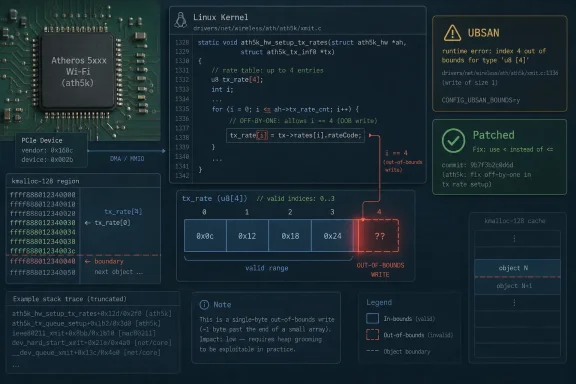
The headline version of CVE-2026-46307 is not dramatic. There is no wormable remote-code-execution claim, no emergency mitigation guidance, and no known exploit chain being passed around by threat actors. The Linux kernel fix simply prevents ath5k from writing a sentinel value just beyond the end of a four-entry transmit-rate array.
That sounds like bookkeeping, because it mostly is. In the reported path,
The upstream fix is equally plain: only write the
That qualifier matters. It separates this CVE from the class of memory corruption bugs that hand attackers a reliable primitive. But it does not make the bug meaningless, because the kernel’s security posture has shifted from “is this exploitable today?” toward “is this memory corruption in privileged code?”
That can frustrate administrators who want every CVE to map neatly to a patching priority. If a vulnerability is “negligible,” why does it get an identifier at all? The answer is that CVE assignment is increasingly a cataloging mechanism, not a marketing claim about imminent danger.
For kernel maintainers, an out-of-bounds write in a driver is a correctness failure in privileged code. Whether that write lands on an adjacent field in a way that appears harmless today is secondary to the broader principle: kernel memory boundaries are not advisory. The fix is simple, the affected code is real, and the record lets distributions, scanners, and enterprises track whether the correction is present.
This is the uncomfortable bargain of modern vulnerability management. The CVE feed gets noisier, but the ecosystem gets a more complete audit trail. For IT teams, the skill is no longer merely spotting “critical” labels; it is learning which low-drama records still belong in the next maintenance window.
You find this hardware in repurposed laptops, small office appliances, lab boxes, thin clients, industrial systems, hobbyist routers, and Linux desktops kept alive because they still do one job well. Some of those machines sit on trusted networks. Some are used as jump boxes. Some run distributions with long support tails and a patch cadence governed by “when someone remembers.”
That does not make every ath5k system an emergency. It does mean the affected population is less theoretical than the chipset’s age suggests. Legacy support is one of Linux’s strengths, and every strength becomes an attack surface when the code is in the kernel.
The more interesting point is that this is a Wi-Fi transmit-status path, not some exotic optional subsystem compiled only by specialists. Wireless drivers process complex device state, firmware behavior, and kernel networking abstractions. Even when the vulnerability itself is mild, the class of code deserves caution because it bridges untrusted radio environments, hardware quirks, and privileged kernel memory.
Here, UBSAN reported an array index out of bounds in
The fix does not require redesigning the driver. It requires respecting the array size. That is precisely why the bug is instructive. Many serious vulnerabilities begin as a similarly banal off-by-one assumption that only becomes dangerous in a different structure layout, compiler configuration, kernel build, or execution path.
In this case, upstream says the overwritten field is
That distinction is important for administrators trying to triage. CVE-2026-46307 should not outrank a remotely exploitable kernel privilege escalation, a browser zero-day, or a VPN appliance flaw under active exploitation. It should also not disappear from patch tracking simply because the write looks boring.
Kernel memory corruption bugs live in context. A field that is harmless today may not remain harmless after a refactor. A driver path that appears difficult to influence may become more interesting when paired with local code execution, unusual hardware state, or fuzzing that explores edge cases maintainers did not manually reason through.
The most sensible reading is conservative but calm: this is a real kernel bug with limited apparent impact. Patch it through normal distribution kernel updates. Do not rip hardware out of production, do not panic over unscored scanner alerts, and do not treat “no CVSS yet” as proof of no relevance.
For this vulnerability, the absence of a base score is not especially crippling. The description gives unusually concrete technical detail: driver, file, array type, invalid index, hardware condition, and likely overwrite target. That is enough for a practical triage call.
The bigger problem is scanner behavior. Many asset and vulnerability tools are optimized to shout when a CVE appears and only calm down after vendor metadata catches up. A newly published Linux kernel CVE with “NVD assessment not yet provided” may show up as unknown severity, informational, medium by default, or policy-breaking simply because the record exists.
That is where IT teams need internal rules. A kernel CVE affecting a driver loaded on production systems deserves verification. A kernel CVE affecting hardware not present on the system deserves de-prioritization. A kernel CVE already patched by the distribution should be closed based on package version, not on whether NVD has finished enriching the page.
The practical first question is not “what is the CVSS?” It is “do we have ath5k loaded anywhere?” On Linux, that can be checked through module listings, hardware inventory, kernel configuration, and endpoint telemetry. If the driver is not present or not loaded, the operational exposure is sharply reduced.
This is especially true in small and mid-sized organizations, where “the Linux box” can be anything from a monitoring appliance to a Wi-Fi bridge to a forgotten build server. If it runs a distribution kernel and has old Atheros wireless hardware, CVE-2026-46307 may be relevant even if the corporate desktop fleet is entirely Microsoft-managed.
There is also a broader lesson for Windows administrators: driver bugs remain one of the stubborn fronts in operating-system security. Microsoft has spent years tightening driver signing, kernel-mode code integrity, vulnerable-driver blocklists, and virtualization-based security because privileged hardware-facing code is uniquely dangerous. Linux faces the same structural problem through a different governance model.
Ath5k is not a Windows driver, but the pattern is familiar across platforms. Hardware support code has long lifetimes, weird edge cases, and uneven test coverage. The deeper an organization’s hardware inventory goes, the more it has to care about obscure driver fixes that never make mainstream headlines.
For admins, that means the right remediation path is usually not manual patching from a Git commit. It is updating to a distribution kernel that includes the backport. Enterprise Linux, Debian, Ubuntu, SUSE, Arch, Fedora, and appliance vendors all have different timing and packaging conventions, so the version that matters is the vendor-shipped kernel package, not just the upstream mainline state.
This is where Linux differs sharply from the single-vendor rhythm Windows administrators know from Patch Tuesday. The upstream fix is the source of truth for the code change, but the operational fix arrives through distribution channels. A CVE can be “fixed upstream” while still “pending vendor evaluation” for a given supported release.
That split explains why vulnerability management on Linux can feel messy. The kernel is one project, but deployed Linux is an ecosystem. CVE-2026-46307 is a small example of a much larger workflow reality: remediation is not complete until your actual systems boot into a kernel containing the relevant patch.
This is where low-severity kernel CVEs become useful probes of operational maturity. They test whether endpoint inventory includes kernel modules. They test whether Linux fleet management is treated as a first-class discipline or an exception handled by the one person who “knows the boxes.” They test whether scanners are tuned to distinguish present code from theoretical package exposure.
For home users, the advice is simpler. If you run Linux on older Wi-Fi hardware, install your distribution’s kernel updates and reboot into the new kernel. If you do not use ath5k hardware, this CVE is unlikely to be directly relevant. If you are unsure, updating remains the best default because kernel updates rarely address only one issue.
For enterprise teams, the better move is to fold this into routine patch operations. Confirm exposure, watch vendor advisories, validate kernel versions after reboot, and avoid one-off exceptions unless there is a strong operational reason. A negligible write is still a kernel write, and kernel writes are not where organizations should accumulate avoidable debt.
The Linux kernel community is not going to rewrite every legacy wireless driver in Rust, and pretending otherwise is not serious. Drivers like ath5k represent years of hardware knowledge encoded in C, and many support devices that will never justify a ground-up rewrite. The practical path is incremental: sanitizers, static analysis, compiler hardening, careful review, and targeted use of safer abstractions where they fit.
Still, every small out-of-bounds CVE strengthens the case for that incremental work. The kernel does not need a catastrophic exploit to justify better bounds discipline. The daily grind of minor memory errors is the argument.
Windows has the same story in a different accent. Microsoft’s push toward memory-safe components, hardened drivers, and kernel attack-surface reduction is not fashion; it is a response to decades of evidence. When privileged code talks to hardware and parses complex state, the cost of small mistakes is too high to leave entirely to convention.
It is important because it shows how vulnerability management actually works in 2026. Security teams are flooded with CVEs, many of them real, many of them low-impact, and many of them lacking complete enrichment when they first appear. The job is not to panic at every identifier; it is to understand enough of the underlying technology to prioritize without ignoring.
The fix also demonstrates a healthy part of the open-source model. The bug report includes a sanitizer trace. The maintainer discussion is public. The patch is simple. The stable references are visible. Even the minimizing language about impact is technically specific rather than hand-wavy.
That transparency should not lull anyone into complacency. It should instead make triage faster. When a vendor tells you exactly which array was exceeded, by which index, in which driver, and what field was overwritten, you have the raw material to make a better decision than any generic severity badge can provide.
That does not mean the record is noise. It means the action should match the risk. The right response is disciplined patching, not alarm.
 A Tiny Wi-Fi Bug Becomes a Security Record
The headline version of CVE-2026-46307 is not dramatic. There is no wormable remote-code-execution claim, no emergency mitigation guidance, and no known exploit chain being passed around by threat actors. The Linux kernel fix simply prevents ath5k from writing a sentinel value just beyond the end of a four-entry transmit-rate array.That sounds like bookkeeping, because it mostly is. In the reported path,
ts_final_idx can reach 3 on AR5212-era hardware, and the driver then tries to touch element 4 by writing to rates[ts_final_idx + 1]. Since IEEE80211_TX_MAX_RATES is 4, valid indexes stop at 3.The upstream fix is equally plain: only write the
idx = -1 sentinel if the calculated array slot is still inside the array. The kernel note adds an important qualifier: the out-of-bounds write appears to land on the next member of the same status structure, ack_signal, which is why maintainers characterize the effect as negligible rather than catastrophic.That qualifier matters. It separates this CVE from the class of memory corruption bugs that hand attackers a reliable primitive. But it does not make the bug meaningless, because the kernel’s security posture has shifted from “is this exploitable today?” toward “is this memory corruption in privileged code?”
The Kernel’s New CVE Era Rewards Precision and Punishes Complacency
Linux kernel CVEs have become more numerous and more granular, and CVE-2026-46307 fits that trend almost perfectly. It is not a splashy vulnerability disclosure. It is a stable-tree fix, assigned a CVE after the fact, documented with the same terse engineering language that appears in the patch trail.That can frustrate administrators who want every CVE to map neatly to a patching priority. If a vulnerability is “negligible,” why does it get an identifier at all? The answer is that CVE assignment is increasingly a cataloging mechanism, not a marketing claim about imminent danger.
For kernel maintainers, an out-of-bounds write in a driver is a correctness failure in privileged code. Whether that write lands on an adjacent field in a way that appears harmless today is secondary to the broader principle: kernel memory boundaries are not advisory. The fix is simple, the affected code is real, and the record lets distributions, scanners, and enterprises track whether the correction is present.
This is the uncomfortable bargain of modern vulnerability management. The CVE feed gets noisier, but the ecosystem gets a more complete audit trail. For IT teams, the skill is no longer merely spotting “critical” labels; it is learning which low-drama records still belong in the next maintenance window.
Ath5k Is Old Enough to Be Boring, Which Is Why It Still Matters
The ath5k driver supports older Atheros 802.11 chipsets, a class of hardware many mainstream Windows users will never knowingly touch in 2026. That alone will tempt some readers to dismiss CVE-2026-46307 as retro-computing lint. In practice, old Wi-Fi silicon has a habit of living in exactly the places where patch discipline is weakest.You find this hardware in repurposed laptops, small office appliances, lab boxes, thin clients, industrial systems, hobbyist routers, and Linux desktops kept alive because they still do one job well. Some of those machines sit on trusted networks. Some are used as jump boxes. Some run distributions with long support tails and a patch cadence governed by “when someone remembers.”
That does not make every ath5k system an emergency. It does mean the affected population is less theoretical than the chipset’s age suggests. Legacy support is one of Linux’s strengths, and every strength becomes an attack surface when the code is in the kernel.
The more interesting point is that this is a Wi-Fi transmit-status path, not some exotic optional subsystem compiled only by specialists. Wireless drivers process complex device state, firmware behavior, and kernel networking abstractions. Even when the vulnerability itself is mild, the class of code deserves caution because it bridges untrusted radio environments, hardware quirks, and privileged kernel memory.
UBSAN Did Its Job Before Attackers Had To
The disclosure text names UBSAN, the Undefined Behavior Sanitizer, as the mechanism that exposed the bad access. That detail should not be treated as incidental. Sanitizers are among the quiet heroes of kernel hardening because they turn “probably fine” assumptions into loud failures during testing and real-world diagnostic runs.Here, UBSAN reported an array index out of bounds in
drivers/net/wireless/ath/ath5k/base.c, with index 4 exceeding a four-element ieee80211_tx_rate array. That is the kind of bug C programmers have been writing for decades: a sentinel marker is useful, but only if the array has room for it. When the final valid entry is already occupied, the conventional “write one more marker” pattern becomes memory corruption.The fix does not require redesigning the driver. It requires respecting the array size. That is precisely why the bug is instructive. Many serious vulnerabilities begin as a similarly banal off-by-one assumption that only becomes dangerous in a different structure layout, compiler configuration, kernel build, or execution path.
In this case, upstream says the overwritten field is
ack_signal, and mac80211 will not read beyond IEEE80211_TX_MAX_RATES. That narrows the concern. But the sanitizer finding still deserves credit: it caught a concrete violation in code that runs inside the kernel, before anyone needed to debate a proof-of-concept exploit.“Negligible” Is Not the Same as “Ignore”
The upstream note’s most reassuring sentence is also the one most likely to be misread. Saying the effect of the out-of-bounds write is negligible is not the same as saying the bug should be ignored. It means the known write target and current structure layout do not suggest a meaningful security impact beyond corrupting an adjacent status field.That distinction is important for administrators trying to triage. CVE-2026-46307 should not outrank a remotely exploitable kernel privilege escalation, a browser zero-day, or a VPN appliance flaw under active exploitation. It should also not disappear from patch tracking simply because the write looks boring.
Kernel memory corruption bugs live in context. A field that is harmless today may not remain harmless after a refactor. A driver path that appears difficult to influence may become more interesting when paired with local code execution, unusual hardware state, or fuzzing that explores edge cases maintainers did not manually reason through.
The most sensible reading is conservative but calm: this is a real kernel bug with limited apparent impact. Patch it through normal distribution kernel updates. Do not rip hardware out of production, do not panic over unscored scanner alerts, and do not treat “no CVSS yet” as proof of no relevance.
NVD’s Silence Leaves Administrators Doing the Real Triage
As of the CVE’s initial publication, NVD had not provided CVSS 4.0, CVSS 3.x, or CVSS 2.0 scoring. That is increasingly common in the gap between CVE publication and enrichment. It also forces security teams to read the underlying record instead of outsourcing judgment to a number.For this vulnerability, the absence of a base score is not especially crippling. The description gives unusually concrete technical detail: driver, file, array type, invalid index, hardware condition, and likely overwrite target. That is enough for a practical triage call.
The bigger problem is scanner behavior. Many asset and vulnerability tools are optimized to shout when a CVE appears and only calm down after vendor metadata catches up. A newly published Linux kernel CVE with “NVD assessment not yet provided” may show up as unknown severity, informational, medium by default, or policy-breaking simply because the record exists.
That is where IT teams need internal rules. A kernel CVE affecting a driver loaded on production systems deserves verification. A kernel CVE affecting hardware not present on the system deserves de-prioritization. A kernel CVE already patched by the distribution should be closed based on package version, not on whether NVD has finished enriching the page.
The practical first question is not “what is the CVSS?” It is “do we have ath5k loaded anywhere?” On Linux, that can be checked through module listings, hardware inventory, kernel configuration, and endpoint telemetry. If the driver is not present or not loaded, the operational exposure is sharply reduced.
Windows Shops Still Have a Reason to Care
WindowsForum readers may reasonably ask why a Linux ath5k driver CVE belongs in their security diet. The answer is that very few modern Windows environments are Windows-only anymore. The same IT team that manages Windows 11 desktops often owns Linux-based routers, NAS devices, hypervisors, containers, WSL workflows, developer laptops, and lab machines.This is especially true in small and mid-sized organizations, where “the Linux box” can be anything from a monitoring appliance to a Wi-Fi bridge to a forgotten build server. If it runs a distribution kernel and has old Atheros wireless hardware, CVE-2026-46307 may be relevant even if the corporate desktop fleet is entirely Microsoft-managed.
There is also a broader lesson for Windows administrators: driver bugs remain one of the stubborn fronts in operating-system security. Microsoft has spent years tightening driver signing, kernel-mode code integrity, vulnerable-driver blocklists, and virtualization-based security because privileged hardware-facing code is uniquely dangerous. Linux faces the same structural problem through a different governance model.
Ath5k is not a Windows driver, but the pattern is familiar across platforms. Hardware support code has long lifetimes, weird edge cases, and uneven test coverage. The deeper an organization’s hardware inventory goes, the more it has to care about obscure driver fixes that never make mainstream headlines.
The Stable Kernel Machine Did What It Was Built to Do
One encouraging aspect of CVE-2026-46307 is the patch flow. The fix moved through the Linux wireless and stable-kernel process, with multiple stable references attached to the CVE record. That is the boring machinery users depend on: a bug is reported, a maintainer applies the patch, stable branches pick it up, and distributions eventually ship the corrected kernel.For admins, that means the right remediation path is usually not manual patching from a Git commit. It is updating to a distribution kernel that includes the backport. Enterprise Linux, Debian, Ubuntu, SUSE, Arch, Fedora, and appliance vendors all have different timing and packaging conventions, so the version that matters is the vendor-shipped kernel package, not just the upstream mainline state.
This is where Linux differs sharply from the single-vendor rhythm Windows administrators know from Patch Tuesday. The upstream fix is the source of truth for the code change, but the operational fix arrives through distribution channels. A CVE can be “fixed upstream” while still “pending vendor evaluation” for a given supported release.
That split explains why vulnerability management on Linux can feel messy. The kernel is one project, but deployed Linux is an ecosystem. CVE-2026-46307 is a small example of a much larger workflow reality: remediation is not complete until your actual systems boot into a kernel containing the relevant patch.
The Real Risk Is Not This Bug Alone, but the Inventory Around It
If there is a villain in this story, it is not ath5k. It is poor asset visibility. An organization that can quickly answer whether it has Atheros 5xxx hardware, whether ath5k is loaded, and which kernel builds are deployed can triage CVE-2026-46307 in minutes. An organization that cannot answer those questions is forced into either overreaction or blind acceptance.This is where low-severity kernel CVEs become useful probes of operational maturity. They test whether endpoint inventory includes kernel modules. They test whether Linux fleet management is treated as a first-class discipline or an exception handled by the one person who “knows the boxes.” They test whether scanners are tuned to distinguish present code from theoretical package exposure.
For home users, the advice is simpler. If you run Linux on older Wi-Fi hardware, install your distribution’s kernel updates and reboot into the new kernel. If you do not use ath5k hardware, this CVE is unlikely to be directly relevant. If you are unsure, updating remains the best default because kernel updates rarely address only one issue.
For enterprise teams, the better move is to fold this into routine patch operations. Confirm exposure, watch vendor advisories, validate kernel versions after reboot, and avoid one-off exceptions unless there is a strong operational reason. A negligible write is still a kernel write, and kernel writes are not where organizations should accumulate avoidable debt.
Memory Safety Keeps Winning the Argument
CVE-2026-46307 also lands in the middle of the wider industry argument over memory safety. The bug is a classic C boundary problem: a computed index steps one element beyond a fixed-size array. It is not glamorous, but it is exactly the kind of defect that memory-safe languages and stricter runtime checks are designed to prevent or expose.The Linux kernel community is not going to rewrite every legacy wireless driver in Rust, and pretending otherwise is not serious. Drivers like ath5k represent years of hardware knowledge encoded in C, and many support devices that will never justify a ground-up rewrite. The practical path is incremental: sanitizers, static analysis, compiler hardening, careful review, and targeted use of safer abstractions where they fit.
Still, every small out-of-bounds CVE strengthens the case for that incremental work. The kernel does not need a catastrophic exploit to justify better bounds discipline. The daily grind of minor memory errors is the argument.
Windows has the same story in a different accent. Microsoft’s push toward memory-safe components, hardened drivers, and kernel attack-surface reduction is not fashion; it is a response to decades of evidence. When privileged code talks to hardware and parses complex state, the cost of small mistakes is too high to leave entirely to convention.
The Patch Is Small Because the Lesson Is Large
The most important thing about CVE-2026-46307 is that it is not important in the way security headlines usually reward. It is not a five-alarm incident. It is not a reason to disconnect Wi-Fi or rebuild fleets. It is not a sign that Linux wireless is uniquely broken.It is important because it shows how vulnerability management actually works in 2026. Security teams are flooded with CVEs, many of them real, many of them low-impact, and many of them lacking complete enrichment when they first appear. The job is not to panic at every identifier; it is to understand enough of the underlying technology to prioritize without ignoring.
The fix also demonstrates a healthy part of the open-source model. The bug report includes a sanitizer trace. The maintainer discussion is public. The patch is simple. The stable references are visible. Even the minimizing language about impact is technically specific rather than hand-wavy.
That transparency should not lull anyone into complacency. It should instead make triage faster. When a vendor tells you exactly which array was exceeded, by which index, in which driver, and what field was overwritten, you have the raw material to make a better decision than any generic severity badge can provide.
The Ath5k Alert Belongs in the Maintenance Window, Not the War Room
CVE-2026-46307 is best treated as a routine kernel maintenance item with unusually clear boundaries. The affected code path is real, the fix is available upstream, and distributions should be expected to absorb it through normal kernel update channels. The apparent impact is limited enough that emergency response would be hard to justify without unusual local exposure.That does not mean the record is noise. It means the action should match the risk. The right response is disciplined patching, not alarm.
- Systems that do not have ath5k hardware or do not load the ath5k module are unlikely to have meaningful exposure to this specific bug.
- Systems that do use older Atheros 5xxx Wi-Fi hardware should receive vendor kernel updates when available and should be rebooted into the fixed kernel.
- The lack of an NVD CVSS score at publication should not prevent triage, because the technical description gives enough detail to assess likely impact.
- Vulnerability scanners may overstate or understate the issue until distribution metadata catches up, so package and kernel-version validation matter.
- The bug is a reminder that legacy drivers remain part of the live attack surface, even when the hardware feels obsolete.
- The most valuable operational lesson is to maintain inventory that can answer which kernel modules and wireless chipsets are actually present.
References
- Primary source: NVD / Linux Kernel
Published: 2026-06-10T01:03:41-07:00
NVD - CVE-2026-46307
 nvd.nist.gov
- Security advisory: MSRC
Published: 2026-06-10T01:03:41-07:00
Original feed URL
Security Update Guide - Microsoft Security Response Center
 msrc.microsoft.com
- Official source: nist.gov
National Vulnerability Database
NIST maintains the National Vulnerability Database (NVD), a repository of information on software and hardware flaws that can compromise computer security. This is a key piece of the nation’s cybersecurity infrastructure.www.nist.gov - Related coverage: lists.debian.org
- Related coverage: stack.watch
- Related coverage: lore-kernel.gnuweeb.org