

CVE-2026-46323 was published by NVD on June 9, 2026, after kernel.org assigned a Linux kernel networking flaw in Generic Receive Offload where zerocopy socket buffers could be merged incorrectly, creating a use-after-free risk in kernel memory handling. The bug is not a Windows vulnerability, but it matters to WindowsForum readers because Linux is now part of many Windows estates: WSL, Hyper-V guests, Azure images, containers, appliances, routers, and security tooling all bring the Linux kernel closer to the admin’s desk. The interesting story is not that a three-line patch exists. It is that modern performance work keeps turning memory ownership into a security boundary.
At first glance, CVE-2026-46323 looks like the kind of Linux CVE that gets lost in the daily flood: a terse kernel.org description, no NVD CVSS score yet, and a commit subject that reads more like a maintainer note than a public warning. “net: gro: don’t merge zcopy skbs” is not exactly Heartbleed branding. But in kernel security, the boring names are often where the interesting engineering lives.
The vulnerability sits in the Linux networking stack’s Generic Receive Offload path, usually abbreviated as GRO. GRO is one of those subsystems most users never see, but every high-throughput network path quietly benefits from it. Instead of forcing the kernel and upper layers to process every incoming packet as a separate unit, GRO coalesces related packets into larger buffers, reducing overhead and improving throughput.
The problem identified in CVE-2026-46323 is that
That is the kernel equivalent of handing someone a key after the lease has expired. The pointer still looks valid, the data structure still has the right shape, and the fast path still wants to avoid extra work. But ownership has already shifted, and once ownership is wrong in kernel memory, reliability and security become the same problem wearing different badges.
That is why GRO exists. It lets the kernel merge compatible packet buffers before they move further up the stack, amortizing work that would otherwise happen repeatedly. For servers, virtual machines, container hosts, and storage systems, these optimizations are not optional niceties. They are part of how commodity hardware handles modern traffic volume.
Zerocopy is born of the same pressure. Copying data is expensive; avoiding unnecessary copies is one of the oldest and most productive tricks in systems programming. But zerocopy is not just “faster copy.” It changes the ownership model of memory. The kernel, device, user space, and networking code may all be coordinating around pages whose lifetime has to be tracked precisely.
CVE-2026-46323 appears where those two optimizations overlap. GRO wants to merge buffers. Zerocopy wants to avoid duplicating or re-referencing memory. The bug is that the merge path did not sufficiently respect the zerocopy status of the source or destination buffer, particularly when the
The fix is blunt in the best kernel-maintainer sense: if either the GRO destination chain tail or the source socket buffer is zerocopy, do not merge them. Return an error code that prevents the unsafe coalescing path. Performance takes the safer branch; memory ownership wins.
This is a recurring problem for kernel CVEs. The Linux kernel project now assigns CVEs at a pace that reflects upstream development reality, not the slower rhythm of enterprise vulnerability management. A bug can be fixed across stable branches before many organizations have a severity score, a vendor advisory, or a dashboard rule that properly identifies exposure.
That mismatch creates a practical trap. If your workflow is “wait for NVD to score it,” you may be late. If your workflow is “treat every kernel CVE as urgent,” you will drown. CVE-2026-46323 sits in the uncomfortable middle, where admins need to understand the affected code path and the patch status rather than outsource judgment to a missing number.
The patch metadata is more useful than the empty score field. The stable review mail for the 7.0 branch shows the change as a small addition to
That is the kind of fix that lowers exploitability by removing an unsafe state transition, not by papering over a crash after the fact. It does not introduce a complex mitigation framework. It simply refuses to combine buffers when the memory lifetime rules are not compatible.
That does not automatically mean CVE-2026-46323 is a universal remote root bug. The public description does not establish a working exploit, a privilege-escalation path, or a remote trigger that should be assumed across all configurations. It describes a memory lifetime flaw in a networking fast path.
The difference matters. Kernel vulnerabilities are often discussed as if “UAF” maps directly to “game over,” but exploitation depends on timing, allocator behavior, reachable code paths, hardening, kernel configuration, workload, and whether an attacker can shape the relevant buffers. A bug can be technically severe and still difficult to exploit in a generic installation.
But the reverse mistake is just as dangerous. A flaw in a networking path can be reachable in more places than a desktop user expects. Virtualized Linux guests, container hosts, Kubernetes nodes, storage appliances, VPN concentrators, and firewall distributions all rely heavily on packet processing. Even if exploitation is non-trivial, the affected code lives in a subsystem that is broadly exercised.
That is why the right response is neither panic nor dismissal. Treat CVE-2026-46323 as a kernel memory safety fix in a performance-sensitive network path, and then ask the operational question: where do you run affected Linux kernels that process untrusted or high-volume network traffic?
Windows Subsystem for Linux is the obvious starting point. WSL 2 runs a real Linux kernel inside a lightweight virtual machine, and that kernel is serviced separately from the Windows NT kernel. A vulnerability in the upstream Linux kernel does not mean the Windows host kernel is vulnerable, but it can matter inside the WSL environment depending on the Microsoft-provided kernel version and whether the affected code is present.
Hyper-V and Azure broaden the picture. Many Windows administrators manage Linux virtual machines even if their endpoints are Windows desktops. Backup appliances, monitoring collectors, CI runners, container hosts, and security scanners frequently run Linux under the hood. The inventory may say “Windows shop,” while the operational reality says “mixed kernel estate.”
Containers make the distinction sharper. Linux containers share the host Linux kernel. If an affected kernel is running on a container host, the blast radius is not limited to a single container image. The application team may think they own a user-space artifact, while the security team must care about the kernel beneath it.
This is where CVE-2026-46323 becomes a reminder about asset visibility. The right question is not “Do we use Linux?” The right question is “Where do we rely on a Linux kernel that we do not patch through our normal Windows Update muscle memory?”
Performance optimizations often encode assumptions about ownership, lifetime, ordering, and exclusivity. They work because most of the time the fast path is right. Security bugs emerge when an exceptional state takes the fast path anyway.
Here, GRO’s job is to combine buffers. Zerocopy’s job is to avoid unnecessary ownership churn. The vulnerable condition emerges when a buffer with managed fragment references is treated as if fragments can simply be appended elsewhere. The kernel description says that when
The patch essentially says: if the buffer is zerocopy, opt out of this merge. That may cost some aggregation opportunity, but it restores a simple invariant. The code no longer has to reason through a fragile combination of packet coalescing and externally managed page references.
This is the pattern security teams should notice. The safest fix is often the one that removes a clever interaction rather than expanding it. In a mature kernel, avoiding a dangerous optimization can be better than trying to preserve every microbenchmark win.
The stable mailing list entry for the 7.0 series shows the patch in a large review batch, not as a standalone spectacle. That is normal kernel hygiene. Security-relevant fixes often travel through the same stable machinery as reliability fixes, driver fixes, and regression repairs.
For enterprise teams, this creates a familiar but annoying mapping problem. The commit hash in a CVE record is not the same thing as a package version in Ubuntu, Debian, Red Hat, SUSE, Oracle Linux, Amazon Linux, Alpine, or a vendor appliance. A scanner may flag the upstream kernel version, while the distribution has backported the patch without changing to a newer upstream release number.
That is why package changelogs and vendor advisories matter. A machine can appear “old” by upstream version while still containing the fix. Conversely, a custom kernel can appear modern while missing a particular stable patch. Kernel version strings are useful clues, not final evidence.
The safest operational approach is to track the vendor kernel package, not just the upstream CVE page. For systems built from upstream stable kernels, the listed stable commits are directly actionable. For distribution kernels, wait for the vendor package metadata or inspect the applied patch set if the system is important enough to justify that work.
CVE-2026-46323 is a textbook example of the gap between source-of-truth fixes and downstream risk labels. Kernel.org has described the bug and published stable references. NVD has received the record and included it in the dataset. But the fields many organizations use for triage — CVSS, CWE, affected product matching — may lag or remain sparse at first publication.
That is a dangerous place for dashboards to be authoritative. A “no score” vulnerability can look less urgent than a medium-scored one, even when the underlying subsystem is more relevant to your environment. It can also create false calm in compliance-driven organizations where the SLA clock starts only after severity appears.
The answer is not to abandon NVD. It remains an important aggregator. But security teams need a second gear for fast-moving open-source infrastructure: upstream commit tracking, vendor security feeds, distribution changelogs, and exposure-based triage.
For Windows-centric administrators, this is the same lesson Microsoft taught with out-of-band fixes and cumulative update nuances. The database entry is not the patch. The severity label is not the exploitability analysis. The real work is mapping a defect to deployed code and reachable attack surface.
The vulnerable path involves GRO receiving and merging socket buffers, with the problematic condition tied to zerocopy-managed fragments. An attacker would need a way to drive the relevant networking behavior and shape memory state sufficiently to turn incorrect fragment ownership into a useful outcome. That is not the same as merely sending any packet to any Linux machine.
Still, network stack bugs deserve respect because they often sit closer to untrusted input than filesystem or local-only subsystem bugs. Even when exploitation requires local capabilities, container workloads and multi-tenant systems can turn “local” into “attacker-controlled workload on the same host.” In cloud and container environments, that distinction is increasingly thin.
Defenders should therefore avoid two lazy conclusions. The first is “network bug equals remote root.” The second is “no score equals no problem.” The correct middle ground is exposure analysis: identify hosts running affected kernels, prioritize systems handling untrusted network traffic or tenant workloads, and apply vendor kernel updates when available.
For hardened servers, existing mitigations such as kernel address space layout randomization, slab hardening, container isolation, and reduced attack surface may raise the bar. They do not eliminate the need to patch. Memory safety bugs in the kernel are precisely the class of flaws where defense in depth buys time rather than forgiveness.
CVE-2026-46323 belongs to the wave of highly specific kernel CVEs that force organizations to improve their triage model. A human can read the description and understand that this is a narrow but real memory-lifetime issue. A naive dashboard may see only an unscored CVE with no weakness enumeration and no immediate vendor mapping.
That gap is where bad process lives. If every unscored kernel CVE becomes an emergency, admins burn out and patch windows become chaotic. If unscored kernel CVEs are ignored, the organization eventually misses the one that matters. The only sustainable path is contextual triage.
Kernel patching also needs a different cadence than application patching. Reboot coordination, live patch availability, workload failover, driver compatibility, and appliance vendor support all affect the deployment timeline. A three-line fix can still require a carefully staged maintenance event.
That is why the vulnerability’s simplicity is deceptive. The code change is small; the operational change may not be. The organizations that handle this well are the ones that already know where Linux kernels live, how they are updated, and who owns the reboot decision.
WSL users should check the WSL kernel update channel rather than assuming Windows Update alone tells the whole story. Enterprise-managed WSL environments deserve more attention than hobbyist shells because developer workstations may handle code, credentials, package registries, and internal network access. The risk is not that Windows itself becomes Linux; it is that Linux becomes an unmanaged pocket inside the Windows estate.
For servers, the most important distinction is between self-managed kernels and vendor-managed kernels. If you compile your own stable kernels, the upstream stable references are directly relevant. If you rely on a distribution, your vendor’s security update is the unit of action.
Appliances are the hardest category. Firewalls, NAS devices, SD-WAN boxes, monitoring probes, and embedded Linux products may not expose a conventional package manager. In those cases, the vendor’s firmware cadence matters more than the upstream patch date. If a device processes hostile network traffic and runs Linux, it belongs on the follow-up list.
Old security models emphasized permissions, users, and files. Those still matter, but kernel exploitation often lives in more subtle territory: reference counts, object lifetimes, speculative states, buffer sharing, and cross-subsystem assumptions. Performance code is particularly exposed because it tries to avoid work the safe but slower path would otherwise do.
The
The patch restores the boundary by refusing to merge zerocopy buffers in this context. It is not glamorous, but it is disciplined. In systems code, discipline often looks like a simple guard condition placed before a clever optimization can run.
For developers, the lesson is to treat ownership metadata as security-sensitive. For administrators, the lesson is to respect small kernel fixes that touch memory lifetime. For security teams, the lesson is to evaluate whether the affected subsystem is reachable in their environment before waiting for a third-party score.
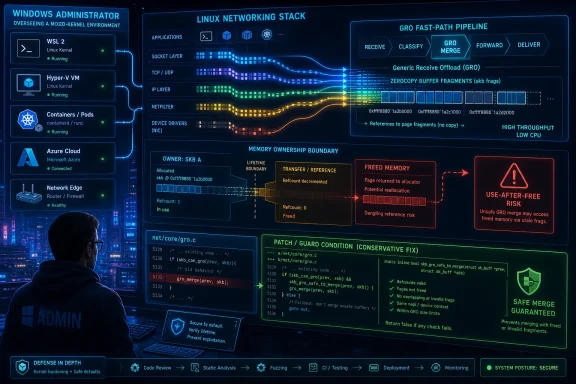 The Kernel Bug Is Small, but the Boundary It Crosses Is Not
At first glance, CVE-2026-46323 looks like the kind of Linux CVE that gets lost in the daily flood: a terse kernel.org description, no NVD CVSS score yet, and a commit subject that reads more like a maintainer note than a public warning. “net: gro: don’t merge zcopy skbs” is not exactly Heartbleed branding. But in kernel security, the boring names are often where the interesting engineering lives.The vulnerability sits in the Linux networking stack’s Generic Receive Offload path, usually abbreviated as GRO. GRO is one of those subsystems most users never see, but every high-throughput network path quietly benefits from it. Instead of forcing the kernel and upper layers to process every incoming packet as a separate unit, GRO coalesces related packets into larger buffers, reducing overhead and improving throughput.
The problem identified in CVE-2026-46323 is that
skb_gro_receive() could copy fragment descriptors between socket buffers without checking whether either buffer was using zerocopy-managed fragments. In ordinary English, the kernel could treat a piece of packet memory as if it had conventional page references when, under zerocopy rules, the buffer did not own those pages in the same way. That mismatch can lead to a use-after-free.That is the kernel equivalent of handing someone a key after the lease has expired. The pointer still looks valid, the data structure still has the right shape, and the fast path still wants to avoid extra work. But ownership has already shifted, and once ownership is wrong in kernel memory, reliability and security become the same problem wearing different badges.
GRO Exists Because the Network Stack Cannot Afford Purity
The Linux network stack is a long-running compromise between clean abstractions and brutal packet economics. Every packet that arrives has to be represented, classified, routed, filtered, copied, passed upward, or dropped. At scale, even small per-packet costs become real CPU time, real latency, and real money.That is why GRO exists. It lets the kernel merge compatible packet buffers before they move further up the stack, amortizing work that would otherwise happen repeatedly. For servers, virtual machines, container hosts, and storage systems, these optimizations are not optional niceties. They are part of how commodity hardware handles modern traffic volume.
Zerocopy is born of the same pressure. Copying data is expensive; avoiding unnecessary copies is one of the oldest and most productive tricks in systems programming. But zerocopy is not just “faster copy.” It changes the ownership model of memory. The kernel, device, user space, and networking code may all be coordinating around pages whose lifetime has to be tracked precisely.
CVE-2026-46323 appears where those two optimizations overlap. GRO wants to merge buffers. Zerocopy wants to avoid duplicating or re-referencing memory. The bug is that the merge path did not sufficiently respect the zerocopy status of the source or destination buffer, particularly when the
SKBFL_MANAGED_FRAG_REFS flag was involved.The fix is blunt in the best kernel-maintainer sense: if either the GRO destination chain tail or the source socket buffer is zerocopy, do not merge them. Return an error code that prevents the unsafe coalescing path. Performance takes the safer branch; memory ownership wins.
The Three-Line Patch Says More Than the Missing CVSS Score
NVD’s record for CVE-2026-46323 was still in a “Received” state at publication, with no NIST CVSS 4.0, 3.x, or 2.0 score assigned. That absence should not be mistaken for evidence that the flaw is harmless. It means the public enrichment pipeline has not yet translated the kernel advisory into the familiar risk shorthand many scanners and dashboards expect.This is a recurring problem for kernel CVEs. The Linux kernel project now assigns CVEs at a pace that reflects upstream development reality, not the slower rhythm of enterprise vulnerability management. A bug can be fixed across stable branches before many organizations have a severity score, a vendor advisory, or a dashboard rule that properly identifies exposure.
That mismatch creates a practical trap. If your workflow is “wait for NVD to score it,” you may be late. If your workflow is “treat every kernel CVE as urgent,” you will drown. CVE-2026-46323 sits in the uncomfortable middle, where admins need to understand the affected code path and the patch status rather than outsource judgment to a missing number.
The patch metadata is more useful than the empty score field. The stable review mail for the 7.0 branch shows the change as a small addition to
net/core/gro.c, inserted before GRO proceeds with other size and flush checks. The logic checks whether either socket buffer is zerocopy and bails out of the merge if so.That is the kind of fix that lowers exploitability by removing an unsafe state transition, not by papering over a crash after the fact. It does not introduce a complex mitigation framework. It simply refuses to combine buffers when the memory lifetime rules are not compatible.
Use-After-Free Is a Class, Not a Prediction
A use-after-free, or UAF, occurs when software continues to use memory after it has been released or after its ownership has moved elsewhere. In user-space applications, that can mean crashes, data corruption, or code execution. In the kernel, it is more serious because the bug occurs in privileged code that arbitrates the rest of the system.That does not automatically mean CVE-2026-46323 is a universal remote root bug. The public description does not establish a working exploit, a privilege-escalation path, or a remote trigger that should be assumed across all configurations. It describes a memory lifetime flaw in a networking fast path.
The difference matters. Kernel vulnerabilities are often discussed as if “UAF” maps directly to “game over,” but exploitation depends on timing, allocator behavior, reachable code paths, hardening, kernel configuration, workload, and whether an attacker can shape the relevant buffers. A bug can be technically severe and still difficult to exploit in a generic installation.
But the reverse mistake is just as dangerous. A flaw in a networking path can be reachable in more places than a desktop user expects. Virtualized Linux guests, container hosts, Kubernetes nodes, storage appliances, VPN concentrators, and firewall distributions all rely heavily on packet processing. Even if exploitation is non-trivial, the affected code lives in a subsystem that is broadly exercised.
That is why the right response is neither panic nor dismissal. Treat CVE-2026-46323 as a kernel memory safety fix in a performance-sensitive network path, and then ask the operational question: where do you run affected Linux kernels that process untrusted or high-volume network traffic?
The Windows Angle Is WSL, Virtualization, and the Linux You Forgot You Run
For a Windows-only home user, CVE-2026-46323 is unlikely to be the patch that defines the month. But the phrase “Windows-only” has become less useful than it used to be. Microsoft spent the past decade making Linux a first-class guest, workload, and developer environment on Windows.Windows Subsystem for Linux is the obvious starting point. WSL 2 runs a real Linux kernel inside a lightweight virtual machine, and that kernel is serviced separately from the Windows NT kernel. A vulnerability in the upstream Linux kernel does not mean the Windows host kernel is vulnerable, but it can matter inside the WSL environment depending on the Microsoft-provided kernel version and whether the affected code is present.
Hyper-V and Azure broaden the picture. Many Windows administrators manage Linux virtual machines even if their endpoints are Windows desktops. Backup appliances, monitoring collectors, CI runners, container hosts, and security scanners frequently run Linux under the hood. The inventory may say “Windows shop,” while the operational reality says “mixed kernel estate.”
Containers make the distinction sharper. Linux containers share the host Linux kernel. If an affected kernel is running on a container host, the blast radius is not limited to a single container image. The application team may think they own a user-space artifact, while the security team must care about the kernel beneath it.
This is where CVE-2026-46323 becomes a reminder about asset visibility. The right question is not “Do we use Linux?” The right question is “Where do we rely on a Linux kernel that we do not patch through our normal Windows Update muscle memory?”
The Patch Is Conservative Because Performance Optimizations Are Security Debt
The fix for CVE-2026-46323 does not try to make unsafe merging safe by repairing page reference counts in place. It chooses not to merge zerocopy socket buffers in the relevant GRO path. That is a conservative engineering choice, and it is revealing.Performance optimizations often encode assumptions about ownership, lifetime, ordering, and exclusivity. They work because most of the time the fast path is right. Security bugs emerge when an exceptional state takes the fast path anyway.
Here, GRO’s job is to combine buffers. Zerocopy’s job is to avoid unnecessary ownership churn. The vulnerable condition emerges when a buffer with managed fragment references is treated as if fragments can simply be appended elsewhere. The kernel description says that when
SKBFL_MANAGED_FRAG_REFS is set, the socket buffer does not hold a reference on the pages in shinfo->frags. Moving those fragments without fixing the page reference count can produce the use-after-free.The patch essentially says: if the buffer is zerocopy, opt out of this merge. That may cost some aggregation opportunity, but it restores a simple invariant. The code no longer has to reason through a fragile combination of packet coalescing and externally managed page references.
This is the pattern security teams should notice. The safest fix is often the one that removes a clever interaction rather than expanding it. In a mature kernel, avoiding a dangerous optimization can be better than trying to preserve every microbenchmark win.
Stable Branches Matter More Than Mainline Theater
The NVD record lists several kernel.org stable references, which is a signal that the fix was backported rather than left only in the development tree. That matters more to administrators than whether the patch looks dramatic in mainline. Most production Linux systems are not running a bleeding-edge kernel; they are running a distribution-maintained stable or long-term branch.The stable mailing list entry for the 7.0 series shows the patch in a large review batch, not as a standalone spectacle. That is normal kernel hygiene. Security-relevant fixes often travel through the same stable machinery as reliability fixes, driver fixes, and regression repairs.
For enterprise teams, this creates a familiar but annoying mapping problem. The commit hash in a CVE record is not the same thing as a package version in Ubuntu, Debian, Red Hat, SUSE, Oracle Linux, Amazon Linux, Alpine, or a vendor appliance. A scanner may flag the upstream kernel version, while the distribution has backported the patch without changing to a newer upstream release number.
That is why package changelogs and vendor advisories matter. A machine can appear “old” by upstream version while still containing the fix. Conversely, a custom kernel can appear modern while missing a particular stable patch. Kernel version strings are useful clues, not final evidence.
The safest operational approach is to track the vendor kernel package, not just the upstream CVE page. For systems built from upstream stable kernels, the listed stable commits are directly actionable. For distribution kernels, wait for the vendor package metadata or inspect the applied patch set if the system is important enough to justify that work.
The Missing Score Is Now Part of the Story
A few years ago, the absence of an NVD score would have been a temporary footnote. In 2026, it is part of the vulnerability management story. CVE volume has climbed, Linux kernel CVE assignment has become more systematic, and public databases are under pressure to enrich records quickly enough for automated tooling.CVE-2026-46323 is a textbook example of the gap between source-of-truth fixes and downstream risk labels. Kernel.org has described the bug and published stable references. NVD has received the record and included it in the dataset. But the fields many organizations use for triage — CVSS, CWE, affected product matching — may lag or remain sparse at first publication.
That is a dangerous place for dashboards to be authoritative. A “no score” vulnerability can look less urgent than a medium-scored one, even when the underlying subsystem is more relevant to your environment. It can also create false calm in compliance-driven organizations where the SLA clock starts only after severity appears.
The answer is not to abandon NVD. It remains an important aggregator. But security teams need a second gear for fast-moving open-source infrastructure: upstream commit tracking, vendor security feeds, distribution changelogs, and exposure-based triage.
For Windows-centric administrators, this is the same lesson Microsoft taught with out-of-band fixes and cumulative update nuances. The database entry is not the patch. The severity label is not the exploitability analysis. The real work is mapping a defect to deployed code and reachable attack surface.
Exploitability Will Hinge on Reachability, Not Branding
CVE-2026-46323 does not yet have the kind of public exploit narrative that makes a vulnerability instantly legible. There is no catchy name, no logo, no proof-of-concept in the provided record, and no NVD score to anchor the conversation. That makes sober analysis more important.The vulnerable path involves GRO receiving and merging socket buffers, with the problematic condition tied to zerocopy-managed fragments. An attacker would need a way to drive the relevant networking behavior and shape memory state sufficiently to turn incorrect fragment ownership into a useful outcome. That is not the same as merely sending any packet to any Linux machine.
Still, network stack bugs deserve respect because they often sit closer to untrusted input than filesystem or local-only subsystem bugs. Even when exploitation requires local capabilities, container workloads and multi-tenant systems can turn “local” into “attacker-controlled workload on the same host.” In cloud and container environments, that distinction is increasingly thin.
Defenders should therefore avoid two lazy conclusions. The first is “network bug equals remote root.” The second is “no score equals no problem.” The correct middle ground is exposure analysis: identify hosts running affected kernels, prioritize systems handling untrusted network traffic or tenant workloads, and apply vendor kernel updates when available.
For hardened servers, existing mitigations such as kernel address space layout randomization, slab hardening, container isolation, and reduced attack surface may raise the bar. They do not eliminate the need to patch. Memory safety bugs in the kernel are precisely the class of flaws where defense in depth buys time rather than forgiveness.
The Kernel’s CVE Firehose Is a Governance Test
Linux kernel CVEs can frustrate enterprise defenders because they mix many categories of risk under the same identifier format. Some fixes close clear privilege-escalation holes. Others address obscure races, rare hardware paths, or defensive correctness issues. Many are security-relevant because kernel memory corruption is inherently dangerous, even if practical exploitation remains uncertain.CVE-2026-46323 belongs to the wave of highly specific kernel CVEs that force organizations to improve their triage model. A human can read the description and understand that this is a narrow but real memory-lifetime issue. A naive dashboard may see only an unscored CVE with no weakness enumeration and no immediate vendor mapping.
That gap is where bad process lives. If every unscored kernel CVE becomes an emergency, admins burn out and patch windows become chaotic. If unscored kernel CVEs are ignored, the organization eventually misses the one that matters. The only sustainable path is contextual triage.
Kernel patching also needs a different cadence than application patching. Reboot coordination, live patch availability, workload failover, driver compatibility, and appliance vendor support all affect the deployment timeline. A three-line fix can still require a carefully staged maintenance event.
That is why the vulnerability’s simplicity is deceptive. The code change is small; the operational change may not be. The organizations that handle this well are the ones that already know where Linux kernels live, how they are updated, and who owns the reboot decision.
Admins Should Treat This as a Patch-Mapping Exercise
For practical purposes, CVE-2026-46323 should trigger inventory and patch verification rather than a crisis room. Start with Linux systems that process network traffic from untrusted sources, run container workloads, or support multi-user access. Then check whether the kernel stream in use has received the relevant stable fix or a distribution backport.WSL users should check the WSL kernel update channel rather than assuming Windows Update alone tells the whole story. Enterprise-managed WSL environments deserve more attention than hobbyist shells because developer workstations may handle code, credentials, package registries, and internal network access. The risk is not that Windows itself becomes Linux; it is that Linux becomes an unmanaged pocket inside the Windows estate.
For servers, the most important distinction is between self-managed kernels and vendor-managed kernels. If you compile your own stable kernels, the upstream stable references are directly relevant. If you rely on a distribution, your vendor’s security update is the unit of action.
Appliances are the hardest category. Firewalls, NAS devices, SD-WAN boxes, monitoring probes, and embedded Linux products may not expose a conventional package manager. In those cases, the vendor’s firmware cadence matters more than the upstream patch date. If a device processes hostile network traffic and runs Linux, it belongs on the follow-up list.
The Signal Hidden in This CVE Is Memory Ownership
The larger lesson in CVE-2026-46323 is not that GRO is unsafe or zerocopy is reckless. Both are necessary technologies. The lesson is that memory ownership has become one of the defining security boundaries in modern kernels.Old security models emphasized permissions, users, and files. Those still matter, but kernel exploitation often lives in more subtle territory: reference counts, object lifetimes, speculative states, buffer sharing, and cross-subsystem assumptions. Performance code is particularly exposed because it tries to avoid work the safe but slower path would otherwise do.
The
SKBFL_MANAGED_FRAG_REFS flag is a good example of this hidden complexity. It encodes a promise about who is responsible for fragment page references. If another subsystem ignores that promise, the pointer may survive longer than the underlying object. That is the seed of a use-after-free.The patch restores the boundary by refusing to merge zerocopy buffers in this context. It is not glamorous, but it is disciplined. In systems code, discipline often looks like a simple guard condition placed before a clever optimization can run.
For developers, the lesson is to treat ownership metadata as security-sensitive. For administrators, the lesson is to respect small kernel fixes that touch memory lifetime. For security teams, the lesson is to evaluate whether the affected subsystem is reachable in their environment before waiting for a third-party score.
The Few Facts That Should Drive the Patch Queue
CVE-2026-46323 is not a headline-grabbing vulnerability, but it is concrete enough to act on. The record, patch, and affected subsystem point to a narrow technical flaw with familiar operational implications: update kernels, verify backports, and do not confuse missing enrichment with missing risk.- CVE-2026-46323 was published by NVD on June 9, 2026, with kernel.org as the source and no NVD CVSS score assigned at the time of publication.
- The flaw is in the Linux kernel networking stack’s GRO path, where zerocopy socket buffers could be merged without respecting managed fragment reference ownership.
- The security consequence described by kernel.org is a possible use-after-free caused by appending fragments without fixing page reference counts.
- The upstream stable fix prevents GRO merging when either the destination chain buffer or the source buffer is zerocopy.
- Windows administrators should care where Linux kernels exist in their estate, including WSL, Hyper-V guests, Azure workloads, containers, and embedded appliances.
- The right response is vendor-kernel verification and timely patching, not panic based on the word “UAF” or complacency based on the absence of a CVSS score.
net/core/gro.c can matter because the Linux fast path is quietly carrying part of your business.References
- Primary source: NVD / Linux Kernel
Published: 2026-06-10T01:06:04-07:00
NVD - CVE-2026-46323
 nvd.nist.gov
- Security advisory: MSRC
Published: 2026-06-10T01:06:04-07:00
Original feed URL
Security Update Guide - Microsoft Security Response Center
 msrc.microsoft.com
- Official source: nist.gov
National Vulnerability Database
NIST maintains the National Vulnerability Database (NVD), a repository of information on software and hardware flaws that can compromise computer security. This is a key piece of the nation’s cybersecurity infrastructure.www.nist.gov - Related coverage: ubuntu.com
CVE-2026-46333 (ssh-keysign-pwn) Linux kernel vulnerability mitigations | Ubuntu
Mitigations are available for CVE-2026-46333 (ssh-keysign-pwn), a Linux local information disclosure vulnerability. ubuntu.com
- Related coverage: labs.cloudsecurityalliance.org
CSA research note ai vuln discovery velocity disclosure crisis 20260524 csa styled
PDF documentlabs.cloudsecurityalliance.org
