

CVE-2026-47287 is a Microsoft-listed tampering vulnerability in Visual Studio Code, published through the Microsoft Security Response Center on June 9, 2026, affecting the developer toolchain rather than the Windows kernel, and currently framed around confidence in the vulnerability’s existence and available technical detail. The important word is not “tampering” by itself, but where that tampering sits: inside the editor many developers use as their daily operating environment. A flaw in VS Code is rarely just an editor bug; it is a potential pressure point in source code, secrets, extensions, build tasks, remote workspaces, and the increasingly automated AI-assisted development loop. Microsoft’s sparse public language leaves defenders with an uncomfortable but familiar Patch Tuesday problem: act before the exploit narrative is fully written.
Microsoft’s Security Update Guide entry for CVE-2026-47287 identifies the issue as a Visual Studio Code tampering vulnerability. That classification matters because tampering sits in a different psychological bucket from the bugs that usually grab headlines. Remote code execution sounds dramatic. Elevation of privilege sounds operationally urgent. Tampering sounds almost administrative, as if someone changed a setting they should not have touched.
That reading is too soft. In a developer tool, tampering can mean interference with code, configuration, extension behavior, workspace trust boundaries, update flow, build output, or files that later move into production. Even when a tampering flaw does not directly hand an attacker a shell, it can corrupt the assumptions that developers and CI systems rely on.
The user-supplied MSRC language focuses on confidence: how certain the vulnerability is, how credible the available technical details are, and how much technical knowledge would-be attackers may already have. That is a revealing framing. Microsoft is not merely saying “there is a bug.” It is placing the bug inside the broader risk discipline of evidence, exploitability, and attacker learning curve.
For administrators, that distinction is practical. A vulnerability confirmed by the vendor, even with limited technical detail, deserves different treatment from a rumor circulating in a GitHub issue or a proof-of-concept repository with unclear provenance. CVE-2026-47287 has crossed the line into vendor acknowledgement. The missing details are not a reason to ignore it; they are a reason to reduce exposure before the details become common knowledge.
That is why a VS Code vulnerability has a bigger blast radius than an old-fashioned editor bug. The application sits close to source repositories, credentials, cloud tokens, SSH keys, environment files, local services, container sockets, private package feeds, and corporate code review workflows. It is also heavily extended, which means its effective behavior is often a mix of Microsoft code, open-source extensions, marketplace packages, workspace settings, and user-specific automation.
The modern developer workstation is not a clean endpoint with a browser and Office installed. It is a production-adjacent system that frequently holds the ingredients required to ship software. If an attacker can alter how that workstation interprets, runs, signs, previews, or publishes code, the target is no longer just the developer’s laptop. The target is the software supply chain behind it.
That is the core risk of CVE-2026-47287. Until Microsoft publishes richer exploit conditions, nobody outside the reporting chain should pretend to know the exact path. But the product context is enough to justify urgency. VS Code is a trusted intermediary in too many workflows for tampering to be treated as cosmetic.
Tampering vulnerabilities belong to that second category. They are about integrity rather than availability or confidentiality. In plain English, the question is whether an attacker can cause something to be modified, substituted, misrepresented, or accepted as trustworthy when it should not be.
In VS Code, integrity has many layers. A workspace can define tasks. Extensions can contribute commands and views. Settings can alter how files are formatted, linted, built, tested, or previewed. Remote development features can blur the boundary between local UI and remote execution. AI coding tools can introduce another layer of automation where the editor becomes both interface and decision amplifier.
That is why the “tampering” label should make enterprise defenders think beyond the local install. The concern is not only whether a developer’s machine is compromised. It is whether a trusted development action can be influenced in a way that survives into a commit, package, container image, deployment script, or production configuration.
At one end of the spectrum, a vulnerability may be little more than a public claim. At the other, the vendor has acknowledged it, assigned a CVE, shipped a fix, and described exploitation requirements. Between those poles sits the dangerous middle: enough information for defenders to know something is real, but not enough to model the exploit with precision.
CVE-2026-47287 appears to live in that uncomfortable middle for public readers. Microsoft’s acknowledgement gives the vulnerability credibility. The public page, however, does not offer the kind of plain-language exploit story that would let every admin immediately sort it into “internet-facing emergency” or “routine desktop patch.”
That gap matters because attackers and defenders do not consume advisories the same way. Defenders often wait for complete detail so they can justify maintenance windows. Attackers look for product class, impact type, patch diff clues, and adjacent research. By the time the clean exploit narrative exists, the best defensive window may already have narrowed.
A developer workstation often has access that ordinary endpoints do not. It may authenticate to GitHub, Azure DevOps, npm, PyPI, NuGet, container registries, Kubernetes clusters, internal APIs, signing systems, staging environments, and production observability tools. Even when formal production access is restricted, the workstation frequently contains enough code, secrets, and trust relationships to support lateral movement.
VS Code sits at the center of that environment. It opens untrusted repositories. It renders Markdown. It launches terminals. It runs debug sessions. It uses extensions that may themselves have broad filesystem and process access. It connects to remote machines and containers. It is exactly the kind of tool where a seemingly local flaw can become an organizational problem.
Security teams should therefore treat CVE-2026-47287 as a developer-infrastructure issue, not merely an application patch. The question is not “How many users have VS Code?” The question is “Which users have VS Code plus access to systems or secrets that would matter if their editor workflow were manipulated?”
That diversity creates inventory drag. A Windows admin may know which laptops have Visual Studio Code installed through winget, Intune, Configuration Manager, or another endpoint platform. They may not know which systems have user-scoped installs, archived portable copies, extension hosts running in remote environments, or stale builds inside disposable developer images.
The vulnerability management challenge is also cultural. Developers are rightly sensitive to forced updates that break extensions, language servers, or debugging flows. But that friction cannot become an excuse for leaving a trusted coding surface exposed after a vendor-confirmed vulnerability.
Organizations need a different posture for IDE security. Instead of treating editor updates as personal preference, they should define a minimum acceptable version, enforce it where possible, and monitor drift where enforcement would be counterproductive. The development environment is part of the production pipeline now. It deserves production-grade hygiene.
This is not an argument against extensions. It is an argument against pretending they are harmless decorations. Extensions often parse untrusted files, run commands, read configuration, start local servers, render webviews, and communicate with external services. In a tampering scenario, those behaviors may influence what can be modified, hidden, trusted, or triggered.
The larger industry has already seen how IDE extensions can become supply-chain targets. Malicious packages, compromised maintainers, lookalike extensions, overbroad permissions, and vulnerable preview features all fit the same pattern: the developer environment is attractive because it is trusted and noisy. There is always another plugin, another workspace prompt, another task definition, another notification.
CVE-2026-47287 should push teams to revisit extension governance. The goal is not to ban useful tools. The goal is to know which extensions are approved, which are abandoned, which have dangerous capabilities, and which are installed across high-value developer populations.
This is especially true for developer tooling because asset databases often miss user-installed software. VS Code can be installed per user. It can be updated outside the normal Windows servicing channel. It may exist in multiple channels or on non-Windows machines outside the direct scope of a Windows admin team.
The right response starts with inventory, but it cannot end there. Teams should validate that VS Code update mechanisms are functioning, check whether endpoint controls block or delay updates, and identify systems where developers intentionally pin versions. They should also look at golden images, cloud dev boxes, and containers that may preserve old editor components or server-side VS Code pieces.
The boring work is the security work. A tampering CVE in a ubiquitous developer tool is exactly the kind of event where the fastest responders are not the teams with the loudest alerting platform. They are the teams that already know what they own.
That is not inherently irresponsible. Coordinated disclosure often begins with constrained language, especially when the vulnerability affects a widely deployed product. The problem is that constrained language shifts work onto customers. Security teams must infer urgency from product, impact, exploitability metrics, update availability, and their own exposure.
For a consumer application, that may be acceptable. For a developer platform used across enterprises, sparse wording has a higher operational cost. Admins need to know whether opening a malicious repository matters, whether extensions are involved, whether user interaction is required, whether remote workspaces change the calculus, and whether Windows-only environments differ from cross-platform deployments.
Until those details are public, the safest interpretation is conservative. Patch first. Then refine the threat model as Microsoft, NVD, researchers, or incident responders publish more. Waiting for perfect information is a strategy, but it is rarely a good one when the affected product is embedded in the software delivery chain.
A Windows estate is no longer defined only by Windows Update. It includes Microsoft Store apps, winget packages, Office click-to-run, browser components, developer tools, WSL distributions, container runtimes, and cloud-connected agents. VS Code often arrives through one of these side doors, and it may update through its own mechanism rather than the channel administrators watch most closely.
That means Windows admins need to treat VS Code as part of endpoint security baselining. If Intune, Defender for Endpoint, Configuration Manager, third-party patching, or software inventory tools can report VS Code versions, those reports should be used. If they cannot, this CVE is a good reason to fix that blind spot.
The practical message is simple: do not wait for a Windows cumulative update to solve a VS Code problem. Check the editor itself, the installation channel, and the update status. If developers use Remote - SSH, Dev Containers, WSL, or Codespaces-like workflows, include those environments in the review rather than assuming the local desktop is the whole story.
That does not mean CVE-2026-47287 is an AI vulnerability. Public information does not support that claim. But the broader context matters because AI coding assistants make editor integrity more valuable. If a development environment can be tampered with, the user may not notice subtle changes in generated code, configuration, prompts, workspace context, or command suggestions.
AI also increases the amount of trust developers place in the tool surface. A prompt result, code action, or automated fix may be accepted quickly because it appears inside a familiar editor. Security controls built around human review become weaker when the pace of code generation accelerates and when the provenance of a suggestion is hard to inspect.
For enterprises adopting AI development tools, CVE-2026-47287 is a reminder that the IDE is now part of the AI security boundary. Model governance, data-loss controls, and prompt policies are incomplete if the local editor surface can be manipulated underneath them.
Opening untrusted repositories should be treated with caution, especially in environments where workspace settings, tasks, or extension recommendations can influence behavior. Developers should avoid running commands, accepting workspace trust prompts, or installing recommended extensions from unfamiliar projects without scrutiny. Security teams should reinforce that advice without turning it into theater.
Organizations with mature endpoint detection should also watch for suspicious editor-adjacent behavior. Unexpected changes to VS Code settings, unusual extension installations, unexplained command execution from the editor process tree, new local servers, and suspicious access to secrets files are all worth attention. None of those observations proves exploitation of CVE-2026-47287, but they are sensible signals in the affected neighborhood.
The key is to avoid both extremes. There is no public basis to panic or claim mass exploitation. There is also no good reason to postpone remediation simply because the advisory is not rich in exploit detail.
That dynamic is particularly relevant for VS Code because its ecosystem is visible, scriptable, and familiar to the people most capable of reverse-engineering a fix. Once update packages, commits, or behavioral changes are compared, the public understanding of a vulnerability can sharpen quickly. A vague tampering advisory can become a concrete attack chain in days or weeks.
This does not mean every CVE becomes weaponized. Most do not. But the attacker economics are different when the affected product is a popular developer tool with access to valuable code and credentials. Even a moderately reliable exploit path may be attractive if it can be delivered through a repository, extension, preview, or social-engineered development workflow.
That is why the best patch window is the boring one: before the conference talk, before the proof of concept, before the exploit scanner, before the social media thread that turns the advisory into a recipe. CVE-2026-47287 is most manageable while it is still mostly an update-management problem.
That perimeter is messy. It includes user settings, extensions, workspace trust, package scripts, Git hooks, local terminals, remote tunnels, containers, secrets stores, and AI assistants. It spans Windows desktops and Linux containers, corporate laptops and cloud-hosted dev environments. VS Code is often the connective tissue.
A tampering vulnerability in that connective tissue is not automatically catastrophic. But it is strategically important. It attacks confidence in the thing developers use to decide what is real: the files they see, the commands they run, the warnings they trust, and the code they ship.
For defenders, the lesson is to stop treating IDE security as a niche developer preference. It belongs in vulnerability management, endpoint hardening, software supply-chain governance, and incident response planning. CVE-2026-47287 is a single entry in Microsoft’s guide, but it points to a much larger architectural truth.
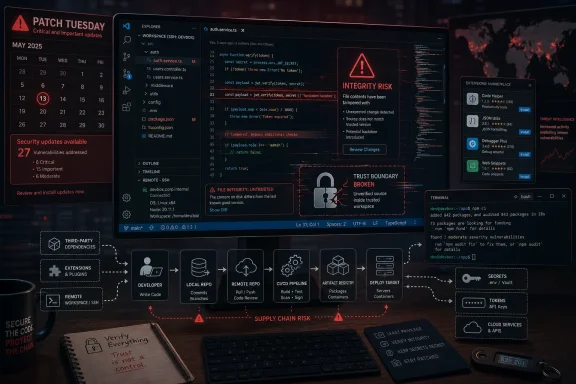 Microsoft’s Quiet Wording Still Carries a Loud Signal
Microsoft’s Security Update Guide entry for CVE-2026-47287 identifies the issue as a Visual Studio Code tampering vulnerability. That classification matters because tampering sits in a different psychological bucket from the bugs that usually grab headlines. Remote code execution sounds dramatic. Elevation of privilege sounds operationally urgent. Tampering sounds almost administrative, as if someone changed a setting they should not have touched.That reading is too soft. In a developer tool, tampering can mean interference with code, configuration, extension behavior, workspace trust boundaries, update flow, build output, or files that later move into production. Even when a tampering flaw does not directly hand an attacker a shell, it can corrupt the assumptions that developers and CI systems rely on.
The user-supplied MSRC language focuses on confidence: how certain the vulnerability is, how credible the available technical details are, and how much technical knowledge would-be attackers may already have. That is a revealing framing. Microsoft is not merely saying “there is a bug.” It is placing the bug inside the broader risk discipline of evidence, exploitability, and attacker learning curve.
For administrators, that distinction is practical. A vulnerability confirmed by the vendor, even with limited technical detail, deserves different treatment from a rumor circulating in a GitHub issue or a proof-of-concept repository with unclear provenance. CVE-2026-47287 has crossed the line into vendor acknowledgement. The missing details are not a reason to ignore it; they are a reason to reduce exposure before the details become common knowledge.
VS Code Has Become a Workbench, Not a Text Editor
Visual Studio Code’s security importance is easy to underestimate because it still looks, at first glance, like a lightweight editor. That mental model is obsolete. For many developers, VS Code is a shell, package manager front end, Git client, debugger, terminal host, extension runtime, remote development portal, notebook environment, container console, and AI assistant surface.That is why a VS Code vulnerability has a bigger blast radius than an old-fashioned editor bug. The application sits close to source repositories, credentials, cloud tokens, SSH keys, environment files, local services, container sockets, private package feeds, and corporate code review workflows. It is also heavily extended, which means its effective behavior is often a mix of Microsoft code, open-source extensions, marketplace packages, workspace settings, and user-specific automation.
The modern developer workstation is not a clean endpoint with a browser and Office installed. It is a production-adjacent system that frequently holds the ingredients required to ship software. If an attacker can alter how that workstation interprets, runs, signs, previews, or publishes code, the target is no longer just the developer’s laptop. The target is the software supply chain behind it.
That is the core risk of CVE-2026-47287. Until Microsoft publishes richer exploit conditions, nobody outside the reporting chain should pretend to know the exact path. But the product context is enough to justify urgency. VS Code is a trusted intermediary in too many workflows for tampering to be treated as cosmetic.
Tampering Is the Security Category Built for Supply-Chain Anxiety
Security teams often prioritize vulnerabilities by asking whether they lead to remote code execution. That bias is understandable, but it can be misleading in developer tooling. The most damaging compromise is not always the one that immediately executes malware; sometimes it is the one that subtly changes what trusted people and systems produce.Tampering vulnerabilities belong to that second category. They are about integrity rather than availability or confidentiality. In plain English, the question is whether an attacker can cause something to be modified, substituted, misrepresented, or accepted as trustworthy when it should not be.
In VS Code, integrity has many layers. A workspace can define tasks. Extensions can contribute commands and views. Settings can alter how files are formatted, linted, built, tested, or previewed. Remote development features can blur the boundary between local UI and remote execution. AI coding tools can introduce another layer of automation where the editor becomes both interface and decision amplifier.
That is why the “tampering” label should make enterprise defenders think beyond the local install. The concern is not only whether a developer’s machine is compromised. It is whether a trusted development action can be influenced in a way that survives into a commit, package, container image, deployment script, or production configuration.
The Confidence Metric Is a Warning About the Information Race
The text supplied with the CVE points to a metric that measures confidence in the existence of the vulnerability and the credibility of known technical details. This is the quiet machinery behind vulnerability management. Not every CVE arrives with the same evidentiary weight, and not every advisory tells defenders how close attackers are to weaponization.At one end of the spectrum, a vulnerability may be little more than a public claim. At the other, the vendor has acknowledged it, assigned a CVE, shipped a fix, and described exploitation requirements. Between those poles sits the dangerous middle: enough information for defenders to know something is real, but not enough to model the exploit with precision.
CVE-2026-47287 appears to live in that uncomfortable middle for public readers. Microsoft’s acknowledgement gives the vulnerability credibility. The public page, however, does not offer the kind of plain-language exploit story that would let every admin immediately sort it into “internet-facing emergency” or “routine desktop patch.”
That gap matters because attackers and defenders do not consume advisories the same way. Defenders often wait for complete detail so they can justify maintenance windows. Attackers look for product class, impact type, patch diff clues, and adjacent research. By the time the clean exploit narrative exists, the best defensive window may already have narrowed.
Developer Machines Are Now Privileged Infrastructure
Enterprise security has spent years learning that identity systems, VPN concentrators, hypervisors, and email servers deserve emergency treatment. Developer endpoints have not always received the same respect. They should.A developer workstation often has access that ordinary endpoints do not. It may authenticate to GitHub, Azure DevOps, npm, PyPI, NuGet, container registries, Kubernetes clusters, internal APIs, signing systems, staging environments, and production observability tools. Even when formal production access is restricted, the workstation frequently contains enough code, secrets, and trust relationships to support lateral movement.
VS Code sits at the center of that environment. It opens untrusted repositories. It renders Markdown. It launches terminals. It runs debug sessions. It uses extensions that may themselves have broad filesystem and process access. It connects to remote machines and containers. It is exactly the kind of tool where a seemingly local flaw can become an organizational problem.
Security teams should therefore treat CVE-2026-47287 as a developer-infrastructure issue, not merely an application patch. The question is not “How many users have VS Code?” The question is “Which users have VS Code plus access to systems or secrets that would matter if their editor workflow were manipulated?”
Patch Tuesday Logic Breaks Down at the Edge of the IDE
Traditional patch management works best when assets are standardized and centrally controlled. Developer tools resist that neatness. Engineers install Insiders builds, portable builds, marketplace extensions, command-line helpers, remote server components, and language-specific toolchains. They may run VS Code on Windows, macOS, Linux, WSL, dev containers, cloud workstations, and browser-hosted environments.That diversity creates inventory drag. A Windows admin may know which laptops have Visual Studio Code installed through winget, Intune, Configuration Manager, or another endpoint platform. They may not know which systems have user-scoped installs, archived portable copies, extension hosts running in remote environments, or stale builds inside disposable developer images.
The vulnerability management challenge is also cultural. Developers are rightly sensitive to forced updates that break extensions, language servers, or debugging flows. But that friction cannot become an excuse for leaving a trusted coding surface exposed after a vendor-confirmed vulnerability.
Organizations need a different posture for IDE security. Instead of treating editor updates as personal preference, they should define a minimum acceptable version, enforce it where possible, and monitor drift where enforcement would be counterproductive. The development environment is part of the production pipeline now. It deserves production-grade hygiene.
The Extension Ecosystem Makes Every VS Code Bug Harder to Reason About
Even when a vulnerability is in VS Code itself, extensions complicate the risk model. The editor’s power comes from its ecosystem, and that ecosystem expands the number of paths through which a flaw might become useful. A workspace opened with no extensions enabled is a different security object from a workspace surrounded by language servers, previewers, test runners, AI assistants, database clients, and deployment tools.This is not an argument against extensions. It is an argument against pretending they are harmless decorations. Extensions often parse untrusted files, run commands, read configuration, start local servers, render webviews, and communicate with external services. In a tampering scenario, those behaviors may influence what can be modified, hidden, trusted, or triggered.
The larger industry has already seen how IDE extensions can become supply-chain targets. Malicious packages, compromised maintainers, lookalike extensions, overbroad permissions, and vulnerable preview features all fit the same pattern: the developer environment is attractive because it is trusted and noisy. There is always another plugin, another workspace prompt, another task definition, another notification.
CVE-2026-47287 should push teams to revisit extension governance. The goal is not to ban useful tools. The goal is to know which extensions are approved, which are abandoned, which have dangerous capabilities, and which are installed across high-value developer populations.
Sparse Advisories Reward Teams That Already Know Their Estate
The frustrating thing about early vulnerability advisories is that they expose the difference between mature and immature asset management. If a team knows where VS Code is installed, which versions are present, who has administrative privileges, and which developers touch sensitive repositories, it can respond quickly even without full exploit detail. If it has to begin with “Do we use this?” it has already lost time.This is especially true for developer tooling because asset databases often miss user-installed software. VS Code can be installed per user. It can be updated outside the normal Windows servicing channel. It may exist in multiple channels or on non-Windows machines outside the direct scope of a Windows admin team.
The right response starts with inventory, but it cannot end there. Teams should validate that VS Code update mechanisms are functioning, check whether endpoint controls block or delay updates, and identify systems where developers intentionally pin versions. They should also look at golden images, cloud dev boxes, and containers that may preserve old editor components or server-side VS Code pieces.
The boring work is the security work. A tampering CVE in a ubiquitous developer tool is exactly the kind of event where the fastest responders are not the teams with the loudest alerting platform. They are the teams that already know what they own.
Microsoft’s Minimal Disclosure Is Both Necessary and Annoying
There is an old tension in vulnerability disclosure: defenders want enough detail to assess risk, while vendors avoid publishing a roadmap for exploitation before users patch. CVE-2026-47287 sits squarely inside that tension. Microsoft’s public acknowledgement gives administrators a signal, but the limited detail forces them to make decisions under uncertainty.That is not inherently irresponsible. Coordinated disclosure often begins with constrained language, especially when the vulnerability affects a widely deployed product. The problem is that constrained language shifts work onto customers. Security teams must infer urgency from product, impact, exploitability metrics, update availability, and their own exposure.
For a consumer application, that may be acceptable. For a developer platform used across enterprises, sparse wording has a higher operational cost. Admins need to know whether opening a malicious repository matters, whether extensions are involved, whether user interaction is required, whether remote workspaces change the calculus, and whether Windows-only environments differ from cross-platform deployments.
Until those details are public, the safest interpretation is conservative. Patch first. Then refine the threat model as Microsoft, NVD, researchers, or incident responders publish more. Waiting for perfect information is a strategy, but it is rarely a good one when the affected product is embedded in the software delivery chain.
Windows Shops Should Not Mistake “VS Code” for “Not My Patch Tuesday”
Visual Studio Code is cross-platform, open-source in its core distribution model, and updated outside the classic Windows cumulative update pipeline. That can make it feel separate from the Windows security rhythm. For WindowsForum readers, that separation is precisely the trap.A Windows estate is no longer defined only by Windows Update. It includes Microsoft Store apps, winget packages, Office click-to-run, browser components, developer tools, WSL distributions, container runtimes, and cloud-connected agents. VS Code often arrives through one of these side doors, and it may update through its own mechanism rather than the channel administrators watch most closely.
That means Windows admins need to treat VS Code as part of endpoint security baselining. If Intune, Defender for Endpoint, Configuration Manager, third-party patching, or software inventory tools can report VS Code versions, those reports should be used. If they cannot, this CVE is a good reason to fix that blind spot.
The practical message is simple: do not wait for a Windows cumulative update to solve a VS Code problem. Check the editor itself, the installation channel, and the update status. If developers use Remote - SSH, Dev Containers, WSL, or Codespaces-like workflows, include those environments in the review rather than assuming the local desktop is the whole story.
The AI Coding Boom Raises the Stakes for Editor Integrity
There is another reason this vulnerability lands differently in 2026 than it would have five years ago. The editor is no longer just where humans type code. It is increasingly where AI systems suggest, transform, explain, refactor, test, and sometimes execute code-adjacent actions.That does not mean CVE-2026-47287 is an AI vulnerability. Public information does not support that claim. But the broader context matters because AI coding assistants make editor integrity more valuable. If a development environment can be tampered with, the user may not notice subtle changes in generated code, configuration, prompts, workspace context, or command suggestions.
AI also increases the amount of trust developers place in the tool surface. A prompt result, code action, or automated fix may be accepted quickly because it appears inside a familiar editor. Security controls built around human review become weaker when the pace of code generation accelerates and when the provenance of a suggestion is hard to inspect.
For enterprises adopting AI development tools, CVE-2026-47287 is a reminder that the IDE is now part of the AI security boundary. Model governance, data-loss controls, and prompt policies are incomplete if the local editor surface can be manipulated underneath them.
The Practical Response Is Patch, Reduce Trust, and Watch the Workflow
The immediate response should not be dramatic, but it should be disciplined. Update VS Code through the official channel. Confirm the updated version is actually installed. Reopen the application and verify that extensions and remote components are not holding onto stale pieces. Then look at the developer workflows most likely to turn an editor flaw into a broader compromise.Opening untrusted repositories should be treated with caution, especially in environments where workspace settings, tasks, or extension recommendations can influence behavior. Developers should avoid running commands, accepting workspace trust prompts, or installing recommended extensions from unfamiliar projects without scrutiny. Security teams should reinforce that advice without turning it into theater.
Organizations with mature endpoint detection should also watch for suspicious editor-adjacent behavior. Unexpected changes to VS Code settings, unusual extension installations, unexplained command execution from the editor process tree, new local servers, and suspicious access to secrets files are all worth attention. None of those observations proves exploitation of CVE-2026-47287, but they are sensible signals in the affected neighborhood.
The key is to avoid both extremes. There is no public basis to panic or claim mass exploitation. There is also no good reason to postpone remediation simply because the advisory is not rich in exploit detail.
The Narrow Window Before the Patch Diff Becomes the Playbook
Every security update starts a race. Vendors publish fixes. Defenders deploy them. Researchers examine them. Attackers do the same. In open and widely distributed software, the patch itself can become the documentation that the advisory did not provide.That dynamic is particularly relevant for VS Code because its ecosystem is visible, scriptable, and familiar to the people most capable of reverse-engineering a fix. Once update packages, commits, or behavioral changes are compared, the public understanding of a vulnerability can sharpen quickly. A vague tampering advisory can become a concrete attack chain in days or weeks.
This does not mean every CVE becomes weaponized. Most do not. But the attacker economics are different when the affected product is a popular developer tool with access to valuable code and credentials. Even a moderately reliable exploit path may be attractive if it can be delivered through a repository, extension, preview, or social-engineered development workflow.
That is why the best patch window is the boring one: before the conference talk, before the proof of concept, before the exploit scanner, before the social media thread that turns the advisory into a recipe. CVE-2026-47287 is most manageable while it is still mostly an update-management problem.
The Editor Is Now Part of the Security Perimeter
CVE-2026-47287 should push Windows and enterprise teams toward a broader conclusion: the security perimeter has moved into the development workspace. Firewalls, endpoint agents, identity controls, and patch baselines still matter, but they do not fully protect a workflow where trusted code is written, generated, tested, packaged, and shipped through an extensible editor.That perimeter is messy. It includes user settings, extensions, workspace trust, package scripts, Git hooks, local terminals, remote tunnels, containers, secrets stores, and AI assistants. It spans Windows desktops and Linux containers, corporate laptops and cloud-hosted dev environments. VS Code is often the connective tissue.
A tampering vulnerability in that connective tissue is not automatically catastrophic. But it is strategically important. It attacks confidence in the thing developers use to decide what is real: the files they see, the commands they run, the warnings they trust, and the code they ship.
For defenders, the lesson is to stop treating IDE security as a niche developer preference. It belongs in vulnerability management, endpoint hardening, software supply-chain governance, and incident response planning. CVE-2026-47287 is a single entry in Microsoft’s guide, but it points to a much larger architectural truth.
The CVE’s Real Message Is to Inventory the Workshop Before It Burns
The most useful response to CVE-2026-47287 is not a round of alarmist speculation. It is a short, concrete operational push aimed at the editor layer of the software factory. Microsoft has acknowledged the vulnerability; public detail is limited; the affected product is widely used and unusually close to sensitive development assets.- Organizations should update Visual Studio Code through official channels and verify that the patched build is actually running on developer endpoints.
- Security teams should inventory user-scoped, portable, remote, and non-Windows VS Code installations rather than relying only on classic Windows software reports.
- Developers should be cautious with untrusted repositories, workspace trust prompts, recommended extensions, and tasks until more technical detail is available.
- Enterprise administrators should review extension governance because VS Code’s risk profile is inseparable from the extensions and workflows surrounding it.
- Detection teams should watch for suspicious VS Code-adjacent behavior, including unexpected settings changes, unusual child processes, and unexplained access to secrets or source directories.
- Leaders should treat developer workstations as privileged infrastructure because compromise at the IDE layer can become compromise of the software supply chain.
References
- Primary source: MSRC
Published: 2026-06-09T07:00:00-07:00
Security Update Guide - Microsoft Security Response Center
 msrc.microsoft.com
- Related coverage: itpro.com
Millions of developers could be impacted by flaws in Visual Studio Code extensions – here's what you need to know, and how to protect yourself | IT Pro
Three newly discovered flaws in Visual Studio Code (VS Code) extensions enable local file exfiltration and remote code execution, researchers have warned.www.itpro.com - Related coverage: support.bull.com
- Official source: microsoft.com
MSRC - Microsoft Security Response Center
The Microsoft Security Response Center is part of the defender community and on the front line of security response evolution. For over twenty years, we have been engaged with security researchers working to protect customers and the broader ecosystem.www.microsoft.com
- Official source: msrc-ppe.microsoft.com
- Official source: learn.microsoft.com
Security Advisories and Bulletins | Microsoft Learn
learn.microsoft.com
- Related coverage: datacomm.com
- Related coverage: sra.io
- Related coverage: cert.gov.vu
Advisory 118 CVE 2026 21509 Microsoft Office Security Feature Bypass Vulnerability
PDF documentcert.gov.vu
- Related coverage: wiz.io
CVE-2025-47287 Impact, Exploitability, and Mitigation Steps | Wiz
Understand the critical aspects of CVE-2025-47287 with a detailed vulnerability assessment, exploitation potential, affected technologies, and remediation guidance.www.wiz.io - Related coverage: sentinelone.com
CVE-2025-47287: Tornadoweb Tornado DoS Vulnerability
CVE-2025-47287 is a denial of service vulnerability in Tornadoweb Tornado. Learn about its impact, affected versions, and mitigation methods.www.sentinelone.com
- Related coverage: test.osv.dev

OSV - Open Source Vulnerabilities
Comprehensive vulnerability database for your open source projects and dependencies.
test.osv.dev
- Related coverage: helpcenter.threatq.com
