Microsoft disclosed CVE-2026-47643 on June 9, 2026, as an Azure Stack Edge remote code execution vulnerability, assigning it a CVSS 3.1 score of 9.8 and listing Azure Stack Edge as the affected product in its Security Update Guide. That is the plain answer, but it is not the whole story. The more interesting part is what this kind of sparse advisory says about confidence, risk, and the uncomfortable place edge infrastructure now occupies between cloud convenience and data-center exposure. For administrators, the message is simple: treat this as real, treat the details as incomplete, and do not confuse limited public information with limited operational risk.
CVE-2026-47643 lands in the category of security bulletins that give defenders enough to prioritize but not enough to fully model the exploit. Microsoft’s acknowledgement matters because it moves the vulnerability out of the rumor economy and into the realm of vendor-confirmed risk. The affected technology is named, the impact class is named, and the severity score is severe enough to demand action.
But the advisory, at least in its public form, does not appear to provide a rich root-cause narrative. That matters for the “report confidence” metric described in the prompt: confidence in existence is high, while confidence in the fine-grained technical mechanics remains constrained by what Microsoft has chosen to publish. This is a common shape for enterprise vulnerability disclosure, especially where working exploit details could materially help attackers.
That distinction is not academic. A confirmed RCE with few public details is still a confirmed RCE. It simply means defenders have to operate from product exposure, version state, and vendor update guidance rather than from packet signatures or exploit-path certainty.
In other words, this is not a case where the industry is guessing whether the vulnerability exists. Microsoft has put its name on the advisory. The uncertainty is about how, not whether.
That is why this vulnerability should not be mentally filed beside routine “important” patch noise. Azure Stack Edge is not a desktop app whose risk is mostly bounded by whether a user opens a malicious attachment. It is infrastructure, often placed close to operational data, local workloads, Kubernetes, storage endpoints, GPU workloads, and hybrid-cloud control planes.
The “remote code execution” label is also doing real work here. RCE is the class of bug administrators lose sleep over because it can turn an externally reachable service or management path into attacker-controlled execution. When the affected product is an edge appliance, the potential blast radius includes local network trust relationships, stored data, container workloads, and the management assumptions that surround hybrid deployments.
None of that proves widespread exploitability in the wild. It does prove that this is not a vulnerability to leave sitting in the “we’ll get to it next maintenance window” pile without a conscious exception decision.
That hybrid nature makes security more interesting than it is for a conventional cloud service. If a vulnerability exists in a Microsoft-operated cloud control plane, Microsoft can often patch or mitigate it centrally. If the issue lives in software running on customer-managed edge hardware, the customer’s update posture suddenly matters. The appliance may be cloud-connected, but it is still a local asset with local downtime, local network reachability, and local operational constraints.
This is the trade Microsoft has been selling for years: bring cloud capabilities to the edge without forcing every workload to live in a distant region. The benefit is flexibility. The cost is that edge devices inherit both cloud-style complexity and appliance-style patch responsibility.
That cost becomes visible whenever a high-severity vulnerability appears. The question is no longer just “Has Microsoft fixed it?” It becomes “Which devices are in scope, which software versions are running, which sites can tolerate downtime, which workloads will restart, and which network paths make exploitation plausible?”
But the absence of those details does not lower the urgency. In fact, it often raises the importance of basic hygiene because defenders cannot confidently rely on narrow mitigations. If you do not know the vulnerable component, you cannot safely assume that hiding one endpoint, disabling one feature, or filtering one protocol removes the risk.
This is where report confidence should be read carefully. The credibility of the vulnerability’s existence is high because Microsoft disclosed it. The technical confidence available to outside observers is more limited because public details are thin. The operational response should follow the first fact, while security engineering analysis should respect the second.
That means organizations should avoid both extremes. It would be reckless to dismiss the CVE because the advisory is brief. It would also be sloppy to claim knowledge of a precise exploit chain that has not been publicly substantiated.
Microsoft’s own Azure Stack Edge update documentation reflects that reality. Updates can be installed through the Azure portal or the local web UI, and the process assumes the device is healthy before installation begins. Depending on the update path and device state, administrators may need to stage packages, verify software versions, and plan for restart behavior.
That operational friction is why high-confidence vulnerabilities in edge devices can remain exposed longer than security teams would like. The patch is rarely just a patch. It is a change event involving compute workloads, Kubernetes behavior, storage flows, and possibly local users who experience the appliance as part of a larger service rather than as “an Azure product.”
This is where Microsoft’s hybrid story meets the administrator’s calendar. A cloud update can disappear into the service fabric. An edge update has to land in a building, at a site, on hardware that someone depends on.
That matters because an administrator reading about CVE-2026-47643 may want to know only whether there is a patch. The better question is whether every deployed appliance can actually reach the fixed state without preparatory updates, compatibility checks, or planned downtime. In real fleets, especially those distributed across many locations, some devices may be current while others are months or years behind.
The old software problem becomes an edge security problem. Devices that miss several update cycles can turn an urgent patch into a mini-migration. Each skipped release increases the chance that the fix is gated by dependencies, changed Kubernetes behavior, container runtime changes, or other release-note landmines.
For administrators, inventory is not clerical work here. It is the difference between “we patched” and “we discovered that the appliance at the remote site cannot take the patch until we complete three other tasks.”
Microsoft’s recent release notes also show the product’s layered nature. The 2604 release includes Kubernetes-related notes such as encryption at rest for newly created or updated Kubernetes secrets and containerd updates that affect older image formats. These details are not necessarily related to CVE-2026-47643, but they illustrate the point: Azure Stack Edge is a stack, not a single binary.
That stackiness complicates incident response. If a device is suspected of exposure, administrators may need to think beyond applying an update. They may need to review deployed workloads, rotate secrets, inspect local accounts, verify network flows, and confirm that no persistence mechanism survived at the workload layer.
The lesson is not that every CVE becomes a full breach. The lesson is that modern edge platforms blur the line between appliance compromise and workload compromise. Once an attacker can execute code in the wrong place, the rest of the environment decides how bad the day becomes.
High-severity RCEs in enterprise infrastructure attract attention because they offer leverage. Attackers do not need every organization to expose an affected service directly to the internet. They need enough reachable deployments, weak segmentation, reused credentials, poor monitoring, or delayed patch windows to make the research worthwhile.
The timing also matters. CVE publication starts a race. Defenders read the advisory and plan updates; attackers read the same advisory and begin looking for clues in patches, binaries, diffs, logs, and exposed interfaces. Sparse public details may delay commodity exploitation, but they do not stop serious reverse engineering.
This is why the correct posture is not panic. It is acceleration. The longer an affected device remains unpatched after public disclosure, the more the asymmetry shifts away from defenders.
There is a reason vendors do this. Publishing exploit-friendly detail on day one can hand attackers a roadmap, particularly when the vulnerable population will take time to update. For edge products, where patching may involve downtime and dependency chains, that concern is more than theoretical.
Still, defenders pay a price for opacity. Without specifics, they may overpatch, underpatch, or struggle to explain urgency to business owners. “Microsoft says 9.8 RCE” is powerful, but it is not the same as “this service on this interface can be exploited under these conditions.”
The uncomfortable truth is that modern vulnerability disclosure often asks administrators to act before they fully understand. CVE-2026-47643 fits that pattern. Trust the vendor enough to patch; distrust the silence enough to verify your own exposure.
Once the fleet is visible, administrators should determine which devices are affected, which updates are available, and which update paths apply. If a device is behind the minimum supported version for the latest release, the remediation plan needs to include intermediate upgrades rather than a single patch event.
Network exposure deserves the same attention. Management interfaces, local web UI access, PowerShell endpoints, storage endpoints, Kubernetes services, and workload-facing ports should be reviewed with the assumption that unnecessary reachability is a liability. Even if the precise vulnerable component is not public, reducing access to administrative and service surfaces is still useful.
Then comes the harder part: post-patch assurance. For a vulnerability with limited public technical detail, administrators should document what was updated, when, from which version to which version, and what workloads were restarted. If there is later evidence of exploitation, that chronology becomes essential.
That invisibility is dangerous. Edge appliances combine local privileges with cloud management, and they often sit in network positions chosen for convenience rather than strict isolation. A device deployed to solve a data-transfer or latency problem can quietly become a bridge between operational networks, cloud identities, and local application stacks.
This is especially relevant for sites with thin IT staffing. A central team may own the Azure subscription, while a local team handles power, cabling, and occasional reboot requests. In that model, a critical RCE can expose a gap in ownership before it exposes a technical flaw.
CVE-2026-47643 should prompt organizations to ask a more basic question: who is accountable for edge patching when the device is both a cloud resource and a local system? If the answer requires a meeting to discover, the risk is already larger than the CVSS score.
In that crowd, an Azure Stack Edge RCE can be easy to overlook if an organization has only a handful of devices. Desktop and server vulnerabilities dominate dashboards because the asset counts are larger. But risk is not asset count multiplied by headline count. A single edge appliance in a privileged network position may matter more than a thousand low-risk endpoints.
This is where asset criticality must override vulnerability fatigue. If Azure Stack Edge is handling sensitive data, hosting operational workloads, or bridging environments, it deserves priority treatment even if it affects a smaller slice of the estate.
Patch Tuesday has trained the industry to think in batches. Edge security demands a more selective eye.
That should shape communication. A CISO briefing should not imply that exploit code is publicly available unless that is verified. It should also not soften the issue into “unconfirmed” simply because root-cause details are absent. Vendor acknowledgement is the meaningful threshold here.
The correct language is blunt but bounded: Microsoft has confirmed a critical-severity remote code execution vulnerability in Azure Stack Edge; public technical detail is limited; affected organizations should patch or otherwise mitigate according to Microsoft guidance; and compensating controls should focus on reducing reachable attack surface until updates are complete.
That kind of wording avoids both hype and complacency. In vulnerability management, precision is not pedantry. It is how teams make defensible decisions under uncertainty.
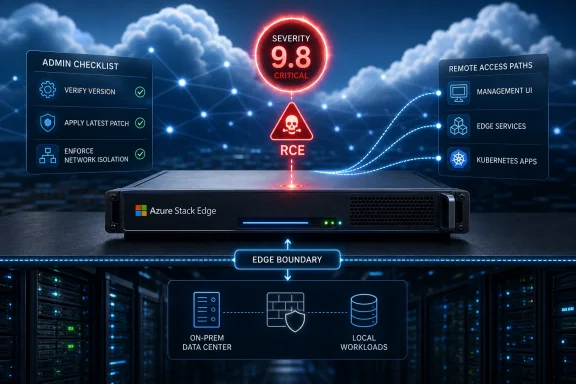 Microsoft Has Confirmed the Vulnerability, Not the Whole Anatomy
CVE-2026-47643 lands in the category of security bulletins that give defenders enough to prioritize but not enough to fully model the exploit. Microsoft’s acknowledgement matters because it moves the vulnerability out of the rumor economy and into the realm of vendor-confirmed risk. The affected technology is named, the impact class is named, and the severity score is severe enough to demand action.But the advisory, at least in its public form, does not appear to provide a rich root-cause narrative. That matters for the “report confidence” metric described in the prompt: confidence in existence is high, while confidence in the fine-grained technical mechanics remains constrained by what Microsoft has chosen to publish. This is a common shape for enterprise vulnerability disclosure, especially where working exploit details could materially help attackers.
That distinction is not academic. A confirmed RCE with few public details is still a confirmed RCE. It simply means defenders have to operate from product exposure, version state, and vendor update guidance rather than from packet signatures or exploit-path certainty.
In other words, this is not a case where the industry is guessing whether the vulnerability exists. Microsoft has put its name on the advisory. The uncertainty is about how, not whether.
A 9.8 Score Is the Part of the Advisory That Does the Talking
The CVSS score attached to CVE-2026-47643 is the loudest signal in the available data. A 9.8 under CVSS 3.1 is the territory of vulnerabilities that can be exploited remotely, require little complexity, require no privileges, and produce high impact across confidentiality, integrity, and availability. Even if every environmental detail will vary from deployment to deployment, that base score is designed to describe the flaw before local controls are considered.That is why this vulnerability should not be mentally filed beside routine “important” patch noise. Azure Stack Edge is not a desktop app whose risk is mostly bounded by whether a user opens a malicious attachment. It is infrastructure, often placed close to operational data, local workloads, Kubernetes, storage endpoints, GPU workloads, and hybrid-cloud control planes.
The “remote code execution” label is also doing real work here. RCE is the class of bug administrators lose sleep over because it can turn an externally reachable service or management path into attacker-controlled execution. When the affected product is an edge appliance, the potential blast radius includes local network trust relationships, stored data, container workloads, and the management assumptions that surround hybrid deployments.
None of that proves widespread exploitability in the wild. It does prove that this is not a vulnerability to leave sitting in the “we’ll get to it next maintenance window” pile without a conscious exception decision.
Azure Stack Edge Is Where Cloud Promises Meet Local Consequences
Azure Stack Edge has always occupied a slightly awkward but strategically important niche in Microsoft’s portfolio. It is a cloud-managed edge appliance for organizations that need Azure services, compute, storage, machine learning, or data movement closer to where data is produced. That can mean factories, branch sites, telecom environments, healthcare facilities, defense-adjacent networks, retail locations, and other places where latency, bandwidth, sovereignty, or intermittency complicate the pure-cloud story.That hybrid nature makes security more interesting than it is for a conventional cloud service. If a vulnerability exists in a Microsoft-operated cloud control plane, Microsoft can often patch or mitigate it centrally. If the issue lives in software running on customer-managed edge hardware, the customer’s update posture suddenly matters. The appliance may be cloud-connected, but it is still a local asset with local downtime, local network reachability, and local operational constraints.
This is the trade Microsoft has been selling for years: bring cloud capabilities to the edge without forcing every workload to live in a distant region. The benefit is flexibility. The cost is that edge devices inherit both cloud-style complexity and appliance-style patch responsibility.
That cost becomes visible whenever a high-severity vulnerability appears. The question is no longer just “Has Microsoft fixed it?” It becomes “Which devices are in scope, which software versions are running, which sites can tolerate downtime, which workloads will restart, and which network paths make exploitation plausible?”
The Sparse Advisory Is a Defensive Problem, Not a Reason to Wait
Security teams often want root-cause detail before acting. That instinct is understandable. Knowing whether a flaw is a deserialization bug, command injection, authentication bypass, memory corruption issue, or management API weakness helps determine exposure and compensating controls.But the absence of those details does not lower the urgency. In fact, it often raises the importance of basic hygiene because defenders cannot confidently rely on narrow mitigations. If you do not know the vulnerable component, you cannot safely assume that hiding one endpoint, disabling one feature, or filtering one protocol removes the risk.
This is where report confidence should be read carefully. The credibility of the vulnerability’s existence is high because Microsoft disclosed it. The technical confidence available to outside observers is more limited because public details are thin. The operational response should follow the first fact, while security engineering analysis should respect the second.
That means organizations should avoid both extremes. It would be reckless to dismiss the CVE because the advisory is brief. It would also be sloppy to claim knowledge of a precise exploit chain that has not been publicly substantiated.
The Edge Appliance Patch Window Is Always Political
For a normal Windows endpoint, security updates are painful but familiar. For edge infrastructure, patching can become a negotiation among IT, operations, application owners, local site managers, and sometimes external customers. Azure Stack Edge devices may host workloads that exist precisely because downtime is expensive or connectivity to the cloud is constrained.Microsoft’s own Azure Stack Edge update documentation reflects that reality. Updates can be installed through the Azure portal or the local web UI, and the process assumes the device is healthy before installation begins. Depending on the update path and device state, administrators may need to stage packages, verify software versions, and plan for restart behavior.
That operational friction is why high-confidence vulnerabilities in edge devices can remain exposed longer than security teams would like. The patch is rarely just a patch. It is a change event involving compute workloads, Kubernetes behavior, storage flows, and possibly local users who experience the appliance as part of a larger service rather than as “an Azure product.”
This is where Microsoft’s hybrid story meets the administrator’s calendar. A cloud update can disappear into the service fabric. An edge update has to land in a building, at a site, on hardware that someone depends on.
Version Paths Matter More Than the CVE Headline
One of the subtler risks with Azure Stack Edge is that the “latest update” is not always one hop away. Microsoft’s release notes for recent versions describe minimum version requirements and supported update paths. For example, the 2604 release maps to software version 3.3.2604.3097 and requires devices to be running 2510 or later before applying it, with older devices needing intermediate steps.That matters because an administrator reading about CVE-2026-47643 may want to know only whether there is a patch. The better question is whether every deployed appliance can actually reach the fixed state without preparatory updates, compatibility checks, or planned downtime. In real fleets, especially those distributed across many locations, some devices may be current while others are months or years behind.
The old software problem becomes an edge security problem. Devices that miss several update cycles can turn an urgent patch into a mini-migration. Each skipped release increases the chance that the fix is gated by dependencies, changed Kubernetes behavior, container runtime changes, or other release-note landmines.
For administrators, inventory is not clerical work here. It is the difference between “we patched” and “we discovered that the appliance at the remote site cannot take the patch until we complete three other tasks.”
Kubernetes and IoT Edge Make the Blast Radius Harder to Reason About
Azure Stack Edge is not merely a storage box. Depending on configuration, it can run Kubernetes workloads, virtual machines, IoT Edge components, and local data services. That makes a remote code execution vulnerability more concerning because successful exploitation may intersect with workloads that have their own secrets, service accounts, mounted shares, and network paths.Microsoft’s recent release notes also show the product’s layered nature. The 2604 release includes Kubernetes-related notes such as encryption at rest for newly created or updated Kubernetes secrets and containerd updates that affect older image formats. These details are not necessarily related to CVE-2026-47643, but they illustrate the point: Azure Stack Edge is a stack, not a single binary.
That stackiness complicates incident response. If a device is suspected of exposure, administrators may need to think beyond applying an update. They may need to review deployed workloads, rotate secrets, inspect local accounts, verify network flows, and confirm that no persistence mechanism survived at the workload layer.
The lesson is not that every CVE becomes a full breach. The lesson is that modern edge platforms blur the line between appliance compromise and workload compromise. Once an attacker can execute code in the wrong place, the rest of the environment decides how bad the day becomes.
“No Known Exploitation” Would Not Be a Comfort Blanket
At the time of writing, public reporting around CVE-2026-47643 appears sparse, and the advisory does not appear to have the kind of widely discussed exploit narrative that accompanies headline-grabbing zero-days. That is good news only in the narrowest sense. The absence of public exploitation reports is not evidence that exploitation is impossible, nor is it a promise that exploit development will be slow.High-severity RCEs in enterprise infrastructure attract attention because they offer leverage. Attackers do not need every organization to expose an affected service directly to the internet. They need enough reachable deployments, weak segmentation, reused credentials, poor monitoring, or delayed patch windows to make the research worthwhile.
The timing also matters. CVE publication starts a race. Defenders read the advisory and plan updates; attackers read the same advisory and begin looking for clues in patches, binaries, diffs, logs, and exposed interfaces. Sparse public details may delay commodity exploitation, but they do not stop serious reverse engineering.
This is why the correct posture is not panic. It is acceleration. The longer an affected device remains unpatched after public disclosure, the more the asymmetry shifts away from defenders.
Microsoft’s Disclosure Style Protects Users and Frustrates Defenders
Microsoft’s Security Update Guide has become a machine for vulnerability disclosure: standardized, searchable, and regular. Its consistency is useful for patch management at scale, but its terseness can frustrate defenders who want context. A CVE page may tell you severity, affected product, impact, and remediation state while leaving out the narrative that would help a security engineer understand the exploit path.There is a reason vendors do this. Publishing exploit-friendly detail on day one can hand attackers a roadmap, particularly when the vulnerable population will take time to update. For edge products, where patching may involve downtime and dependency chains, that concern is more than theoretical.
Still, defenders pay a price for opacity. Without specifics, they may overpatch, underpatch, or struggle to explain urgency to business owners. “Microsoft says 9.8 RCE” is powerful, but it is not the same as “this service on this interface can be exploited under these conditions.”
The uncomfortable truth is that modern vulnerability disclosure often asks administrators to act before they fully understand. CVE-2026-47643 fits that pattern. Trust the vendor enough to patch; distrust the silence enough to verify your own exposure.
The Practical Response Starts With Exposure, Not Exploit Code
The first operational step is to identify Azure Stack Edge devices and map their software versions. That sounds obvious, but hybrid infrastructure is notorious for falling between teams. Cloud administrators may see the Azure resource. Local infrastructure teams may manage the network. Application teams may own workloads. Security may own the risk register but not the maintenance window.Once the fleet is visible, administrators should determine which devices are affected, which updates are available, and which update paths apply. If a device is behind the minimum supported version for the latest release, the remediation plan needs to include intermediate upgrades rather than a single patch event.
Network exposure deserves the same attention. Management interfaces, local web UI access, PowerShell endpoints, storage endpoints, Kubernetes services, and workload-facing ports should be reviewed with the assumption that unnecessary reachability is a liability. Even if the precise vulnerable component is not public, reducing access to administrative and service surfaces is still useful.
Then comes the harder part: post-patch assurance. For a vulnerability with limited public technical detail, administrators should document what was updated, when, from which version to which version, and what workloads were restarted. If there is later evidence of exploitation, that chronology becomes essential.
The Risk Is Highest Where Edge Became Invisible
The most exposed organizations may not be the ones with the most Azure Stack Edge devices. They may be the ones that stopped thinking of those devices as servers. Appliances tend to become invisible when they work. They sit in racks, move data, host workloads, and appear in dashboards until something breaks.That invisibility is dangerous. Edge appliances combine local privileges with cloud management, and they often sit in network positions chosen for convenience rather than strict isolation. A device deployed to solve a data-transfer or latency problem can quietly become a bridge between operational networks, cloud identities, and local application stacks.
This is especially relevant for sites with thin IT staffing. A central team may own the Azure subscription, while a local team handles power, cabling, and occasional reboot requests. In that model, a critical RCE can expose a gap in ownership before it exposes a technical flaw.
CVE-2026-47643 should prompt organizations to ask a more basic question: who is accountable for edge patching when the device is both a cloud resource and a local system? If the answer requires a meeting to discover, the risk is already larger than the CVSS score.
The June Patch Context Makes Prioritization Harder, Not Easier
CVE-2026-47643 arrived as part of a busy Microsoft security cycle, with reporting indicating that June 2026 Patch Tuesday addressed a large number of flaws, including multiple zero-days. That volume creates triage pressure. Security teams must decide what to patch first, what can wait, and what needs emergency change control.In that crowd, an Azure Stack Edge RCE can be easy to overlook if an organization has only a handful of devices. Desktop and server vulnerabilities dominate dashboards because the asset counts are larger. But risk is not asset count multiplied by headline count. A single edge appliance in a privileged network position may matter more than a thousand low-risk endpoints.
This is where asset criticality must override vulnerability fatigue. If Azure Stack Edge is handling sensitive data, hosting operational workloads, or bridging environments, it deserves priority treatment even if it affects a smaller slice of the estate.
Patch Tuesday has trained the industry to think in batches. Edge security demands a more selective eye.
The Confidence Metric Says “Confirmed,” Even If the Exploit Story Is Unwritten
The report-confidence framing in the prompt is useful because it separates two things that often get muddled. First, there is confidence that a vulnerability exists. Second, there is confidence in the public understanding of the vulnerability’s technical mechanics. CVE-2026-47643 scores high on the first and more cautiously on the second.That should shape communication. A CISO briefing should not imply that exploit code is publicly available unless that is verified. It should also not soften the issue into “unconfirmed” simply because root-cause details are absent. Vendor acknowledgement is the meaningful threshold here.
The correct language is blunt but bounded: Microsoft has confirmed a critical-severity remote code execution vulnerability in Azure Stack Edge; public technical detail is limited; affected organizations should patch or otherwise mitigate according to Microsoft guidance; and compensating controls should focus on reducing reachable attack surface until updates are complete.
That kind of wording avoids both hype and complacency. In vulnerability management, precision is not pedantry. It is how teams make defensible decisions under uncertainty.
The Azure Stack Edge Checklist That Actually Matters
The immediate response to CVE-2026-47643 should be disciplined rather than theatrical. The organizations that fare best will be those that already know where their edge appliances are, what versions they run, and which business processes depend on them.- Organizations should inventory every Azure Stack Edge device and verify its current software version before assuming the fleet is covered.
- Administrators should review Microsoft’s supported update paths because older devices may require intermediate upgrades before they can reach a fixed release.
- Teams should restrict management and service exposure wherever possible while patching is being scheduled or completed.
- Workload owners should prepare for restarts, Kubernetes pod recovery behavior, and any application-specific validation required after the device update.
- Security teams should preserve update timelines, version evidence, and relevant logs in case later threat intelligence changes the incident-response posture.
- Leadership should treat sparse public exploit detail as a reason to move methodically, not as a reason to defer remediation.
References
- Primary source: MSRC
Published: 2026-06-09T07:00:00-07:00
Security Update Guide - Microsoft Security Response Center
 msrc.microsoft.com
- Related coverage: datacomm.com
- Official source: microsoft.com
MSRC - Microsoft Security Response Center
The Microsoft Security Response Center is part of the defender community and on the front line of security response evolution. For over twenty years, we have been engaged with security researchers working to protect customers and the broader ecosystem.www.microsoft.com
- Related coverage: hkcert.org
Microsoft Edge Multiple Vulnerabilities
Multiple vulnerabilities were identified in Microsoft Edge. A remote attacker could exploit some of these vulnerabilities to trigger remote code execution, denial of service condition and sensitive information disclosure on the targeted system.www.hkcert.org - Related coverage: thewindowsupdate.com
- Related coverage: bleepingcomputer.com
Microsoft June 2026 Patch Tuesday fixes 3 zero-day, 200 flaws
Today is Microsoft's June 2026 Patch Tuesday, with security updates for 200 flaws and three publicly disclosed zero-day vulnerabilities.www.bleepingcomputer.com

- Related coverage: hivepro.com
- Security advisory: cisa.gov