

Microsoft’s June 9, 2026 Security Update Guide entry for CVE-2026-47652 identifies a Windows Hyper-V remote code execution vulnerability in Microsoft’s virtualization stack, with the vendor’s own advisory serving as the authoritative confirmation that the flaw exists and has been assigned a patch-trackable CVE. That makes the vulnerability more than rumor, but less than a fully public exploit story. The interesting part is not merely that Hyper-V has another RCE on the books; it is that Microsoft’s scoring language tells defenders how much to trust the advisory while revealing very little about the bug itself. In vulnerability management, that gap between confirmed existence and withheld mechanics is where real patch decisions are made.
The phrase “Windows Hyper-V Remote Code Execution Vulnerability” carries a particular weight in enterprise Windows shops. Hyper-V is not a desktop accessory in the environments where it matters most; it is a boundary, a consolidation layer, a development substrate, a VDI platform, and in many Windows Server deployments, part of the machinery that keeps workloads separated from one another.
CVE-2026-47652 appears in Microsoft’s Security Update Guide as a vendor-recognized vulnerability. That is the first and most important fact for administrators. Microsoft is not merely relaying third-party speculation or reserving an identifier for a theoretical weakness; it has published an advisory under its own security response process.
But the public entry, as is often the case with Microsoft Patch Tuesday disclosures, does not necessarily hand defenders a neat root-cause narrative. The user-facing CVE title gives the affected component family and impact class, while the scoring fields communicate severity, exploitation assumptions, remediation status, and confidence. Those fields are not decorative metadata. They are the compressed language of modern vulnerability triage.
The metric text supplied with this advisory points to Report Confidence, the CVSS measure that tries to answer a deceptively practical question: how sure are we that this vulnerability is real, and how credible are the details we have? In this case, the presence of a Microsoft advisory means defenders should treat the issue as confirmed for operational purposes, even if the underlying bug class, trigger path, and exploit constraints are not publicly spelled out in full.
That distinction matters because a confirmed vulnerability with sparse public detail is still a patching problem. It simply is not yet an incident-response blueprint for attackers to copy and paste.
That does not mean every Hyper-V RCE is automatically a catastrophic guest-to-host escape. Microsoft’s titles are broad, and “remote code execution” can describe different attacker positions depending on the component and vector. Some Hyper-V vulnerabilities historically have required local privileges, guest access, crafted packets, or specific configuration exposure. Others have been more alarming because they touched the trust line between a virtual machine and its host.
The problem for defenders is that the title alone cannot settle which mental model applies. “Windows Hyper-V Remote Code Execution Vulnerability” tells us enough to prioritize the component, but not enough to construct a full attack graph. In the absence of public exploit details, the safe assumption is not panic; it is inventory-driven urgency.
Hyper-V’s footprint is broader than many organizations admit. It may be present on dedicated virtualization hosts, developer workstations running local VMs, Windows Server systems hosting production workloads, lab machines, CI infrastructure, virtualized security tools, and platforms that depend on virtualization-based security. Even when administrators think of Hyper-V as a server feature, parts of the broader Windows virtualization stack can show up in places that are not labeled “hypervisor” on an asset spreadsheet.
That is why Hyper-V advisories tend to be operationally awkward. The systems most affected may not be the ones that look like endpoints, but they also may not be neatly captured by a virtualization team’s patch cycle. The bug belongs to Windows, but the blast radius belongs to infrastructure.
The metric exists because vulnerability information arrives in stages. A researcher may disclose symptoms before root cause is known. A vendor may acknowledge impact while withholding technical details. A public proof of concept may appear before patch quality is understood. Different observers may agree that something bad happens while disagreeing about why it happens.
For CVE-2026-47652, the key point is that Microsoft’s own advisory changes the confidence equation. Administrators do not need to wait for a blog post, a reverse-engineered patch diff, or an exploit demonstration to believe that the vulnerability exists. The vendor has put the issue into the official update pipeline.
At the same time, confidence in existence is not the same as complete knowledge of exploitability. A confirmed vulnerability can still have hidden preconditions. It can require a particular role, feature state, VM configuration, network placement, or guest-host relationship. It can be severe in theory but difficult in practice, or modestly scored but valuable inside a real intrusion chain.
This is where many patch discussions go wrong. One side treats limited public detail as a reason to defer. The other treats an RCE label as proof of imminent compromise. The better reading is more disciplined: Microsoft has confirmed enough to justify remediation, but not enough for outsiders to claim certainty about real-world exploit paths unless Microsoft’s advisory or later research says so.
That frustration is not accidental. Vendors deliberately withhold some technical detail to reduce the value of the advisory as an attacker manual. Once a patch ships, reverse engineers can compare binaries and infer the fix, but the advisory itself usually avoids giving them a head start. The tradeoff is familiar: defenders get enough to patch, but not always enough to explain the risk cleanly to management.
Hyper-V makes that tradeoff sharper. Virtualization bugs are complex, and exploitability often depends on subtle details in device emulation, synthetic drivers, hypercalls, memory handling, and guest-host communication. Publicly describing those mechanics too early may help defenders understand the risk, but it can also help capable adversaries reproduce it.
The result is a kind of forced trust. Enterprises that rely on Microsoft’s platform have to decide whether the vendor’s security classification is enough to move. For CVE-2026-47652, the answer should be yes, with the urgency calibrated by exposure. Hyper-V hosts, systems running untrusted or semi-trusted guest workloads, shared development infrastructure, and externally managed hosting environments should move ahead of ordinary endpoints with dormant virtualization features.
The practical lesson is not that Microsoft should publish exploit recipes. It is that organizations need patch programs mature enough to act on vendor-confirmed but technically sparse advisories. Waiting for perfect clarity is often just waiting for attackers to do the analysis for you.
That is the essential Hyper-V security story. Virtualization creates a promise that one environment can run next to another without becoming it. Cloud providers, enterprise data centers, and lab networks all depend on that promise. When a hypervisor RCE appears, defenders have to ask whether the bug weakens a wall they rely on but rarely inspect.
Even if CVE-2026-47652 does not become a widely exploited VM escape, the category demands attention because virtualization boundaries are high-value. Attackers who already control one workload often want a path to the host, to neighboring workloads, to stored credentials, or to management infrastructure. A hypervisor flaw can be valuable not as an initial entry point, but as the escalation step that turns a contained compromise into a platform event.
That is why vulnerability scanners alone may understate the issue. A scanner can tell you whether a KB is installed. It may not tell you whether the host runs untrusted guests, whether developers import arbitrary VM images, whether nested virtualization is enabled, or whether a backup appliance has privileged visibility into the environment. Those are architectural facts, not just patch facts.
The best Hyper-V response therefore begins with classification. Production clusters hosting mixed-trust workloads should be treated differently from a single-purpose server running a tightly controlled internal VM. Developer machines that routinely execute downloaded images may deserve more urgency than their “non-server” label suggests. Security teams should resist the instinct to rank assets by operating system name alone.
That matters because patch prioritization without feature inventory becomes guesswork. If every Windows machine is treated identically, scarce maintenance windows go to the loudest team rather than the riskiest host. If only the virtualization cluster is considered, developer workstations and lab environments may remain exposed long after production is patched.
Administrators should also remember that Windows feature state and workload state are not the same thing. A machine may have Hyper-V components installed but no active VM workload. Another may not be in the official virtualization cluster but may still host local VMs used for build automation, malware analysis, sandboxing, or testing. The difference changes urgency, but it does not eliminate the need to verify.
For enterprises using centralized update management, the immediate work is straightforward but not trivial. Identify affected Windows versions, map them to available cumulative updates, validate those updates against representative Hyper-V workloads, and stage deployment in a way that does not create avoidable downtime. Hyper-V patching is not just a reboot problem; it is a workload migration, cluster health, backup compatibility, and maintenance coordination problem.
For smaller shops and enthusiasts, the advice is simpler. If you use Hyper-V, install the relevant Windows security update promptly. If you do not knowingly use Hyper-V but have enabled Windows features such as virtualization labs, local test VMs, containers, or security features that depend on virtualization, check your update status rather than assuming the advisory is irrelevant.
Report Confidence helps, but it is still only one part of the picture. A confirmed vulnerability with no known exploitation may rank below an actively exploited lower-score flaw in emergency response. Conversely, a high-impact vulnerability in a critical isolation boundary may deserve rapid remediation even before public exploitation appears. Context is not an excuse to delay; it is the method by which delay stops being random.
For CVE-2026-47652, the context points toward serious but measured action. Microsoft has confirmed the issue. The affected component is security-sensitive. Public technical details appear limited at publication time. That combination argues for prompt patching of Hyper-V systems and close monitoring for advisory revisions, not for sensational claims about active exploitation unless Microsoft or credible researchers provide that evidence.
The most mature security teams will treat the advisory as a change-management trigger and a watch item. They will deploy the update, review logs and health after reboot, watch for revised MSRC metadata, monitor exploit repositories and threat intelligence for credible movement, and update internal risk notes if new exploit conditions become public. The point is to close the known exposure while keeping room for the story to develop.
That is also how WindowsForum readers should read Patch Tuesday coverage more broadly. The first advisory is rarely the final word. Microsoft can revise affected-product tables, exploitation assessments, FAQ language, and mitigation notes after initial publication. A CVE is not a static tombstone; it is a record that can evolve as research, telemetry, and customer feedback arrive.
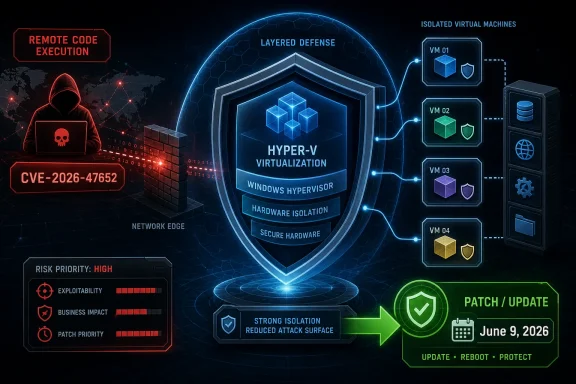 Microsoft Confirms the Bug, but Not the Blueprint
The phrase “Windows Hyper-V Remote Code Execution Vulnerability” carries a particular weight in enterprise Windows shops. Hyper-V is not a desktop accessory in the environments where it matters most; it is a boundary, a consolidation layer, a development substrate, a VDI platform, and in many Windows Server deployments, part of the machinery that keeps workloads separated from one another.CVE-2026-47652 appears in Microsoft’s Security Update Guide as a vendor-recognized vulnerability. That is the first and most important fact for administrators. Microsoft is not merely relaying third-party speculation or reserving an identifier for a theoretical weakness; it has published an advisory under its own security response process.
But the public entry, as is often the case with Microsoft Patch Tuesday disclosures, does not necessarily hand defenders a neat root-cause narrative. The user-facing CVE title gives the affected component family and impact class, while the scoring fields communicate severity, exploitation assumptions, remediation status, and confidence. Those fields are not decorative metadata. They are the compressed language of modern vulnerability triage.
The metric text supplied with this advisory points to Report Confidence, the CVSS measure that tries to answer a deceptively practical question: how sure are we that this vulnerability is real, and how credible are the details we have? In this case, the presence of a Microsoft advisory means defenders should treat the issue as confirmed for operational purposes, even if the underlying bug class, trigger path, and exploit constraints are not publicly spelled out in full.
That distinction matters because a confirmed vulnerability with sparse public detail is still a patching problem. It simply is not yet an incident-response blueprint for attackers to copy and paste.
Hyper-V RCE Is Never Just Another Windows Line Item
Remote code execution in Hyper-V sits in a different mental category from many application-layer bugs. A browser RCE threatens the user context and the device in front of it. A document-parser RCE usually needs a file, a preview path, or a user interaction chain. A hypervisor RCE raises the more uncomfortable possibility of code crossing a virtualization boundary.That does not mean every Hyper-V RCE is automatically a catastrophic guest-to-host escape. Microsoft’s titles are broad, and “remote code execution” can describe different attacker positions depending on the component and vector. Some Hyper-V vulnerabilities historically have required local privileges, guest access, crafted packets, or specific configuration exposure. Others have been more alarming because they touched the trust line between a virtual machine and its host.
The problem for defenders is that the title alone cannot settle which mental model applies. “Windows Hyper-V Remote Code Execution Vulnerability” tells us enough to prioritize the component, but not enough to construct a full attack graph. In the absence of public exploit details, the safe assumption is not panic; it is inventory-driven urgency.
Hyper-V’s footprint is broader than many organizations admit. It may be present on dedicated virtualization hosts, developer workstations running local VMs, Windows Server systems hosting production workloads, lab machines, CI infrastructure, virtualized security tools, and platforms that depend on virtualization-based security. Even when administrators think of Hyper-V as a server feature, parts of the broader Windows virtualization stack can show up in places that are not labeled “hypervisor” on an asset spreadsheet.
That is why Hyper-V advisories tend to be operationally awkward. The systems most affected may not be the ones that look like endpoints, but they also may not be neatly captured by a virtualization team’s patch cycle. The bug belongs to Windows, but the blast radius belongs to infrastructure.
The Confidence Metric Is a Warning Against Two Bad Instincts
Report Confidence is one of the CVSS fields that rarely gets the attention it deserves. Severity scores dominate dashboards because they are easy to sort. Exploitability labels get attention because they hint at whether attackers are already moving. Confidence is quieter, but it is often the field that tells defenders whether they are acting on smoke, a credible report, or a vendor-confirmed fire.The metric exists because vulnerability information arrives in stages. A researcher may disclose symptoms before root cause is known. A vendor may acknowledge impact while withholding technical details. A public proof of concept may appear before patch quality is understood. Different observers may agree that something bad happens while disagreeing about why it happens.
For CVE-2026-47652, the key point is that Microsoft’s own advisory changes the confidence equation. Administrators do not need to wait for a blog post, a reverse-engineered patch diff, or an exploit demonstration to believe that the vulnerability exists. The vendor has put the issue into the official update pipeline.
At the same time, confidence in existence is not the same as complete knowledge of exploitability. A confirmed vulnerability can still have hidden preconditions. It can require a particular role, feature state, VM configuration, network placement, or guest-host relationship. It can be severe in theory but difficult in practice, or modestly scored but valuable inside a real intrusion chain.
This is where many patch discussions go wrong. One side treats limited public detail as a reason to defer. The other treats an RCE label as proof of imminent compromise. The better reading is more disciplined: Microsoft has confirmed enough to justify remediation, but not enough for outsiders to claim certainty about real-world exploit paths unless Microsoft’s advisory or later research says so.
Patch Tuesday Still Runs on Controlled Disclosure
Microsoft’s Security Update Guide is built for scale, not storytelling. On a busy Patch Tuesday, it has to publish machine-readable and human-readable data across Windows, Office, Azure, SQL Server, Exchange, developer tools, and countless shared components. The result is efficient, but often unsatisfying for anyone trying to understand why one vulnerability deserves same-day emergency change control and another can wait for a maintenance window.That frustration is not accidental. Vendors deliberately withhold some technical detail to reduce the value of the advisory as an attacker manual. Once a patch ships, reverse engineers can compare binaries and infer the fix, but the advisory itself usually avoids giving them a head start. The tradeoff is familiar: defenders get enough to patch, but not always enough to explain the risk cleanly to management.
Hyper-V makes that tradeoff sharper. Virtualization bugs are complex, and exploitability often depends on subtle details in device emulation, synthetic drivers, hypercalls, memory handling, and guest-host communication. Publicly describing those mechanics too early may help defenders understand the risk, but it can also help capable adversaries reproduce it.
The result is a kind of forced trust. Enterprises that rely on Microsoft’s platform have to decide whether the vendor’s security classification is enough to move. For CVE-2026-47652, the answer should be yes, with the urgency calibrated by exposure. Hyper-V hosts, systems running untrusted or semi-trusted guest workloads, shared development infrastructure, and externally managed hosting environments should move ahead of ordinary endpoints with dormant virtualization features.
The practical lesson is not that Microsoft should publish exploit recipes. It is that organizations need patch programs mature enough to act on vendor-confirmed but technically sparse advisories. Waiting for perfect clarity is often just waiting for attackers to do the analysis for you.
The Real Boundary Is Trust, Not Network Distance
The “remote” in remote code execution can mislead readers when the affected component is a hypervisor. In many enterprise threat models, the attacker may already have access to a guest VM, a tenant workload, a compromised admin tool, or a development environment. The question is not always whether the internet can directly reach the vulnerable service. It is whether malicious code can reach the vulnerable interface from a lower-trust place.That is the essential Hyper-V security story. Virtualization creates a promise that one environment can run next to another without becoming it. Cloud providers, enterprise data centers, and lab networks all depend on that promise. When a hypervisor RCE appears, defenders have to ask whether the bug weakens a wall they rely on but rarely inspect.
Even if CVE-2026-47652 does not become a widely exploited VM escape, the category demands attention because virtualization boundaries are high-value. Attackers who already control one workload often want a path to the host, to neighboring workloads, to stored credentials, or to management infrastructure. A hypervisor flaw can be valuable not as an initial entry point, but as the escalation step that turns a contained compromise into a platform event.
That is why vulnerability scanners alone may understate the issue. A scanner can tell you whether a KB is installed. It may not tell you whether the host runs untrusted guests, whether developers import arbitrary VM images, whether nested virtualization is enabled, or whether a backup appliance has privileged visibility into the environment. Those are architectural facts, not just patch facts.
The best Hyper-V response therefore begins with classification. Production clusters hosting mixed-trust workloads should be treated differently from a single-purpose server running a tightly controlled internal VM. Developer machines that routinely execute downloaded images may deserve more urgency than their “non-server” label suggests. Security teams should resist the instinct to rank assets by operating system name alone.
Windows Admins Need an Inventory They Can Believe
CVE-2026-47652 is the sort of advisory that exposes weak asset intelligence. Many organizations can list Windows servers. Fewer can quickly list Windows servers with Hyper-V enabled, hosts with active virtual switches, machines running guest workloads from outside the organization, and endpoints using virtualization features for development, testing, or security isolation.That matters because patch prioritization without feature inventory becomes guesswork. If every Windows machine is treated identically, scarce maintenance windows go to the loudest team rather than the riskiest host. If only the virtualization cluster is considered, developer workstations and lab environments may remain exposed long after production is patched.
Administrators should also remember that Windows feature state and workload state are not the same thing. A machine may have Hyper-V components installed but no active VM workload. Another may not be in the official virtualization cluster but may still host local VMs used for build automation, malware analysis, sandboxing, or testing. The difference changes urgency, but it does not eliminate the need to verify.
For enterprises using centralized update management, the immediate work is straightforward but not trivial. Identify affected Windows versions, map them to available cumulative updates, validate those updates against representative Hyper-V workloads, and stage deployment in a way that does not create avoidable downtime. Hyper-V patching is not just a reboot problem; it is a workload migration, cluster health, backup compatibility, and maintenance coordination problem.
For smaller shops and enthusiasts, the advice is simpler. If you use Hyper-V, install the relevant Windows security update promptly. If you do not knowingly use Hyper-V but have enabled Windows features such as virtualization labs, local test VMs, containers, or security features that depend on virtualization, check your update status rather than assuming the advisory is irrelevant.
Severity Scores Should Start the Conversation, Not End It
The industry has trained itself to sort by CVSS, and then wonders why patch prioritization still feels wrong. CVSS is useful, but it is not a business impact model. It does not know which Hyper-V host runs a domain controller lab, which one hosts customer workloads, which one is reachable by contractors, or which one sits under a fragile legacy application that cannot tolerate surprise reboots.Report Confidence helps, but it is still only one part of the picture. A confirmed vulnerability with no known exploitation may rank below an actively exploited lower-score flaw in emergency response. Conversely, a high-impact vulnerability in a critical isolation boundary may deserve rapid remediation even before public exploitation appears. Context is not an excuse to delay; it is the method by which delay stops being random.
For CVE-2026-47652, the context points toward serious but measured action. Microsoft has confirmed the issue. The affected component is security-sensitive. Public technical details appear limited at publication time. That combination argues for prompt patching of Hyper-V systems and close monitoring for advisory revisions, not for sensational claims about active exploitation unless Microsoft or credible researchers provide that evidence.
The most mature security teams will treat the advisory as a change-management trigger and a watch item. They will deploy the update, review logs and health after reboot, watch for revised MSRC metadata, monitor exploit repositories and threat intelligence for credible movement, and update internal risk notes if new exploit conditions become public. The point is to close the known exposure while keeping room for the story to develop.
That is also how WindowsForum readers should read Patch Tuesday coverage more broadly. The first advisory is rarely the final word. Microsoft can revise affected-product tables, exploitation assessments, FAQ language, and mitigation notes after initial publication. A CVE is not a static tombstone; it is a record that can evolve as research, telemetry, and customer feedback arrive.
The Hyper-V Patch Belongs at the Front of the Maintenance Queue
The immediate takeaway from CVE-2026-47652 is not that every Windows system is equally endangered. It is that Hyper-V’s role as an isolation layer gives this advisory a higher operational priority than its sparse public wording might suggest. Defenders should respond to what is confirmed, while being honest about what is still unknown.- Microsoft’s advisory is enough to treat CVE-2026-47652 as a confirmed vulnerability, even if public technical details remain limited.
- Hyper-V hosts that run untrusted, semi-trusted, customer, developer, or frequently changing guest workloads should be patched before low-risk systems with no active virtualization role.
- Administrators should verify Hyper-V exposure through feature and workload inventory rather than relying on server names, team ownership, or assumptions about where virtualization is used.
- Patch testing should include VM start, stop, migration, backup, virtual switch, and cluster-health checks, because virtualization updates can fail operationally even when they install cleanly.
- Security teams should monitor Microsoft’s advisory for revisions after June 9, 2026, because exploitation assessment, affected products, and mitigation guidance can change after initial Patch Tuesday publication.
- Organizations should avoid treating the absence of public exploit code as proof of safety, especially for vulnerabilities in boundary-enforcing components such as hypervisors.
References
- Primary source: MSRC
Published: 2026-06-09T07:00:00-07:00
Security Update Guide - Microsoft Security Response Center
 msrc.microsoft.com
- Related coverage: threats.kaspersky.com
Kaspersky Threats — KLA90878
threats.kaspersky.com
- Official source: microsoft.com
Microsoft Hyper-V Bounty Program | MSRC
www.microsoft.com
- Related coverage: sentinelone.com
CVE-2026-21247: Windows 10 1607 Hyper-V RCE Vulnerability
CVE-2026-21247 is a remote code execution vulnerability in Windows 10 1607 Hyper-V. Learn about its impact, affected versions, and mitigation methods.www.sentinelone.com
- Related coverage: datacomm.com
- Related coverage: bleepingcomputer.com
- Related coverage: rapid7.com
Rapid7 Vulnerability Database
Rapid7's VulnDB is curated repository of vetted computer software exploits and exploitable vulnerabilities.www.rapid7.com - Official source: msrc-ppe.microsoft.com
- Official source: learn.microsoft.com
Security Advisories and Bulletins | Microsoft Learn
learn.microsoft.com - Related coverage: sra.io
