Microsoft’s Security Update Guide entry for CVE-2026-45607 identifies a Windows Hyper-V remote code execution vulnerability, published in the June 2026 Patch Tuesday window, with the practical concern centered on how much administrators can trust the sparse public details while still acting quickly. That is the awkward bargain of modern Windows vulnerability management: the patch often arrives before the story does. For Hyper-V, that gap matters because the affected boundary is not a browser tab or a document parser, but the virtualization layer many organizations treat as infrastructure bedrock.
The key phrase in the advisory is not just “remote code execution.” It is the quieter language around confidence: the metric that measures how certain the industry can be about the vulnerability’s existence and how credible the known technical details are. Microsoft’s acknowledgement moves CVE-2026-45607 out of rumor territory, but the absence of broad public exploit detail means defenders are being asked to prioritize based on vendor confirmation, product criticality, and the blast radius of the affected component rather than on a tidy exploit narrative.
That is not a weakness in the process so much as a reminder of what Patch Tuesday has become. Microsoft now ships risk signals, partial technical summaries, CVSS metadata, exploitability assessments, and product matrices into an ecosystem that wants instant certainty. Hyper-V vulnerabilities expose the limits of that appetite: by the time everyone agrees on the exploit mechanics, the responsible maintenance window may already have passed.
Hyper-V is not just another Windows feature for labs and enthusiasts. It is the hypervisor behind Windows Server virtualization, developer workstations, nested test environments, virtual desktop setups, security features, and cloud-adjacent architectures that borrow the same mental model of isolated compute. A flaw in that layer carries symbolic weight because virtualization is sold as a boundary.
That does not mean every Hyper-V CVE is a guest-to-host catastrophe, and it would be reckless to assume CVE-2026-45607 has that shape without published technical proof. Microsoft’s “Windows Hyper-V Remote Code Execution Vulnerability” naming tells us the impacted component and class of bug, but not the full path from attacker to code execution. The useful security posture is to treat the advisory as real while resisting the temptation to invent missing exploit details.
This is where administrators should separate severity from drama. Remote code execution in a hypervisor-adjacent component deserves fast attention even if exploitation is constrained, authenticated, local-to-guest, dependent on configuration, or otherwise less cinematic than the headline implies. The worst patching mistakes happen when teams wait for a blog post that explains why the bug is scary instead of recognizing that the product boundary itself is already enough reason to move.
For WindowsForum readers, the practical question is not whether Hyper-V is suddenly unsafe. It is whether your organization knows where Hyper-V is actually enabled. Many estates have the role installed on obvious hosts and quietly present on developer machines, lab servers, Windows 11 Pro systems, security tooling boxes, and CI runners. The vulnerability inventory problem often arrives before the vulnerability itself.
At one end of the spectrum, a vendor has reproduced the flaw, shipped a fix, assigned a CVE, and mapped the affected products. At the other, there may be public claims, incomplete crash analysis, or third-party research that points toward a bug without proving exploitability. CVE-2026-45607 is anchored by Microsoft’s advisory, so the vulnerability’s existence should be treated as confirmed for operational purposes. What remains unclear publicly is the exploit path, the exact preconditions, and whether working exploit code is circulating beyond the reporting chain.
That distinction matters because attackers and defenders consume the same ambiguity differently. Defenders need enough certainty to schedule change; attackers need enough detail to reproduce the flaw. A high-confidence vendor acknowledgement with limited public detail can actually be the most uncomfortable middle ground: defenders cannot dismiss it, but attackers may still be in the race to reverse-engineer the patch.
The old model of “wait for proof-of-concept code, then panic” is badly suited to this kind of advisory. In Microsoft’s ecosystem, patches are often the technical disclosure. Once binaries are available, skilled researchers and adversaries can compare old and new code, narrow the changed function, and infer the bug class. The confidence metric is therefore not just about whether the bug exists; it is about how quickly the knowledge gap may close.
For Hyper-V, this nuance is especially important. A vulnerability could involve device emulation, synthetic drivers, virtual networking, saved state parsing, VM bus communication, clipboard or enhanced session integration, or host-side management logic. Each route has a different operational meaning. A flaw reachable from an untrusted guest has a different urgency profile than one reachable only through a privileged management action.
Microsoft’s advisory title alone does not settle that question. That is why administrators should avoid both extremes: do not wave it away because details are thin, and do not claim every Hyper-V host is exposed to unauthenticated internet RCE unless Microsoft says so. The safer middle position is disciplined urgency. Patch the systems where Hyper-V is enabled, validate the update in representative clusters, and watch for revised exploitability guidance.
This is also where CVSS can mislead non-specialists. A score can summarize attack vector, privileges required, user interaction, scope, and impact, but it cannot describe your estate. A lab Hyper-V host running disposable malware samples has a different risk profile from a production virtualization cluster hosting domain controllers, build infrastructure, or privileged administrative jump boxes. The vulnerability is universal; the exposure is local.
A bug in a hypervisor component is rarely just a bug in an application. It raises the possibility that code running in one trust zone can influence another. Even when exploitation is limited, the psychological impact is larger because virtualization is part of how organizations compartmentalize risk. The guest is supposed to be the mess; the host is supposed to be the clean room.
Microsoft has spent years building Windows security features on virtualization-based foundations. Virtualization-based Security, Credential Guard, Hypervisor-Protected Code Integrity, Windows Sandbox, Application Guard-style designs, and developer virtualization workflows all lean on the credibility of isolation. CVE-2026-45607 should not be read as an indictment of those architectures, but it is a reminder that isolation is an engineered system, not a law of physics.
That distinction matters for defenders. Security architecture should assume that isolation boundaries reduce risk, not abolish it. Hyper-V patching therefore belongs in the same category as domain controller patching, VPN appliance patching, and backup infrastructure patching: it protects the platforms that protect everything else.
Production Hyper-V estates create a familiar tension. Clusters can be drained and patched, but not without planning. Guest workloads may have uptime requirements. Firmware, drivers, backup agents, endpoint protection, and management tools may interact badly with cumulative updates. For home lab users, the risk is inconvenience; for enterprises, the risk is an outage that competes with the vulnerability itself.
Still, the answer cannot be indefinite delay. When Microsoft patches a Hyper-V RCE, administrators should assume that reverse engineering begins immediately. The time between update release and exploit comprehension is not fixed, but it is rarely generous. Even if exploitation starts as difficult, public analysis can turn difficult into repeatable.
The right operational stance is staged acceleration. Patch a pilot ring of non-critical Hyper-V hosts first, monitor for regressions, then move through production according to business criticality and exposure. If your organization cannot patch quickly, that fact should become visible as a risk exception rather than hidden inside a vague “testing” bucket.
That does not make every Hyper-V bug internet-exposed. It means network topology alone is a poor comfort blanket. A vulnerability requiring authenticated access can still be serious if attackers commonly obtain low-privilege footholds before escalating. A vulnerability requiring guest interaction can still matter if tenants, developers, contractors, or malware-analysis workflows run untrusted VMs.
The cloud era has also normalized dense privilege concentration. A single virtualization host may carry workloads with wildly different trust assumptions. A developer VM, a build runner, a test domain controller, and a security appliance may coexist because virtualization makes that easy. The convenience of consolidation becomes the danger of shared fate.
For Windows enthusiasts, this should also reframe home labs. The lab box running Hyper-V may also store credentials, browser sessions, backups, source code, and administrative tools. A vulnerability in the virtualization layer is not just a problem for Fortune 500 clusters. It can collapse the tidy mental separation between “that risky VM” and “my real machine.”
The confidence metric described in the MSRC text helps explain why. Urgency rises when the vulnerability is known to exist with certainty. Vendor confirmation provides that certainty even when exploit details remain scarce. Public exploit code would raise the heat further, but waiting for it is like waiting for smoke before replacing faulty wiring.
This does not mean every organization should drop everything instantly. Risk management still has to account for uptime, redundancy, change freezes, compliance windows, and test coverage. But the decision should be explicit: if a Hyper-V host remains unpatched after the update is available, someone should be able to say why, for how long, and what compensating controls are in place.
Compensating controls may include limiting who can create or run VMs, restricting enhanced session features, tightening host management access, isolating untrusted guest networks, reviewing administrative group membership, and monitoring for unusual host-guest interactions. None of these substitutes for the patch. They are ways to reduce the danger while the patch process catches up.
That is why sparse advisories are not as protective as they look. Limited public detail may slow casual exploitation, but it does not freeze capable actors. The more valuable the target class, the more likely someone is diffing the patch. Hyper-V is valuable because it offers a path toward privilege concentration and boundary crossing.
This is also why defenders should be skeptical of comfort drawn from low early chatter. The first day after Patch Tuesday is noisy, and not every serious bug gets immediate public attention. Some vulnerabilities become operationally important only after a working exploit circulates privately, appears in a tool, or is folded into a broader intrusion chain.
For administrators, the lesson is mechanical rather than dramatic. Do not wait for consensus on Twitter, Reddit, Mastodon, or vendor blogs before treating the update as important. Microsoft’s release is itself a signal that the code path was worth fixing. In a hypervisor, that should be enough to start the clock.
Administrators should also look for machines that run untrusted or semi-trusted guest workloads. Malware analysis labs, developer test environments, education labs, contractor sandboxes, QA farms, and CI infrastructure deserve special attention. A Hyper-V flaw is more concerning when the guest workload is not fully trusted by the host owner.
In enterprise environments, privilege is the second inventory. Who can create VMs, attach virtual disks, configure virtual switches, import appliances, modify checkpoints, or access host management consoles? A vulnerability with preconditions can become easier to exploit when operational roles are broad and stale permissions accumulate.
Finally, monitor update health. Hyper-V hosts are often tied to backup products, storage drivers, NIC teaming, virtual switches, GPU partitioning, and endpoint security software. A disciplined patch plan includes not just installation but validation that guests restart cleanly, networking behaves normally, replication continues, and management tooling still sees the host.
The problem for defenders is that patch prioritization depends on context the advisory may not provide. Is exploitation more plausible from a guest? Does it require a particular virtual device? Are client editions meaningfully exposed? Are Server Core installations affected the same way? Are mitigations available beyond the update? These are the questions that determine how a security team sequences work.
Microsoft sometimes updates advisories after initial publication, adding exploitability assessments, revised affected product lists, FAQ entries, or acknowledgements. That means CVE tracking should not be a one-time read. Security teams should revisit the entry after the first wave of Patch Tuesday reporting, especially if they manage large Hyper-V fleets.
This is an area where community publications and forums can be useful, provided they do not overclaim. Administrators comparing patch outcomes, cluster behavior, and product compatibility can surface operational issues faster than official documents. But exploit claims, mitigation scripts, and “not affected” assertions should be treated cautiously unless they trace back to Microsoft or reproducible testing.
CVE-2026-45607 is a useful forcing function because it asks whether Hyper-V is part of the security baseline or an exception to it. If the virtualization layer is trusted enough to host critical workloads, it must be maintained with the seriousness of critical infrastructure. That means documented patch cadence, emergency procedures, cluster capacity for live migration, and business buy-in for host reboots.
For smaller shops, the same principle applies at a different scale. If there is only one Hyper-V host, the maintenance window is still real. If backups depend on that host, test restore assumptions before patching. If domain services run as guests, make sure authentication and recovery paths survive a host restart. The goal is not panic; it is reducing the number of surprises that can turn a security update into an outage.
The strongest security programs treat patching as engineering. They ask what can fail, what depends on what, who owns the decision, and how quickly the environment can recover. Hyper-V vulnerabilities expose whether that engineering exists or whether the organization has simply been lucky.
The key phrase in the advisory is not just “remote code execution.” It is the quieter language around confidence: the metric that measures how certain the industry can be about the vulnerability’s existence and how credible the known technical details are. Microsoft’s acknowledgement moves CVE-2026-45607 out of rumor territory, but the absence of broad public exploit detail means defenders are being asked to prioritize based on vendor confirmation, product criticality, and the blast radius of the affected component rather than on a tidy exploit narrative.
That is not a weakness in the process so much as a reminder of what Patch Tuesday has become. Microsoft now ships risk signals, partial technical summaries, CVSS metadata, exploitability assessments, and product matrices into an ecosystem that wants instant certainty. Hyper-V vulnerabilities expose the limits of that appetite: by the time everyone agrees on the exploit mechanics, the responsible maintenance window may already have passed.
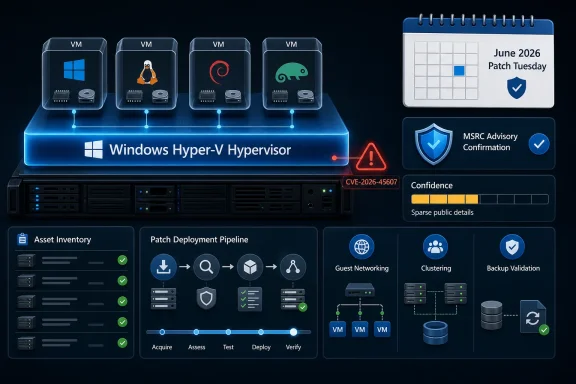 Hyper-V Turns a Routine Patch Into an Infrastructure Decision
Hyper-V is not just another Windows feature for labs and enthusiasts. It is the hypervisor behind Windows Server virtualization, developer workstations, nested test environments, virtual desktop setups, security features, and cloud-adjacent architectures that borrow the same mental model of isolated compute. A flaw in that layer carries symbolic weight because virtualization is sold as a boundary.That does not mean every Hyper-V CVE is a guest-to-host catastrophe, and it would be reckless to assume CVE-2026-45607 has that shape without published technical proof. Microsoft’s “Windows Hyper-V Remote Code Execution Vulnerability” naming tells us the impacted component and class of bug, but not the full path from attacker to code execution. The useful security posture is to treat the advisory as real while resisting the temptation to invent missing exploit details.
This is where administrators should separate severity from drama. Remote code execution in a hypervisor-adjacent component deserves fast attention even if exploitation is constrained, authenticated, local-to-guest, dependent on configuration, or otherwise less cinematic than the headline implies. The worst patching mistakes happen when teams wait for a blog post that explains why the bug is scary instead of recognizing that the product boundary itself is already enough reason to move.
For WindowsForum readers, the practical question is not whether Hyper-V is suddenly unsafe. It is whether your organization knows where Hyper-V is actually enabled. Many estates have the role installed on obvious hosts and quietly present on developer machines, lab servers, Windows 11 Pro systems, security tooling boxes, and CI runners. The vulnerability inventory problem often arrives before the vulnerability itself.
Microsoft’s Confidence Signal Is Doing More Work Than the CVE Title
The user-supplied MSRC language describes a metric that measures confidence in the existence of the vulnerability and the credibility of known technical details. That may sound like scoring-system bureaucracy, but it is one of the more honest parts of modern vulnerability disclosure. It admits that not all CVEs arrive with the same quality of evidence.At one end of the spectrum, a vendor has reproduced the flaw, shipped a fix, assigned a CVE, and mapped the affected products. At the other, there may be public claims, incomplete crash analysis, or third-party research that points toward a bug without proving exploitability. CVE-2026-45607 is anchored by Microsoft’s advisory, so the vulnerability’s existence should be treated as confirmed for operational purposes. What remains unclear publicly is the exploit path, the exact preconditions, and whether working exploit code is circulating beyond the reporting chain.
That distinction matters because attackers and defenders consume the same ambiguity differently. Defenders need enough certainty to schedule change; attackers need enough detail to reproduce the flaw. A high-confidence vendor acknowledgement with limited public detail can actually be the most uncomfortable middle ground: defenders cannot dismiss it, but attackers may still be in the race to reverse-engineer the patch.
The old model of “wait for proof-of-concept code, then panic” is badly suited to this kind of advisory. In Microsoft’s ecosystem, patches are often the technical disclosure. Once binaries are available, skilled researchers and adversaries can compare old and new code, narrow the changed function, and infer the bug class. The confidence metric is therefore not just about whether the bug exists; it is about how quickly the knowledge gap may close.
Remote Code Execution Is a Category, Not a Complete Story
“Remote code execution” is one of the most abused phrases in security reporting because it compresses too many realities into one frightening label. It can mean unauthenticated exploitation across the internet, authenticated exploitation from a guest VM, code execution after user interaction, or a path that requires a carefully staged local condition. The words describe the impact, not necessarily the ease.For Hyper-V, this nuance is especially important. A vulnerability could involve device emulation, synthetic drivers, virtual networking, saved state parsing, VM bus communication, clipboard or enhanced session integration, or host-side management logic. Each route has a different operational meaning. A flaw reachable from an untrusted guest has a different urgency profile than one reachable only through a privileged management action.
Microsoft’s advisory title alone does not settle that question. That is why administrators should avoid both extremes: do not wave it away because details are thin, and do not claim every Hyper-V host is exposed to unauthenticated internet RCE unless Microsoft says so. The safer middle position is disciplined urgency. Patch the systems where Hyper-V is enabled, validate the update in representative clusters, and watch for revised exploitability guidance.
This is also where CVSS can mislead non-specialists. A score can summarize attack vector, privileges required, user interaction, scope, and impact, but it cannot describe your estate. A lab Hyper-V host running disposable malware samples has a different risk profile from a production virtualization cluster hosting domain controllers, build infrastructure, or privileged administrative jump boxes. The vulnerability is universal; the exposure is local.
The Virtualization Boundary Is a Promise Attackers Love to Test
Hypervisors are attractive targets because they sit beneath workloads but above hardware. They are meant to enforce isolation while also providing the very interfaces that make virtual machines useful: storage, networking, graphics, time synchronization, memory management, and device abstraction. Those interfaces are where the boundary gets complicated.A bug in a hypervisor component is rarely just a bug in an application. It raises the possibility that code running in one trust zone can influence another. Even when exploitation is limited, the psychological impact is larger because virtualization is part of how organizations compartmentalize risk. The guest is supposed to be the mess; the host is supposed to be the clean room.
Microsoft has spent years building Windows security features on virtualization-based foundations. Virtualization-based Security, Credential Guard, Hypervisor-Protected Code Integrity, Windows Sandbox, Application Guard-style designs, and developer virtualization workflows all lean on the credibility of isolation. CVE-2026-45607 should not be read as an indictment of those architectures, but it is a reminder that isolation is an engineered system, not a law of physics.
That distinction matters for defenders. Security architecture should assume that isolation boundaries reduce risk, not abolish it. Hyper-V patching therefore belongs in the same category as domain controller patching, VPN appliance patching, and backup infrastructure patching: it protects the platforms that protect everything else.
Patch Tuesday Still Rewards the Boring Teams
The organizations best positioned for CVE-2026-45607 are not the ones with the flashiest threat intel dashboards. They are the ones with accurate asset inventory, tested rollback plans, maintenance windows for virtualization hosts, and a habit of reading Microsoft advisories before social media turns them into folklore. Hypervisor vulnerabilities punish improvisation.Production Hyper-V estates create a familiar tension. Clusters can be drained and patched, but not without planning. Guest workloads may have uptime requirements. Firmware, drivers, backup agents, endpoint protection, and management tools may interact badly with cumulative updates. For home lab users, the risk is inconvenience; for enterprises, the risk is an outage that competes with the vulnerability itself.
Still, the answer cannot be indefinite delay. When Microsoft patches a Hyper-V RCE, administrators should assume that reverse engineering begins immediately. The time between update release and exploit comprehension is not fixed, but it is rarely generous. Even if exploitation starts as difficult, public analysis can turn difficult into repeatable.
The right operational stance is staged acceleration. Patch a pilot ring of non-critical Hyper-V hosts first, monitor for regressions, then move through production according to business criticality and exposure. If your organization cannot patch quickly, that fact should become visible as a risk exception rather than hidden inside a vague “testing” bucket.
The Cloud Has Changed How We Misread Hyper-V Risk
One reason Hyper-V advisories can be misunderstood is that the word “remote” lands differently in 2026 than it did a decade ago. Many workloads are hybrid, many administrators manage infrastructure remotely, and many local boundaries are reachable through layers of automation. The attacker may not need to sit at the keyboard if they can reach the VM, management plane, deployment pipeline, or compromised account that touches the vulnerable component.That does not make every Hyper-V bug internet-exposed. It means network topology alone is a poor comfort blanket. A vulnerability requiring authenticated access can still be serious if attackers commonly obtain low-privilege footholds before escalating. A vulnerability requiring guest interaction can still matter if tenants, developers, contractors, or malware-analysis workflows run untrusted VMs.
The cloud era has also normalized dense privilege concentration. A single virtualization host may carry workloads with wildly different trust assumptions. A developer VM, a build runner, a test domain controller, and a security appliance may coexist because virtualization makes that easy. The convenience of consolidation becomes the danger of shared fate.
For Windows enthusiasts, this should also reframe home labs. The lab box running Hyper-V may also store credentials, browser sessions, backups, source code, and administrative tools. A vulnerability in the virtualization layer is not just a problem for Fortune 500 clusters. It can collapse the tidy mental separation between “that risky VM” and “my real machine.”
The Absence of Exploit Detail Is Not the Absence of Risk
Security teams often ask whether a vulnerability is being exploited in the wild. It is a fair question, but it can become a trap when it turns into the only question. For CVE-2026-45607, the more useful framing is whether the vulnerability affects a high-value boundary and whether Microsoft has supplied a fix. On both counts, the answer pushes toward action.The confidence metric described in the MSRC text helps explain why. Urgency rises when the vulnerability is known to exist with certainty. Vendor confirmation provides that certainty even when exploit details remain scarce. Public exploit code would raise the heat further, but waiting for it is like waiting for smoke before replacing faulty wiring.
This does not mean every organization should drop everything instantly. Risk management still has to account for uptime, redundancy, change freezes, compliance windows, and test coverage. But the decision should be explicit: if a Hyper-V host remains unpatched after the update is available, someone should be able to say why, for how long, and what compensating controls are in place.
Compensating controls may include limiting who can create or run VMs, restricting enhanced session features, tightening host management access, isolating untrusted guest networks, reviewing administrative group membership, and monitoring for unusual host-guest interactions. None of these substitutes for the patch. They are ways to reduce the danger while the patch process catches up.
Reverse Engineering Turns Patch Notes Into Attack Maps
The modern vulnerability race does not require Microsoft to publish a detailed root-cause analysis. Attackers can build their own. Once a security update lands, the changed binaries become a map of where Microsoft touched the code. Skilled analysts compare versions, identify modified functions, and work backward toward trigger conditions.That is why sparse advisories are not as protective as they look. Limited public detail may slow casual exploitation, but it does not freeze capable actors. The more valuable the target class, the more likely someone is diffing the patch. Hyper-V is valuable because it offers a path toward privilege concentration and boundary crossing.
This is also why defenders should be skeptical of comfort drawn from low early chatter. The first day after Patch Tuesday is noisy, and not every serious bug gets immediate public attention. Some vulnerabilities become operationally important only after a working exploit circulates privately, appears in a tool, or is folded into a broader intrusion chain.
For administrators, the lesson is mechanical rather than dramatic. Do not wait for consensus on Twitter, Reddit, Mastodon, or vendor blogs before treating the update as important. Microsoft’s release is itself a signal that the code path was worth fixing. In a hypervisor, that should be enough to start the clock.
Where Windows Admins Should Look First
The first task is to identify affected systems, not to debate the advisory’s adjectives. Check Windows Server hosts with the Hyper-V role, failover clusters, standalone virtualization servers, Windows 10 and Windows 11 systems where Hyper-V, Windows Sandbox, WSL-related virtualization, developer platforms, or security features may have enabled hypervisor components. The visible Hyper-V Manager console is not the only clue.Administrators should also look for machines that run untrusted or semi-trusted guest workloads. Malware analysis labs, developer test environments, education labs, contractor sandboxes, QA farms, and CI infrastructure deserve special attention. A Hyper-V flaw is more concerning when the guest workload is not fully trusted by the host owner.
In enterprise environments, privilege is the second inventory. Who can create VMs, attach virtual disks, configure virtual switches, import appliances, modify checkpoints, or access host management consoles? A vulnerability with preconditions can become easier to exploit when operational roles are broad and stale permissions accumulate.
Finally, monitor update health. Hyper-V hosts are often tied to backup products, storage drivers, NIC teaming, virtual switches, GPU partitioning, and endpoint security software. A disciplined patch plan includes not just installation but validation that guests restart cleanly, networking behaves normally, replication continues, and management tooling still sees the host.
Microsoft’s Advisory Model Still Leaves Gaps for Defenders
Microsoft’s Security Update Guide is indispensable, but it is also shaped by competing incentives. The company must give customers enough information to patch intelligently without handing attackers a recipe. That balance often produces entries that are accurate yet frustratingly terse. CVE-2026-45607 appears to sit in that familiar zone.The problem for defenders is that patch prioritization depends on context the advisory may not provide. Is exploitation more plausible from a guest? Does it require a particular virtual device? Are client editions meaningfully exposed? Are Server Core installations affected the same way? Are mitigations available beyond the update? These are the questions that determine how a security team sequences work.
Microsoft sometimes updates advisories after initial publication, adding exploitability assessments, revised affected product lists, FAQ entries, or acknowledgements. That means CVE tracking should not be a one-time read. Security teams should revisit the entry after the first wave of Patch Tuesday reporting, especially if they manage large Hyper-V fleets.
This is an area where community publications and forums can be useful, provided they do not overclaim. Administrators comparing patch outcomes, cluster behavior, and product compatibility can surface operational issues faster than official documents. But exploit claims, mitigation scripts, and “not affected” assertions should be treated cautiously unless they trace back to Microsoft or reproducible testing.
The Real Test Is Whether Hyper-V Is Treated Like Critical Infrastructure
The uncomfortable truth is that many organizations patch hypervisors more slowly than the workloads running on them. Guest operating systems get automated attention because they look like servers. Hosts get special handling because they are fragile, shared, and politically expensive to reboot. Attackers understand that asymmetry.CVE-2026-45607 is a useful forcing function because it asks whether Hyper-V is part of the security baseline or an exception to it. If the virtualization layer is trusted enough to host critical workloads, it must be maintained with the seriousness of critical infrastructure. That means documented patch cadence, emergency procedures, cluster capacity for live migration, and business buy-in for host reboots.
For smaller shops, the same principle applies at a different scale. If there is only one Hyper-V host, the maintenance window is still real. If backups depend on that host, test restore assumptions before patching. If domain services run as guests, make sure authentication and recovery paths survive a host restart. The goal is not panic; it is reducing the number of surprises that can turn a security update into an outage.
The strongest security programs treat patching as engineering. They ask what can fail, what depends on what, who owns the decision, and how quickly the environment can recover. Hyper-V vulnerabilities expose whether that engineering exists or whether the organization has simply been lucky.
The Signal Hidden Inside CVE-2026-45607’s Sparse Advisory
The most important reading of CVE-2026-45607 is that Microsoft has confirmed a Hyper-V remote code execution issue, while public technical detail remains limited enough that defenders should prioritize remediation without making unsupported claims about exploitation. That is not a satisfying narrative, but it is a useful one. The work now is inventory, patching, validation, and continued monitoring for advisory updates.- Microsoft’s acknowledgement is enough to treat CVE-2026-45607 as operationally real, even if public exploit mechanics are not fully described.
- Hyper-V hosts should be prioritized because virtualization boundaries concentrate trust across many guest workloads.
- Administrators should inventory both obvious server hosts and less obvious Windows client systems where Hyper-V-related features may be enabled.
- Patch testing should include guest startup, virtual networking, backup integration, replication, clustering, and management tooling.
- Teams that cannot patch immediately should document the exception, reduce guest and management exposure, and keep checking for revised Microsoft guidance.
References
- Primary source: MSRC
Published: 2026-06-09T07:00:00-07:00
Security Update Guide - Microsoft Security Response Center
 msrc.microsoft.com
- Related coverage: threats.kaspersky.com
Kaspersky Threats — KLA90878
threats.kaspersky.com
- Related coverage: sentinelone.com
CVE-2026-21247: Windows 10 1607 Hyper-V RCE Vulnerability
CVE-2026-21247 is a remote code execution vulnerability in Windows 10 1607 Hyper-V. Learn about its impact, affected versions, and mitigation methods.www.sentinelone.com
- Related coverage: datacomm.com
- Related coverage: bleepingcomputer.com
- Related coverage: rapid7.com
Rapid7 Vulnerability Database
Rapid7's VulnDB is curated repository of vetted computer software exploits and exploitable vulnerabilities.www.rapid7.com
- Related coverage: thewindowsupdate.com
- Official source: microsoft.com
MSRC - Microsoft Security Response Center
The Microsoft Security Response Center is part of the defender community and on the front line of security response evolution. For over twenty years, we have been engaged with security researchers working to protect customers and the broader ecosystem.www.microsoft.com
- Official source: msrc-ppe.microsoft.com
- Official source: learn.microsoft.com
- Related coverage: sra.io