

Microsoft’s CVE-2026-47655 is an information disclosure vulnerability in Microsoft Graph, published through the Microsoft Security Response Center’s Security Update Guide, with the available public framing focused less on exploit mechanics than on confidence in the report and the credibility of known technical details. That matters because Graph is not a side door in Microsoft’s cloud; it is the front hallway for Microsoft 365 identity, mail, files, calendars, devices, and application data. When Graph gets a CVE, the security conversation is really about trust boundaries inside the Microsoft cloud. The uncomfortable part is that the most visible detail here is not the bug’s root cause, but the scoring language around how certain defenders should be that the bug exists.
“Information disclosure” is one of those vulnerability categories that can sound deceptively mild. It does not carry the cinematic force of remote code execution, the operational panic of ransomware, or the crisp escalation story of a privilege bypass. But in Microsoft Graph, disclosure can be the event that makes every other attack easier.
Graph is the API fabric that binds Microsoft 365 and Entra ID into something developers can automate. It exposes directory objects, messages, groups, Teams artifacts, SharePoint and OneDrive content, device management surfaces, audit-adjacent data, and a growing set of security and compliance signals. That breadth is exactly why Graph is useful—and exactly why a disclosure flaw in Graph deserves a sober reading even when the public advisory does not hand defenders a dramatic exploit chain.
The phrase “Microsoft Graph Information Disclosure Vulnerability” should therefore be read as a cloud control-plane issue, not merely as an application bug. The damage from an information disclosure flaw depends on what crosses the boundary: a tenant identifier is one thing, message content is another, and tokens, object metadata, or policy-sensitive configuration data are something else entirely. The public label does not settle that question.
That uncertainty is the story. Microsoft has disclosed the CVE, but the excerpted scoring explanation supplied with the advisory focuses on report confidence: how certain the industry should be that the vulnerability exists, and how credible the known technical details are. For defenders, that turns CVE-2026-47655 into a case study in modern cloud vulnerability management, where the most important operational question is often not “Can I install a patch?” but “What did Microsoft change, and how should I validate my own exposure?”
This is not a trivial distinction. In vulnerability management, there is a major difference between an internet rumor, a researcher’s partial write-up, a vendor acknowledgment, and a working exploit. Security teams often compress all of those states into a single “CVE present” ticket, but that is not how risk actually behaves.
A confirmed vulnerability with limited public technical detail can be less immediately exploitable than a fully documented proof of concept, but it can also be more strategically important. Attackers do not need the vendor to publish a root-cause essay; they can diff behavior, test API edge cases, and probe authorization boundaries. In a cloud API as central as Graph, the absence of public exploit details is not the same as the absence of attacker interest.
That is why the confidence metric matters here. It is a signal about certainty, not severity by itself. It tells defenders that the issue should not be dismissed as speculative, while also reminding them that the public record may not yet contain enough detail to support precise compensating controls.
Microsoft Graph is consumed through Microsoft’s hosted service, not through a DLL that every admin can inventory and patch on a server. If the vulnerable component is entirely service-side, remediation may already be deployed by Microsoft before many customers fully understand the bug. That is good for speed, but it complicates accountability and validation.
In a traditional Windows vulnerability, defenders can ask whether a specific KB is installed. In a Graph vulnerability, the better questions are different. Which permissions could have exposed data? Which tenants, apps, or identities used the affected paths? Were logs generated that can distinguish normal API use from suspicious probing? Did Microsoft provide enough detail for customers to hunt?
This is where cloud security often asks enterprises to accept a trade. Microsoft can fix global service flaws faster than any customer could patch a sprawling on-prem estate. But customers may get less forensic texture than they would from a local vulnerability with file versions, binaries, registry keys, and repeatable test cases. Speed improves; visibility does not always keep up.
Graph sits at the center of that reconnaissance universe. Even data that looks harmless in isolation can be powerful when combined with phishing, consent-grant abuse, token theft, business email compromise, or lateral movement through SaaS integrations. A disclosed object ID, group membership pattern, mail routing hint, conditional access clue, or application permission footprint can become an attacker’s map.
That is the real risk model for CVE-2026-47655. The scary version is not necessarily a single API call dumping a crown-jewel database. It is the quieter possibility that Graph revealed more than a caller should have been able to learn, thereby reducing the attacker’s uncertainty.
Defenders should think in terms of attack preparation. Did the flaw expose data that helps target privileged users? Did it make tenant structure easier to enumerate? Did it reveal application relationships or permission grants? Did it cross tenant, user, role, or consent boundaries? Until Microsoft or independent researchers provide more detail, those remain open questions—but they are the right questions.
This gap is especially visible in large cloud platforms. Microsoft has to balance disclosure with the risk of enabling copycat exploitation, particularly when an issue concerns authorization logic or service behavior that may still be observable. Customers, meanwhile, need actionable detail. Those incentives do not always line up.
The result is often a sparse advisory that gives security teams just enough to prioritize, but not enough to prove absence of harm. That is frustrating, but it is not unique to Microsoft. It is a structural feature of cloud vulnerability disclosure: the party with the most technical visibility is also the party most constrained in what it can safely publish.
For IT pros, the right response is neither blind trust nor theatrical outrage. The right response is disciplined validation. Treat the vendor acknowledgment as credible, then use tenant logging, app inventory, identity governance, and least-privilege review to reduce the chance that any similar Graph flaw would matter as much next time.
Many Microsoft 365 tenants contain legacy enterprise applications, automation scripts, third-party SaaS connectors, security tools, migration utilities, and abandoned test registrations. Some have broad Graph permissions granted long ago for convenience and never revisited. In that environment, an information disclosure flaw does not need to be catastrophic on its own to become useful.
This is the part of the story that security teams can control. They may not be able to patch Graph, but they can reduce what any one token, app registration, or compromised identity can see. They can remove stale service principals, review high-privilege Graph permissions, require administrative workflows for consent, and monitor unusual API patterns.
The lesson is not that every Graph app is dangerous. The lesson is that Graph centralizes privilege in ways that demand hygiene. A vulnerability in the platform is Microsoft’s problem to fix; excessive permission grants are the customer’s problem to manage.
Security operations teams live in this gray zone constantly. A CVE can be real, confirmed, and relevant without being an emergency. It can also become more urgent if technical details emerge, if researchers reproduce the issue, if exploit code appears, or if threat intelligence begins to show scanning or abuse.
The prudent stance is staged response. First, acknowledge the vulnerability and confirm whether Microsoft has indicated customer action. Second, inspect Graph-heavy applications and high-risk permissions. Third, hunt for anomalous Graph activity around the advisory window, especially from unfamiliar apps, unusual IP ranges, unexpected service principals, or identities touching data they rarely access. Fourth, keep watching the advisory for revisions.
That approach may sound less satisfying than “patch now,” but cloud security often denies administrators that clean verb. The work becomes governance, logging, and blast-radius reduction.
But centralization changes risk. A flaw in a niche API remains niche. A flaw in Graph inherits the importance of everything Graph can represent. The platform’s value proposition and its risk profile are inseparable.
This is especially true as AI assistants and automation agents lean more heavily on organizational data. Graph is a natural substrate for those systems because it knows where the documents are, who works with whom, what meetings matter, and which applications sit inside the tenant. The more Microsoft turns Graph into the nervous system of work, the more every information boundary inside Graph becomes a security boundary.
CVE-2026-47655 should be read against that backdrop. It is not just another line in a vulnerability database. It is a reminder that API authorization bugs in cloud productivity platforms are now enterprise security events, even when the public description is short.
A mature cloud vulnerability response program should not wait for a perfect advisory. It should already know which applications have Graph access, which permissions are considered toxic, which service principals are ownerless, which logs are retained long enough to investigate, and which teams can interpret Graph activity without starting from scratch. If those basics are missing, a sparse CVE becomes a scramble.
Microsoft can help by making advisories more operationally useful where safe. Customers benefit from clear affected-service statements, mitigation status, detection guidance, and whether exploitation has been observed. Even when root-cause details must remain private, cloud customers need enough information to determine whether tenant-level review is warranted.
Still, administrators should not outsource readiness to the vendor. Graph is too important to be treated as a black box that only Microsoft understands. Enterprises that build on it need their own inventory, their own baselines, and their own risk appetite for permissions.
That means looking beyond the CVE score. Scores compress reality; governance explains it. A tenant with rigorous app consent review, short-lived credentials, strong conditional access, centralized logging, and monitored service principals is not in the same position as a tenant with broad application permissions and minimal oversight.
This is where executives often misunderstand cloud risk. Buying a secure platform does not eliminate the need to operate it securely. Microsoft can fix Graph’s service-side flaws, but it cannot retroactively decide which third-party apps your organization consented to, which automation accounts are overprivileged, or whether your logs are retained long enough to answer uncomfortable questions.
The governance audit should be practical. Identify apps with high-impact Graph permissions. Confirm owners. Remove unused grants. Investigate credentials that never rotate. Check whether risky consent events produce alerts. Make sure security teams can distinguish expected Graph calls from strange ones. Those tasks are not glamorous, but they are exactly what turns a vague advisory into a manageable event.
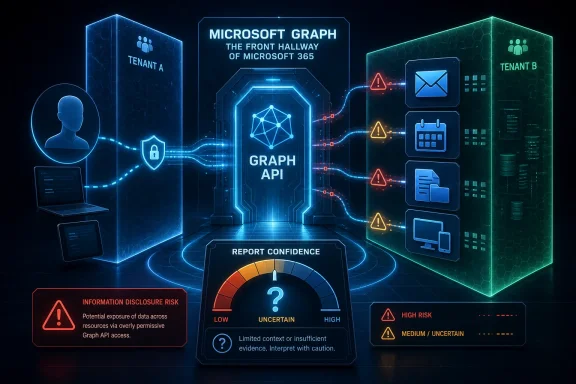 Microsoft Graph Turns a Modest Phrase Into a Large Blast Radius
“Information disclosure” is one of those vulnerability categories that can sound deceptively mild. It does not carry the cinematic force of remote code execution, the operational panic of ransomware, or the crisp escalation story of a privilege bypass. But in Microsoft Graph, disclosure can be the event that makes every other attack easier.Graph is the API fabric that binds Microsoft 365 and Entra ID into something developers can automate. It exposes directory objects, messages, groups, Teams artifacts, SharePoint and OneDrive content, device management surfaces, audit-adjacent data, and a growing set of security and compliance signals. That breadth is exactly why Graph is useful—and exactly why a disclosure flaw in Graph deserves a sober reading even when the public advisory does not hand defenders a dramatic exploit chain.
The phrase “Microsoft Graph Information Disclosure Vulnerability” should therefore be read as a cloud control-plane issue, not merely as an application bug. The damage from an information disclosure flaw depends on what crosses the boundary: a tenant identifier is one thing, message content is another, and tokens, object metadata, or policy-sensitive configuration data are something else entirely. The public label does not settle that question.
That uncertainty is the story. Microsoft has disclosed the CVE, but the excerpted scoring explanation supplied with the advisory focuses on report confidence: how certain the industry should be that the vulnerability exists, and how credible the known technical details are. For defenders, that turns CVE-2026-47655 into a case study in modern cloud vulnerability management, where the most important operational question is often not “Can I install a patch?” but “What did Microsoft change, and how should I validate my own exposure?”
The Confidence Metric Is Doing More Work Than Usual
The text attached to CVE-2026-47655 describes a metric that measures confidence in the existence of the vulnerability and the credibility of the known technical details. That language maps to the logic of CVSS report confidence: a vulnerability may be rumored, partly corroborated, or confirmed by the vendor or author of the affected technology. The more certain the vulnerability is, the more seriously defenders should treat its existence, even if the technical recipe remains private.This is not a trivial distinction. In vulnerability management, there is a major difference between an internet rumor, a researcher’s partial write-up, a vendor acknowledgment, and a working exploit. Security teams often compress all of those states into a single “CVE present” ticket, but that is not how risk actually behaves.
A confirmed vulnerability with limited public technical detail can be less immediately exploitable than a fully documented proof of concept, but it can also be more strategically important. Attackers do not need the vendor to publish a root-cause essay; they can diff behavior, test API edge cases, and probe authorization boundaries. In a cloud API as central as Graph, the absence of public exploit details is not the same as the absence of attacker interest.
That is why the confidence metric matters here. It is a signal about certainty, not severity by itself. It tells defenders that the issue should not be dismissed as speculative, while also reminding them that the public record may not yet contain enough detail to support precise compensating controls.
Cloud CVEs Break the Old Patch Tuesday Muscle Memory
For Windows administrators, vulnerability response has long been shaped by Patch Tuesday. A CVE appears, an update lands, test rings begin, deployment telemetry is watched, and the monthly ritual continues. Cloud service vulnerabilities do not fit that pattern cleanly.Microsoft Graph is consumed through Microsoft’s hosted service, not through a DLL that every admin can inventory and patch on a server. If the vulnerable component is entirely service-side, remediation may already be deployed by Microsoft before many customers fully understand the bug. That is good for speed, but it complicates accountability and validation.
In a traditional Windows vulnerability, defenders can ask whether a specific KB is installed. In a Graph vulnerability, the better questions are different. Which permissions could have exposed data? Which tenants, apps, or identities used the affected paths? Were logs generated that can distinguish normal API use from suspicious probing? Did Microsoft provide enough detail for customers to hunt?
This is where cloud security often asks enterprises to accept a trade. Microsoft can fix global service flaws faster than any customer could patch a sprawling on-prem estate. But customers may get less forensic texture than they would from a local vulnerability with file versions, binaries, registry keys, and repeatable test cases. Speed improves; visibility does not always keep up.
Information Disclosure Is a First-Stage Weapon
Security teams sometimes under-rank information disclosure because it does not always produce immediate compromise. That habit is dangerous in identity-heavy cloud environments. Modern attacks frequently begin with reconnaissance: mapping users, groups, applications, policies, mailboxes, device states, and trust relationships before attempting a more invasive step.Graph sits at the center of that reconnaissance universe. Even data that looks harmless in isolation can be powerful when combined with phishing, consent-grant abuse, token theft, business email compromise, or lateral movement through SaaS integrations. A disclosed object ID, group membership pattern, mail routing hint, conditional access clue, or application permission footprint can become an attacker’s map.
That is the real risk model for CVE-2026-47655. The scary version is not necessarily a single API call dumping a crown-jewel database. It is the quieter possibility that Graph revealed more than a caller should have been able to learn, thereby reducing the attacker’s uncertainty.
Defenders should think in terms of attack preparation. Did the flaw expose data that helps target privileged users? Did it make tenant structure easier to enumerate? Did it reveal application relationships or permission grants? Did it cross tenant, user, role, or consent boundaries? Until Microsoft or independent researchers provide more detail, those remain open questions—but they are the right questions.
Vendor Acknowledgment Is Not the Same as Customer Clarity
A vendor-confirmed vulnerability should raise confidence, but it should not end the conversation. Microsoft’s acknowledgment means the issue belongs in risk registers, vulnerability dashboards, and security leadership briefings. It does not automatically tell customers whether their specific tenant data was accessible, whether exploitation was detected, or whether any action remains.This gap is especially visible in large cloud platforms. Microsoft has to balance disclosure with the risk of enabling copycat exploitation, particularly when an issue concerns authorization logic or service behavior that may still be observable. Customers, meanwhile, need actionable detail. Those incentives do not always line up.
The result is often a sparse advisory that gives security teams just enough to prioritize, but not enough to prove absence of harm. That is frustrating, but it is not unique to Microsoft. It is a structural feature of cloud vulnerability disclosure: the party with the most technical visibility is also the party most constrained in what it can safely publish.
For IT pros, the right response is neither blind trust nor theatrical outrage. The right response is disciplined validation. Treat the vendor acknowledgment as credible, then use tenant logging, app inventory, identity governance, and least-privilege review to reduce the chance that any similar Graph flaw would matter as much next time.
The Real Exposure Lives in App Permissions
If there is one place administrators should look after a Graph disclosure advisory, it is application permissions. Microsoft Graph’s power is mediated through delegated permissions, application permissions, admin consent, and identity context. The same vulnerability can have very different consequences depending on whether an environment has tightly governed app access or years of accumulated consent sprawl.Many Microsoft 365 tenants contain legacy enterprise applications, automation scripts, third-party SaaS connectors, security tools, migration utilities, and abandoned test registrations. Some have broad Graph permissions granted long ago for convenience and never revisited. In that environment, an information disclosure flaw does not need to be catastrophic on its own to become useful.
This is the part of the story that security teams can control. They may not be able to patch Graph, but they can reduce what any one token, app registration, or compromised identity can see. They can remove stale service principals, review high-privilege Graph permissions, require administrative workflows for consent, and monitor unusual API patterns.
The lesson is not that every Graph app is dangerous. The lesson is that Graph centralizes privilege in ways that demand hygiene. A vulnerability in the platform is Microsoft’s problem to fix; excessive permission grants are the customer’s problem to manage.
The Public Record Leaves Exploitability in the Gray Zone
The advisory text provided with CVE-2026-47655 does not, by itself, establish public exploitation, proof-of-concept availability, or a clear attacker playbook. That should temper panic. It should not invite complacency.Security operations teams live in this gray zone constantly. A CVE can be real, confirmed, and relevant without being an emergency. It can also become more urgent if technical details emerge, if researchers reproduce the issue, if exploit code appears, or if threat intelligence begins to show scanning or abuse.
The prudent stance is staged response. First, acknowledge the vulnerability and confirm whether Microsoft has indicated customer action. Second, inspect Graph-heavy applications and high-risk permissions. Third, hunt for anomalous Graph activity around the advisory window, especially from unfamiliar apps, unusual IP ranges, unexpected service principals, or identities touching data they rarely access. Fourth, keep watching the advisory for revisions.
That approach may sound less satisfying than “patch now,” but cloud security often denies administrators that clean verb. The work becomes governance, logging, and blast-radius reduction.
Microsoft’s Own Platform Strategy Raises the Stakes
Microsoft has spent years making Graph the connective tissue of its productivity, identity, endpoint, and security products. That strategy makes sense. Developers want one API surface; enterprises want automation; Microsoft wants a coherent platform story across Microsoft 365, Windows, Entra, Intune, Defender, and Copilot-era workloads.But centralization changes risk. A flaw in a niche API remains niche. A flaw in Graph inherits the importance of everything Graph can represent. The platform’s value proposition and its risk profile are inseparable.
This is especially true as AI assistants and automation agents lean more heavily on organizational data. Graph is a natural substrate for those systems because it knows where the documents are, who works with whom, what meetings matter, and which applications sit inside the tenant. The more Microsoft turns Graph into the nervous system of work, the more every information boundary inside Graph becomes a security boundary.
CVE-2026-47655 should be read against that backdrop. It is not just another line in a vulnerability database. It is a reminder that API authorization bugs in cloud productivity platforms are now enterprise security events, even when the public description is short.
Defenders Need Better Cloud Disclosure Muscle
The Windows admin community is good at patching operating systems. It is less uniformly mature at responding to opaque service-side CVEs. That gap is becoming a liability.A mature cloud vulnerability response program should not wait for a perfect advisory. It should already know which applications have Graph access, which permissions are considered toxic, which service principals are ownerless, which logs are retained long enough to investigate, and which teams can interpret Graph activity without starting from scratch. If those basics are missing, a sparse CVE becomes a scramble.
Microsoft can help by making advisories more operationally useful where safe. Customers benefit from clear affected-service statements, mitigation status, detection guidance, and whether exploitation has been observed. Even when root-cause details must remain private, cloud customers need enough information to determine whether tenant-level review is warranted.
Still, administrators should not outsource readiness to the vendor. Graph is too important to be treated as a black box that only Microsoft understands. Enterprises that build on it need their own inventory, their own baselines, and their own risk appetite for permissions.
The CVE Is Also a Governance Audit in Disguise
The best use of CVE-2026-47655 may be as a forcing function. Security teams can use it to ask whether their Microsoft 365 and Entra environments are prepared for the next Graph-related advisory, whether or not this specific vulnerability turns out to have broad customer impact.That means looking beyond the CVE score. Scores compress reality; governance explains it. A tenant with rigorous app consent review, short-lived credentials, strong conditional access, centralized logging, and monitored service principals is not in the same position as a tenant with broad application permissions and minimal oversight.
This is where executives often misunderstand cloud risk. Buying a secure platform does not eliminate the need to operate it securely. Microsoft can fix Graph’s service-side flaws, but it cannot retroactively decide which third-party apps your organization consented to, which automation accounts are overprivileged, or whether your logs are retained long enough to answer uncomfortable questions.
The governance audit should be practical. Identify apps with high-impact Graph permissions. Confirm owners. Remove unused grants. Investigate credentials that never rotate. Check whether risky consent events produce alerts. Make sure security teams can distinguish expected Graph calls from strange ones. Those tasks are not glamorous, but they are exactly what turns a vague advisory into a manageable event.
The Useful Lesson Is Smaller Than the Fear and Larger Than the Bug
CVE-2026-47655 does not need to be treated as a five-alarm crisis based on the public information currently visible. It does deserve to be treated as a meaningful signal about the security posture of Microsoft Graph and the tenants that depend on it.- Microsoft has identified CVE-2026-47655 as an information disclosure vulnerability in Microsoft Graph, making it relevant to Microsoft 365 and Entra-centered environments.
- The advisory language emphasizes confidence in the vulnerability’s existence and the credibility of known technical details, not a public exploit narrative.
- Information disclosure in Graph can matter because metadata, directory relationships, app permissions, and user context can support later attacks.
- Customers may not have a local patch to deploy if the vulnerable component is service-side, so validation shifts toward logs, permissions, and app governance.
- The most practical near-term response is to review high-privilege Graph permissions, stale service principals, unusual API activity, and Microsoft advisory updates.
- The longer-term response is to treat Graph as critical infrastructure inside the tenant, not merely as a developer convenience.
References
- Primary source: MSRC
Published: 2026-06-04T07:00:00-07:00
Security Update Guide - Microsoft Security Response Center
 msrc.microsoft.com
- Official source: microsoft.com
MSRC - Microsoft Security Response Center
The Microsoft Security Response Center is part of the defender community and on the front line of security response evolution. For over twenty years, we have been engaged with security researchers working to protect customers and the broader ecosystem.www.microsoft.com
- Related coverage: sra.io
- Related coverage: appsecure.security
CVE-2022-47655 | High Vulnerability in Debian Libde265
High-severity buffer overflow in Debian Libde265. User interaction required for exploitation. Patch immediately to mitigate risks.www.appsecure.security
