

Microsoft has disclosed CVE-2026-48572, an elevation-of-privilege vulnerability in the Windows App Package Installer, as part of its July 14, 2026 security release. The flaw affects a component involved in deploying modern Windows application packages, making it relevant to administrators who permit MSIX or App Installer-based software deployment.
Detailed in the Microsoft Security Response Center’s Security Update Guide, CVE-2026-48572 was published at 7:00 a.m. Pacific time on July 14. Microsoft’s advisory confirms the vulnerability’s existence, but the initial public material provides limited technical detail about its root cause, exploitation path, and prerequisites.
That makes the immediate instruction straightforward: install the applicable July 2026 security updates, then verify that managed endpoints actually reached the corrected Windows build or package version. Administrators should not treat the absence of public exploit instructions as evidence that the flaw is harmless.
Windows App Package Installer is associated with installing packages such as MSIX and APPX files. These formats are used by Microsoft Store applications, enterprise line-of-business software, Windows application deployment tools, and manually distributed packages.
Installation is security-sensitive because Windows must decide what a package may write, which identity it receives, what capabilities it can request, and whether an operation requires administrative approval. A defect at this boundary can potentially allow a process or signed-in user to obtain permissions that should have remained unavailable.
An elevation-of-privilege vulnerability is not automatically a remote compromise. In the usual Windows threat model, an attacker first needs some degree of access to the machine, such as the ability to run code under a standard user account. Successful exploitation could then provide broader control over the endpoint, depending on the privileges granted and the affected execution context.
That distinction matters, but it should not become an excuse to delay remediation. Privilege-escalation bugs are routinely combined with phishing, malicious documents, browser weaknesses, credential theft, or an existing foothold. The first exploit gets code onto the system; the elevation flaw helps the attacker move beyond the restrictions placed on that code.
The practical danger is therefore the exploit chain. A vulnerability that is not independently reachable from the internet can still become the step that turns a limited account into an administrative or SYSTEM-level presence.
Microsoft’s acknowledgement is important because it distinguishes a confirmed product defect from an unverified report or theoretical weakness. It means administrators can treat the vulnerability as real even while the company withholds details that could make exploitation easier.
It does not, however, answer the questions incident responders will want resolved:
The lack of technical depth means defenders should avoid presenting assumptions as facts. CVE-2026-48572 concerns the Windows App Package Installer, but that name alone does not prove that every MSIX file is dangerous, that Microsoft Store installations are the only exposure, or that disabling one user-facing installer interface completely removes the vulnerable code path.
App Installer can create some confusion because Windows application deployment spans operating-system components, Microsoft Store-delivered software, PowerShell cmdlets, management platforms, and package-management tools. An administrator could update the visible App Installer application and still miss an operating-system correction, or deploy a cumulative Windows update while overlooking a separately serviced package.
Security teams should therefore map CVE-2026-48572 against the exact products, KB articles, build numbers, and downloads Microsoft identifies for their environment. The deployment record should show not merely that an update was approved, but that it installed successfully and survived the required restart or servicing operation.
For Windows fleets, a sensible response sequence is:
This is not a reason to halt all packaged-app deployment without evidence of active exploitation. It is a reason to make sure package sources are controlled, signing requirements are enforced, and standard users cannot freely introduce untrusted installers into sensitive systems.
Package signing is another useful layer. Enterprises distributing internal MSIX packages should protect signing keys, limit who can publish packages, and monitor unexpected changes in certificate use. A package being signed does not guarantee that it is safe, but a properly managed trust policy makes arbitrary package delivery more difficult.
Administrators should also review who is allowed to sideload applications and whether developer-oriented deployment settings are enabled on production endpoints. Broad sideloading permissions may be necessary for some development or testing machines, but they rarely belong on every workstation.
Endpoint monitoring should focus on suspicious behavior around installation rather than an unverified exploit signature. Useful signals include unexpected package registrations, installers launched from user-writable or temporary directories, unusual child processes, changes to protected locations, and a standard-user process suddenly operating with elevated rights.
Microsoft Defender for Endpoint and comparable endpoint detection platforms may be able to connect those events into a broader incident story. That is particularly important for elevation vulnerabilities because the exploit itself may be brief, while the attacker’s subsequent credential access, persistence, service creation, or security-tool tampering is easier to observe.
For administrators, the unresolved technical details do not change the near-term decision. Deploy the exact updates listed by Microsoft, verify the corrected versions across the fleet, and investigate machines that remain behind the July 14, 2026 baseline. The next meaningful milestone will be whether Microsoft revises the advisory or researchers publish enough detail to clarify how the Windows App Package Installer allowed privileges to be crossed.
Detailed in the Microsoft Security Response Center’s Security Update Guide, CVE-2026-48572 was published at 7:00 a.m. Pacific time on July 14. Microsoft’s advisory confirms the vulnerability’s existence, but the initial public material provides limited technical detail about its root cause, exploitation path, and prerequisites.
That makes the immediate instruction straightforward: install the applicable July 2026 security updates, then verify that managed endpoints actually reached the corrected Windows build or package version. Administrators should not treat the absence of public exploit instructions as evidence that the flaw is harmless.
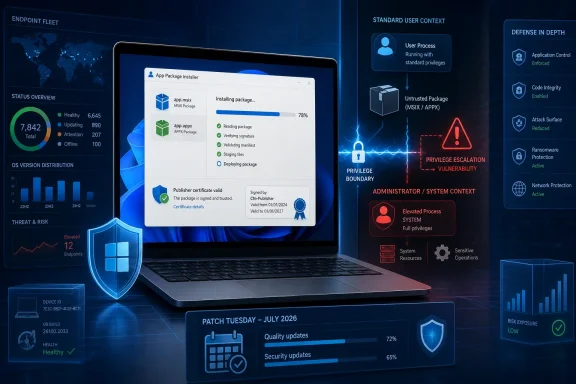 Package Installation Sits on a Privilege Boundary
Windows App Package Installer is associated with installing packages such as MSIX and APPX files. These formats are used by Microsoft Store applications, enterprise line-of-business software, Windows application deployment tools, and manually distributed packages.Installation is security-sensitive because Windows must decide what a package may write, which identity it receives, what capabilities it can request, and whether an operation requires administrative approval. A defect at this boundary can potentially allow a process or signed-in user to obtain permissions that should have remained unavailable.
An elevation-of-privilege vulnerability is not automatically a remote compromise. In the usual Windows threat model, an attacker first needs some degree of access to the machine, such as the ability to run code under a standard user account. Successful exploitation could then provide broader control over the endpoint, depending on the privileges granted and the affected execution context.
That distinction matters, but it should not become an excuse to delay remediation. Privilege-escalation bugs are routinely combined with phishing, malicious documents, browser weaknesses, credential theft, or an existing foothold. The first exploit gets code onto the system; the elevation flaw helps the attacker move beyond the restrictions placed on that code.
The practical danger is therefore the exploit chain. A vulnerability that is not independently reachable from the internet can still become the step that turns a limited account into an administrative or SYSTEM-level presence.
Microsoft Has Confirmed the Flaw, Not Explained It
The disclosure material supplied for CVE-2026-48572 emphasizes Microsoft’s assessment of report confidence. In Common Vulnerability Scoring System terminology, that metric concerns how confidently the vulnerability and its technical characteristics have been established.Microsoft’s acknowledgement is important because it distinguishes a confirmed product defect from an unverified report or theoretical weakness. It means administrators can treat the vulnerability as real even while the company withholds details that could make exploitation easier.
It does not, however, answer the questions incident responders will want resolved:
- Microsoft has not publicly described the exact package-processing operation that crosses the privilege boundary.
- The initial information does not explain whether exploitation requires a specially constructed package, a particular deployment configuration, or prior local code execution.
- No public root-cause description establishes whether the defect lies in package validation, file handling, permissions, registration, servicing, or another installation stage.
- The available summary does not provide enough information to build a reliable standalone detection rule for attempted exploitation.
The lack of technical depth means defenders should avoid presenting assumptions as facts. CVE-2026-48572 concerns the Windows App Package Installer, but that name alone does not prove that every MSIX file is dangerous, that Microsoft Store installations are the only exposure, or that disabling one user-facing installer interface completely removes the vulnerable code path.
Patch the Product Microsoft Lists, Not the Product Name You Infer
The most important deployment detail is the Security Updates table in Microsoft’s advisory. That table, rather than the broad vulnerability title, determines which supported Windows products and servicing packages receive a correction.App Installer can create some confusion because Windows application deployment spans operating-system components, Microsoft Store-delivered software, PowerShell cmdlets, management platforms, and package-management tools. An administrator could update the visible App Installer application and still miss an operating-system correction, or deploy a cumulative Windows update while overlooking a separately serviced package.
Security teams should therefore map CVE-2026-48572 against the exact products, KB articles, build numbers, and downloads Microsoft identifies for their environment. The deployment record should show not merely that an update was approved, but that it installed successfully and survived the required restart or servicing operation.
For Windows fleets, a sensible response sequence is:
- Review Microsoft’s CVE entry and record each affected product present in the organization.
- Deploy the listed July 2026 updates through Windows Update, Windows Update for Business, WSUS, Microsoft Configuration Manager, Intune, or the organization’s patch-management platform.
- Confirm corrected build and package versions using inventory data rather than relying solely on an update approval state.
- Investigate endpoints where the update repeatedly fails, remains pending, or reports an unexpected supersedence condition.
- Monitor Microsoft’s advisory revision history for changes to affected products, exploitability assessments, mitigations, and acknowledgements.
This is not a reason to halt all packaged-app deployment without evidence of active exploitation. It is a reason to make sure package sources are controlled, signing requirements are enforced, and standard users cannot freely introduce untrusted installers into sensitive systems.
Application Control Can Limit the Starting Point
Patching closes the documented defect, but application control can reduce the opportunities an attacker has to reach vulnerable installation paths in the first place. Windows Defender Application Control and AppLocker can restrict which binaries, scripts, installers, and packaged applications are permitted to run.Package signing is another useful layer. Enterprises distributing internal MSIX packages should protect signing keys, limit who can publish packages, and monitor unexpected changes in certificate use. A package being signed does not guarantee that it is safe, but a properly managed trust policy makes arbitrary package delivery more difficult.
Administrators should also review who is allowed to sideload applications and whether developer-oriented deployment settings are enabled on production endpoints. Broad sideloading permissions may be necessary for some development or testing machines, but they rarely belong on every workstation.
Endpoint monitoring should focus on suspicious behavior around installation rather than an unverified exploit signature. Useful signals include unexpected package registrations, installers launched from user-writable or temporary directories, unusual child processes, changes to protected locations, and a standard-user process suddenly operating with elevated rights.
Microsoft Defender for Endpoint and comparable endpoint detection platforms may be able to connect those events into a broader incident story. That is particularly important for elevation vulnerabilities because the exploit itself may be brief, while the attacker’s subsequent credential access, persistence, service creation, or security-tool tampering is easier to observe.
July’s Fix Needs Verification, Not Just Approval
CVE-2026-48572 arrives as a confirmed Windows privilege-boundary defect with relatively little public technical explanation. Its component makes it relevant to both ordinary Windows endpoints and enterprises that have standardized on MSIX application delivery.For administrators, the unresolved technical details do not change the near-term decision. Deploy the exact updates listed by Microsoft, verify the corrected versions across the fleet, and investigate machines that remain behind the July 14, 2026 baseline. The next meaningful milestone will be whether Microsoft revises the advisory or researchers publish enough detail to clarify how the Windows App Package Installer allowed privileges to be crossed.
References
- Primary source: MSRC
Published: 2026-07-14T07:00:00-07:00
Security Update Guide - Microsoft Security Response Center
 msrc.microsoft.com
- Official source: learn.microsoft.com
Current status of Windows app distribution features - Windows apps | Microsoft Learn
Up-to-date status of Windows app distribution features, including ms-appinstaller protocol status, .appinstaller schema versions, and platform support differences between Windows 10 and Windows 11.learn.microsoft.com - Related coverage: aha.org
