

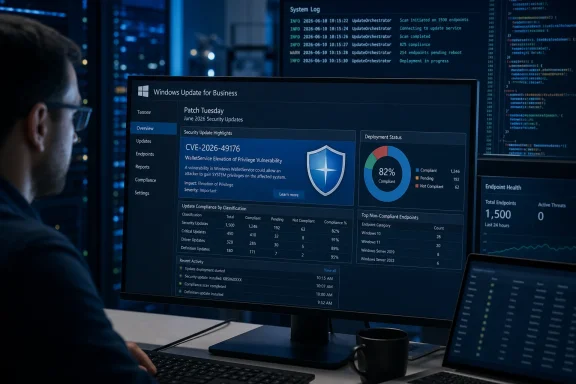
Microsoft has fixed CVE-2026-49176, an Important-rated elevation-of-privilege vulnerability in Windows WalletService, through the July 14, 2026 security updates. The flaw creates a path for an attacker who already has authorized local access to gain additional privileges, making the cumulative Windows update the primary remediation rather than a service-level workaround.
The Microsoft Security Response Center published the advisory at 10 a.m. Pacific time as part of July’s unusually large Patch Tuesday release. BleepingComputer counted 570 Microsoft vulnerabilities addressed during the rollout, including 254 elevation-of-privilege issues; CVE-2026-49176 is one of them, but Microsoft has not identified it as publicly disclosed or exploited in attacks.
That distinction matters. WalletService is not presented here as a remotely exploitable entry point, and Microsoft has disclosed no evidence that attackers are using this specific bug. It should nevertheless be treated as a post-compromise risk that could help turn limited local access into a more damaging foothold.
Microsoft classifies CVE-2026-49176 as an elevation-of-privilege vulnerability. In practical terms, that category generally describes a flaw used after an attacker has obtained some ability to execute code or interact with the affected system under a constrained security context.
It is therefore different from an unauthenticated remote-code-execution vulnerability exposed directly to the internet. An attacker would first need the access required by Microsoft’s attack model, whether obtained through stolen credentials, malicious software, another vulnerability, or misuse by an authorized user.
That prerequisite lowers the urgency compared with a remotely reachable zero-day, but it does not make the vulnerability harmless. Privilege escalation is often the bridge between initial access and actions such as disabling security controls, accessing other users’ information, establishing persistence, or tampering with system configuration.
The advisory’s WalletService label also should not be interpreted as a warning that Microsoft Wallet accounts or payment credentials can be stolen remotely. The published impact is privilege elevation in Windows, not a disclosed payment-data breach, authentication bypass, or Microsoft account compromise. Microsoft has not released technical evidence supporting broader claims.
Microsoft’s exploit-maturity information is intended to communicate how much confidence exists in both the vulnerability and the available technical evidence. A confirmed vendor finding carries more weight than an uncorroborated claim, but it does not automatically tell defenders how easy exploitation will be in real environments.
The lack of technical detail has two consequences. It denies would-be attackers a vendor-supplied roadmap, but it also leaves administrators with few useful controls beyond deploying the security update and monitoring endpoints for suspicious privilege changes.
Microsoft has not published a mitigation that would provide equivalent protection while leaving the vulnerable code installed. Administrators should not disable WalletService across a fleet solely on the basis of the component name, particularly where applications or Windows features may depend on it. Unplanned service changes can introduce support problems without reliably closing every path to the vulnerable code.
The update itself is the security boundary change Microsoft has tested. If a device cannot be patched immediately, its compensating controls should focus on reducing opportunities for local code execution and limiting the usefulness of any compromised account.
The risk is less immediate on tightly controlled machines where users cannot introduce code and application execution is strongly restricted. Even there, postponing the update indefinitely leaves a privilege-escalation primitive available if another control later fails.
Enterprise administrators should deploy the relevant July cumulative update through Windows Update for Business, Microsoft Intune, Windows Server Update Services, Configuration Manager, or their usual patch platform. Because Windows security fixes are cumulative, teams normally do not need to locate and install a separate WalletService package.
A sensible rollout should include the following actions:
The patch cycle also included 59 Critical-rated vulnerabilities, according to BleepingComputer’s count, while CVE-2026-49176 remained at Important severity. That ranking gives administrators a rational reason to test and deploy actively exploited or remotely exploitable fixes first when maintenance capacity is constrained.
Severity, however, is not a complete deployment strategy. Attackers frequently combine vulnerabilities with different ratings: one provides execution under a normal account, another raises privileges, and a third assists lateral movement or persistence. A local elevation-of-privilege bug can become substantially more valuable when chained with phishing, browser exploitation, stolen remote-access credentials, or malicious software already executing in a user session.
This is why organizations should avoid filtering Patch Tuesday solely for Critical ratings. Doing so can leave behind exactly the local privilege-escalation weaknesses needed to convert a contained incident into a system-level compromise.
There is currently no public indication that CVE-2026-49176 is a zero-day or under active exploitation. That is useful for triage, but it is not a reason to exclude the fix from the regular July deployment cycle.
Managed environments have more work to do because the scale of July’s release increases the chance of testing bottlenecks and deployment exceptions. Administrators should record any device held back for compatibility reasons, attach an owner and deadline to the exception, and prevent a temporary pause from becoming an untracked gap.
Security teams should also distinguish between not known to be exploited and not exploitable. Microsoft’s initial advisory describes a genuine vulnerability that warranted a security update. The absence of public exploitation only reflects what Microsoft had disclosed as of July 14, 2026.
The next meaningful milestone will be any revision to the MSRC record that adds affected-product detail, exploitability changes, acknowledgements, or a more specific description of the flaw. Until then, CVE-2026-49176 is best handled as a confirmed local privilege-escalation risk with limited public technical detail: lower priority than July’s active zero-days, but firmly inside the normal Patch Tuesday deployment window.
The Microsoft Security Response Center published the advisory at 10 a.m. Pacific time as part of July’s unusually large Patch Tuesday release. BleepingComputer counted 570 Microsoft vulnerabilities addressed during the rollout, including 254 elevation-of-privilege issues; CVE-2026-49176 is one of them, but Microsoft has not identified it as publicly disclosed or exploited in attacks.
That distinction matters. WalletService is not presented here as a remotely exploitable entry point, and Microsoft has disclosed no evidence that attackers are using this specific bug. It should nevertheless be treated as a post-compromise risk that could help turn limited local access into a more damaging foothold.
 The Attack Starts After Access Has Already Been Gained
Microsoft classifies CVE-2026-49176 as an elevation-of-privilege vulnerability. In practical terms, that category generally describes a flaw used after an attacker has obtained some ability to execute code or interact with the affected system under a constrained security context.It is therefore different from an unauthenticated remote-code-execution vulnerability exposed directly to the internet. An attacker would first need the access required by Microsoft’s attack model, whether obtained through stolen credentials, malicious software, another vulnerability, or misuse by an authorized user.
That prerequisite lowers the urgency compared with a remotely reachable zero-day, but it does not make the vulnerability harmless. Privilege escalation is often the bridge between initial access and actions such as disabling security controls, accessing other users’ information, establishing persistence, or tampering with system configuration.
The advisory’s WalletService label also should not be interpreted as a warning that Microsoft Wallet accounts or payment credentials can be stolen remotely. The published impact is privilege elevation in Windows, not a disclosed payment-data breach, authentication bypass, or Microsoft account compromise. Microsoft has not released technical evidence supporting broader claims.
Microsoft Is Keeping the Technical Detail Narrow
The initial MSRC entry confirms the vulnerability’s existence and affected component but offers limited public information about its root cause. No proof-of-concept code, exploit procedure, detailed call path, or service configuration workaround was included in the material available at publication time.Microsoft’s exploit-maturity information is intended to communicate how much confidence exists in both the vulnerability and the available technical evidence. A confirmed vendor finding carries more weight than an uncorroborated claim, but it does not automatically tell defenders how easy exploitation will be in real environments.
The lack of technical detail has two consequences. It denies would-be attackers a vendor-supplied roadmap, but it also leaves administrators with few useful controls beyond deploying the security update and monitoring endpoints for suspicious privilege changes.
Microsoft has not published a mitigation that would provide equivalent protection while leaving the vulnerable code installed. Administrators should not disable WalletService across a fleet solely on the basis of the component name, particularly where applications or Windows features may depend on it. Unplanned service changes can introduce support problems without reliably closing every path to the vulnerable code.
The update itself is the security boundary change Microsoft has tested. If a device cannot be patched immediately, its compensating controls should focus on reducing opportunities for local code execution and limiting the usefulness of any compromised account.
Patch Priority Depends on Who Can Reach the Device
CVE-2026-49176 belongs near the front of the queue for shared workstations, virtual desktop infrastructure, jump boxes, development machines, kiosks with additional software installed, and other endpoints where multiple users or untrusted processes may operate. Systems handling downloaded executables, scripts, archives, email attachments, or third-party plug-ins also have more realistic paths to an initial foothold.The risk is less immediate on tightly controlled machines where users cannot introduce code and application execution is strongly restricted. Even there, postponing the update indefinitely leaves a privilege-escalation primitive available if another control later fails.
Enterprise administrators should deploy the relevant July cumulative update through Windows Update for Business, Microsoft Intune, Windows Server Update Services, Configuration Manager, or their usual patch platform. Because Windows security fixes are cumulative, teams normally do not need to locate and install a separate WalletService package.
A sensible rollout should include the following actions:
- Confirm that July 2026 Windows security updates are approved for every supported client and server release in the organization.
- Test the cumulative update against line-of-business applications, authentication tooling, endpoint protection, and device-management agents.
- Prioritize systems used by administrators, developers, contractors, and other users who can execute locally supplied content.
- Verify installation through update-compliance reporting rather than relying only on deployment status.
- Investigate repeated service failures, unusual child processes, unexpected token changes, and unexplained local administrator activity on machines awaiting the patch.
A Crowded Patch Tuesday Can Hide Routine but Useful Exploit Links
CVE-2026-49176 is not one of the vulnerabilities driving the headlines around July 2026 Patch Tuesday. BleepingComputer reported that Microsoft fixed three zero-days in the release, including two vulnerabilities observed in attacks and one that had been publicly disclosed. WalletService was not among those three.The patch cycle also included 59 Critical-rated vulnerabilities, according to BleepingComputer’s count, while CVE-2026-49176 remained at Important severity. That ranking gives administrators a rational reason to test and deploy actively exploited or remotely exploitable fixes first when maintenance capacity is constrained.
Severity, however, is not a complete deployment strategy. Attackers frequently combine vulnerabilities with different ratings: one provides execution under a normal account, another raises privileges, and a third assists lateral movement or persistence. A local elevation-of-privilege bug can become substantially more valuable when chained with phishing, browser exploitation, stolen remote-access credentials, or malicious software already executing in a user session.
This is why organizations should avoid filtering Patch Tuesday solely for Critical ratings. Doing so can leave behind exactly the local privilege-escalation weaknesses needed to convert a contained incident into a system-level compromise.
There is currently no public indication that CVE-2026-49176 is a zero-day or under active exploitation. That is useful for triage, but it is not a reason to exclude the fix from the regular July deployment cycle.
The Cumulative Update Is the Practical Fix
For home users and unmanaged Windows PCs, the appropriate response is straightforward: install the July 2026 cumulative security update offered by Windows Update, restart if requested, and confirm that update installation completed successfully. Users do not need to interact with WalletService or remove wallet-related applications.Managed environments have more work to do because the scale of July’s release increases the chance of testing bottlenecks and deployment exceptions. Administrators should record any device held back for compatibility reasons, attach an owner and deadline to the exception, and prevent a temporary pause from becoming an untracked gap.
Security teams should also distinguish between not known to be exploited and not exploitable. Microsoft’s initial advisory describes a genuine vulnerability that warranted a security update. The absence of public exploitation only reflects what Microsoft had disclosed as of July 14, 2026.
The next meaningful milestone will be any revision to the MSRC record that adds affected-product detail, exploitability changes, acknowledgements, or a more specific description of the flaw. Until then, CVE-2026-49176 is best handled as a confirmed local privilege-escalation risk with limited public technical detail: lower priority than July’s active zero-days, but firmly inside the normal Patch Tuesday deployment window.
References
- Primary source: MSRC
Published: 2026-07-14T07:00:00-07:00
Security Update Guide - Microsoft Security Response Center
 msrc.microsoft.com
