

Microsoft has patched CVE-2026-50297, a Windows Win32k elevation-of-privilege vulnerability that could let a low-privileged attacker gain extensive control of a compromised PC or server. The flaw affects supported editions from Windows Server 2012 through Windows Server 2025, along with Windows 10 and Windows 11, and was disclosed with Microsoft’s July 14, 2026 security updates.
Detailed in the Microsoft Security Response Center’s Security Update Guide, the vulnerability stems from improper access control in Windows Win32k. Administrators should deploy the July cumulative updates rather than treating the flaw as a remotely exploitable entry point: exploitation requires an attacker to already have local access and valid low-level privileges.
The National Vulnerability Database lists a Microsoft-assigned CVSS 3.1 base score of 7.0, categorized as High. Microsoft’s vector indicates that exploitation requires no user interaction but carries high attack complexity; a successful attack could have a high impact on confidentiality, integrity, and availability.
Win32k is a central part of the Windows graphical subsystem, handling functions associated with windows, menus, input, drawing, and other interactions between user-mode applications and the operating system. Its position close to the kernel makes Win32k vulnerabilities particularly useful for privilege escalation, even when they cannot be reached directly across a network.
CVE-2026-50297 is classified under CWE-284, Improper Access Control. Microsoft’s description remains concise: an authorized attacker can exploit the weakness locally to elevate privileges. The company has not published a root-cause analysis, proof-of-concept code, or the precise Win32k operation involved.
The CVSS vector provides the clearest public picture of the attack:
The practical concern is the gap between “authorized attacker” and “trusted user.” In vulnerability terminology, authorized means the attacker already possesses some ability to log on or execute code; it does not mean the activity is legitimate. Malware running under an ordinary account could potentially use the flaw to reach administrative or SYSTEM-level capabilities, depending on the final exploit technique.
Windows Server 2012 must reach build 9200.26226, while Windows Server 2012 R2 must reach build 9600.23291. Microsoft lists both full and Server Core installations where applicable, so removing the graphical shell does not by itself eliminate exposure.
Administrators can check the installed build by running
The presence of Windows 10 version 21H2 and 22H2 in the affected data does not imply that every consumer installation of those releases remains entitled to ordinary servicing. Some editions and deployment channels have different support timelines, while older systems may receive updates only through specialized servicing arrangements. Organizations maintaining legacy Windows 10 or Windows Server deployments should verify that each device is covered by an active support or extended-security program.
In CVSS terminology, confirmed report confidence means that the vendor or available technical evidence substantiates the vulnerability’s existence. Microsoft’s acknowledgement and security update satisfy that standard. It does not mean attackers have confirmed exploitation in the wild.
CISA’s initial Stakeholder-Specific Vulnerability Categorization entry, added on July 14, recorded no known exploitation and described the vulnerability as not readily automatable. CISA nevertheless assessed the potential technical impact as total, reflecting the level of control that a successful privilege-escalation chain could provide.
As of the initial disclosure, CVE-2026-50297 was not identified in the available government data as an actively exploited vulnerability. It should not be described as a zero-day solely because it received a CVE and patch on the same date.
That distinction matters for patch triage. Internet-facing remote-code-execution bugs and vulnerabilities already used in attacks generally deserve the fastest emergency response. CVE-2026-50297 instead belongs in the category of significant local escalation flaws that should be fixed through an accelerated, well-tested cumulative-update deployment.
Those controls do not correct Win32k’s access-control defect. They are barriers around the vulnerable component, not substitutes for the July security update. An endpoint product may also detect one exploit implementation while missing another technique targeting the same underlying weakness.
Server administrators should pay particular attention to systems where ordinary users, service accounts, developers, or contractors can run programs interactively. Remote Desktop Session Hosts, shared administrative servers, virtual desktop infrastructure, build systems, and multi-user application servers give local privilege-escalation vulnerabilities more opportunities than tightly controlled single-purpose servers.
For workstations, the main risk is an attack chain that begins with execution under the logged-on user. Removing local administrator rights remains valuable, but CVE-2026-50297 demonstrates why that control must be paired with timely patching: privilege-escalation vulnerabilities are specifically designed to cross the boundary that least-privilege configurations create.
Organizations deploying the July 2026 cumulative updates should validate line-of-business applications and monitor Microsoft’s release-health channels for servicing issues, but they should avoid delaying solely because the CVSS score is 7.0 rather than 9.8. The score reflects local access and high complexity; it does not diminish the potential outcome after successful exploitation.
The immediate milestone is straightforward: Windows 11 24H2 devices should report build 26100.8875 or later, Windows 11 25H2 should report 26200.8875 or later, and corresponding Windows 10 and Windows Server systems should meet their corrected build thresholds. Any managed endpoint still below those levels remains exposed to CVE-2026-50297 and should stay in the July patch queue until installation and restart status are verified.
Detailed in the Microsoft Security Response Center’s Security Update Guide, the vulnerability stems from improper access control in Windows Win32k. Administrators should deploy the July cumulative updates rather than treating the flaw as a remotely exploitable entry point: exploitation requires an attacker to already have local access and valid low-level privileges.
The National Vulnerability Database lists a Microsoft-assigned CVSS 3.1 base score of 7.0, categorized as High. Microsoft’s vector indicates that exploitation requires no user interaction but carries high attack complexity; a successful attack could have a high impact on confidentiality, integrity, and availability.
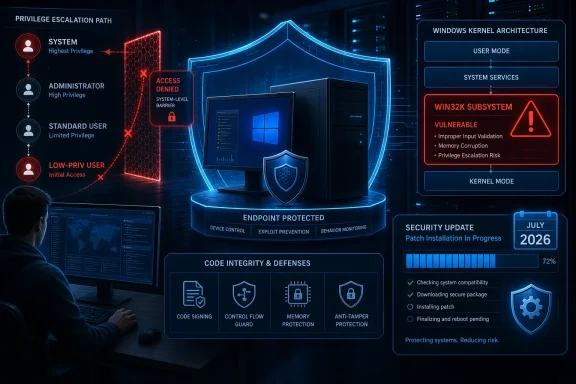 A Local Flaw With System-Level Consequences
Win32k is a central part of the Windows graphical subsystem, handling functions associated with windows, menus, input, drawing, and other interactions between user-mode applications and the operating system. Its position close to the kernel makes Win32k vulnerabilities particularly useful for privilege escalation, even when they cannot be reached directly across a network.CVE-2026-50297 is classified under CWE-284, Improper Access Control. Microsoft’s description remains concise: an authorized attacker can exploit the weakness locally to elevate privileges. The company has not published a root-cause analysis, proof-of-concept code, or the precise Win32k operation involved.
The CVSS vector provides the clearest public picture of the attack:
- The attacker must have local access to the affected Windows system.
- The attacker needs existing low-level privileges.
- Exploitation requires no action from another user.
- Attack complexity is rated high, suggesting that reliable exploitation depends on conditions beyond simply running a malicious executable.
- A successful attack can produce high confidentiality, integrity, and availability impact.
The practical concern is the gap between “authorized attacker” and “trusted user.” In vulnerability terminology, authorized means the attacker already possesses some ability to log on or execute code; it does not mean the activity is legitimate. Malware running under an ordinary account could potentially use the flaw to reach administrative or SYSTEM-level capabilities, depending on the final exploit technique.
July’s Builds Mark the Security Boundary
The affected-product data submitted by Microsoft covers a broad span of Windows releases. Systems below the following build levels remain within the vulnerable ranges listed in the CVE record:| Windows release | Security build threshold |
|---|---|
| Windows 10 version 1607 and Windows Server 2016 | 14393.9339 |
| Windows 10 version 1809 and Windows Server 2019 | 17763.9020 |
| Windows 10 version 21H2 | 19044.7548 |
| Windows 10 version 22H2 | 19045.7548 |
| Windows 11 version 24H2 | 26100.8875 |
| Windows 11 version 25H2 | 26200.8875 |
| Windows 11 version 26H1 | 28000.2269 |
| Windows Server 2022 | 20348.5386 |
| Windows Server 2025 | 26100.33158 |
Administrators can check the installed build by running
winver, examining the operating-system inventory in Microsoft Intune or Configuration Manager, or querying devices through PowerShell and their endpoint-management platform. The relevant comparison is not simply whether Windows Update reports that it checked recently, but whether the machine has installed the July 2026 security release and reached the corrected build.The presence of Windows 10 version 21H2 and 22H2 in the affected data does not imply that every consumer installation of those releases remains entitled to ordinary servicing. Some editions and deployment channels have different support timelines, while older systems may receive updates only through specialized servicing arrangements. Organizations maintaining legacy Windows 10 or Windows Server deployments should verify that each device is covered by an active support or extended-security program.
“Confirmed” Describes Evidence, Not Active Exploitation
The report-confidence metric accompanying CVE-2026-50297 is marked confirmed. That language can sound more alarming than intended, particularly when it appears beside a Windows kernel-adjacent vulnerability.In CVSS terminology, confirmed report confidence means that the vendor or available technical evidence substantiates the vulnerability’s existence. Microsoft’s acknowledgement and security update satisfy that standard. It does not mean attackers have confirmed exploitation in the wild.
CISA’s initial Stakeholder-Specific Vulnerability Categorization entry, added on July 14, recorded no known exploitation and described the vulnerability as not readily automatable. CISA nevertheless assessed the potential technical impact as total, reflecting the level of control that a successful privilege-escalation chain could provide.
As of the initial disclosure, CVE-2026-50297 was not identified in the available government data as an actively exploited vulnerability. It should not be described as a zero-day solely because it received a CVE and patch on the same date.
That distinction matters for patch triage. Internet-facing remote-code-execution bugs and vulnerabilities already used in attacks generally deserve the fastest emergency response. CVE-2026-50297 instead belongs in the category of significant local escalation flaws that should be fixed through an accelerated, well-tested cumulative-update deployment.
Endpoint Controls Reduce the Opening, Not the Need to Patch
Because exploitation begins locally, controls that limit code execution can reduce the likelihood that CVE-2026-50297 becomes useful. Microsoft Defender for Endpoint, application control, attack-surface-reduction rules, least-privilege account policies, and restrictions on interactive server logons all make it harder for an attacker to establish the foothold required to attempt escalation.Those controls do not correct Win32k’s access-control defect. They are barriers around the vulnerable component, not substitutes for the July security update. An endpoint product may also detect one exploit implementation while missing another technique targeting the same underlying weakness.
Server administrators should pay particular attention to systems where ordinary users, service accounts, developers, or contractors can run programs interactively. Remote Desktop Session Hosts, shared administrative servers, virtual desktop infrastructure, build systems, and multi-user application servers give local privilege-escalation vulnerabilities more opportunities than tightly controlled single-purpose servers.
For workstations, the main risk is an attack chain that begins with execution under the logged-on user. Removing local administrator rights remains valuable, but CVE-2026-50297 demonstrates why that control must be paired with timely patching: privilege-escalation vulnerabilities are specifically designed to cross the boundary that least-privilege configurations create.
Organizations deploying the July 2026 cumulative updates should validate line-of-business applications and monitor Microsoft’s release-health channels for servicing issues, but they should avoid delaying solely because the CVSS score is 7.0 rather than 9.8. The score reflects local access and high complexity; it does not diminish the potential outcome after successful exploitation.
The immediate milestone is straightforward: Windows 11 24H2 devices should report build 26100.8875 or later, Windows 11 25H2 should report 26200.8875 or later, and corresponding Windows 10 and Windows Server systems should meet their corrected build thresholds. Any managed endpoint still below those levels remains exposed to CVE-2026-50297 and should stay in the July patch queue until installation and restart status are verified.
References
- Primary source: MSRC
Published: 2026-07-14T07:00:00-07:00
Security Update Guide - Microsoft Security Response Center
 msrc.microsoft.com
- Related coverage: aha.org
- Related coverage: safe.security
Windows Win32k Elevation of Privilege Vulnerability [CVE-2021-1732]
In this research paper, you can learn about Windows Win32k elevation of privilege vulnerability (CVE-2021-1732) and how it works. Download it here.safe.security
