

CVE-2026-50331 is a Windows Application Model Core API use-after-free vulnerability that can let a locally authenticated attacker elevate privileges on supported Windows 10, Windows 11, and Windows Server systems. Microsoft fixed the flaw in the July 14, 2026 security updates, assigning it an Important severity rating and a CVSS 3.1 base score of 7.8.
Detailed in Microsoft’s Security Update Guide, the vulnerability is not remotely exploitable on its own. An attacker must already possess low-level access to the target computer, but successful exploitation could compromise confidentiality, integrity, and availability without additional user interaction.
Microsoft says exploitation is less likely. The company had not observed attacks and the vulnerability was not publicly disclosed before the patch became available. That lowers its immediate urgency compared with the actively exploited vulnerabilities in July’s unusually large Patch Tuesday release, but it does not make the flaw safe to leave unpatched.
Microsoft describes CVE-2026-50331 as a use-after-free condition, categorized as CWE-416. This class of vulnerability occurs when software continues to reference memory after that memory has been released, potentially allowing an attacker to influence what occupies the freed space.
The resulting behavior can range from an application crash to controlled memory corruption. In this case, Microsoft has confirmed that the issue can be used for local elevation of privilege within the Windows Application Model.
The CVSS vector is
The vulnerability’s attack complexity is rated low. That distinction matters because some local privilege-escalation bugs depend on unreliable race conditions or narrow system states; CVE-2026-50331 is scored as potentially repeatable once an attacker has established the required foothold.
Microsoft also marks the report confidence as confirmed. The vendor has therefore validated the vulnerability and the available technical assessment rather than publishing an advisory based only on an uncorroborated report.
No mitigation or workaround has been published. Installing the applicable July cumulative security update is the prescribed remediation.
Affected branches include:
Windows Server Core is not insulated by its smaller graphical footprint. The vulnerable Application Model component is present in the affected Server Core configurations listed by Microsoft, so removing the desktop experience does not constitute a workaround.
For Windows 11 24H2 and 25H2, the fix is included in KB5101650, which advances the operating systems to builds 26100.8875 and 26200.8875 respectively. Windows 11 26H1 receives the July security changes through KB5101649, which advances that branch beyond its vulnerable June build.
Microsoft’s affected-version records identify these fixed build boundaries:
That makes it relevant to attack chaining. Code initially confined to a standard user account may have limited access to protected files, security controls, other users’ data, and system-wide configuration. A working privilege-escalation exploit can remove those restrictions and turn an otherwise contained compromise into control over the machine.
The CVSS assessment assigns high potential impact across confidentiality, integrity, and availability. Microsoft has not publicly documented the precise privilege level obtainable, the vulnerable function, or a proof-of-concept exploitation sequence, so claims that the flaw definitively grants SYSTEM access would go beyond the information currently available.
There is also no evidence as of July 15 that CVE-2026-50331 is being exploited in the wild. BleepingComputer’s July Patch Tuesday tracking and the Zero Day Initiative’s release review both list it as neither publicly disclosed nor actively exploited when Microsoft issued the update.
That status should shape prioritization, not justify indefinite delay. Internet-facing vulnerabilities and the two vulnerabilities Microsoft identified as actively exploited in July deserve faster emergency attention, while CVE-2026-50331 belongs in the normal accelerated deployment cycle for workstations, multi-user systems, Remote Desktop hosts, and servers where untrusted or lower-privileged code can run.
Security teams should also avoid treating vulnerability-scanner results as authoritative until Microsoft’s July metadata has been fully ingested. CVE-2026-50331 was published only on July 14, and the National Vulnerability Database initially marked the record as awaiting enrichment even though Microsoft’s CVSS score and affected-product information were already available.
Because Microsoft has supplied no standalone mitigation, disabling an unrelated application feature or restricting one packaged app is not a documented fix. The vulnerable surface belongs to the Windows Application Model, and the security boundary is restored through the operating-system update.
The immediate task is straightforward: install the July 14, 2026 cumulative update, restart where required, and verify that each device has reached its branch’s fixed build. With no public exploit and Microsoft rating exploitation less likely, CVE-2026-50331 is not the month’s top emergency—but on systems where an attacker already has a foothold, the difference between a standard account and elevated control is exactly the boundary this patch is meant to preserve.
Detailed in Microsoft’s Security Update Guide, the vulnerability is not remotely exploitable on its own. An attacker must already possess low-level access to the target computer, but successful exploitation could compromise confidentiality, integrity, and availability without additional user interaction.
Microsoft says exploitation is less likely. The company had not observed attacks and the vulnerability was not publicly disclosed before the patch became available. That lowers its immediate urgency compared with the actively exploited vulnerabilities in July’s unusually large Patch Tuesday release, but it does not make the flaw safe to leave unpatched.
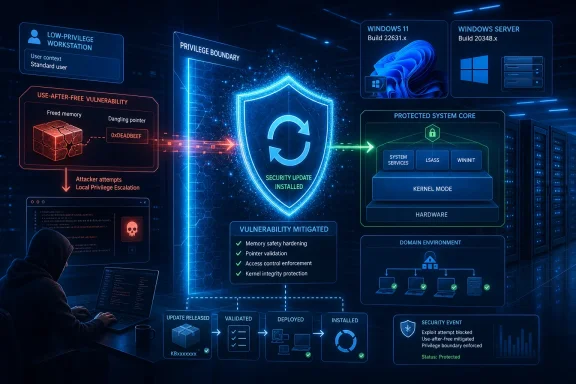 A Memory-Safety Bug Opens a Privilege Boundary
Microsoft describes CVE-2026-50331 as a use-after-free condition, categorized as CWE-416. This class of vulnerability occurs when software continues to reference memory after that memory has been released, potentially allowing an attacker to influence what occupies the freed space.The resulting behavior can range from an application crash to controlled memory corruption. In this case, Microsoft has confirmed that the issue can be used for local elevation of privilege within the Windows Application Model.
The CVSS vector is
AV:L/AC:L/PR:L/UI:N/S:U/C:H/I:H/A:H. In practical terms, that means exploitation requires local access and existing low privileges, but Microsoft does not identify unusual timing requirements, complicated configuration dependencies, or victim interaction as prerequisites.The vulnerability’s attack complexity is rated low. That distinction matters because some local privilege-escalation bugs depend on unreliable race conditions or narrow system states; CVE-2026-50331 is scored as potentially repeatable once an attacker has established the required foothold.
Microsoft also marks the report confidence as confirmed. The vendor has therefore validated the vulnerability and the available technical assessment rather than publishing an advisory based only on an uncorroborated report.
No mitigation or workaround has been published. Installing the applicable July cumulative security update is the prescribed remediation.
Supported Windows Generations Share the Exposure
CVE-2026-50331 spans current Windows 11 releases, extended Windows 10 deployments, and several Windows Server generations. The affected product data includes both x64 and ARM64 systems where those architectures are supported, along with 32-bit editions of older Windows releases.Affected branches include:
- Windows 10 versions 1607, 1809, 21H2, and 22H2 are affected in servicing configurations where Microsoft still supplies the applicable security updates.
- Windows 11 versions 24H2, 25H2, and 26H1 are affected.
- Windows Server 2016, Windows Server 2019, Windows Server 2022, and Windows Server 2025 are affected.
- Server Core installations of Windows Server 2016, 2019, and 2025 are included in Microsoft’s affected-product records.
Windows Server Core is not insulated by its smaller graphical footprint. The vulnerable Application Model component is present in the affected Server Core configurations listed by Microsoft, so removing the desktop experience does not constitute a workaround.
For Windows 11 24H2 and 25H2, the fix is included in KB5101650, which advances the operating systems to builds 26100.8875 and 26200.8875 respectively. Windows 11 26H1 receives the July security changes through KB5101649, which advances that branch beyond its vulnerable June build.
Microsoft’s affected-version records identify these fixed build boundaries:
- Windows 10 1607 and Windows Server 2016 require build 14393.9339 or later.
- Windows 10 1809 and Windows Server 2019 require build 17763.9020 or later.
- Windows 10 21H2 requires build 19044.7548 or later.
- Windows 10 22H2 requires build 19045.7548 or later.
- Windows 11 24H2 requires build 26100.8875 or later.
- Windows 11 25H2 requires build 26200.8875 or later.
- Windows Server 2022 requires build 20348.5386 or later.
- Windows Server 2025 requires build 26100.33158 or later.
Local Does Not Mean Low Impact
CVE-2026-50331 cannot serve as the initial network entry point described by its current scoring. Instead, it is the sort of flaw an attacker could use after gaining access through phishing, stolen credentials, a malicious application, an exposed remote-management service, or another vulnerability.That makes it relevant to attack chaining. Code initially confined to a standard user account may have limited access to protected files, security controls, other users’ data, and system-wide configuration. A working privilege-escalation exploit can remove those restrictions and turn an otherwise contained compromise into control over the machine.
The CVSS assessment assigns high potential impact across confidentiality, integrity, and availability. Microsoft has not publicly documented the precise privilege level obtainable, the vulnerable function, or a proof-of-concept exploitation sequence, so claims that the flaw definitively grants SYSTEM access would go beyond the information currently available.
There is also no evidence as of July 15 that CVE-2026-50331 is being exploited in the wild. BleepingComputer’s July Patch Tuesday tracking and the Zero Day Initiative’s release review both list it as neither publicly disclosed nor actively exploited when Microsoft issued the update.
That status should shape prioritization, not justify indefinite delay. Internet-facing vulnerabilities and the two vulnerabilities Microsoft identified as actively exploited in July deserve faster emergency attention, while CVE-2026-50331 belongs in the normal accelerated deployment cycle for workstations, multi-user systems, Remote Desktop hosts, and servers where untrusted or lower-privileged code can run.
Patch Verification Is the Practical Control
Organizations using Windows Update for Business, Microsoft Intune, Windows Server Update Services, Configuration Manager, or third-party patching platforms should confirm that the July 14 cumulative update reached each affected servicing branch. A successful deployment record should be paired with a build-number check and, where policy requires it, a restart verification.Security teams should also avoid treating vulnerability-scanner results as authoritative until Microsoft’s July metadata has been fully ingested. CVE-2026-50331 was published only on July 14, and the National Vulnerability Database initially marked the record as awaiting enrichment even though Microsoft’s CVSS score and affected-product information were already available.
Because Microsoft has supplied no standalone mitigation, disabling an unrelated application feature or restricting one packaged app is not a documented fix. The vulnerable surface belongs to the Windows Application Model, and the security boundary is restored through the operating-system update.
The immediate task is straightforward: install the July 14, 2026 cumulative update, restart where required, and verify that each device has reached its branch’s fixed build. With no public exploit and Microsoft rating exploitation less likely, CVE-2026-50331 is not the month’s top emergency—but on systems where an attacker already has a foothold, the difference between a standard account and elevated control is exactly the boundary this patch is meant to preserve.
References
- Primary source: MSRC
Published: 2026-07-14T07:00:00-07:00
Security Update Guide - Microsoft Security Response Center
 msrc.microsoft.com
