

CVE-2026-50360 exposes Windows SMB Server to a high-severity privilege-escalation attack that can be launched across a network by an attacker who already has valid credentials. Microsoft fixed the flaw in its July 14, 2026 security updates, making prompt deployment particularly important for file servers, infrastructure hosts, and workstations accepting inbound SMB connections.
Detailed in Microsoft’s Security Update Guide and added to the National Vulnerability Database on July 14, the vulnerability carries a CVSS 3.1 score of 8.8 out of 10. Microsoft classifies it as Important rather than Critical because exploitation requires an authorized attacker, but the combination of network access, low attack complexity, and potentially severe consequences makes that distinction less comforting inside a compromised environment.
The Zero Day Initiative’s July security review lists CVE-2026-50360 as neither publicly disclosed nor known to be exploited when Microsoft released the patch. There is currently no public indication that it has entered CISA’s Known Exploited Vulnerabilities catalog.
Microsoft describes the underlying weakness as an incorrect implementation of an authentication algorithm in Windows SMB Server. The issue is categorized as CWE-303, Incorrect Implementation of Authentication Algorithm, indicating that the server does not correctly apply an authentication mechanism under the vulnerable conditions.
The available description is brief, and Microsoft has not published proof-of-concept code, packet-level details, or the exact privilege level an attacker obtains. The CVSS vector nevertheless reveals the practical shape of the attack: it is remotely reachable, requires low privileges, involves no user interaction, and has low attack complexity.
That means CVE-2026-50360 is not an anonymous internet-to-SYSTEM exploit. An attacker must first possess credentials or otherwise establish an authorized position from which the vulnerable SMB Server can be reached. Once that prerequisite is met, successful exploitation could result in a high impact to confidentiality, integrity, and availability, according to Microsoft’s CVSS assessment.
This is the sort of vulnerability that becomes more dangerous after the first defensive boundary has already failed. Stolen employee credentials, a compromised workstation, an exposed service account, or access obtained through another vulnerability could supply the initial foothold. CVE-2026-50360 could then reportedly be used to expand the attacker’s authority on another Windows computer over the network.
SMB’s position inside Windows networks makes that scenario relevant beyond traditional file servers. The protocol supports shared folders and printers, but it is also used by administrative tooling, application workflows, deployment systems, backup products, and other Windows services. A system does not need “file server” in its hostname to present an SMB attack surface.
Administrators should verify that systems have reached at least these corrected levels:
The version numbers matter because vulnerability scanners and asset inventories may identify the CVE through the installed OS revision rather than a separately installed SMB component. Windows cumulative updates are cumulative by design, so installing a later security update should also carry the correction forward.
Windows Server 2025 and Windows 11 24H2 both use a 26100-based branch, but their servicing revisions are not interchangeable. A protected Windows 11 24H2 client reports 26100.8875, while Windows Server 2025 reaches 26100.33158 through its separate server servicing path. Administrators should evaluate each product against its own build target instead of comparing only the first portion of the version number.
Microsoft’s published affected-product list does not identify Windows Server 2016 or Windows Server 2019 as vulnerable to CVE-2026-50360. That absence should not be treated as permission to defer their July updates, which address other vulnerabilities, but it helps narrow the immediate exposure assessment for this particular SMB flaw.
Internet-facing TCP port 445 should already be blocked except where there is an explicitly engineered requirement. CVE-2026-50360 reinforces that baseline, but perimeter filtering alone does not address the more plausible internal threat. Microsoft’s scoring assumes that the attacker is already authorized, so segmentation and east-west traffic controls are central to reducing exposure.
Security teams should examine whether ordinary user accounts can initiate SMB sessions to sensitive server tiers. Allowing every workstation subnet to reach every server over TCP 445 gives a compromised account a broad set of possible targets. Windows Defender Firewall rules, network access controls, privileged access workstations, and tiered administration can limit that reach even when credentials have been stolen.
Organizations unable to deploy the cumulative updates immediately should reduce SMB access to the narrowest set of trusted systems and accounts required for operations. Disabling SMB Server functionality may be possible on endpoints that do not host shares or depend on inbound SMB, but it can disrupt management and application workflows. Microsoft has not presented a configuration workaround as a substitute for installing the security update.
Monitoring should focus on unusual authenticated SMB connections rather than only failed logons. A valid low-privilege account connecting successfully to a high-value server may not trigger controls designed around brute-force attacks. Connections from unexpected workstations, service-account use from new hosts, and rapid SMB access across multiple systems warrant investigation.
That distinction matters when interpreting vulnerability-confidence metrics. Public exploit code and independent technical research can increase confidence in exactly how a flaw works, but vendor confirmation and patched version data already establish that the defect is real. What remains unknown is how readily attackers can reconstruct the vulnerable code path from the July binaries and turn it into a dependable exploit.
Microsoft and the Zero Day Initiative reported no known exploitation or prior public disclosure at release. That gives administrators a patching window, not a reason to ignore the issue. Monthly security updates expose a before-and-after comparison that researchers and attackers can analyze, and SMB remains an attractive target because it connects large portions of typical Windows estates.
For enterprise IT, the concrete objective is to move Windows Server 2022 to build 20348.5386, Windows Server 2025 to 26100.33158, and affected Windows clients to their corresponding July 14 security builds. Until those levels are verified across the estate, a stolen low-privilege identity may retain a network-reachable path to a much more damaging compromise.
Detailed in Microsoft’s Security Update Guide and added to the National Vulnerability Database on July 14, the vulnerability carries a CVSS 3.1 score of 8.8 out of 10. Microsoft classifies it as Important rather than Critical because exploitation requires an authorized attacker, but the combination of network access, low attack complexity, and potentially severe consequences makes that distinction less comforting inside a compromised environment.
The Zero Day Initiative’s July security review lists CVE-2026-50360 as neither publicly disclosed nor known to be exploited when Microsoft released the patch. There is currently no public indication that it has entered CISA’s Known Exploited Vulnerabilities catalog.
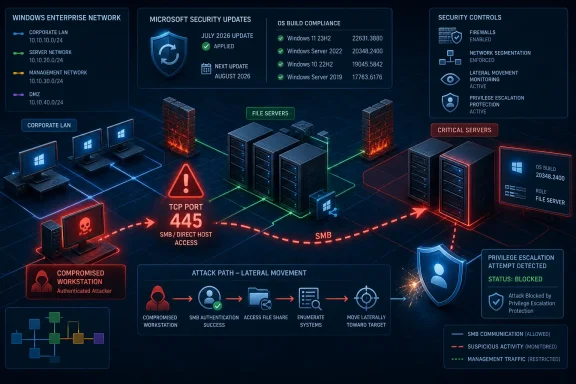 Authentication Failure Turns a Foothold Into a Larger Breach
Microsoft describes the underlying weakness as an incorrect implementation of an authentication algorithm in Windows SMB Server. The issue is categorized as CWE-303, Incorrect Implementation of Authentication Algorithm, indicating that the server does not correctly apply an authentication mechanism under the vulnerable conditions.The available description is brief, and Microsoft has not published proof-of-concept code, packet-level details, or the exact privilege level an attacker obtains. The CVSS vector nevertheless reveals the practical shape of the attack: it is remotely reachable, requires low privileges, involves no user interaction, and has low attack complexity.
That means CVE-2026-50360 is not an anonymous internet-to-SYSTEM exploit. An attacker must first possess credentials or otherwise establish an authorized position from which the vulnerable SMB Server can be reached. Once that prerequisite is met, successful exploitation could result in a high impact to confidentiality, integrity, and availability, according to Microsoft’s CVSS assessment.
This is the sort of vulnerability that becomes more dangerous after the first defensive boundary has already failed. Stolen employee credentials, a compromised workstation, an exposed service account, or access obtained through another vulnerability could supply the initial foothold. CVE-2026-50360 could then reportedly be used to expand the attacker’s authority on another Windows computer over the network.
SMB’s position inside Windows networks makes that scenario relevant beyond traditional file servers. The protocol supports shared folders and printers, but it is also used by administrative tooling, application workflows, deployment systems, backup products, and other Windows services. A system does not need “file server” in its hostname to present an SMB attack surface.
July Updates Establish the Protected Build Levels
CVE-2026-50360 affects supported client and server editions spanning Windows 10, Windows 11, Windows Server 2022, and Windows Server 2025. Microsoft’s affected-version data identifies the July 14 cumulative updates as the remediation, with machines running earlier builds remaining vulnerable.Administrators should verify that systems have reached at least these corrected levels:
- Windows 10 version 21H2 must be on OS Build 19044.7548 or later.
- Windows 10 version 22H2 must be on OS Build 19045.7548 or later.
- Windows 11 version 24H2 must be on OS Build 26100.8875 or later.
- Windows 11 version 25H2 must be on OS Build 26200.8875 or later.
- Windows 11 version 26H1 must be on a build newer than the affected 28000.2269 baseline.
- Windows Server 2022 must be on OS Build 20348.5386 or later.
- Windows Server 2025, including Server Core, must be on OS Build 26100.33158 or later.
The version numbers matter because vulnerability scanners and asset inventories may identify the CVE through the installed OS revision rather than a separately installed SMB component. Windows cumulative updates are cumulative by design, so installing a later security update should also carry the correction forward.
Windows Server 2025 and Windows 11 24H2 both use a 26100-based branch, but their servicing revisions are not interchangeable. A protected Windows 11 24H2 client reports 26100.8875, while Windows Server 2025 reaches 26100.33158 through its separate server servicing path. Administrators should evaluate each product against its own build target instead of comparing only the first portion of the version number.
Microsoft’s published affected-product list does not identify Windows Server 2016 or Windows Server 2019 as vulnerable to CVE-2026-50360. That absence should not be treated as permission to defer their July updates, which address other vulnerabilities, but it helps narrow the immediate exposure assessment for this particular SMB flaw.
Patch the Servers an Attacker Would Reach First
The most urgent systems are those that combine inbound SMB access with valuable privileges or data. Domain-connected file servers, Windows Server hosts used for software distribution, management servers, backup infrastructure, virtualization management systems, and administrative workstations deserve priority over ordinary endpoints that do not accept SMB traffic.Internet-facing TCP port 445 should already be blocked except where there is an explicitly engineered requirement. CVE-2026-50360 reinforces that baseline, but perimeter filtering alone does not address the more plausible internal threat. Microsoft’s scoring assumes that the attacker is already authorized, so segmentation and east-west traffic controls are central to reducing exposure.
Security teams should examine whether ordinary user accounts can initiate SMB sessions to sensitive server tiers. Allowing every workstation subnet to reach every server over TCP 445 gives a compromised account a broad set of possible targets. Windows Defender Firewall rules, network access controls, privileged access workstations, and tiered administration can limit that reach even when credentials have been stolen.
Organizations unable to deploy the cumulative updates immediately should reduce SMB access to the narrowest set of trusted systems and accounts required for operations. Disabling SMB Server functionality may be possible on endpoints that do not host shares or depend on inbound SMB, but it can disrupt management and application workflows. Microsoft has not presented a configuration workaround as a substitute for installing the security update.
Monitoring should focus on unusual authenticated SMB connections rather than only failed logons. A valid low-privilege account connecting successfully to a high-value server may not trigger controls designed around brute-force attacks. Connections from unexpected workstations, service-account use from new hosts, and rapid SMB access across multiple systems warrant investigation.
Limited Disclosure Does Not Mean Limited Impact
The sparse technical detail currently available raises uncertainty about the precise exploitation method, but not about the existence of the vulnerability. Microsoft assigned the CVE, identified the authentication implementation error, published affected build boundaries, and shipped corrected cumulative updates. NVD has reproduced Microsoft’s description and scoring while marking its own enrichment work as pending.That distinction matters when interpreting vulnerability-confidence metrics. Public exploit code and independent technical research can increase confidence in exactly how a flaw works, but vendor confirmation and patched version data already establish that the defect is real. What remains unknown is how readily attackers can reconstruct the vulnerable code path from the July binaries and turn it into a dependable exploit.
Microsoft and the Zero Day Initiative reported no known exploitation or prior public disclosure at release. That gives administrators a patching window, not a reason to ignore the issue. Monthly security updates expose a before-and-after comparison that researchers and attackers can analyze, and SMB remains an attractive target because it connects large portions of typical Windows estates.
For enterprise IT, the concrete objective is to move Windows Server 2022 to build 20348.5386, Windows Server 2025 to 26100.33158, and affected Windows clients to their corresponding July 14 security builds. Until those levels are verified across the estate, a stolen low-privilege identity may retain a network-reachable path to a much more damaging compromise.
References
- Primary source: MSRC
Published: 2026-07-14T07:00:00-07:00
Security Update Guide - Microsoft Security Response Center
 msrc.microsoft.com
- Official source: support.microsoft.com
July 14, 2026—KB5099540 (OS Build 20348.5386) | Microsoft Support
July 14, 2026—KB5099540 (OS Build 20348.5386)support.microsoft.com - Official source: learn.microsoft.com
Windows Server release information | Microsoft Learn
Release information about Windows Serverlearn.microsoft.com - Official source: cdn-dynmedia-1.microsoft.com
- Related coverage: windowsforum.com
CVE-2026-49166: Patch Windows 11 Print Privilege Escalation | Windows Forum
CVE-2026-49166 is a newly patched Windows Print Configuration vulnerability that allows an authenticated local attacker to elevate privileges by triggering...windowsforum.com
