

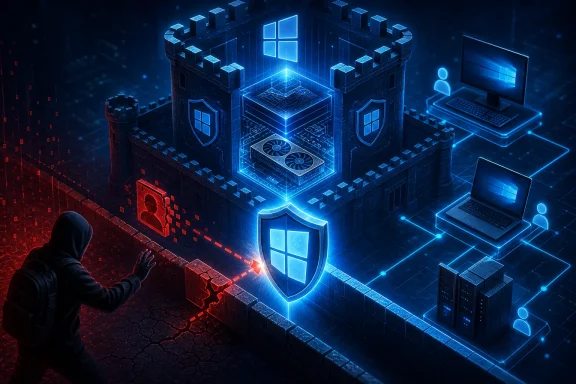
The vulnerability was published on July 14, 2026, as part of Microsoft’s monthly security release. Microsoft’s Security Update Guide classifies it as a DirectX Graphics Kernel remote code execution vulnerability, while the underlying CVE description identifies an untrusted pointer dereference in Windows DirectX.
Microsoft says the vulnerability was not publicly disclosed or known to be exploited when the update shipped. The company assesses exploitation as less likely, but the kernel-level component, total potential technical impact, and lack of a separate mitigation make the July cumulative updates the practical remedy.
“Remote Code Execution” Does Not Mean Internet-Remote
The advisory’s title can create the wrong impression. CVE-2026-50382 is not described as an unauthenticated, network-reachable DirectX attack that can compromise any exposed Windows PC.
Microsoft’s CVSS vector is AV:L/AC:L/PR:L/UI:N/S:C/C:H/I:H/A:H. In practical terms, exploitation requires local access and low privileges, but it has low attack complexity and requires no additional user interaction. The attacker must already be authorized to execute code or otherwise operate within a vulnerable system’s local security context.
That makes CVE-2026-50382 more relevant to post-compromise activity than initial access. Malware, a malicious local application, or an attacker controlling a low-privileged account could potentially use the graphics flaw to reach resources protected by another security authority.
The changed-scope rating is particularly significant. A successful exploit could affect confidentiality, integrity, and availability beyond the vulnerable DirectX component, with Microsoft assigning High impact to all three categories. CISA’s Stakeholder-Specific Vulnerability Categorization data similarly characterizes the potential technical impact as total, while indicating that exploitation had not been observed and was not considered automatable at publication.
This distinction does not make the flaw harmless. It means administrators should treat it as a possible link in an attack chain rather than as a wormable network entry point.
A Trusted Pointer Becomes a Kernel Liability
CVE-2026-50382 is mapped to CWE-822, Untrusted Pointer Dereference. This class of vulnerability occurs when software accesses memory through a pointer that cannot be assumed to reference a valid or appropriately controlled location.
In a graphics kernel component, unsafe pointer handling can have consequences well beyond a crashed game or a reset display driver. The DirectX Graphics Kernel coordinates graphics operations at a privileged layer of Windows and forms part of the boundary between applications, graphics drivers, GPU resources, and the operating system kernel.
Microsoft has not published the vulnerable function, triggering operation, or a proof-of-concept exploit. The public description also does not establish whether a particular graphics API, GPU vendor, or driver configuration is required. Administrators should therefore avoid assuming that systems without gaming workloads or discrete graphics cards are unaffected.
The “Confirmed” report-confidence metric addresses certainty, not prevalence. It indicates that Microsoft has confirmed the vulnerability and that credible technical information exists; it does not mean exploitation has been confirmed in the wild. Microsoft’s temporal metrics list exploit-code maturity as unproven and an official fix as available, lowering the temporal score to 7.7.
That combination describes a well-substantiated vulnerability with a vendor patch, but without public exploitation evidence at release. It also leaves security researchers with enough information to identify the weakness category and compare patched binaries, making prolonged update delays increasingly difficult to justify.
The Fix Reaches Current Windows Clients and Servers
Microsoft delivered the correction through cumulative Windows security updates. The affected-version records list builds below the following fixed levels:
- Windows 10 version 1809 and Windows Server 2019 are protected at OS build 17763.9020 through KB5099538.
- Windows 10 versions 21H2 and 22H2 are protected at builds 19044.7548 and 19045.7548 through KB5099539.
- Windows 11 versions 24H2 and 25H2 are protected at builds 26100.8875 and 26200.8875 through KB5101650.
- Windows Server 2022 is protected at build 20348.5386 through KB5099540.
- Windows Server 2025 is protected at build 26100.33158 through KB5099536.
- Windows 11 version 26H1 is protected at build 28000.2269, with Microsoft’s affected-product data pointing to the relevant servicing release for that branch.
Both x64 and ARM64 systems are included where those architectures are supported. The affected records also cover 32-bit Windows 10 installations and Server Core editions of Windows Server 2019 and Windows Server 2025.
The broad product range is a consequence of DirectX being a Windows platform component rather than evidence that every machine exposes an identical exploitation path. Microsoft has not identified GPU models, graphics drivers, Windows features, or deployment roles that remove the risk.
For managed environments, inventory checks should focus on the OS build rather than whether a device appears to use DirectX-heavy software. Server Core should not be excluded simply because it lacks the conventional desktop experience; Microsoft explicitly lists affected Server Core products.
Patch Testing Has More Than Graphics to Consider
CVE-2026-50382 has no documented workaround or registry-based mitigation, leaving installation of the cumulative update as the supported response. Endpoint controls that prevent untrusted code execution and limit access to local accounts can reduce the opportunity for exploitation, but they do not correct the pointer-handling defect.
Administrators should still test the July updates against business-critical workloads because the same cumulative packages contain broader Windows changes. Microsoft says updates released on or after July 14 enforce registration requirements for third-party Transport Driver Interface transports, which could disrupt applications using sockets over unregistered legacy transports.
Windows Server 2022 also has a documented BitLocker concern for a limited set of managed systems using an unrecommended Group Policy configuration. Those devices may request the BitLocker recovery key during the first restart after KB5099540. Microsoft recommends correcting the affected TPM platform-validation policy and refreshing BitLocker bindings before deployment.
A limited number of Dell devices with Intel processors may not immediately receive KB5101650 because of an incompatibility that Dell reported. Microsoft says the issue could cause shutdowns, poor performance, additional heat, and battery drain, so the update may be withheld on those systems while compatibility is addressed.
These deployment considerations call for staged validation, not an indefinite pause. CVE-2026-50382 requires an attacker to have already gained low-privileged access, but its low complexity, lack of user interaction, and potential to cross a security boundary make it valuable for turning a limited foothold into a more serious compromise.
Organizations should verify successful installation by checking the resulting Windows build and investigating machines that remain below the fixed level. With no public exploit reported as of July 15, 2026, defenders still have an opportunity to close the DirectX Graphics Kernel path before patch analysis produces more actionable attack details.