

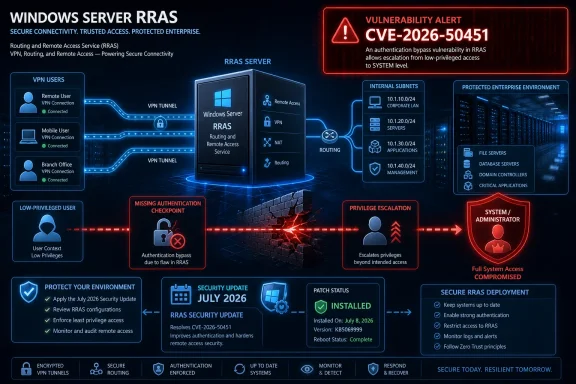
Detailed in Microsoft’s Security Update Guide and subsequently added to the National Vulnerability Database, the flaw affects supported Windows 11 editions, multiple Windows Server generations, and several Windows 10 releases still receiving security updates through specialized servicing channels. Administrators should deploy the July cumulative security updates rather than treating RRAS as solely a VPN-server concern.
Microsoft describes the weakness as “missing authentication for critical function,” mapped to CWE-306. In practical terms, RRAS contains a privileged operation that does not perform the authentication or authorization validation expected before granting access to sensitive functionality.
Local Access Keeps the Flaw Out of the Wormable Tier
CVE-2026-50451 is a local elevation-of-privilege vulnerability, not an unauthenticated attack that can be launched directly against an exposed VPN endpoint. Microsoft’s CVSS vector is CVSS:3.1/AV:L/AC:L/PR:L/UI:N/S:U/C:H/I:H/A:N.
That vector establishes several important limits. An attacker needs local access and low privileges, exploitation requires no user interaction, and Microsoft considers the attack complexity low. A successful attack could have a high impact on confidentiality and integrity, although Microsoft assigned no direct availability impact.
The phrase authorized attacker in Microsoft’s description can be misleading. It does not mean the attacker is permitted to perform the privileged action; it means the attacker already has some authenticated access to the affected Windows system. That starting point could come from a compromised standard user account, a malicious insider, an exposed application that provides local execution, or another vulnerability used earlier in an attack chain.
This makes CVE-2026-50451 more relevant after the initial breach than at the network perimeter. Attackers commonly begin with restricted permissions and then seek a path to administrative or SYSTEM-level control. Elevation can allow them to access protected data, modify security-sensitive settings, interfere with monitoring, steal additional credentials, or establish persistence.
Microsoft has not published proof-of-concept code or detailed exploitation steps. CISA’s initial Stakeholder-Specific Vulnerability Categorization assessment recorded no known exploitation and classified the flaw as not readily automatable, while judging its potential technical impact as total. Those observations lower the immediate likelihood of mass exploitation, but they do not reduce the consequence of a successful attack on a sensitive server.
RRAS Reaches Beyond Traditional Dial-Up and VPN Servers
RRAS is part of the Windows Remote Access architecture and supports VPN connectivity, routing between networks, Network Address Translation, demand-dial routing, BGP, RIP, multicast routing, and other network functions. On Windows Server, Microsoft packages RRAS VPN and routing capabilities within the Remote Access role.
That puts the service on machines that may occupy unusually trusted positions. An RRAS server can sit at a network edge, connect remote users to internal resources, route traffic between subnets, or support an Always On VPN deployment. Compromising such a system may provide more useful network visibility and reach than compromising a typical workstation.
The affected component also exists across Windows client and server products even when an organization is not actively using RRAS. Microsoft’s documentation says the RemoteAccess service is disabled by default on Windows client and server versions, which provides some exposure reduction for systems where it has never been configured.
Administrators should not treat a disabled service as a substitute for installing the security update, however. Roles change, dormant features are sometimes enabled during troubleshooting, and asset records do not always reflect the configuration currently running on a machine. The Windows cumulative update removes the vulnerable code path rather than relying on a service remaining unused.
The first triage step should be identifying machines running or configured for the RemoteAccess service. Server Manager, service inventories, endpoint-management platforms, PowerShell remoting, Microsoft Defender for Endpoint, and configuration-management databases can all help narrow that list. Internet-facing VPN servers and systems routing traffic between security zones deserve priority even though the vulnerability itself requires local access.
Affected Builds Span Windows 10 Through Server 2025
The Microsoft-issued CVE record lists a broad range of affected platforms. Fixed build thresholds include:
- Windows 11 versions 24H2 and 25H2 are protected at build 8875 in their respective 26100 and 26200 branches.
- Windows 11 version 26H1 is protected at build 28000.2269.
- Windows Server 2025 is protected at build 26100.33158.
- Windows Server 2022 is protected at build 20348.5386.
- Windows Server 2019 and Windows 10 version 1809 are protected at build 17763.9020.
- Windows Server 2016 and Windows 10 version 1607 are protected at build 14393.9339.
- Windows 10 versions 21H2 and 22H2 are protected at builds 19044.7548 and 19045.7548.
- Windows Server 2012 R2 is protected at build 9600.23291, while Windows Server 2012 is protected at build 9200.26226.
Both full and Server Core installations are listed where Microsoft maintains separate product records. The inclusion of Windows Server 2012 and 2012 R2 reflects systems receiving applicable Extended Security Updates rather than a return to normal mainstream support.
The build numbers matter because vulnerability scanners can lag behind newly published Patch Tuesday data or report only the presence of the RRAS role. Verifying the installed OS build provides a direct way to confirm whether Microsoft’s remediation is present. Administrators should still use the applicable cumulative update and servicing documentation for each Windows release rather than attempting to acquire an individual RRAS file.
Organizations with Windows 10 version 22H2 should also pay attention to servicing eligibility. By July 2026, ordinary consumer and most standard commercial installations are outside their original support lifecycle; continued receipt of relevant fixes depends on the device’s edition and enrollment in an Extended Security Updates program or another qualifying servicing channel.
Patch Priority Depends on Where the Machine Sits
CVE-2026-50451 does not carry the urgency of a confirmed zero-day or a network-reachable remote-code-execution flaw. There is no published evidence of exploitation as of July 15, 2026, and an attacker must already be able to execute code locally with some privileges.
That does not make a long delay sensible. Low-complexity privilege-escalation vulnerabilities are valuable building blocks because they turn limited footholds into substantially more powerful compromises. Once technical analysis or proof-of-concept code appears, attackers can incorporate the flaw into credential theft, lateral movement, and persistence workflows without needing to solve the initial-access problem.
For enterprise deployments, the practical order is straightforward:
- Patch active RRAS VPN, routing, DirectAccess, and Always On VPN infrastructure during the earliest approved maintenance window.
- Prioritize RRAS systems exposed to remote users or positioned between trusted and untrusted network segments.
- Confirm that July 2026 cumulative updates reached Server Core installations and older servers covered by Extended Security Updates.
- Audit unexpected use of the
RemoteAccessservice and disable it where the role has no operational purpose. - Monitor privileged-group changes, service configuration changes, and unusual activity originating from previously low-privileged accounts.
Testing remains appropriate because RRAS servers can be connectivity-critical and may participate in clustered or load-balanced deployments. Administrators should validate VPN authentication, tunnel establishment, routing tables, NAT behavior, accounting, Network Policy Server integration, and failover after patching rather than confirming only that the server restarted.
The immediate milestone is deployment of the July 14 security update across supported builds. The unresolved issue is whether Microsoft or an external researcher will publish deeper technical details; until then, CVE-2026-50451 should be treated as a post-compromise privilege-escalation path with heightened priority on Windows systems that bridge users, networks, or security boundaries.
References
- CVE-2026-50451 Windows Routing and Remote Access Service (RRAS) Elevation of Privilege Vulnerability MSRC · 2026-07-14T07:00:00-07:00
- learn.microsoft.com learn.microsoft.com