

Microsoft has fixed CVE-2026-50466, a Windows Brokering File System elevation-of-privilege vulnerability that could let a locally authenticated attacker turn limited access into broad control of an affected Windows 11 or Windows Server 2025 machine. The correction arrived in Microsoft’s July 14, 2026 security updates and should be treated as a standard priority deployment for workstations where untrusted code can run and servers exposed to interactive users.
Detailed in the Microsoft Security Response Center’s Security Update Guide, the flaw is rated Important with a CVSS 3.1 base score of 7.8. Microsoft describes it as a use-after-free memory-safety error in the Brokering File System, tracked under CWE-416.
The vulnerability is not remotely exploitable on its own. An attacker must already possess low-level privileges on the target, but exploitation requires neither user interaction nor unusually complex conditions.
CVE-2026-50466 carries the vector
The high confidentiality, integrity, and availability impact ratings show why Microsoft classifies this as more than a routine reliability defect. Successful exploitation could give an attacker enough authority to access protected information, modify system resources, and interfere with the machine’s operation.
A use-after-free occurs when software continues using an area of memory after it has been released. If an attacker can influence what replaces the freed object, subsequent operations may process attacker-controlled data as though it were still the original trusted object. In a privileged Windows component, that memory corruption can become a route across the security boundary separating ordinary users from the operating system.
Microsoft has not published exploit code, a step-by-step attack path, or the exact Brokering File System operation that triggers the condition. That restraint limits immediate defensive opportunities beyond applying the update, but it also means administrators should avoid drawing conclusions about exposure from whether a particular file-system feature appears to be actively used.
The affected component is part of Windows rather than an optional third-party application. Removing a desktop utility or disabling a browser extension will not address the underlying defect.
That status can be easy to misread. Confirmed is not the same as exploited in the wild. Microsoft’s original July 14 assessment says CVE-2026-50466 was not publicly disclosed before the update, was not known to have been exploited, and was considered “Exploitation Less Likely.”
Those distinctions matter when administrators are triaging a particularly large Patch Tuesday release. BleepingComputer counted 570 vulnerabilities addressed in Microsoft’s July 2026 releases, including separate zero-days that were publicly disclosed or observed in attacks. CVE-2026-50466 was not one of those zero-days at publication.
The absence of observed exploitation lowers its immediate urgency relative to an internet-facing remote-code-execution flaw or an active zero-day. It does not make the patch optional. Local privilege-escalation bugs are frequently paired with phishing, malicious documents, browser vulnerabilities, exposed remote-access credentials, or compromised software installers.
In that kind of attack chain, the first-stage intrusion only needs to obtain code execution as a standard user. CVE-2026-50466 could then provide the privilege jump needed to tamper with security controls, reach other users’ data, establish persistence, or use the compromised endpoint as a stronger foothold inside the network.
No user interaction and low attack complexity also improve the vulnerability’s usefulness after initial access. An operator or piece of malware would not necessarily need to wait for a privileged user to perform a particular action.
Endpoints managed through Windows Update for Business, Microsoft Intune, Windows Server Update Services, Configuration Manager, or another patch platform should be checked for successful installation rather than merely update approval. The relevant OS build can be verified with
A restart is normally part of completing Windows cumulative-update installation. Systems that downloaded the package but remain in a pending-reboot state should not be counted as remediated until the new build is active.
Administrators should also review devices that are outside normal management coverage. Shared laboratory PCs, developer workstations, virtual desktop images, jump boxes, and manually maintained servers are exactly where a local privilege-escalation flaw can remain available after the main fleet reports healthy compliance.
Application control through Windows Defender Application Control or AppLocker can reduce the chance of an attacker launching an unfamiliar first-stage executable. Microsoft Defender for Endpoint and other endpoint detection platforms may identify suspicious behavior around privilege escalation, credential access, persistence, or security-tool tampering. Removing unnecessary local accounts and limiting interactive server logons also reduces the number of principals positioned to attack a local-only vulnerability.
Those measures should be considered layers around the patch, not substitutes for it.
The July updates also contain broader operating-system changes that deserve normal compatibility testing. Microsoft says KB5101650 introduces security hardening around third-party Transport Driver Interface registration, which may affect software using sockets over unregistered TDI transports. The same client update may also be temporarily unavailable to a limited number of Dell devices with Intel processors because of a reported incompatibility associated with shutdowns, heat, battery drain, and reduced performance.
Windows Server 2025’s KB5099536 includes the corresponding TDI hardening and the month’s accumulated quality fixes. Server teams should validate networking agents, monitoring products, backup tools, storage software, and other kernel-adjacent components before broad rollout, particularly where older drivers remain in service.
That testing requirement should change deployment sequencing, not become an indefinite pause. Prioritize multi-user systems, administrative workstations, developer machines, virtual desktop hosts, and servers where lower-privileged accounts can execute code. Pilot the cumulative update on representative hardware and workloads, monitor for regressions, then expand deployment while tracking machines that miss their maintenance window.
Microsoft’s original assessment offers no evidence that CVE-2026-50466 was already under attack on July 14, 2026. The concrete security boundary is nevertheless clear: machines left below the corrected July builds retain a confirmed, low-complexity path from an ordinary local foothold toward full system compromise.
Detailed in the Microsoft Security Response Center’s Security Update Guide, the flaw is rated Important with a CVSS 3.1 base score of 7.8. Microsoft describes it as a use-after-free memory-safety error in the Brokering File System, tracked under CWE-416.
The vulnerability is not remotely exploitable on its own. An attacker must already possess low-level privileges on the target, but exploitation requires neither user interaction nor unusually complex conditions.
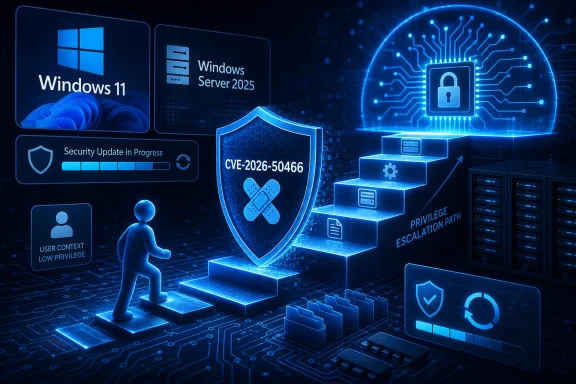 A Local Bug With System-Wide Consequences
CVE-2026-50466 carries the vector CVSS:3.1/AV:L/AC:L/PR:L/UI:N/S:U/C:H/I:H/A:H. In practical terms, the attack starts locally, requires an existing low-privilege account or process, and can be attempted without persuading another user to open a document, visit a page, or approve a prompt.The high confidentiality, integrity, and availability impact ratings show why Microsoft classifies this as more than a routine reliability defect. Successful exploitation could give an attacker enough authority to access protected information, modify system resources, and interfere with the machine’s operation.
A use-after-free occurs when software continues using an area of memory after it has been released. If an attacker can influence what replaces the freed object, subsequent operations may process attacker-controlled data as though it were still the original trusted object. In a privileged Windows component, that memory corruption can become a route across the security boundary separating ordinary users from the operating system.
Microsoft has not published exploit code, a step-by-step attack path, or the exact Brokering File System operation that triggers the condition. That restraint limits immediate defensive opportunities beyond applying the update, but it also means administrators should avoid drawing conclusions about exposure from whether a particular file-system feature appears to be actively used.
The affected component is part of Windows rather than an optional third-party application. Removing a desktop utility or disabling a browser extension will not address the underlying defect.
Confirmed Does Not Mean Exploited
The Security Update Guide marks the vulnerability’s report confidence as Confirmed. This is the CVSS temporal metric described in the material accompanying Microsoft’s advisory: it indicates that the vulnerability’s existence and technical basis have been verified, rather than resting on an incomplete or disputed report.That status can be easy to misread. Confirmed is not the same as exploited in the wild. Microsoft’s original July 14 assessment says CVE-2026-50466 was not publicly disclosed before the update, was not known to have been exploited, and was considered “Exploitation Less Likely.”
Those distinctions matter when administrators are triaging a particularly large Patch Tuesday release. BleepingComputer counted 570 vulnerabilities addressed in Microsoft’s July 2026 releases, including separate zero-days that were publicly disclosed or observed in attacks. CVE-2026-50466 was not one of those zero-days at publication.
The absence of observed exploitation lowers its immediate urgency relative to an internet-facing remote-code-execution flaw or an active zero-day. It does not make the patch optional. Local privilege-escalation bugs are frequently paired with phishing, malicious documents, browser vulnerabilities, exposed remote-access credentials, or compromised software installers.
In that kind of attack chain, the first-stage intrusion only needs to obtain code execution as a standard user. CVE-2026-50466 could then provide the privilege jump needed to tamper with security controls, reach other users’ data, establish persistence, or use the compromised endpoint as a stronger foothold inside the network.
No user interaction and low attack complexity also improve the vulnerability’s usefulness after initial access. An operator or piece of malware would not necessarily need to wait for a privileged user to perform a particular action.
July’s Cumulative Updates Carry the Fix
Microsoft identifies current Windows 11 releases and Windows Server 2025 as affected, including ARM64 and x64 client systems where applicable. The July cumulative updates move supported installations onto corrected builds:- Windows 11 versions 24H2 and 25H2 receive KB5101650, bringing the operating system to builds 26100.8875 and 26200.8875 respectively.
- Windows 11 version 26H1 receives KB5101649, bringing the operating system to build 28000.2525.
- Windows Server 2025, including Server Core installations, receives KB5099536 and moves to build 26100.33158.
Endpoints managed through Windows Update for Business, Microsoft Intune, Windows Server Update Services, Configuration Manager, or another patch platform should be checked for successful installation rather than merely update approval. The relevant OS build can be verified with
winver, PowerShell, endpoint inventory software, or the organization’s vulnerability-management tooling.A restart is normally part of completing Windows cumulative-update installation. Systems that downloaded the package but remain in a pending-reboot state should not be counted as remediated until the new build is active.
Administrators should also review devices that are outside normal management coverage. Shared laboratory PCs, developer workstations, virtual desktop images, jump boxes, and manually maintained servers are exactly where a local privilege-escalation flaw can remain available after the main fleet reports healthy compliance.
Deployment Risk Still Needs Testing
CVE-2026-50466 does not have a Microsoft-published workaround or configuration-based mitigation that replaces the security update. Existing controls can make exploitation harder to reach, but they do not repair the use-after-free condition.Application control through Windows Defender Application Control or AppLocker can reduce the chance of an attacker launching an unfamiliar first-stage executable. Microsoft Defender for Endpoint and other endpoint detection platforms may identify suspicious behavior around privilege escalation, credential access, persistence, or security-tool tampering. Removing unnecessary local accounts and limiting interactive server logons also reduces the number of principals positioned to attack a local-only vulnerability.
Those measures should be considered layers around the patch, not substitutes for it.
The July updates also contain broader operating-system changes that deserve normal compatibility testing. Microsoft says KB5101650 introduces security hardening around third-party Transport Driver Interface registration, which may affect software using sockets over unregistered TDI transports. The same client update may also be temporarily unavailable to a limited number of Dell devices with Intel processors because of a reported incompatibility associated with shutdowns, heat, battery drain, and reduced performance.
Windows Server 2025’s KB5099536 includes the corresponding TDI hardening and the month’s accumulated quality fixes. Server teams should validate networking agents, monitoring products, backup tools, storage software, and other kernel-adjacent components before broad rollout, particularly where older drivers remain in service.
That testing requirement should change deployment sequencing, not become an indefinite pause. Prioritize multi-user systems, administrative workstations, developer machines, virtual desktop hosts, and servers where lower-privileged accounts can execute code. Pilot the cumulative update on representative hardware and workloads, monitor for regressions, then expand deployment while tracking machines that miss their maintenance window.
Microsoft’s original assessment offers no evidence that CVE-2026-50466 was already under attack on July 14, 2026. The concrete security boundary is nevertheless clear: machines left below the corrected July builds retain a confirmed, low-complexity path from an ordinary local foothold toward full system compromise.
References
- Primary source: MSRC
Published: 2026-07-14T07:00:00-07:00
Security Update Guide - Microsoft Security Response Center
 msrc.microsoft.com
