

CVE-2026-50483 exposes sensitive information through the Windows Graphics Component on unpatched Windows 11 and Windows Server 2025 systems, but Microsoft’s July 14, 2026 security updates close the local disclosure route. The flaw requires an attacker to already have low-privilege access, yet a successful exploit can produce a high confidentiality impact without user interaction.
Detailed in Microsoft’s Security Update Guide and corresponding CVE record, the vulnerability carries a CVSS 3.1 base score of 5.5 and an Important severity rating. Microsoft says it was neither publicly disclosed nor known to be exploited when the updates shipped, and assesses future exploitation as less likely.
That makes CVE-2026-50483 a patch-management issue rather than an emergency isolation event. Administrators should still verify cumulative-update deployment, particularly on multi-user servers, virtual desktop infrastructure, shared workstations, and endpoints where an initial account compromise could be chained with other vulnerabilities.
Microsoft describes CVE-2026-50483 as an exposure of sensitive information to an unauthorized actor in the Microsoft Graphics Component. An authorized attacker can exploit the weakness locally to disclose information that should not be available at their privilege level.
The CVSS vector is
The vulnerability does not directly allow an attacker to alter data, obtain administrator rights, or make the system unavailable. Its rated effect is confined to confidentiality, but Microsoft assigns that confidentiality loss the highest impact level available in the CVSS vector.
That distinction matters. A 5.5 score can appear modest next to remote-code-execution or privilege-escalation vulnerabilities, but it does not mean the information exposed would necessarily be trivial. Microsoft has not publicly specified what data can be recovered, which graphics operation triggers the disclosure, or whether the weakness involves uninitialized memory, an out-of-bounds read, or another failure to clear or validate data.
The vulnerability is classified as CWE-200, Exposure of Sensitive Information to an Unauthorized Actor. This is a broad category rather than a detailed root-cause description, leaving defenders without enough technical information to build a reliable detection rule around the vulnerable behavior itself.
For now, the cumulative update is the meaningful control. There is no documented registry mitigation, Group Policy workaround, graphics-feature toggle, or configuration change that substitutes for installing the corrected Windows components.
Microsoft’s recorded version boundaries are unusually useful for deployment verification:
Windows Server 2025 receives KB5099536, which advances the operating system to build 26100.33158. The same fixed build threshold applies to full installations and Server Core, so organizations should not assume that removing the desktop experience eliminates exposure to this graphics-component flaw.
Windows 11 version 26H1 has a slightly different timeline. Microsoft’s CVE data marks builds before 28000.2269 as affected, while the July cumulative update, KB5101649, advances systems to build 28000.2525. Devices already at or beyond the stated fixed threshold fall outside the affected range, but installing July’s cumulative update remains the simplest way to bring the OS onto the current security baseline.
Windows 11 version 23H2 does not appear in Microsoft’s affected-product data for CVE-2026-50483. Older Windows 10 and Windows Server releases are likewise absent. Administrators should follow Microsoft’s product list rather than infer exposure merely because a machine contains graphics-related Windows binaries.
A simple PowerShell query can expose the relevant build information:
The resulting build should be compared with the fixed boundary for that specific Windows release. A device running Windows 11 24H2 at build 26100.8875 or later, for example, is beyond the affected range recorded for CVE-2026-50483.
Administrators using Microsoft Intune, Windows Autopatch, Configuration Manager, Windows Server Update Services, or another patch platform should verify installed-state reporting rather than rely only on update approval. Devices can miss a cumulative update because they were powered off, paused, blocked by safeguards, unable to contact the update service, or left pending a restart.
Microsoft has also temporarily withheld KB5101650 from a limited number of Dell PCs with Intel processors because of a reported compatibility problem involving unexpected shutdowns, reduced performance, increased heat, and battery drain. That safeguard creates a potential gap for affected Windows 11 24H2 and 25H2 devices, so IT teams should identify withheld hardware and monitor Microsoft and Dell for the promised resolution rather than forcing deployment without testing.
Microsoft reports no general known issues with KB5101650, but the Dell hold demonstrates why build-level compliance is more informative than assuming every eligible endpoint received Patch Tuesday automatically.
The concern is what happens after that first foothold. Information-disclosure vulnerabilities can reveal memory contents, internal state, or other data useful in bypassing defensive assumptions and preparing a second-stage exploit. Microsoft has not said that CVE-2026-50483 can expose credentials, cryptographic material, kernel addresses, or data belonging to another user, so those outcomes should not be treated as confirmed.
Still, the CVSS rating’s high confidentiality impact supports treating the disclosed material as potentially meaningful. Shared systems deserve particular attention because they place data from several users, sessions, applications, or workloads on the same machine.
Remote Desktop Session Host servers, developer workstations, jump boxes, kiosk-style devices, and Windows Server 2025 hosts accepting code or content from less-trusted sources all offer plausible conditions in which a low-privilege attacker could benefit from a local disclosure bug. Server Core remains in scope despite its reduced graphical shell because the affected Microsoft Graphics Component is still present in the supported operating-system image.
Microsoft’s initial assessment gives defenders some breathing room: the vulnerability was not publicly disclosed, was not observed under active exploitation, and is considered less likely to be exploited. Those fields describe Microsoft’s knowledge at publication on July 14, however, not a permanent guarantee that exploit research will not emerge.
The immediate administrative task is therefore straightforward: deploy the appropriate cumulative update, restart where required, and confirm the resulting OS build. CVE-2026-50483 may not justify interrupting every maintenance window on its own, but systems remaining below 26100.8875, 26200.8875, 28000.2269, or Server 2025 build 26100.33158 retain a confirmed local path to sensitive information.
Detailed in Microsoft’s Security Update Guide and corresponding CVE record, the vulnerability carries a CVSS 3.1 base score of 5.5 and an Important severity rating. Microsoft says it was neither publicly disclosed nor known to be exploited when the updates shipped, and assesses future exploitation as less likely.
That makes CVE-2026-50483 a patch-management issue rather than an emergency isolation event. Administrators should still verify cumulative-update deployment, particularly on multi-user servers, virtual desktop infrastructure, shared workstations, and endpoints where an initial account compromise could be chained with other vulnerabilities.
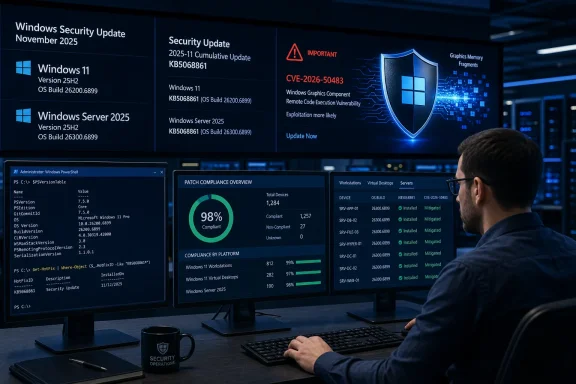 Local Access Keeps the Score Down, Not the Data Impact
Microsoft describes CVE-2026-50483 as an exposure of sensitive information to an unauthorized actor in the Microsoft Graphics Component. An authorized attacker can exploit the weakness locally to disclose information that should not be available at their privilege level.The CVSS vector is
CVSS:3.1/AV:L/AC:L/PR:L/UI:N/S:U/C:H/I:N/A:N. In practical terms, the attacker needs local access and low privileges, exploitation is considered low complexity, and no second user needs to open a file, click a link, or approve a prompt.The vulnerability does not directly allow an attacker to alter data, obtain administrator rights, or make the system unavailable. Its rated effect is confined to confidentiality, but Microsoft assigns that confidentiality loss the highest impact level available in the CVSS vector.
That distinction matters. A 5.5 score can appear modest next to remote-code-execution or privilege-escalation vulnerabilities, but it does not mean the information exposed would necessarily be trivial. Microsoft has not publicly specified what data can be recovered, which graphics operation triggers the disclosure, or whether the weakness involves uninitialized memory, an out-of-bounds read, or another failure to clear or validate data.
The vulnerability is classified as CWE-200, Exposure of Sensitive Information to an Unauthorized Actor. This is a broad category rather than a detailed root-cause description, leaving defenders without enough technical information to build a reliable detection rule around the vulnerable behavior itself.
For now, the cumulative update is the meaningful control. There is no documented registry mitigation, Group Policy workaround, graphics-feature toggle, or configuration change that substitutes for installing the corrected Windows components.
The Affected List Centers on Newer Windows Releases
The CVE record submitted by Microsoft identifies Windows 11 versions 24H2, 25H2, and 26H1, plus Windows Server 2025 and its Server Core installation option. Both x64 and Arm64 editions of the affected Windows 11 releases are included, while the Windows Server 2025 entries apply to x64 systems.Microsoft’s recorded version boundaries are unusually useful for deployment verification:
- Windows 11 version 24H2 is affected before OS build 26100.8875.
- Windows 11 version 25H2 is affected before OS build 26200.8875.
- Windows 11 version 26H1 is affected before OS build 28000.2269.
- Windows Server 2025 is affected before OS build 26100.33158.
- Windows Server 2025 Server Core is affected before OS build 26100.33158.
Windows Server 2025 receives KB5099536, which advances the operating system to build 26100.33158. The same fixed build threshold applies to full installations and Server Core, so organizations should not assume that removing the desktop experience eliminates exposure to this graphics-component flaw.
Windows 11 version 26H1 has a slightly different timeline. Microsoft’s CVE data marks builds before 28000.2269 as affected, while the July cumulative update, KB5101649, advances systems to build 28000.2525. Devices already at or beyond the stated fixed threshold fall outside the affected range, but installing July’s cumulative update remains the simplest way to bring the OS onto the current security baseline.
Windows 11 version 23H2 does not appear in Microsoft’s affected-product data for CVE-2026-50483. Older Windows 10 and Windows Server releases are likewise absent. Administrators should follow Microsoft’s product list rather than infer exposure merely because a machine contains graphics-related Windows binaries.
Build Numbers Provide the Fastest Compliance Check
On an individual PC,winver provides a quick visual check of the installed Windows version and OS build. PowerShell, endpoint-management inventory, and configuration-management tools are more appropriate for checking a fleet.A simple PowerShell query can expose the relevant build information:
Code:
Get-ComputerInfo |
Select-Object WindowsProductName, WindowsVersion, OsBuildNumberAdministrators using Microsoft Intune, Windows Autopatch, Configuration Manager, Windows Server Update Services, or another patch platform should verify installed-state reporting rather than rely only on update approval. Devices can miss a cumulative update because they were powered off, paused, blocked by safeguards, unable to contact the update service, or left pending a restart.
Microsoft has also temporarily withheld KB5101650 from a limited number of Dell PCs with Intel processors because of a reported compatibility problem involving unexpected shutdowns, reduced performance, increased heat, and battery drain. That safeguard creates a potential gap for affected Windows 11 24H2 and 25H2 devices, so IT teams should identify withheld hardware and monitor Microsoft and Dell for the promised resolution rather than forcing deployment without testing.
Microsoft reports no general known issues with KB5101650, but the Dell hold demonstrates why build-level compliance is more informative than assuming every eligible endpoint received Patch Tuesday automatically.
Information Disclosure Is Often a Chaining Primitive
CVE-2026-50483 does not provide the initial remote foothold implied by more severe network vulnerabilities. An attacker must first execute code or operate an account locally with at least low privileges, narrowing the immediate attack surface.The concern is what happens after that first foothold. Information-disclosure vulnerabilities can reveal memory contents, internal state, or other data useful in bypassing defensive assumptions and preparing a second-stage exploit. Microsoft has not said that CVE-2026-50483 can expose credentials, cryptographic material, kernel addresses, or data belonging to another user, so those outcomes should not be treated as confirmed.
Still, the CVSS rating’s high confidentiality impact supports treating the disclosed material as potentially meaningful. Shared systems deserve particular attention because they place data from several users, sessions, applications, or workloads on the same machine.
Remote Desktop Session Host servers, developer workstations, jump boxes, kiosk-style devices, and Windows Server 2025 hosts accepting code or content from less-trusted sources all offer plausible conditions in which a low-privilege attacker could benefit from a local disclosure bug. Server Core remains in scope despite its reduced graphical shell because the affected Microsoft Graphics Component is still present in the supported operating-system image.
Microsoft’s initial assessment gives defenders some breathing room: the vulnerability was not publicly disclosed, was not observed under active exploitation, and is considered less likely to be exploited. Those fields describe Microsoft’s knowledge at publication on July 14, however, not a permanent guarantee that exploit research will not emerge.
The immediate administrative task is therefore straightforward: deploy the appropriate cumulative update, restart where required, and confirm the resulting OS build. CVE-2026-50483 may not justify interrupting every maintenance window on its own, but systems remaining below 26100.8875, 26200.8875, 28000.2269, or Server 2025 build 26100.33158 retain a confirmed local path to sensitive information.
References
- Primary source: MSRC
Published: 2026-07-14T07:00:00-07:00
Security Update Guide - Microsoft Security Response Center
 msrc.microsoft.com
- Related coverage: aha.org
