

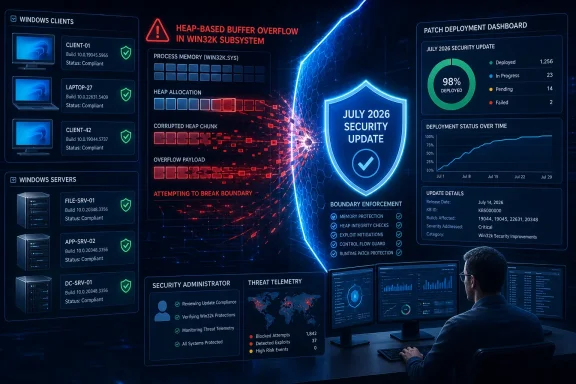
Microsoft’s Security Response Center describes the flaw as a heap-based buffer overflow in Windows Win32k and assigns it a CVSS 3.1 base score of 8.8. The National Vulnerability Database received the Microsoft-authored record on July 14 but was still awaiting its own enrichment when checked on July 15.
The immediate remediation is straightforward: deploy the corresponding July cumulative or security update. The harder part is inventory, because the affected list stretches from Windows Server 2012 to Windows Server 2025 and includes Windows 10, Windows 11 24H2, Windows 11 25H2, and Windows 11 26H1.
A Local Bug With System-Wide Consequences
CVE-2026-50489 is not described as remotely exploitable. Microsoft’s CVSS vector identifies a local attack path requiring low privileges, with no user interaction and low attack complexity.
That means an attacker must first obtain the ability to execute code or operate through an authorized account on the target. The vulnerability then becomes useful as the second stage of an intrusion, potentially turning a constrained foothold into a much more powerful one.
The CVSS vector also marks the scope as changed and rates the possible confidentiality, integrity, and availability impact as high. In practical terms, exploitation could allow a process operating under limited rights to escape its intended security context and interfere with resources beyond that context.
This is why local privilege-escalation bugs deserve more attention than the word local sometimes receives. Phishing, malicious documents, browser flaws, stolen credentials and exposed remote-management services can provide initial access; a Win32k vulnerability can supply the privilege needed to disable defenses, access other users’ data, dump credentials or establish persistence.
Microsoft classifies the root cause as CWE-122, a heap-based buffer overflow. Such flaws occur when software writes more data into a heap allocation than the allocation can safely hold, corrupting adjacent memory and potentially affecting program control or security-relevant data.
Microsoft has not published the detailed vulnerable function, triggering sequence or proof-of-concept code in its advisory. That limits defenders’ ability to build a reliable vulnerability-specific detection rule and makes patch state the clearest indicator of exposure.
July Builds Mark the Security Boundary
For Windows 11 24H2 and 25H2, CVE-2026-50489 is addressed by KB5101650. Installing it moves Windows 11 24H2 to OS Build 26100.8875 and Windows 11 25H2 to OS Build 26200.8875.
Microsoft’s support documentation says KB5101650 is available through Windows Update, Windows Update for Business, Microsoft Update Catalog and Windows Server Update Services when the Windows 11 product and Security Updates classification are enabled. Microsoft was not listing any generally applicable known issue for the update at publication time, although deployment teams should still perform their usual application, driver and VPN testing.
The CVE record identifies these minimum fixed builds across the affected Windows families:
- Windows 10 version 1607 and Windows Server 2016 are protected at Build 14393.9339 or later.
- Windows 10 version 1809 and Windows Server 2019 are protected at Build 17763.9020 or later.
- Windows 10 versions 21H2 and 22H2 are protected at Builds 19044.7548 and 19045.7548 respectively.
- Windows 11 24H2 and 25H2 are protected at Builds 26100.8875 and 26200.8875 respectively.
- Windows 11 26H1 is protected at Build 28000.2525 or later.
- Windows Server 2022 is protected at Build 20348.5386 or later.
- Windows Server 2025 is protected at Build 26100.33158 or later.
- Windows Server 2012 and 2012 R2 require their applicable July servicing updates, reaching Builds 9200.26226 and 9600.23291 respectively.
Microsoft associates several July packages with the affected server and legacy Windows branches, including KB5099536 for Windows Server 2025, KB5099538 for the 17763 branch, KB5099539 for Windows 10 21H2 and 22H2, and KB5099540 for Windows Server 2022. The exact package offered depends on the installed product, architecture and servicing channel.
Checking only whether an update installation reports “successful” is not enough. Administrators should verify the resulting OS build with winver, PowerShell inventory, Microsoft Intune, Configuration Manager, Windows Update for Business reports or their vulnerability-management platform.
Systems below the documented fixed build remain exposed even if they installed an earlier July preview or have a recent servicing-stack update. The relevant threshold is the cumulative update containing the security fix.
Win32k Keeps the Exposure Broad
Win32k is a long-standing part of the Windows graphical and user-interface subsystem, handling low-level operations used throughout interactive sessions. Its reach across Windows editions helps explain why CVE-2026-50489 appears in both desktop and server product lists, including Server Core installations.
A server without the full Desktop Experience should therefore not be assumed immune. Microsoft explicitly lists Server Core variants of Windows Server 2012, 2012 R2, 2016, 2019 and 2025 among the affected products.
The vulnerability is also architecture-spanning. Microsoft lists x86, x64 and ARM64 combinations where those architectures are supported by the corresponding Windows release, so administrators cannot treat Arm-based Windows 11 devices as outside the patch scope.
The broad product coverage increases the likelihood of overlooked systems. Windows 10 21H2 and 22H2 installations may survive in regulated, embedded or extended-support environments, while Server 2012 and 2012 R2 machines often remain behind application dependencies that make emergency maintenance difficult.
Unsupported installations deserve particular scrutiny. The CVE table describes products for which Microsoft is providing applicable fixes through supported servicing arrangements; it does not turn an otherwise unsupported Windows deployment into a supported one. Machines outside a valid servicing channel may need an upgrade, isolation or replacement rather than an expectation of normal Windows Update coverage.
Exploitation Reporting Needs Careful Handling
Microsoft and the Zero Day Initiative’s July 2026 update review did not list CVE-2026-50489 as publicly disclosed or exploited when their material was published. No public proof of concept was identified in those primary reports.
A separate KEVIntel entry aggregated by the Computer Incident Response Center Luxembourg labeled the vulnerability “confirmed exploited” on July 14, while also noting that it was not in CISA’s Known Exploited Vulnerabilities catalog and that malware use was unknown. That third-party signal carried limited supporting detail and conflicts with Microsoft’s release-time exploitation status, so it should not be treated as equivalent to a Microsoft or CISA confirmation.
The uncertainty should affect priority, not delay remediation. A low-complexity local privilege-escalation vulnerability with an 8.8 score is valuable in an attacker’s chain even before a dependable public exploit appears.
Endpoint detection teams should watch for suspicious processes launched from user-writable locations, unusual child processes gaining elevated tokens, security-tool tampering and unexpected creation of privileged services or scheduled tasks. Those are behavioral indicators rather than CVE-specific signatures, but Microsoft’s limited technical disclosure leaves behavior and patch state as the more dependable defensive controls.
For enterprise deployment, internet-facing servers and high-value administrative workstations should move first, followed by shared-session systems, virtual desktop infrastructure, jump hosts and machines used by developers or help-desk staff. These systems combine opportunities for initial code execution with credentials or privileges worth stealing.
The concrete checkpoint is the installed build: Windows 11 24H2 must report 26100.8875 or later, Windows 11 25H2 must report 26200.8875 or later, and server fleets must meet the corresponding July 14 threshold. Until those numbers appear in inventory, CVE-2026-50489 remains an open privilege-escalation path regardless of whether exploitation is ultimately confirmed in the wild.
References
- CVE-2026-50489 Win32k Elevation of Privilege Vulnerability MSRC · 2026-07-14T07:00:00-07:00