

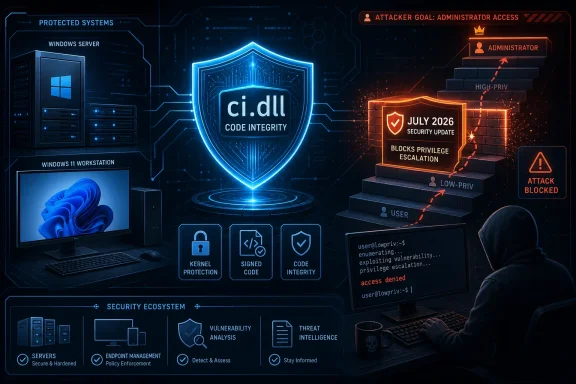
ci.dll), affects supported releases from Windows Server 2012 through Windows 11 version 26H1. Microsoft fixed the vulnerability in its July 14, 2026 security updates, and administrators should prioritize deployment because successful exploitation could give a low-privileged local attacker extensive control over a compromised machine.
Detailed in Microsoft’s Security Update Guide, the vulnerability is rated Important with a CVSS 3.1 base score of 7.0. Microsoft describes the underlying issue as an out-of-bounds read in ci.dll, while the National Vulnerability Database also associates it with type confusion under CWE-843.
The available disclosure confirms the flaw’s existence and affected Windows builds, but it does not provide a proof of concept or a detailed exploitation sequence. That makes CVE-2026-50491 a conventional patch-first advisory: defenders have enough information to identify vulnerable systems, while the technical material needed to judge real-world exploit development remains limited.
Code Integrity Makes This More Than a Routine DLL Bug
Code Integrity is part of the Windows trust boundary responsible for determining whether executable code satisfies the operating system’s signing and integrity policies. Its work is closely tied to protections such as kernel-mode code signing, Windows Defender Application Control and virtualization-based security.
An error in ci.dll is therefore notable even when Microsoft rates it below Critical. The vulnerable code is not merely part of an optional desktop application; it participates in security decisions about code entering sensitive areas of Windows.
Microsoft says exploitation requires local access, existing low-level privileges and no user interaction. The published CVSS vector is CVSS:3.1/AV:L/AC:H/PR:L/UI:N/S:U/C:H/I:H/A:H, indicating that the attack has high complexity but could produce high confidentiality, integrity and availability impact if successful.
Those conditions make CVE-2026-50491 unsuitable as an initial intrusion method. An attacker must already be able to execute code on the target under an authorized account. In practice, its value would be as a second-stage tool used after phishing, credential theft, exploitation of an exposed service or another foothold-producing attack.
A local privilege escalation can turn that restricted foothold into a substantially deeper compromise. Depending on the exploit’s eventual capabilities, that could let an intruder interfere with security software, access data belonging to other users, establish persistence or tamper with operating-system configuration.
Microsoft has not publicly documented the precise privileges obtained after successful exploitation. Administrators should consequently avoid assuming that every successful attempt automatically results in NT AUTHORITY\SYSTEM, even though that is a common objective for Windows elevation-of-privilege exploits.
High Complexity Is a Speed Bump, Not a Mitigation
The Attack Complexity rating of High is the most reassuring part of the CVSS vector, but it should not be interpreted as evidence that exploitation is impractical. It means an attacker must satisfy conditions beyond simply invoking the vulnerable component with an obvious malformed input.
Microsoft has not disclosed what those conditions are. They could involve system state, timing, memory layout, a particular Code Integrity operation or another prerequisite that is not under the attacker’s direct control.
The underlying weaknesses nevertheless give researchers a starting point. CWE-125 describes an out-of-bounds read, where software accesses memory outside the intended buffer, while CWE-843 covers use of a resource through an incompatible type. In a security-sensitive Windows component, that combination warrants attention even without public exploit code.
Report confidence is high because Microsoft, the vendor responsible for Windows and ci.dll, has acknowledged and patched the flaw. Technical confidence is a separate matter: the public record currently establishes the vulnerability class and impact but does not reveal the faulty function, reachable interface or structure involved.
CVE-2026-50491 was not identified among the three zero-days highlighted in July’s broader Patch Tuesday reporting. BleepingComputer reported that the release addressed two vulnerabilities already exploited in attacks and one other flaw that had been publicly disclosed; this Code Integrity issue was not among them. There is currently no public indication that CVE-2026-50491 was exploited before Microsoft issued its fix.
That status can change as researchers compare patched and unpatched versions of ci.dll. Patch diffing often gives vulnerability researchers a clearer picture of the modified code, especially when a vendor advisory initially provides only a weakness category and CVSS vector.
The Fix Reaches Deep Into the Supported Windows Fleet
Microsoft’s affected-product data covers both current Windows 11 installations and older server estates that remain under applicable servicing arrangements. Systems below the following July 2026 build levels remain within the vulnerable version ranges:
- Windows 11 versions 24H2 and 25H2 are affected below builds 26100.8875 and 26200.8875, respectively.
- Windows 11 version 26H1 is affected below build 28000.2525.
- Windows Server 2025 is affected below build 26100.33158.
- Windows Server 2022 is affected below build 20348.5386.
- Windows Server 2019 and Windows 10 version 1809 are affected below build 17763.9020.
- Windows Server 2016 and Windows 10 version 1607 are affected below build 14393.9339.
- Windows 10 versions 21H2 and 22H2 are affected below builds 19044.7548 and 19045.7548.
- Windows Server 2012 R2 is affected below build 9600.23291, while Windows Server 2012 is affected below build 9200.26226.
The affected records include x64 and ARM64 Windows 11 systems, along with applicable 32-bit Windows 10 editions. Server Core installations are also explicitly covered for several Windows Server generations, removing any basis for treating the absence of the full desktop experience as protection.
The breadth of the list reflects the shared role of Code Integrity across Windows releases. It also means administrators cannot limit remediation to user workstations: domain infrastructure, application servers and long-lived systems covered by extended servicing may all require review.
For managed environments, the most reliable compliance check is the installed cumulative update or OS build rather than the presence or version of ci.dll alone. Component versions can differ across servicing channels, and manually replacing a protected Windows binary is neither a supported nor a safe remediation method.
Patch Priority Depends on Who Can Run Code
Internet-facing exposure does not define the risk from CVE-2026-50491 because the attack vector is local. The more useful question is where untrusted or lightly trusted users can already execute code.
Shared workstations, virtual desktop infrastructure, Remote Desktop Session Hosts, development machines and servers running third-party workloads deserve closer attention. The same applies to environments where service accounts, contractors or compromised application processes may begin with restricted privileges but still have local execution capability.
Security teams should deploy the July 2026 cumulative updates through Windows Update, Windows Server Update Services, Microsoft Configuration Manager or their existing endpoint-management platform. Pilot testing remains appropriate because the update contains fixes for a very large Patch Tuesday release, but delaying solely because this CVE is rated Important leaves a security-boundary component exposed.
Endpoint detection teams can also review alerts involving unexpected access to Code Integrity interfaces, suspicious driver activity and low-privileged processes followed by privileged process creation. Microsoft has not published vulnerability-specific indicators of compromise, so such monitoring is behavioral rather than a definitive CVE-2026-50491 detection method.
The immediate administrative task is concrete: inventory Windows builds, move affected systems to the July 14, 2026 servicing level, and verify that machines which require a restart have actually completed it. Until Microsoft’s update is installed, Code Integrity remains a potential escalation path for any attacker who has already crossed the first line of defense.