

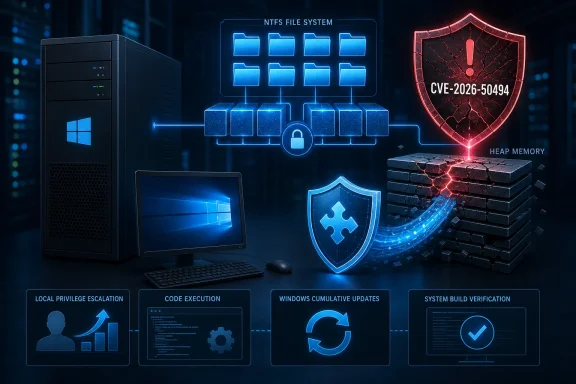
Despite Microsoft’s title, “Windows NTFS Remote Code Execution Vulnerability,” the published technical record describes a local attack requiring existing low-level privileges. The National Vulnerability Database, using Microsoft’s CNA data, says an authorized attacker could exploit a heap-based buffer overflow in NTFS to execute code locally.
That distinction matters. CVE-2026-50494 is not documented as an unauthenticated, network-reachable flaw that can directly compromise an exposed Windows machine. It is still a serious memory-corruption vulnerability in a privileged and broadly deployed operating-system component, but an attacker must first obtain access to the target.
The CVSS Vector Tells a More Precise Story
Microsoft assigned CVE-2026-50494 a CVSS 3.1 base score of 7.8, placing it in the High scoring band while rating the Windows update itself Important. Its vector is CVSS:3.1/AV:L/AC:L/PR:L/UI:N/S:U/C:H/I:H/A:H.
Each part narrows the practical risk:
- The attack vector is local rather than network-based.
- Attack complexity is low, indicating that specialized conditions are not expected to be necessary.
- Low privileges are required before exploitation can begin.
- No separate user interaction is required once the attacker has the necessary access.
- Successful exploitation can produce high confidentiality, integrity, and availability impact.
The weakness is classified as CWE-122, a heap-based buffer overflow. This class of bug occurs when software writes more data into a heap allocation than it can safely hold, potentially corrupting adjacent memory. Depending on the affected process, available mitigations, and attacker control over the corrupted data, that can lead to a crash or deliberate code execution.
Microsoft’s naming convention can therefore be misleading if “remote code execution” is read as “remotely exploitable over the network.” Here, code execution is the vulnerability’s potential impact, while the CVSS attack vector and Microsoft-provided description specify that exploitation is local.
That makes CVE-2026-50494 more relevant as a post-compromise tool than as an initial-access route. An attacker who has already gained a foothold through stolen credentials, malware, a vulnerable application, or another security flaw could potentially use the NTFS bug to deepen control over the system or execute code in a more consequential context.
NTFS Puts the Bug Across a Wide Windows Estate
NTFS is the default file system for most Windows system volumes and remains deeply integrated into normal file, directory, metadata, and storage operations. A vulnerability in that code has a broad installation footprint even when the exploitation prerequisites reduce immediate exposure.
Microsoft’s affected-product data covers both desktop and server platforms. Fixed builds listed in the CVE record include:
| Windows release | First fixed build |
|---|---|
| Windows 10 version 1607 and Windows Server 2016 | 14393.9339 |
| Windows 10 version 1809 and Windows Server 2019 | 17763.9020 |
| Windows 10 versions 21H2 and 22H2 | 19044.7548 and 19045.7548 |
| Windows Server 2022 | 20348.5386 |
| Windows 11 versions 24H2 and 25H2 | 26100.8875 and 26200.8875 |
| Windows 11 version 26H1 | 28000.2525 |
| Windows Server 2025 | 26100.33158 |
Windows Server 2012 and Windows Server 2012 R2 are also included in Microsoft’s affected records, covering both full and Server Core installations. Those older releases require the appropriate Extended Security Updates entitlement and deployment path where applicable.
Architecture coverage varies by release. The affected data includes x64 systems throughout, 32-bit editions of several Windows 10 releases, and ARM64 editions of Windows 10 21H2 and 22H2 and current Windows 11 versions.
For inventory work, administrators should not rely only on the marketing version displayed by winver. Comparing the complete OS build against Microsoft’s fixed build is the clearer test, particularly on Windows Server and managed Windows 10 estates where multiple servicing channels may remain in operation.
Patch the Foothold Before It Becomes a Chain
CVE-2026-50494’s local access requirement lowers the likelihood of an Internet-wide worm or direct drive-by compromise. It does not make the flaw safe to defer indefinitely, especially on shared systems, Remote Desktop Session Hosts, developer workstations, virtual desktop infrastructure, and servers where less-trusted users or applications can execute code.
Low-complexity local vulnerabilities are frequently most valuable when chained with another weakness. An attacker might use a phishing payload or application flaw for initial execution, then turn to an operating-system vulnerability to escape restrictions, manipulate protected resources, or establish more durable access.
The published CVSS assessment gives high impact ratings across confidentiality, integrity, and availability. That means Microsoft considers successful exploitation capable of exposing protected information, altering system data, and disrupting operation—not merely crashing an unprivileged application.
Security teams should prioritize systems that combine local code access with valuable data or administrative credentials. Domain administration workstations, management servers, build machines, jump hosts, multi-user servers, and endpoints used by privileged staff deserve attention even though the CVE is not scored as network-accessible.
There is no useful workaround in the public record that substitutes for installing the security update. Disabling NTFS is not a realistic mitigation for normal Windows installations, and broad changes to storage access would introduce substantial operational damage without reliably addressing every path to the vulnerable code.
Build Verification Is the Final Control
The July 14 cumulative updates carry the NTFS correction alongside the rest of Microsoft’s monthly security fixes. Organizations using Windows Update for Business, Windows Server Update Services, Microsoft Intune, Configuration Manager, or third-party patch platforms should confirm installation success rather than treating update approval as proof of remediation.
A machine that downloaded the package but failed during servicing remains exposed. Administrators should check update compliance reports, restart status, servicing errors, and the resulting OS build, with special scrutiny for devices that were offline during the deployment window or are held behind compatibility safeguards.
Because CVE-2026-50494 is a confirmed heap-corruption issue in a fundamental Windows component, endpoint detection remains a secondary control rather than a replacement for patching. Exploitation may appear as unusual process behavior, storage-related faults, or crashes, but those signals are not guaranteed to identify an attempt before code execution succeeds.
The practical deadline is therefore the next successful maintenance cycle. Windows 11 24H2 systems below build 26100.8875, Windows 10 22H2 systems below 19045.7548, Windows Server 2022 systems below 20348.5386, and the other affected releases below their respective July 2026 baselines should still be treated as vulnerable.
References
- CVE-2026-50494 Windows NTFS Remote Code Execution Vulnerability MSRC · 2026-07-14T07:00:00-07:00