

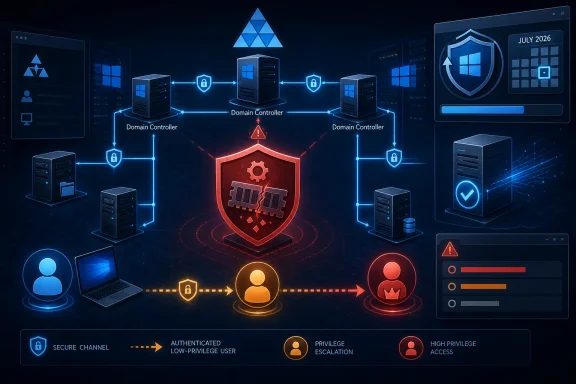
Detailed in Microsoft’s Security Update Guide, the vulnerability is a use-after-free memory-safety bug in Windows Netlogon. Microsoft says successful exploitation could compromise confidentiality, integrity, and availability without requiring user interaction, although the attacker must already possess low-level privileges and overcome high attack complexity.
The National Vulnerability Database lists the issue as CWE-416 and describes the attacker as authorized, not anonymous. That distinction matters: CVE-2026-50500 is not a pre-authentication Netlogon takeover, but it could become a potent privilege-escalation step after an attacker acquires an ordinary account or foothold inside a Windows network.
Microsoft Confirms the Bug, but Technical Detail Remains Thin
Confidence in the vulnerability’s existence is high because Microsoft, acting as the assigning CVE Numbering Authority, confirmed the affected component, identified the underlying weakness, calculated the severity score, and released patches. This is stronger evidence than a scanner-only report or an uncorroborated researcher claim.
The public disclosure nevertheless stops short of providing exploitation instructions. Microsoft has identified the root cause as a use-after-free condition but has not published the vulnerable function, triggering RPC operation, memory layout, or sequence of Netlogon messages needed to reach the flaw. The NVD record was still awaiting independent enrichment on July 15.
That combination creates an important distinction between vulnerability confidence and exploit maturity. Administrators can be confident that the defect exists and that Microsoft’s updates address it, while attackers still face substantial work to turn the advisory into reliable exploit code.
Microsoft’s CVSS vector is:
CVSS:3.1/AV:N/AC:H/PR:L/UI:N/S:U/C:H/I:H/A:H
The network attack vector means exploitation can cross a network boundary rather than requiring code to run directly at the console. Low privileges are required, no victim action is necessary, and the scope remains within the affected security authority. Microsoft assigned high impact ratings across confidentiality, integrity, and availability.
The high-complexity rating is the main factor holding the score at 7.5. Use-after-free vulnerabilities often depend on carefully controlling object lifetime, memory reuse, timing, or protocol state. High complexity does not mean exploitation is impossible; it means a reliable attack is expected to require conditions beyond simply sending one malformed request.
As of July 15, Microsoft had not identified CVE-2026-50500 as publicly disclosed or actively exploited, and no credible public proof of concept had emerged. BleepingComputer included it among the Important-rated issues in Microsoft’s unusually large July 2026 Patch Tuesday release rather than among that month’s zero-days.
Netlogon Places the Risk Near the Heart of Active Directory
Netlogon is a core Windows authentication component used to maintain secure channels between computers and domain controllers. It supports domain authentication operations and therefore occupies a much more sensitive position than a typical client-side service.
The low-privilege requirement means an attacker must first obtain authorization in the target environment. That could occur through stolen credentials, password spraying, malware on a joined endpoint, abuse of a service account, or another vulnerability. CVE-2026-50500 could then provide a route from initial access to more consequential control.
Microsoft’s impact assessment indicates that successful exploitation can produce a broad privilege gain, although the company has not publicly specified the exact resulting privilege level. Administrators should not assume from the generic “elevation of privilege” label alone that every successful attempt automatically grants Domain Admin membership or complete domain control.
It is equally important not to confuse CVE-2026-50500 with CVE-2020-1472, the notorious Zerologon vulnerability. Zerologon exploited a cryptographic weakness and could allow an unauthenticated attacker to impersonate a domain controller under practical conditions. The new issue requires an authorized attacker and carries a high-complexity rating.
CVE-2026-50500 also follows CVE-2026-41089, a separate critical Netlogon remote-code-execution flaw Microsoft addressed in May 2026. The two vulnerabilities have different root causes and attack requirements. July’s update should therefore be treated as a new security boundary repair, not merely a revision of the May fix.
The Patch Reaches Clients and Servers
Microsoft’s affected-product data spans Windows client and server releases, including Windows 10, Windows 11, Windows Server 2012, Windows Server 2016, Windows Server 2019, Windows Server 2022, and Windows Server 2025. Server Core installations are included where applicable.
The corrected build thresholds published in the CVE record include:
- Windows 10 versions 21H2 and 22H2 are protected at builds 19044.7548 and 19045.7548.
- Windows 11 versions 24H2 and 25H2 are protected at builds 26100.8875 and 26200.8875.
- Windows 11 version 26H1 is protected at build 28000.2525.
- Windows Server 2016 is protected at build 14393.9339.
- Windows Server 2019 is protected at build 17763.9020.
- Windows Server 2022 receives its July security corrections through build 20348.5386.
- Windows Server 2025 receives its July corrections through build 26100.33158.
Relevant July packages include KB5099535 for Windows Server 2016, KB5099539 for supported Windows 10 21H2 and 22H2 systems, KB5099540 for Windows Server 2022, KB5099536 for Windows Server 2025, KB5101649 for Windows 11 26H1, and KB5101650 for Windows 11 24H2 and 25H2. Older Windows Server versions covered through extended servicing have their own July packages and servicing requirements.
The differing Windows 11 and Windows Server 2025 build numbers are not contradictory even though both product families derive from the 26100 code base. Microsoft maintains separate servicing branches, so administrators should verify the installed KB and the product-specific build rather than comparing only the first five build digits.
Legacy systems need additional attention. Windows Server 2012 and Windows Server 2012 R2 generally require Extended Security Updates or another applicable support arrangement to receive current security fixes. A vulnerability scanner may correctly flag the operating system while Windows Update offers nothing if the machine lacks the necessary ESU entitlement or activation.
Domain Controllers Belong at the Front of the Queue
The absence of known exploitation reduces the need for emergency isolation, but it does not justify leaving domain controllers exposed through a normal month-long workstation rollout. Netlogon’s role and the vulnerability’s network reach make domain controllers the priority deployment group.
Administrators should inventory every writable and read-only domain controller, confirm that July 2026 updates are available through Windows Server Update Services, Microsoft Configuration Manager, Azure Update Manager, or their normal patch platform, and test authentication-dependent workloads before broad deployment. Validation should cover domain sign-ins, machine-account secure channels, trusts, clustered services, backup agents, network-attached storage, and non-Windows products that integrate with Active Directory.
After installation and restart, teams should verify the full OS build with winver, Get-ComputerInfo, or their endpoint-management inventory. Checking only whether an update job completed successfully is insufficient when supersedence, pending reboots, servicing-stack failures, or ESU configuration can leave a machine below the fixed build.
There is no published registry workaround or configuration-only mitigation that provides the same protection as Microsoft’s code correction. Network segmentation, restricted RPC exposure, strong account controls, credential hygiene, and monitoring for unusual Netlogon activity can reduce opportunity, but they do not remove the vulnerable memory condition.
CVE-2026-50500 is currently a confirmed, patched vulnerability with limited public exploitation knowledge—not another Zerologon-scale emergency. The practical deadline is still close: organizations should complete domain-controller testing and deploy the July 14 updates before public reverse engineering turns Microsoft’s patch into a clearer map of the underlying bug.
References
- CVE-2026-50500 Windows Netlogon Elevation of Privilege Vulnerability MSRC · 2026-07-14T07:00:00-07:00