

Microsoft has fixed CVE-2026-50503, an Important-rated Windows Runtime elevation-of-privilege vulnerability affecting Windows 11 24H2, Windows 11 25H2, Windows 11 26H1, and Windows Server 2025. The flaw requires an attacker to already have local, low-privilege access, but successful exploitation could provide full control over the affected system.
Detailed in Microsoft’s July 14, 2026 security release, CVE-2026-50503 carries a CVSS 3.1 base score of 7.0. Microsoft says the vulnerability is not known to have been publicly disclosed or exploited, and assesses exploitation as “less likely.”
The immediate action is straightforward: install the applicable cumulative Windows update and verify that endpoints have reached the corrected build. Microsoft has not documented a separate mitigation or configuration workaround that can replace patching.
Microsoft describes CVE-2026-50503 as a race condition caused by concurrent execution against a shared resource without proper synchronization. The associated weakness is CWE-362, a broad category covering situations where multiple operations access the same resource in an unsafe order.
Race conditions are often difficult to exploit reliably because the attacker must manipulate timing so that operations occur in a particular sequence. That requirement is reflected in the vulnerability’s CVSS vector, which marks attack complexity as high.
The attacker must also possess low-level privileges and execute code locally. No user interaction is required once those conditions are met, and the flaw is not remotely exploitable on its own.
That makes CVE-2026-50503 a potential second-stage vulnerability rather than an initial entry point. An attacker could combine it with a malicious document, compromised application, stolen standard-user account, remote management breach, or another vulnerability that first provides code execution.
Successful exploitation can affect confidentiality, integrity, and availability at the highest level represented in Microsoft’s CVSS vector. In practical terms, a low-privilege process could reportedly cross a Windows security boundary and gain the authority needed to access protected data, modify system resources, disable defenses, create privileged accounts, or establish persistence.
Microsoft has not published proof-of-concept code, detailed function names, or a step-by-step description of the vulnerable execution path. The existence of the flaw is nevertheless vendor-confirmed, rather than based solely on an unverified third-party report.
The corrected release thresholds listed for the vulnerability are:
Windows 11 26H1 receives KB5101649 and moves to build 28000.2525. Microsoft’s CVE data lists versions before build 28000.2269 as affected, indicating that newer 26H1 servicing builds already cross the published correction threshold. Administrators should still deploy KB5101649 because cumulative Windows updates carry the latest security content and supersede earlier packages.
To check a machine manually, run
Windows administrators should therefore evaluate CVE-2026-50503 in combination with the rest of their exposure. Shared workstations, Remote Desktop Session Hosts, application servers that run third-party agents, developer PCs, virtual desktop infrastructure, and systems where users can execute downloaded software offer more opportunities for local code to reach the vulnerable component.
The high-complexity rating means exploitation requires additional preparation or favorable runtime conditions. It does not mean exploitation is impossible, nor does it prevent researchers from finding more dependable triggering techniques after the update has exposed the existence of the bug.
Microsoft currently reports no public disclosure and no observed exploitation. That gives IT teams room to follow their normal validation process, but it is not a reason to defer the update indefinitely—especially because the CVE affects Windows Server 2025 as well as current Windows 11 releases.
Security teams should watch for later changes to Microsoft’s exploitability assessment, the US Cybersecurity and Infrastructure Security Agency’s Known Exploited Vulnerabilities catalog, and endpoint detections associated with unexpected privilege transitions. Microsoft’s July 14 advisory is the initial disclosure, and the National Vulnerability Database was still awaiting its own enrichment immediately after publication.
The reported symptoms can include unexpected shutdowns, reduced performance, increased heat, and battery drain. Microsoft and Dell are using a safeguard mechanism to prevent installation on affected models while they prepare a resolution.
Administrators should not bypass that block simply to make compliance dashboards turn green. A safeguarded device needs to be tracked as an exception, kept under tighter monitoring, and updated when Microsoft or Dell clears the compatibility hold.
This does not change the underlying CVE exposure. It means some organizations may temporarily need compensating controls such as application allowlisting, reduced local software execution, removal of unnecessary local accounts, stronger endpoint detection, and tighter administrative credential separation.
For unaffected hardware, organizations can deploy the normal cumulative update through Windows Update, Windows Update for Business, Microsoft Intune, WSUS, Configuration Manager, or the Microsoft Update Catalog. As with any broad Windows security release, pilot rings should include representative Arm64 and x64 clients, security agents, line-of-business applications, and Windows Server 2025 workloads.
CVE-2026-50503 is not an internet-facing zero-day, but it provides exactly the kind of privilege step attackers seek after gaining a foothold. Windows 11 systems should be brought to the July 2026 cumulative builds, Windows Server 2025 should reach build 26100.33158, and Dell devices held back by the compatibility safeguard should remain visible as unresolved security exceptions rather than disappearing into the deployment queue.
Detailed in Microsoft’s July 14, 2026 security release, CVE-2026-50503 carries a CVSS 3.1 base score of 7.0. Microsoft says the vulnerability is not known to have been publicly disclosed or exploited, and assesses exploitation as “less likely.”
The immediate action is straightforward: install the applicable cumulative Windows update and verify that endpoints have reached the corrected build. Microsoft has not documented a separate mitigation or configuration workaround that can replace patching.
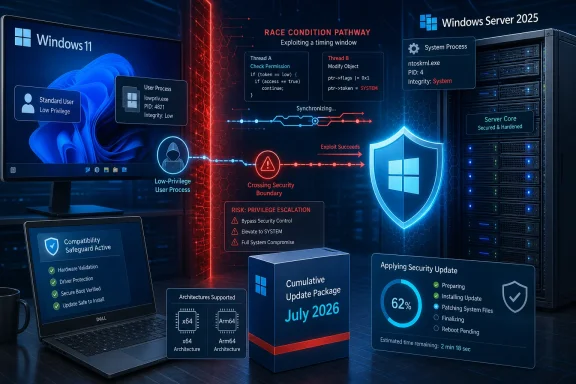 A Race Condition Opens the Privilege Boundary
Microsoft describes CVE-2026-50503 as a race condition caused by concurrent execution against a shared resource without proper synchronization. The associated weakness is CWE-362, a broad category covering situations where multiple operations access the same resource in an unsafe order.Race conditions are often difficult to exploit reliably because the attacker must manipulate timing so that operations occur in a particular sequence. That requirement is reflected in the vulnerability’s CVSS vector, which marks attack complexity as high.
The attacker must also possess low-level privileges and execute code locally. No user interaction is required once those conditions are met, and the flaw is not remotely exploitable on its own.
That makes CVE-2026-50503 a potential second-stage vulnerability rather than an initial entry point. An attacker could combine it with a malicious document, compromised application, stolen standard-user account, remote management breach, or another vulnerability that first provides code execution.
Successful exploitation can affect confidentiality, integrity, and availability at the highest level represented in Microsoft’s CVSS vector. In practical terms, a low-privilege process could reportedly cross a Windows security boundary and gain the authority needed to access protected data, modify system resources, disable defenses, create privileged accounts, or establish persistence.
Microsoft has not published proof-of-concept code, detailed function names, or a step-by-step description of the vulnerable execution path. The existence of the flaw is nevertheless vendor-confirmed, rather than based solely on an unverified third-party report.
The Corrected Builds Span Client and Server
Microsoft’s CVE record identifies affected releases across both x64 and Arm64 Windows 11 systems, while the Windows Server exposure applies to x64 installations. Server Core is explicitly included alongside the full Windows Server 2025 installation.The corrected release thresholds listed for the vulnerability are:
- Windows 11 24H2 is corrected at OS build 26100.8875.
- Windows 11 25H2 is corrected at OS build 26200.8875.
- Windows Server 2025 is corrected at OS build 26100.33158, including Server Core.
- Windows 11 26H1 systems should install the latest available cumulative update and confirm their servicing status against Microsoft’s Security Update Guide.
Windows 11 26H1 receives KB5101649 and moves to build 28000.2525. Microsoft’s CVE data lists versions before build 28000.2269 as affected, indicating that newer 26H1 servicing builds already cross the published correction threshold. Administrators should still deploy KB5101649 because cumulative Windows updates carry the latest security content and supersede earlier packages.
To check a machine manually, run
winver or inspect the operating-system build through PowerShell, endpoint management, Windows Update for Business reports, Microsoft Intune, Configuration Manager, or the organization’s vulnerability-management platform. Merely approving an update in WSUS does not demonstrate that it installed successfully.Local Access Does Not Make the Flaw Harmless
The absence of remote exploitation lowers the immediate risk to an untouched system, but it does not make this a cosmetic patch. Elevation-of-privilege vulnerabilities are valuable because many initial-access techniques leave an attacker trapped inside a standard-user context.Windows administrators should therefore evaluate CVE-2026-50503 in combination with the rest of their exposure. Shared workstations, Remote Desktop Session Hosts, application servers that run third-party agents, developer PCs, virtual desktop infrastructure, and systems where users can execute downloaded software offer more opportunities for local code to reach the vulnerable component.
The high-complexity rating means exploitation requires additional preparation or favorable runtime conditions. It does not mean exploitation is impossible, nor does it prevent researchers from finding more dependable triggering techniques after the update has exposed the existence of the bug.
Microsoft currently reports no public disclosure and no observed exploitation. That gives IT teams room to follow their normal validation process, but it is not a reason to defer the update indefinitely—especially because the CVE affects Windows Server 2025 as well as current Windows 11 releases.
Security teams should watch for later changes to Microsoft’s exploitability assessment, the US Cybersecurity and Infrastructure Security Agency’s Known Exploited Vulnerabilities catalog, and endpoint detections associated with unexpected privilege transitions. Microsoft’s July 14 advisory is the initial disclosure, and the National Vulnerability Database was still awaiting its own enrichment immediately after publication.
Patch Testing Has an Extra Dell Complication
Deployment of KB5101650 may require additional attention on a limited number of Dell PCs with Intel processors. Microsoft says the July update may be temporarily unavailable to affected devices because of an incompatibility reported by Dell.The reported symptoms can include unexpected shutdowns, reduced performance, increased heat, and battery drain. Microsoft and Dell are using a safeguard mechanism to prevent installation on affected models while they prepare a resolution.
Administrators should not bypass that block simply to make compliance dashboards turn green. A safeguarded device needs to be tracked as an exception, kept under tighter monitoring, and updated when Microsoft or Dell clears the compatibility hold.
This does not change the underlying CVE exposure. It means some organizations may temporarily need compensating controls such as application allowlisting, reduced local software execution, removal of unnecessary local accounts, stronger endpoint detection, and tighter administrative credential separation.
For unaffected hardware, organizations can deploy the normal cumulative update through Windows Update, Windows Update for Business, Microsoft Intune, WSUS, Configuration Manager, or the Microsoft Update Catalog. As with any broad Windows security release, pilot rings should include representative Arm64 and x64 clients, security agents, line-of-business applications, and Windows Server 2025 workloads.
CVE-2026-50503 is not an internet-facing zero-day, but it provides exactly the kind of privilege step attackers seek after gaining a foothold. Windows 11 systems should be brought to the July 2026 cumulative builds, Windows Server 2025 should reach build 26100.33158, and Dell devices held back by the compatibility safeguard should remain visible as unresolved security exceptions rather than disappearing into the deployment queue.
References
- Primary source: MSRC
Published: 2026-07-14T07:00:00-07:00
Security Update Guide - Microsoft Security Response Center
 msrc.microsoft.com
