

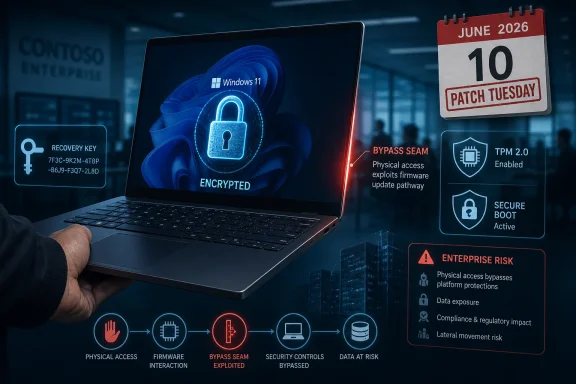
The vulnerability lands in a particularly bad month for defenders. Microsoft’s June 2026 Patch Tuesday was unusually large, with security vendors counting 198 addressed CVEs and three publicly disclosed zero-days. CVE-2026-50507 was not the highest-scoring bug in that pile, but it is one of the more strategically interesting ones because it turns a physical-access scenario into a data exposure problem rather than a routine endpoint-hardening issue.
BitLocker’s Job Is Boring Until It Fails
BitLocker is supposed to make stolen hardware boring. A lost laptop should be an asset-management headache, not a breach notification. That is the premise behind device encryption in modern Windows: encrypt the operating system volume, bind access to trusted boot measurements and key protectors, and make sure the disk is useless to anyone who cannot satisfy the machine’s expected startup path.
That bargain has always had caveats. BitLocker is not magic; it is an engineering system that depends on firmware, TPM state, boot integrity, recovery behavior, Windows Recovery Environment policy, and user or administrator choices. But for most Windows fleets, the day-to-day value is simple. If a powered-off laptop disappears, encryption should stop the thief from pulling usable data off the drive.
CVE-2026-50507 matters because it lives in the narrow space where that promise becomes fragile. Microsoft describes the impact as a security feature bypass, not a cryptographic break. That distinction is important. The attacker is not being handed a universal BitLocker master key, nor is AES suddenly suspect. Instead, the vulnerability reportedly allows the attacker to navigate around the protection boundary that should prevent encrypted data from becoming available.
That makes the bug less cinematic than a remote worm and more operationally consequential than its “Important” label might suggest. For a ransomware crew, physical access is a limiting condition. For a malicious insider, a border search, a stolen executive laptop, a repaired machine with sensitive residue, or a device left in a hotel room, physical access is not theoretical at all.
The Confidence Signal Is Stronger Than the Public Detail
The user-facing security question here is not only “how bad is it?” It is also “how sure are we?” Microsoft’s advisory gives CVE-2026-50507 the official stamp that matters most in enterprise risk management: vendor acknowledgement. In vulnerability scoring language, that means the existence of the flaw is not merely rumored, inferred, or described by third-party researchers without confirmation. It is accepted by the vendor responsible for the affected technology.
That does not mean every technical detail is public. In fact, the public record remains deliberately constrained. Microsoft and security vendors have described the broad exploitation condition — physical access to the system — and the broad result — bypassing BitLocker Device Encryption to access encrypted data. They have not published a step-by-step exploit chain in mainstream advisories, and that restraint is useful for defenders even if it frustrates researchers.
The confidence picture is therefore asymmetric. Confidence in the existence of the vulnerability is high because Microsoft has assigned a CVE, placed it in the Security Update Guide, and shipped a patch. Confidence in the exact root cause, affected execution path, and exploit mechanics is lower for the general public because those details are not fully disclosed in Microsoft’s advisory. That is not a contradiction. It is how responsible patch publication often looks when the vendor wants administrators to act before copy-paste exploitation becomes widespread.
There is also a darker side to that partial opacity. Attackers do not need a beautifully written whitepaper if they can patch-diff Windows binaries, compare behavior across builds, or work from public researcher hints. The more the security community discusses a named bypass, the more likely motivated actors will spend time reconstructing it. Microsoft’s “Exploitation More Likely” assessment is a signal that defenders should not treat the lack of a public exploit recipe as comfort.
The Physical-Access Requirement Is a Boundary, Not a Reassurance
The phrase “physical access required” often causes patch queues to relax. That instinct is understandable in cloud-first and remote-first security programs, where internet-facing bugs dominate the panic cycle. But BitLocker exists precisely because physical access is one of the canonical threats to endpoint data.
A disk encryption bypass is different from a local privilege escalation bug on an already-compromised machine. The attacker may not need credentials, domain access, malware footholds, or phishing success if the target asset is in hand. The whole point of encryption is to make possession of the hardware insufficient. CVE-2026-50507 chips away at that assumption.
The affected scenario is also unusually relevant to executives, legal teams, journalists, developers, government workers, and field staff. These are the users whose devices routinely hold cached mail, browser sessions, source repositories, secrets, customer files, VPN artifacts, and local copies of cloud-synced documents. In a well-managed environment, many of those assets should be protected by additional controls. In the real world, the laptop remains a dense little archive of organizational life.
Physical access also scales differently from remote exploitation. It is not mass exploitation in the botnet sense, but it is highly targeted. An attacker does not need to compromise 10,000 machines if the one machine contains merger documents, source code, privileged admin tokens, or offline case material. The correct mental model is not “wormable Windows bug.” It is “the stolen laptop exception may have an exception.”
Patch Tuesday’s Record Month Makes Prioritization Harder
June 2026 was a brutal month for vulnerability managers because the denominator was so large. A Patch Tuesday approaching 200 CVEs forces triage teams to make choices, and those choices often follow familiar gravity: remote code execution first, critical severity first, known exploited first, domain controllers and internet-facing services first. By those instincts, a BitLocker bypass with physical access may not naturally rise to the top.
That would be a mistake for certain fleets. Severity scores are useful, but they flatten context. A branch-office kiosk and a CFO’s travel laptop do not carry the same data exposure risk. A developer workstation with local signing material is not the same problem as a shared training-room PC. BitLocker bypass risk is asset-sensitive, not merely vulnerability-sensitive.
This is where mature Windows management pays off. If an organization knows which devices are mobile, which are encrypted, which use TPM-only protectors, which hold regulated data, and which travel internationally, it can prioritize intelligently. If it does not know, CVE-2026-50507 becomes another reminder that endpoint inventory is not clerical work. It is the map you need when a security feature fails.
There is a related lesson in the timing. CVE-2026-50507 appears alongside other high-interest Windows flaws, including publicly disclosed zero-days in HTTP.sys and the Collaborative Translation Framework. The attacker’s menu is broad. Defenders do not get to patch one dramatic vulnerability and call the month solved.
BitLocker’s Weakest Moments Are Around Recovery
BitLocker’s most delicate design problem has always been recovery. A perfect encryption system that locks out legitimate users after firmware changes, boot repairs, failed updates, or motherboard replacements is not acceptable at enterprise scale. Windows therefore has recovery paths, key escrow mechanisms, trusted recovery environments, and policy knobs that try to balance security with survivability.
That balance is hard. Windows Recovery Environment exists because machines break. Startup Repair exists because boot chains fail. Recovery keys exist because TPM measurements change. Each of those mechanisms is legitimate, but each also creates a policy surface that must be protected as carefully as the normal boot path.
Microsoft’s own documentation makes clear that Windows RE can interact with BitLocker-protected drives under certain trusted conditions, and that modified recovery environments should trigger recovery-key requirements. That is the intended boundary. The fear with modern BitLocker bypasses is that a clever attacker may find seams between “trusted enough to recover” and “locked enough to protect.”
For administrators, this means BitLocker posture cannot stop at “is encryption enabled?” That checkbox is the beginning, not the end. The real questions are whether recovery keys are escrowed correctly, whether devices use TPM-only unlock or require pre-boot authentication, whether Secure Boot is enforced, whether recovery partitions are healthy and current, and whether firmware configuration is locked against casual tampering.
TPM-Only Convenience Keeps Meeting Physical Reality
The Windows ecosystem has spent years making encryption less visible. That was broadly the right move. Users do not reliably enable security features that make every boot more annoying, and organizations cannot afford support storms caused by routine pre-boot prompts. TPM-only BitLocker made encryption deployable at massive scale because the machine could unlock transparently when the boot environment looked right.
The cost is that transparent unlock relies heavily on the integrity of the startup and recovery path. Add a PIN, and the attacker needs something the user knows before the volume unlocks. Use TPM-only, and the system is trying to decide whether the environment is trustworthy enough to release secrets without bothering the user. That decision is automated, and automated trust decisions are fertile ground for bypass research.
This does not mean every organization should immediately force BitLocker PINs on every laptop. That would be an easy column to write and a miserable policy to operate. Accessibility, remote support, user friction, keyboard layouts, travel scenarios, and help-desk load all matter. But CVE-2026-50507 should reopen the discussion for high-risk devices.
A tiered model is more defensible. Standard corporate laptops may remain TPM-only with rapid patching and strong device compliance rules. Privileged admin workstations, executives’ travel machines, legal laptops, and systems holding sensitive local datasets may justify pre-boot authentication. The point is not to punish everyone with maximum friction. It is to stop treating all encrypted endpoints as if they carry the same threat model.
Security Feature Bypass Is Not a Soft Category
Microsoft’s “security feature bypass” label sometimes sounds gentler than it is. A bypass does not necessarily crash a service, execute arbitrary code, or hand over administrator rights. But it can invalidate the control that stands between an attacker and a protected asset. When the feature is BitLocker, the protected asset is data at rest.
That distinction matters for incident response. If an unpatched encrypted laptop is stolen, the organization’s risk analysis may need to account for the possibility that encryption alone is no longer a complete compensating control. That does not automatically mean every lost laptop is a breach. It does mean counsel, privacy teams, and security leadership may ask harder questions about patch state, protector configuration, device model, shutdown state, and exposure window.
It also matters for cyber insurance and compliance narratives. Many organizations lean on full-disk encryption as a safe harbor in lost-device policies. The logic is straightforward: if the data was encrypted and the key was not compromised, reporting obligations may be reduced. A credible BitLocker bypass complicates that comfort, especially for devices missing the June 2026 update.
The industry has seen this pattern before with Secure Boot, Mark of the Web, SmartScreen, and other Windows security boundaries. Attackers love bypasses because they turn trusted workflows against themselves. Defenders sometimes underrate them because they do not look like classic exploitation. CVE-2026-50507 is another case where the impact is best measured by what assumption breaks, not by whether shellcode runs.
Public Research Has Changed the Patch Clock
The surrounding context is unusually noisy. Recent BitLocker bypass discussions have included named techniques, public proof-of-concept claims, and researcher disputes over disclosure. CVE-2026-50507 has been associated by at least one security vendor with a flaw known as Bitskrieg, reportedly tied to work involving Chaotic Eclipse, also known as Nightmare Eclipse, and another researcher. A separate BitLocker issue, CVE-2026-45585, has been publicly discussed under the YellowKey name and prompted Microsoft mitigation guidance in May.
The names are less important than the pattern. BitLocker is receiving sustained public attention from researchers who are probing recovery, boot, and device-encryption assumptions. Some of that work is useful and necessary. Some of the disclosure drama has been messy. For defenders, the practical result is the same: attackers have more breadcrumbs than they did a month ago.
This changes the patch clock. In a quiet vulnerability with no public research trail, an organization might accept a longer deployment window for a physical-access bypass. In a live research cycle with named techniques and public argument over exploitability, that patience becomes harder to justify. The exploit may still require hands-on access, but the knowledge needed to reproduce it may diffuse faster than normal.
Microsoft’s “Exploitation More Likely” rating should be read in that light. It is not a guarantee that criminals are already using the bug. It is an official nudge that the conditions for exploitation are favorable enough that administrators should move with urgency. In practical terms, that means laptops and other mobile Windows devices should not wait behind lower-risk desktops simply because this is not remote.
Administrators Need to Audit the Control, Not Just Install the Update
The immediate action is obvious: deploy the June 2026 Windows security updates to affected supported systems. But BitLocker incidents are rarely solved by patching alone because encryption posture is a configuration story as much as a binary story. A patched fleet with sloppy recovery-key handling, unmanaged firmware settings, and unknown encryption states is still brittle.
Start with visibility. Administrators should confirm which endpoints are actually protected by BitLocker or device encryption, which devices have recovery keys escrowed to Microsoft Entra ID or Active Directory, and which machines are sitting in a suspended or partially protected state. Device encryption can appear deceptively simple in consumer and small-business settings, but the enterprise version of “simple” must include reporting.
Then examine high-value assets. Privileged access workstations, executives’ travel systems, incident-response laptops, developer machines, legal devices, and systems used in regulated workflows deserve a separate posture review. If a machine’s loss would cause a crisis, it should not be governed by the same defaults as a general-purpose endpoint.
Finally, test recovery deliberately. Many organizations discover during an incident that recovery keys are missing, stale, duplicated, inaccessible to the right support staff, or escrowed in a tenant nobody can reach quickly. That is not a BitLocker vulnerability in the CVE sense, but it becomes a security failure when the organization has to choose between protecting data and restoring business operations.
The June BitLocker Lesson Fits in a Carry-On Bag
CVE-2026-50507 is not a reason to abandon BitLocker. It is a reason to treat BitLocker as a living security control rather than a one-time deployment milestone. The practical lesson is that encryption is strongest when patching, hardware trust, recovery policy, and user workflow are managed together.
- Microsoft’s June 9, 2026 update addresses CVE-2026-50507, a Windows BitLocker security feature bypass rated Important with a CVSS score reported by security vendors as 6.8.
- The vulnerability requires physical access, but that condition is central to BitLocker’s threat model rather than a reason to ignore the issue.
- Microsoft’s acknowledgement and patch make confidence in the vulnerability’s existence high, while the public technical details remain limited.
- Mobile devices, executive laptops, privileged administrator systems, and endpoints holding sensitive local data should be prioritized ahead of low-risk fixed desktops.
- Organizations should verify BitLocker status, recovery-key escrow, Secure Boot posture, Windows RE integrity, and whether high-risk systems need stronger pre-boot authentication.
- Lost-device response plans should account for patch state and BitLocker configuration instead of assuming encryption always ends the data-exposure analysis.
The forward-looking story is not that BitLocker has failed, but that Windows’ quietest security feature is now under louder scrutiny. Microsoft can patch CVE-2026-50507, and administrators should deploy that patch quickly, but the bigger shift is cultural: full-disk encryption can no longer be treated as a static checkbox that permanently neutralizes lost hardware risk. The next serious BitLocker story will probably arrive through the same seams — recovery, boot trust, firmware state, and convenience — and the organizations best prepared for it will be the ones that use this month’s bypass not as a panic button, but as a rehearsal.