

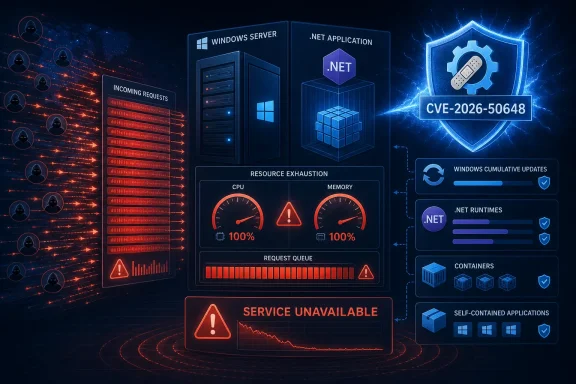
Microsoft assigned CVE-2026-50648 a CVSS 3.1 base score of 7.5 out of 10. The vulnerability requires no privileges or user interaction, carries low attack complexity, and can be exploited across a network, according to the Microsoft-authored CVE record published through the National Vulnerability Database.
The underlying weakness is categorized as CWE-770, Allocation of Resources Without Limits or Throttling. In practical terms, vulnerable code can be induced to consume a finite resource without enforcing an adequate ceiling, allowing hostile requests to degrade availability or stop a service from responding.
A Network-Reachable Failure Without Code Execution
CVE-2026-50648 does not provide remote code execution, disclose data, or directly alter information. Its security impact is entirely on availability, but that distinction offers limited comfort when .NET is hosting a customer portal, internal API, authentication dependency, management service, or other workload that must remain reachable.
Microsoft’s CVSS vector is AV:N/AC:L/PR:N/UI:N/S:U/C:N/I:N/A:H. That describes a network-reachable attack requiring neither credentials nor assistance from a user, with a high potential impact on availability.
A successful attacker could therefore trigger the vulnerable resource-allocation behavior remotely where an affected .NET component is exposed through an application. The public description does not identify the exact protocol, API, payload format, or resource that becomes exhausted, so administrators should not assume that an existing web application firewall rule or request-size limit will necessarily block exploitation.
The absence of those implementation details also limits opportunities for reliable detection. A sudden increase in CPU use, memory pressure, thread exhaustion, request queues, process recycling, or application-pool failures could indicate a denial-of-service attempt, but the same symptoms can arise from legitimate traffic spikes and ordinary software defects.
CISA’s initial SSVC data recorded no known exploitation as of July 14. It nevertheless classified exploitation as automatable, meaning the conditions described in the CVE appear suitable for repeatable attacks without extensive manual work. That combination supports normal expedited patching rather than emergency incident handling, unless an organization is already investigating unexplained availability failures.
The Affected Footprint Extends Beyond .NET Framework
Despite Microsoft’s advisory title referring to .NET Framework, the published affected-products record covers both the Windows-integrated framework and current .NET releases. It lists vulnerable versions of .NET 8, .NET 9, and .NET 10 alongside multiple .NET Framework combinations shipped with supported editions of Windows and Windows Server.
Affected platforms include configurations based on:
- .NET 8 releases before 8.0.29.
- .NET 9 releases before 9.0.18.
- Multiple .NET 10 builds identified in Microsoft’s affected-version data.
- .NET Framework 3.5, 4.7.2, 4.8, and 4.8.1 across applicable Windows releases.
- Visual Studio 2022 versions 17.12 and 17.14, plus Visual Studio 2026 version 18.7.
The Windows list spans legacy server installations through current client and server releases. Microsoft’s record names Windows Server 2012 and 2012 R2, Windows Server 2016, Windows Server 2019, Windows Server 2022, and Windows Server 2025, including applicable Server Core installations. Client configurations include Windows 10 releases and Windows 11 versions 23H2, 24H2, 25H2, and 26H1 where the affected .NET Framework package is present.
That breadth matters for inventory work. Security teams should not limit searches to developer workstations or systems with a separately installed modern .NET runtime. .NET Framework is also delivered and serviced as a Windows component, while server applications may carry their own .NET runtime through self-contained deployment rather than relying on the system-wide installation.
For framework-dependent .NET applications, updating the runtime installed on the host may be sufficient. Self-contained applications generally require the application owner or software vendor to rebuild and redeploy the workload with a corrected runtime, because Windows Update does not replace the private runtime bundled inside the application directory.
July’s Servicing Builds Carry the Fix
Microsoft’s .NET team detailed the remediation in its July 2026 servicing announcement. The current releases published on July 14 are .NET 8.0.29, .NET 9.0.18, and .NET 10.0.10, with updated installers, binaries, container images, and Linux packages available through the usual servicing channels.
For Windows 10 version 22H2, Microsoft documents CVE-2026-50648 as one of the vulnerabilities addressed by KB5102203, the July 14 cumulative update for .NET Framework 3.5, 4.8, and 4.8.1. The update is distributed through Windows Update, Windows Update for Business, the Microsoft Update Catalog, and Windows Server Update Services.
Microsoft says it is not currently aware of problems with KB5102203. That status can change as deployment expands, but there is no documented known issue specific to CVE-2026-50648 at publication time.
Administrators should use the update identified for each operating-system version rather than deploying the Windows 10 package universally. .NET Framework KB numbers vary by Windows and Windows Server release even when they correct the same underlying vulnerability.
Visual Studio installations also require attention. Microsoft’s affected-products data sets corrected thresholds at Visual Studio 2022 17.12.22, Visual Studio 2022 17.14.36, and Visual Studio 2026 18.7.4. Developer endpoints, build servers, and hosted CI workers should be included in compliance checks rather than treated as lower-priority desktop systems.
Patch the Runtime, Then Find the Copies Windows Cannot See
The immediate task is to approve July’s .NET Framework security updates for supported Windows systems and move modern .NET workloads onto the latest servicing release for their major version. Internet-facing application servers and systems whose availability affects authentication, payments, remote management, or production APIs deserve the earliest deployment slots.
Containerized and self-contained applications need a separate review. Teams should examine container base-image tags, software bills of materials, deployment manifests, application directories, and CI pipelines for embedded .NET runtimes that will remain vulnerable after the host operating system is patched.
Monitoring should focus on abrupt resource exhaustion and repeated process failure around .NET services, particularly where the triggering traffic originates from untrusted networks. Those signals cannot confirm CVE-2026-50648 by themselves, but they can help identify systems requiring isolation or accelerated maintenance.
Public technical detail remains sparse, and neither Microsoft’s CVE description nor the initial NVD record provides a proof of concept. That lowers immediate copy-and-paste exploitation risk, but it also leaves defenders without a dependable request signature. Installing the corrected runtime is the only broadly applicable mitigation currently documented, and the remaining operational challenge is finding every application that carries its own vulnerable copy.