

Microsoft has patched CVE-2026-50670, an 8.8-rated Windows Win32k elevation-of-privilege vulnerability that can allow an attacker with existing local access to gain higher privileges. The fix arrived with the July 14, 2026 security updates and applies across supported Windows 10, Windows 11, Windows Server 2019, Windows Server 2022, and Windows Server 2025 installations.
Detailed in Microsoft’s Security Update Guide, the flaw is an out-of-bounds read in the Windows kernel’s Win32k component. Exploitation requires an authorized attacker to execute code locally, but it needs no additional user interaction once that foothold exists.
Microsoft had not classified CVE-2026-50670 as publicly disclosed or exploited in the wild when the advisory was published. That makes it less urgent than the actively exploited vulnerabilities in July’s unusually large Patch Tuesday release, but its high CVSS score and broad Windows footprint still justify prompt deployment.
Win32k provides kernel-mode support for core Windows graphical and user-interface operations. Because the component runs at a highly privileged level, memory-safety errors in its code can become useful links in an attacker’s exploitation chain.
CVE-2026-50670 stems from an out-of-bounds read, meaning the affected code can access memory outside the intended boundary of a buffer. Microsoft’s public description does not provide enough detail to determine exactly which Win32k operation triggers the condition or how the leaked memory is converted into reliable privilege escalation.
The vulnerability is local rather than network-reachable. An attacker cannot directly compromise an unpatched PC by simply sending packets to it over the internet; the attacker must already be able to run code on the target using a low-privileged account or compromised process.
That requirement limits the initial attack surface but does not make the flaw harmless. Malware commonly arrives through phishing, malicious downloads, browser vulnerabilities, document exploits, stolen credentials, or abused remote-management tools. A local elevation-of-privilege vulnerability can then provide the step from constrained execution to control over protected system resources.
A successful exploit could potentially let an attacker access data belonging to other users, modify protected files, disable defensive controls, tamper with services, or establish persistence that survives ordinary cleanup. The CVSS assessment reflects high potential impact to confidentiality, integrity, and availability.
Microsoft lists the vulnerability’s report confidence as confirmed. In practical terms, that means defenders should treat the flaw as established rather than speculative, even though Microsoft has withheld the technical detail that exploit developers would need for a straightforward reproduction.
Affected branches include:
Representative updates include KB5099538 for Windows 10 Version 1809 and Windows Server 2019, KB5099540 for Windows Server 2022, and KB5099536 for Windows Server 2025. Because Windows cumulative updates package multiple security corrections together, there is no separate CVE-2026-50670 installer to deploy.
The patch requires a restart on the affected Windows versions. That matters for server fleets where updates may be staged successfully but remain ineffective until maintenance windows permit a reboot. Vulnerability scanners can also report confusing results during this interval if they detect the installed package without confirming the running kernel build.
Administrators should check the update’s installation status, current build number, and most recent boot time. A management console showing a successful download or pending restart is not evidence that the vulnerable kernel code has been replaced in memory.
That distinction is important when prioritizing patches. Internet-facing remote-code-execution flaws generally demand immediate attention because they can create the first foothold. Local privilege-escalation bugs become particularly dangerous on endpoints where untrusted code frequently runs, including employee workstations, virtual desktops, application servers, shared systems, and developer machines.
They are also relevant to environments using least-privilege accounts. Running users without administrator rights remains valuable because it limits what many payloads can do immediately, but it is not a substitute for patching kernel vulnerabilities. A working local exploit can turn the compromised standard account into a much more capable position.
Application-control policies, Microsoft Defender for Endpoint, attack-surface-reduction rules, and credential protections can make it harder for an attacker to reach or benefit from the vulnerable code path. None of those controls corrects the underlying Win32k memory error, however, and Microsoft has not published a registry-based workaround or standalone mitigation for CVE-2026-50670.
The practical remediation is therefore straightforward: install the July 2026 cumulative security update and restart the machine.
CVE-2026-50670 was not one of the month’s disclosed or actively exploited zero-days. Organizations facing limited maintenance capacity may reasonably place exploited SharePoint Server and Active Directory Federation Services vulnerabilities ahead of this Win32k issue, particularly where those products are exposed to hostile networks.
Endpoint-heavy organizations should not let it drift into a distant patch cycle, though. The combination of low attack complexity, required low privileges, no user interaction, and high post-exploitation impact gives CVE-2026-50670 the profile of a useful second-stage vulnerability if researchers or attackers develop a reliable exploit.
Deployment rings remain sensible. IT teams should test the July cumulative updates against graphics-intensive applications, remote desktop infrastructure, security agents, accessibility software, and other products that interact deeply with the Windows user-interface stack, then move quickly from pilot devices to broad deployment.
Security teams should also continue monitoring Microsoft’s advisory for revisions. A change in the exploitation assessment, publication of proof-of-concept code, or addition to the Cybersecurity and Infrastructure Security Agency’s Known Exploited Vulnerabilities catalog would materially alter the priority.
For now, the immediate checkpoint is concrete: affected machines need the July 14, 2026 cumulative update, the corresponding patched build, and a completed restart. Anything short of that leaves the vulnerable Win32k code running.
Detailed in Microsoft’s Security Update Guide, the flaw is an out-of-bounds read in the Windows kernel’s Win32k component. Exploitation requires an authorized attacker to execute code locally, but it needs no additional user interaction once that foothold exists.
Microsoft had not classified CVE-2026-50670 as publicly disclosed or exploited in the wild when the advisory was published. That makes it less urgent than the actively exploited vulnerabilities in July’s unusually large Patch Tuesday release, but its high CVSS score and broad Windows footprint still justify prompt deployment.
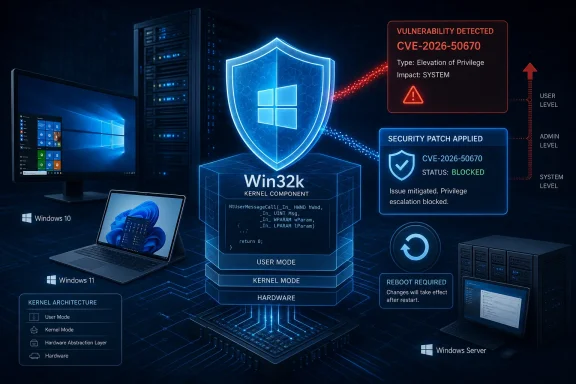 A Local Bug With System-Level Consequences
Win32k provides kernel-mode support for core Windows graphical and user-interface operations. Because the component runs at a highly privileged level, memory-safety errors in its code can become useful links in an attacker’s exploitation chain.CVE-2026-50670 stems from an out-of-bounds read, meaning the affected code can access memory outside the intended boundary of a buffer. Microsoft’s public description does not provide enough detail to determine exactly which Win32k operation triggers the condition or how the leaked memory is converted into reliable privilege escalation.
The vulnerability is local rather than network-reachable. An attacker cannot directly compromise an unpatched PC by simply sending packets to it over the internet; the attacker must already be able to run code on the target using a low-privileged account or compromised process.
That requirement limits the initial attack surface but does not make the flaw harmless. Malware commonly arrives through phishing, malicious downloads, browser vulnerabilities, document exploits, stolen credentials, or abused remote-management tools. A local elevation-of-privilege vulnerability can then provide the step from constrained execution to control over protected system resources.
A successful exploit could potentially let an attacker access data belonging to other users, modify protected files, disable defensive controls, tamper with services, or establish persistence that survives ordinary cleanup. The CVSS assessment reflects high potential impact to confidentiality, integrity, and availability.
Microsoft lists the vulnerability’s report confidence as confirmed. In practical terms, that means defenders should treat the flaw as established rather than speculative, even though Microsoft has withheld the technical detail that exploit developers would need for a straightforward reproduction.
The Patch Reaches Across Windows Generations
Microsoft’s affected-product data shows that CVE-2026-50670 crosses several Windows code bases and processor architectures. Both desktop and server systems are exposed, including Server Core installations where applicable.Affected branches include:
- Windows 10 Version 1809 systems below build 17763.9020 are affected.
- Windows 10 Version 21H2 systems below build 19044.7548 are affected.
- Windows 10 Version 22H2 systems below build 19045.7548 are affected.
- Windows 11 Version 24H2 systems below build 26100.8875 are affected.
- Windows 11 Version 25H2 systems below build 26200.8875 are affected.
- Windows 11 version 26H1 systems below build 28000.2525 are affected.
- Windows Server 2019 systems below build 17763.9020 are affected.
- Windows Server 2022 systems below build 20348.5386 are affected.
- Windows Server 2025 systems below build 26100.33158 are affected.
Representative updates include KB5099538 for Windows 10 Version 1809 and Windows Server 2019, KB5099540 for Windows Server 2022, and KB5099536 for Windows Server 2025. Because Windows cumulative updates package multiple security corrections together, there is no separate CVE-2026-50670 installer to deploy.
The patch requires a restart on the affected Windows versions. That matters for server fleets where updates may be staged successfully but remain ineffective until maintenance windows permit a reboot. Vulnerability scanners can also report confusing results during this interval if they detect the installed package without confirming the running kernel build.
Administrators should check the update’s installation status, current build number, and most recent boot time. A management console showing a successful download or pending restart is not evidence that the vulnerable kernel code has been replaced in memory.
Why Win32k Bugs Stay Valuable to Attackers
Win32k vulnerabilities have a long history in Windows exploitation because they sit at the boundary between ordinary user-mode applications and privileged kernel operations. Attackers do not necessarily need CVE-2026-50670 to provide initial entry; they need it to erase the restrictions imposed on the access they already have.That distinction is important when prioritizing patches. Internet-facing remote-code-execution flaws generally demand immediate attention because they can create the first foothold. Local privilege-escalation bugs become particularly dangerous on endpoints where untrusted code frequently runs, including employee workstations, virtual desktops, application servers, shared systems, and developer machines.
They are also relevant to environments using least-privilege accounts. Running users without administrator rights remains valuable because it limits what many payloads can do immediately, but it is not a substitute for patching kernel vulnerabilities. A working local exploit can turn the compromised standard account into a much more capable position.
Application-control policies, Microsoft Defender for Endpoint, attack-surface-reduction rules, and credential protections can make it harder for an attacker to reach or benefit from the vulnerable code path. None of those controls corrects the underlying Win32k memory error, however, and Microsoft has not published a registry-based workaround or standalone mitigation for CVE-2026-50670.
The practical remediation is therefore straightforward: install the July 2026 cumulative security update and restart the machine.
Patch Priority Depends on the Existing Foothold Risk
CVE-2026-50670 was one of hundreds of vulnerabilities addressed in Microsoft’s July 2026 release. BleepingComputer’s Patch Tuesday reporting counted 570 Microsoft flaws, including three zero-days and more than 250 elevation-of-privilege vulnerabilities, while other industry counts differ depending on whether Chromium and related entries are included.CVE-2026-50670 was not one of the month’s disclosed or actively exploited zero-days. Organizations facing limited maintenance capacity may reasonably place exploited SharePoint Server and Active Directory Federation Services vulnerabilities ahead of this Win32k issue, particularly where those products are exposed to hostile networks.
Endpoint-heavy organizations should not let it drift into a distant patch cycle, though. The combination of low attack complexity, required low privileges, no user interaction, and high post-exploitation impact gives CVE-2026-50670 the profile of a useful second-stage vulnerability if researchers or attackers develop a reliable exploit.
Deployment rings remain sensible. IT teams should test the July cumulative updates against graphics-intensive applications, remote desktop infrastructure, security agents, accessibility software, and other products that interact deeply with the Windows user-interface stack, then move quickly from pilot devices to broad deployment.
Security teams should also continue monitoring Microsoft’s advisory for revisions. A change in the exploitation assessment, publication of proof-of-concept code, or addition to the Cybersecurity and Infrastructure Security Agency’s Known Exploited Vulnerabilities catalog would materially alter the priority.
For now, the immediate checkpoint is concrete: affected machines need the July 14, 2026 cumulative update, the corresponding patched build, and a completed restart. Anything short of that leaves the vulnerable Win32k code running.
References
- Primary source: MSRC
Published: 2026-07-14T07:00:00-07:00
Security Update Guide - Microsoft Security Response Center
 msrc.microsoft.com
- Related coverage: safe.security
Windows Win32k Elevation of Privilege Vulnerability [CVE-2021-1732]
In this research paper, you can learn about Windows Win32k elevation of privilege vulnerability (CVE-2021-1732) and how it works. Download it here.safe.security
