

Microsoft’s CVE-2026-5223 advisory covers a medium-severity Cargo vulnerability, disclosed by the Rust Security Response Team in May 2026 and updated in Microsoft’s Security Update Guide in June, that lets malicious crates from third-party Rust registries overwrite cached source for other crates from the same registry. The bug is not a Windows kernel panic, not a remote desktop worm, and not the kind of vulnerability that lights up consumer headlines. But it lands squarely in the place modern software teams increasingly fear: the build pipeline. For Windows admins and developers shipping Rust into Azure Linux images, internal tooling, agents, services, or cross-platform applications, the lesson is simple: package cache integrity is now part of your security boundary.
The uncomfortable part of CVE-2026-5223 is not that Cargo had a bug. Every package manager eventually has one. The uncomfortable part is that the vulnerable behavior involved the local source cache, the quiet piece of developer infrastructure that exists precisely so builds can be faster, repeatable, and less dependent on network fetches.
Cargo, Rust’s package manager and build tool, downloads crate source archives and extracts them under the user’s Cargo directory. Once there, the extracted source can be reused by future builds. That cache is supposed to be boring infrastructure: a convenience layer between the registry and the compiler.
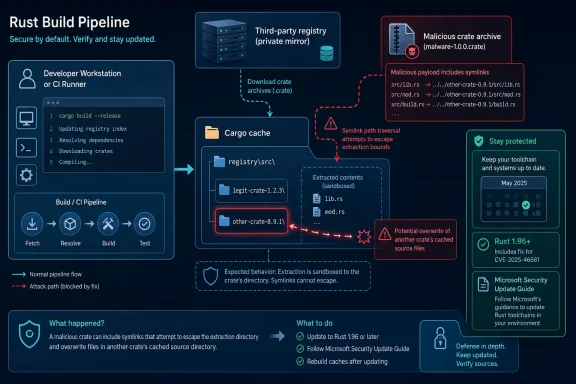
CVE-2026-5223 shows why boring infrastructure is security-sensitive infrastructure. According to the Rust advisory, Cargo incorrectly handled symbolic links inside crate tarballs downloaded from third-party registries. A malicious crate could craft an archive that escaped its own expected extraction area by one level and overwrote cached source belonging to another crate from the same registry.
That is not the same thing as “any Rust project can be compromised by any crate on the internet.” The practical scope is narrower. The advisory says crates.io users are not affected because crates.io already forbids uploading crates that contain symlinks. The danger sits with third-party registries, private registries, mirrors, and internal package feeds — exactly the places enterprise teams use when they want more control over software supply chains.
And that is the irony. Many organizations build private registries to reduce risk. CVE-2026-5223 is a reminder that a private registry is not automatically a safer registry; it is another system whose assumptions must be tested.
The Microsoft entry lists the issue as a security vulnerability, released on May 27, 2026, with subsequent updates through June 13, 2026. In Microsoft’s affected software table, the visible entries concern Azure Linux 3.0 Rust packages, including rust 1.75.0 and rust 1.90.0 package lines, with fixed build numbers listed for each. Microsoft rates the entries shown in the Security Update Guide as low severity for those Azure Linux packages, while the upstream Rust advisory characterizes the vulnerability as medium for users of third-party registries.
That difference is not necessarily a contradiction. Severity ratings are often contextual. The Rust project is describing the vulnerability class for affected Cargo users. Microsoft is rating specific packaged products in its ecosystem, where exposure depends on the shipped version, deployment model, and likely usage.
For WindowsForum readers, the important point is not whether the badge says low or medium. The important point is that this is a build-time trust issue, and Microsoft’s inclusion of it in the Security Update Guide makes it part of the normal enterprise patch conversation. If your estate includes Azure Linux workloads, Windows-hosted Rust build agents, DevOps runners, or private Cargo registries, this advisory belongs in the same queue as the more familiar monthly Windows and .NET updates.
Cargo already had protections intended to prevent files from being extracted outside the crate’s own cache directory. CVE-2026-5223 found a path around that protection in the third-party registry case. The crafted tarball did not need to attack the compiler directly. It attacked the local cache layout, where one crate’s extracted source could be made to collide with another crate’s cached source from the same registry.
That distinction matters. Developers tend to think of a dependency attack as malicious source entering the dependency graph under its own name: typosquatting, account hijacking, dependency confusion, or a maintainer gone rogue. This vulnerability is more subtle. The malicious crate can be the delivery mechanism, while the tampered crate is the one the victim believes they are building.
In security terms, that is why cache poisoning is nasty. A cache is trusted because it is local, because it is reused, and because it sits behind tooling that developers generally do not inspect by hand. Once a bad artifact has influenced the cache, the developer’s mental model and the filesystem’s actual state can diverge.
The Rust project’s mitigation is blunt and sensible: Cargo in Rust 1.96.0 rejects extracting any symlink inside crate tarballs, regardless of whether the archive comes from crates.io or a third-party registry. That may inconvenience edge cases, but upstream says Cargo itself never added symlinks when running
Many enterprise Rust deployments are more complicated than “developer laptop talks to crates.io.” Companies use alternative registries to host private crates, enforce license policy, mirror dependencies for reliability, satisfy air-gapped build requirements, or route dependency access through internal review. Those practices are reasonable, and in regulated environments they are often necessary. But they create a second ecosystem where registry behavior, archive validation, cache layout, and client assumptions all matter.
The third-party registry angle is what makes CVE-2026-5223 strategically interesting. The software industry has spent years telling organizations to centralize dependency control. Use private feeds. Use mirrors. Don’t let every build worker fetch directly from the public internet. Pin versions. Cache artifacts. Make builds reproducible.
All of that remains good advice. But centralization changes the failure mode. If a private registry accepts archive structures that the public registry rejects, then the private control plane can become less restrictive than the public one. If internal mirrors preserve dangerous archive content without normalization, they can faithfully reproduce risk at scale.
This is where security teams need to resist a lazy conclusion. The answer is not to abandon third-party registries. The answer is to treat them like production systems rather than convenience appliances. They should validate archives, reject dangerous filesystem constructs, log publishing events, preserve provenance, and support rapid revocation when something goes wrong.
The vulnerability is tied to Cargo behavior and registry source archives, not to a specific end-user operating system. A Windows developer building Rust code against a third-party registry could be affected in principle if they are using a vulnerable Cargo version and interacting with a registry that allows the malicious archive structure. A Windows-hosted CI runner is not magically insulated because the final binary targets Windows.
This is increasingly how security issues cross old platform boundaries. The exploit path lives in the development toolchain. The resulting artifact may be a Windows service, a CLI utility, a driver-adjacent tool, an agent, or a cloud component deployed somewhere else. The compromised stage is upstream of the operating system compatibility matrix.
For sysadmins, that means inventory must include build tools, not just runtime packages. The vulnerable product is not merely “the app.” It may be the Rust toolchain installed on a developer workstation, the Cargo version baked into a build container, the Azure Linux image running a build job, or the self-hosted runner sitting quietly under a desk because nobody wanted to pay for more hosted minutes.
Microsoft’s advisory matters here because Microsoft shops increasingly run hybrid developer stacks. Visual Studio Code on Windows, WSL for Linux tooling, Azure Linux containers for CI, Rust for systems components, and private feeds for dependency control are no longer unusual. CVE-2026-5223 sits right at that intersection.
The harder part is proving that the vulnerable pattern was never exploited in your environment. Build caches are ephemeral in some organizations and surprisingly persistent in others. Developer laptops can keep Cargo caches around for years. CI workers may reuse volumes for speed. Self-hosted runners may carry state across projects because nobody documented the cleanup policy.
That creates a forensic problem. If a malicious crate had overwritten cached source for another crate, the build output could depend on poisoned local state rather than solely on the dependency manifest. Rebuilding in a clean environment after patching becomes more than a hygiene recommendation; it becomes a way to restore confidence.
Organizations that rely on private Cargo registries should audit registry contents for symlinks, especially for packages published before the fix was broadly deployed. They should also review whether their registry software enforces the same constraints crates.io enforces. If the answer is “we assume it does,” that assumption deserves a test.
The most practical response is layered. Update the Rust toolchain. Patch distribution packages. Clean or rebuild Cargo caches on shared workers. Validate registry archives. Rebuild sensitive artifacts in known-clean environments. Then document the control so the next supply-chain advisory does not trigger a scavenger hunt.
But the pattern is important because it reflects where software risk has moved. Attackers do not need to wait until code reaches production if they can influence the factory that produces it. Package managers, build caches, container layers, CI secrets, artifact repositories, signing keys, and dependency mirrors are all part of the production system now, whether or not the org chart admits it.
Rust’s reputation for memory safety does not eliminate supply-chain risk. That is not a criticism of Rust; it is a reality of every language ecosystem. A memory-safe compiler cannot save you from building source code you did not mean to build. A strong type system cannot prove the integrity of a poisoned cache.
The public registry’s policy also deserves credit. crates.io forbidding symlinks in uploaded crates meant the largest Rust package source avoided this specific bug’s practical impact. That is a strong argument for registry-side policy, not just client-side patching. Good ecosystems make dangerous states hard to publish in the first place.
Microsoft’s presence in the advisory chain adds another layer. The vulnerability may be upstream Rust, but enterprise exposure is downstream: Azure Linux packages, hosted build environments, internal developer platforms, and the patch dashboards security teams actually watch. The modern vendor boundary is porous, and advisories increasingly reflect that.
 The Supply Chain Bug Hides in the Place Developers Trust Most
The uncomfortable part of CVE-2026-5223 is not that Cargo had a bug. Every package manager eventually has one. The uncomfortable part is that the vulnerable behavior involved the local source cache, the quiet piece of developer infrastructure that exists precisely so builds can be faster, repeatable, and less dependent on network fetches.Cargo, Rust’s package manager and build tool, downloads crate source archives and extracts them under the user’s Cargo directory. Once there, the extracted source can be reused by future builds. That cache is supposed to be boring infrastructure: a convenience layer between the registry and the compiler.
CVE-2026-5223 shows why boring infrastructure is security-sensitive infrastructure. According to the Rust advisory, Cargo incorrectly handled symbolic links inside crate tarballs downloaded from third-party registries. A malicious crate could craft an archive that escaped its own expected extraction area by one level and overwrote cached source belonging to another crate from the same registry.
That is not the same thing as “any Rust project can be compromised by any crate on the internet.” The practical scope is narrower. The advisory says crates.io users are not affected because crates.io already forbids uploading crates that contain symlinks. The danger sits with third-party registries, private registries, mirrors, and internal package feeds — exactly the places enterprise teams use when they want more control over software supply chains.
And that is the irony. Many organizations build private registries to reduce risk. CVE-2026-5223 is a reminder that a private registry is not automatically a safer registry; it is another system whose assumptions must be tested.
Microsoft’s Advisory Turns a Rust Bug Into an Enterprise Patch Signal
Microsoft’s Security Update Guide entry for CVE-2026-5223 is not claiming ownership of Rust’s ecosystem. The assigning CNA is Rust, and the upstream technical fix comes from the Rust project. Microsoft’s role here is more practical: it has products and distributions that carry Rust components, and its customers expect those update channels to reflect relevant vulnerabilities.The Microsoft entry lists the issue as a security vulnerability, released on May 27, 2026, with subsequent updates through June 13, 2026. In Microsoft’s affected software table, the visible entries concern Azure Linux 3.0 Rust packages, including rust 1.75.0 and rust 1.90.0 package lines, with fixed build numbers listed for each. Microsoft rates the entries shown in the Security Update Guide as low severity for those Azure Linux packages, while the upstream Rust advisory characterizes the vulnerability as medium for users of third-party registries.
That difference is not necessarily a contradiction. Severity ratings are often contextual. The Rust project is describing the vulnerability class for affected Cargo users. Microsoft is rating specific packaged products in its ecosystem, where exposure depends on the shipped version, deployment model, and likely usage.
For WindowsForum readers, the important point is not whether the badge says low or medium. The important point is that this is a build-time trust issue, and Microsoft’s inclusion of it in the Security Update Guide makes it part of the normal enterprise patch conversation. If your estate includes Azure Linux workloads, Windows-hosted Rust build agents, DevOps runners, or private Cargo registries, this advisory belongs in the same queue as the more familiar monthly Windows and .NET updates.
The Bug Is About Symlinks, but the Risk Is About Assumptions
Symbolic links are old Unix machinery, and that makes them deceptively easy to underestimate. A symlink is simply a filesystem pointer, but archive extraction bugs involving symlinks have a long history because extraction is a moment when software translates data into filesystem state. If that translation is not carefully constrained, an archive can write somewhere the extractor did not intend.Cargo already had protections intended to prevent files from being extracted outside the crate’s own cache directory. CVE-2026-5223 found a path around that protection in the third-party registry case. The crafted tarball did not need to attack the compiler directly. It attacked the local cache layout, where one crate’s extracted source could be made to collide with another crate’s cached source from the same registry.
That distinction matters. Developers tend to think of a dependency attack as malicious source entering the dependency graph under its own name: typosquatting, account hijacking, dependency confusion, or a maintainer gone rogue. This vulnerability is more subtle. The malicious crate can be the delivery mechanism, while the tampered crate is the one the victim believes they are building.
In security terms, that is why cache poisoning is nasty. A cache is trusted because it is local, because it is reused, and because it sits behind tooling that developers generally do not inspect by hand. Once a bad artifact has influenced the cache, the developer’s mental model and the filesystem’s actual state can diverge.
The Rust project’s mitigation is blunt and sensible: Cargo in Rust 1.96.0 rejects extracting any symlink inside crate tarballs, regardless of whether the archive comes from crates.io or a third-party registry. That may inconvenience edge cases, but upstream says Cargo itself never added symlinks when running
cargo package or cargo publish, so the expected compatibility impact should be limited.Crates.io Escapes, but Enterprise Mirrors Do Not Get a Free Pass
The advisory’s most reassuring sentence is also the one most likely to be misread: users of crates.io are not affected. That does not mean Rust’s supply chain has no issue. It means the public registry’s existing policy blocked the specific precondition needed for this vulnerability.Many enterprise Rust deployments are more complicated than “developer laptop talks to crates.io.” Companies use alternative registries to host private crates, enforce license policy, mirror dependencies for reliability, satisfy air-gapped build requirements, or route dependency access through internal review. Those practices are reasonable, and in regulated environments they are often necessary. But they create a second ecosystem where registry behavior, archive validation, cache layout, and client assumptions all matter.
The third-party registry angle is what makes CVE-2026-5223 strategically interesting. The software industry has spent years telling organizations to centralize dependency control. Use private feeds. Use mirrors. Don’t let every build worker fetch directly from the public internet. Pin versions. Cache artifacts. Make builds reproducible.
All of that remains good advice. But centralization changes the failure mode. If a private registry accepts archive structures that the public registry rejects, then the private control plane can become less restrictive than the public one. If internal mirrors preserve dangerous archive content without normalization, they can faithfully reproduce risk at scale.
This is where security teams need to resist a lazy conclusion. The answer is not to abandon third-party registries. The answer is to treat them like production systems rather than convenience appliances. They should validate archives, reject dangerous filesystem constructs, log publishing events, preserve provenance, and support rapid revocation when something goes wrong.
Windows Developers Are in the Blast Radius Even When Windows Is Not the Target
A Rust Cargo vulnerability can sound, at first, like a Linux developer problem. That would be a mistake. Cargo is a cross-platform tool, Rust is widely used for Windows-targeting applications, and modern Windows development environments routinely run Linux containers, WSL, GitHub Actions runners, Azure DevOps agents, and mixed OS build farms.The vulnerability is tied to Cargo behavior and registry source archives, not to a specific end-user operating system. A Windows developer building Rust code against a third-party registry could be affected in principle if they are using a vulnerable Cargo version and interacting with a registry that allows the malicious archive structure. A Windows-hosted CI runner is not magically insulated because the final binary targets Windows.
This is increasingly how security issues cross old platform boundaries. The exploit path lives in the development toolchain. The resulting artifact may be a Windows service, a CLI utility, a driver-adjacent tool, an agent, or a cloud component deployed somewhere else. The compromised stage is upstream of the operating system compatibility matrix.
For sysadmins, that means inventory must include build tools, not just runtime packages. The vulnerable product is not merely “the app.” It may be the Rust toolchain installed on a developer workstation, the Cargo version baked into a build container, the Azure Linux image running a build job, or the self-hosted runner sitting quietly under a desk because nobody wanted to pay for more hosted minutes.
Microsoft’s advisory matters here because Microsoft shops increasingly run hybrid developer stacks. Visual Studio Code on Windows, WSL for Linux tooling, Azure Linux containers for CI, Rust for systems components, and private feeds for dependency control are no longer unusual. CVE-2026-5223 sits right at that intersection.
The Fix Is Straightforward; Proving You Are Fixed Is Not
On paper, remediation is simple: update Cargo through Rust 1.96.0 or later, and ensure third-party registries reject symlinks in crate tarballs. Microsoft’s Azure Linux package entries list fixed builds for the affected Rust package lines shown in the Security Update Guide, so Azure Linux administrators should pull the relevant security updates through their normal package-management workflow.The harder part is proving that the vulnerable pattern was never exploited in your environment. Build caches are ephemeral in some organizations and surprisingly persistent in others. Developer laptops can keep Cargo caches around for years. CI workers may reuse volumes for speed. Self-hosted runners may carry state across projects because nobody documented the cleanup policy.
That creates a forensic problem. If a malicious crate had overwritten cached source for another crate, the build output could depend on poisoned local state rather than solely on the dependency manifest. Rebuilding in a clean environment after patching becomes more than a hygiene recommendation; it becomes a way to restore confidence.
Organizations that rely on private Cargo registries should audit registry contents for symlinks, especially for packages published before the fix was broadly deployed. They should also review whether their registry software enforces the same constraints crates.io enforces. If the answer is “we assume it does,” that assumption deserves a test.
The most practical response is layered. Update the Rust toolchain. Patch distribution packages. Clean or rebuild Cargo caches on shared workers. Validate registry archives. Rebuild sensitive artifacts in known-clean environments. Then document the control so the next supply-chain advisory does not trigger a scavenger hunt.
The Advisory Is Small, but the Pattern Is Large
CVE-2026-5223 is not the most dramatic vulnerability of 2026. It does not carry the simplicity of “open port, instant compromise.” It requires a vulnerable Cargo, a third-party registry that permits the dangerous archive content, and user interaction in the sense that someone has to build with the malicious input. That is why the severity does not land in the catastrophic range.But the pattern is important because it reflects where software risk has moved. Attackers do not need to wait until code reaches production if they can influence the factory that produces it. Package managers, build caches, container layers, CI secrets, artifact repositories, signing keys, and dependency mirrors are all part of the production system now, whether or not the org chart admits it.
Rust’s reputation for memory safety does not eliminate supply-chain risk. That is not a criticism of Rust; it is a reality of every language ecosystem. A memory-safe compiler cannot save you from building source code you did not mean to build. A strong type system cannot prove the integrity of a poisoned cache.
The public registry’s policy also deserves credit. crates.io forbidding symlinks in uploaded crates meant the largest Rust package source avoided this specific bug’s practical impact. That is a strong argument for registry-side policy, not just client-side patching. Good ecosystems make dangerous states hard to publish in the first place.
Microsoft’s presence in the advisory chain adds another layer. The vulnerability may be upstream Rust, but enterprise exposure is downstream: Azure Linux packages, hosted build environments, internal developer platforms, and the patch dashboards security teams actually watch. The modern vendor boundary is porous, and advisories increasingly reflect that.
The Rust Cache Lesson Microsoft Shops Should Actually Carry Forward
The immediate response should be calm, but not passive. CVE-2026-5223 is a manageable vulnerability if teams understand where Cargo is used, which registries they trust, and how their build workers handle persistent cache state.- Organizations using only crates.io are not the primary audience for emergency action, because the public registry already blocks the symlink condition described in the advisory.
- Teams using third-party, private, mirrored, or internal Cargo registries should verify that those registries reject symlinks in crate tarballs and should audit existing packages where feasible.
- Developers and CI administrators should update to Rust 1.96.0 or later, or install vendor packages that include the Cargo fix.
- Azure Linux 3.0 environments should receive the relevant Rust package updates through normal Microsoft-supported update channels.
- Shared build workers should be treated as potentially stateful systems, and cleaning Cargo caches before rebuilding sensitive artifacts is a reasonable confidence-restoration step.
- Security teams should add package-manager cache behavior and registry archive validation to their supply-chain review checklist, rather than treating this as a one-off Rust oddity.
References
- Primary source: MSRC
Published: 2026-06-13T01:42:27-07:00
Security Update Guide - Microsoft Security Response Center
 msrc.microsoft.com
