

CVE-2026-53000 is a newly published Linux kernel vulnerability in netfilter NAT hook handling, disclosed through kernel.org and added to NVD on June 24, 2026, with a kernel.org CVSS 3.1 score of 7.8 High and fixes identified in stable kernel commits. The bug is not a flashy remote worm candidate, and that is precisely why it matters. It lives in the kind of kernel plumbing that modern Windows-adjacent infrastructure increasingly depends on: WSL, Linux containers, firewalling stacks, routers, appliances, and cloud hosts. The lesson is less “panic about netfilter” than “stop treating local kernel CVEs as someone else’s Linux problem.”
Netfilter is one of those subsystems most users never name but many systems rely on every minute. It is the Linux kernel framework behind packet filtering, NAT, connection tracking, and much of the firewall behavior exposed through iptables, nftables, container runtimes, VPN appliances, and host security products.
CVE-2026-53000 concerns how netfilter NAT releases internal hook operations. The fix changes the lifetime handling of NAT hook structures so they are released using
That sounds narrow, but kernel vulnerabilities often begin in narrowness. The affected files listed in the CVE record sit in IPv4 NAT, IPv6 NAT, and the NAT core. Those are not experimental corners of the tree; they are part of the everyday machinery of Linux networking.
The CVE’s own description points to a change introduced in Linux 5.14: userspace gained the ability to dump active netfilter hooks. Historically, the data path did not use the original
Modern kernels are full of objects that may be read by one CPU while another CPU is updating or tearing them down. Linux uses RCU, short for read-copy-update, to make that concurrency workable. The basic idea is that readers can move quickly without heavy locking, while writers defer reclamation until it is safe to assume old readers have finished.
CVE-2026-53000 is the sort of issue that appears when an object’s lifetime model no longer matches its visibility. The original netfilter NAT hook structures were not historically part of the hot-path reader story in the same way as ordinary base hooks. NAT hooks are special because they are called indirectly through a central NAT dispatcher, and according to the CVE text they were not yet visible to the nfnetlink hook dump subsystem.
That “not yet” is doing a lot of work. The fix is forward-looking as much as corrective: if NAT hooks become exposed to the hook-dump subsystem, their backing operations need RCU-style deferred freeing too. The CVE also notes that an error path in
This is how many kernel vulnerabilities are born: not from one obviously reckless line of code, but from a contract that shifts under a subsystem. A data structure that was once private becomes inspectable. A diagnostic interface becomes a security boundary. An error path that was once improbable becomes reachable enough to deserve a CVE.
That combination is familiar to anyone who has managed Linux fleets for more than a release cycle. It says an attacker generally needs some local foothold first, but if the vulnerable condition can be exploited, the prize is potentially kernel-level impact. In the CVSS model, local does not mean low value; it means the exploit begins after access has already been obtained.
This distinction matters in 2026 because “local” has become slippery. A local attacker may be a malicious tenant inside a container host, a compromised low-privilege service account, a workload escape attempt, a user with shell access to a shared system, or an untrusted process in a developer environment. On a laptop, local may mean malware running as a normal user. On a server, it may mean the weakest service account on a box that also terminates traffic for something important.
The NVD page, at the time reflected in the submitted record, had not yet provided its own NIST CVSS score. That is not unusual for recently published kernel CVEs, especially amid ongoing NVD enrichment delays and workflow changes. For operators, the actionable data point is the CNA score from kernel.org, plus the affected-version information and stable fixes.
The absence of a NIST-enriched score should not be misread as absence of risk. It means the public database pipeline has not finished adding its own assessment. The upstream maintainer already treated the issue as security-relevant and assigned a high-impact vector.
Windows estates now contain Linux in ways that are easy to underestimate. Developers use Windows Subsystem for Linux. Security teams run Linux-based scanners. DevOps teams build and test containers from Windows workstations before shipping them to Linux hosts. Small businesses run firewalls, NAS boxes, hypervisors, Kubernetes nodes, and edge appliances that are Linux underneath even when their management console is browser-based and vendor-branded.
WSL is not a one-to-one substitute for a general-purpose Linux server kernel, and exposure depends on Microsoft’s kernel packaging, installed WSL version, feature use, and the distribution model in play. But the broader point stands: Windows environments are no longer Windows-only environments. The attack surface lives across the seams.
For sysadmins, the question is not whether this CVE can be exploited against every Windows desktop. It cannot be responsibly described that way from the public record. The question is whether any Linux kernel in your estate is new enough to be affected, old enough not to be fixed, and exposed to untrusted local users or workloads that can interact with netfilter-related facilities.
That includes systems running container networking, NAT rules, VPN forwarding, namespace-heavy workloads, or firewall management layers. Netfilter is frequently touched indirectly. Administrators may never run a raw netfilter command and still depend on it through Docker, Kubernetes, firewalld, nftables, iptables compatibility layers, or appliance orchestration code.
The same record also lists fixed boundaries that include stable-series versions. It identifies 6.18.33 and earlier within the 6.18 stable line as unaffected, 7.0.10 and earlier within the 7.0 line as unaffected, and 7.1 as the original commit for the fix. It also lists three specific stable Git commits as references.
Those version fields can look odd to readers accustomed to product-style advisories. Kernel CVE records often mix Git commit ranges, stable backports, and semantic version-style affected statements. The result is accurate for maintainers but less comfortable for administrators who just want to know whether a package on Ubuntu, Debian, Fedora, Arch, SUSE, Red Hat, Oracle, Amazon Linux, or an appliance image is fixed.
The practical answer is to trust your distribution’s security advisory and kernel package changelog, not just the upstream mainline version number. Vendors backport fixes aggressively. A system may report an older-looking kernel version while carrying the patch. Conversely, a custom kernel, vendor appliance, or pinned cloud image may lag behind upstream stable even if its version string appears modern.
This is where vulnerability scanners often get noisy. A scanner that keys only on version strings may flag a backported kernel as vulnerable. A scanner that relies only on NVD enrichment may lag the upstream record. A mature patch process correlates CVE data, distro advisories, package release notes, and actual build metadata.
Before that change, the original hook operations used at registration were not part of the active data path in a way that made immediate freeing dangerous to the same degree. Once another subsystem can look back into the tail of the pointer-array blob used by the data path, memory lifetime rules have to be stricter. NAT hooks, because of their indirect dispatch model, sat at the edge of that rule.
Security engineering is full of these edge cases. The first implementation may be safe because no one can observe a stale pointer. A later diagnostic feature may make observation possible. A future feature may expand the set of hooks visible to userspace. An error path may expose a partially registered structure earlier than expected.
None of that implies negligence. It illustrates why kernel development is relentlessly adversarial, even when no attacker is present. The code is being attacked by time, by new features, by concurrency, by backports, and by every subsystem that makes previously private state more visible.
The move to
Real intrusions are staged. Attackers frequently begin with low privilege, then chain misconfigurations, credential theft, kernel bugs, container escapes, and lateral movement. A local kernel vulnerability can be the difference between nuisance and root, between one compromised service and a compromised host, between a container breach and a platform breach.
The CVSS vector for CVE-2026-53000 says privileges are required, but only low privileges. It also says no user interaction is needed. That makes the vulnerability relevant wherever untrusted or semi-trusted local execution exists.
Shared development hosts are one example. Container build workers are another. University systems, CI runners, jump boxes, bastion hosts, and multi-user research boxes all fit the pattern. So do internet-facing services that may be exploitable for code execution under a restricted account before privilege escalation is attempted.
The public CVE text does not provide a proof of concept, exploitation recipe, or confirmed exploitation in the wild. That restraint matters. But defenders do not need public exploit code to justify patching a high-scored local kernel memory-lifetime bug in a networking subsystem.
A workload running in a container may be unprivileged from the host’s perspective, but it is still executing code that relies on host kernel isolation. If an exploit can cross from low-privilege code to kernel impact, the boundary that mattered most was never the container image. It was the kernel.
Netfilter is especially relevant in container environments because container networking frequently depends on NAT, packet filtering, connection tracking, and rules generated by orchestration systems. The vulnerable code path described here is not “Docker bug” or “Kubernetes bug,” but it sits under the network behavior those platforms use.
That does not mean every container host is exploitable through CVE-2026-53000. Public information does not support that sweeping claim. It does mean container operators should treat kernel remediation as part of workload isolation, not merely as host hygiene.
The uncomfortable operational truth is that kernel patching remains one of the hardest tasks in otherwise automated infrastructure. Containers can be rebuilt quickly. Nodes can be drained and replaced. But stateful workloads, maintenance windows, appliance images, and custom drivers still create inertia. Attackers love inertia.
That gap is increasingly normal. The CVE record, the CNA’s assessment, distribution advisories, vendor patches, EPSS-style exploit prediction, CISA KEV status, and scanner output can all arrive on different timelines. Treating NVD as the single source of operational truth was always a simplification; in 2026 it is an increasingly fragile one.
For Windows-heavy organizations that have recently pulled Linux visibility into Microsoft Defender, SIEM pipelines, asset inventories, and patch dashboards, this matters. A dashboard may show a CVE before a full NVD analysis exists. Another may wait for enrichment and miss early action windows. A third may overstate exposure by ignoring backports.
The answer is not to abandon CVE feeds. It is to understand what each feed is telling you. NVD is a database. Kernel.org is upstream authority for the Linux kernel. Your distribution is the authority for whether its shipped package contains the fix. Your asset inventory is the authority for whether the vulnerable kernel is actually present and reachable in your environment.
In other words: vulnerability management has become evidence management. CVE-2026-53000 is a small case study in that larger shift.
Enterprise distributions routinely carry security fixes without moving to a new upstream kernel major version. A Red Hat-family system, a Debian stable machine, or an Ubuntu LTS server may have a kernel version that looks ancient by mainline standards but includes selected patches. That is not a workaround; it is the enterprise Linux model.
The reverse problem is more dangerous. Embedded and appliance vendors often fork kernels, apply product-specific patches, and release updates on their own cadence. A firewall, NAS, SD-WAN box, or industrial gateway may be Linux-based and netfilter-dependent while giving the customer little visibility into kernel commit status. In those cases, the vendor advisory is not a nicety. It is the only practical map.
Cloud-managed environments sit somewhere in between. If you run managed Kubernetes, you may depend on the provider’s node images and maintenance windows. If you run self-managed clusters, you own the node image pipeline. If you run containers on developer workstations, kernel exposure may depend on WSL, virtualization layers, or a local Linux VM.
The key is to avoid version-string theater. Do not ask only “is this kernel 5.14 or later?” Ask whether the specific fix has landed in the kernel package you actually boot, and whether a reboot or node recycle has happened since the package arrived.
That does not automatically mean CVE-2026-53000 is exploitable on every WSL installation. Exposure depends on the WSL kernel version, enabled features, installed tooling, privileges, and whether relevant netfilter NAT code paths are reachable. WSL networking behavior has also evolved over time, and not every Linux kernel feature is exposed in the same way as on a general-purpose server.
Still, WSL should not be invisible to patch management. Developer workstations are high-value targets because they often hold source code, credentials, SSH keys, package tokens, cloud CLIs, and access to production-adjacent systems. A Linux kernel vulnerability in a developer environment deserves more respect than it would have received when WSL was treated as a toy shell.
Organizations that manage Windows endpoints should verify how WSL updates are delivered, whether users can pin or customize WSL kernels, and how endpoint security tooling inventories that kernel. The answer may differ between consumer machines, unmanaged developer laptops, Intune-managed fleets, and locked-down enterprise workstations.
The right posture is not panic. It is inventory. If you do not know which WSL kernels are running across your Windows fleet, CVE-2026-53000 is a useful excuse to find out.
Security bugs often hide there because developers and reviewers naturally spend more mental energy on the successful path. The normal flow says: allocate, initialize, register, use, unregister, free. The error flow says: allocate, partially initialize, fail in the third helper, unwind two steps, skip one cleanup under one condition, and hope no observer saw the intermediate state.
In a concurrent kernel, that hope is not a strategy. If an object can be observed during partial registration, its lifetime must be safe for observation even if the registration ultimately fails. That is the logic behind defensive memory reclamation here.
The lesson generalizes beyond netfilter. As operating systems expose more introspection to userspace, more internal states become observable. Tracing, diagnostics, eBPF-adjacent tooling, netlink interfaces, live telemetry, and security agents all increase the pressure on old assumptions. Observability is valuable, but it widens the surface where memory lifetime must be exact.
This is one reason kernel CVEs can feel abstract and operationally urgent at the same time. The bug may not describe a familiar misconfiguration, but the class of mistake maps directly to exploitation patterns defenders already understand: stale pointers, use-after-free conditions, race windows, and privilege escalation.
A better triage script starts with where untrusted code runs. Multi-tenant systems, container hosts, CI runners, shared jump boxes, developer workstations, and servers that run risky parsers or exposed services deserve faster attention. The exposure is not merely whether port 443 is open. It is whether an attacker can plausibly get low-privilege execution and then attempt escalation.
Next comes kernel freshness and reboot reality. Linux administrators know the ritual: the package is patched, the running kernel is not. A fix installed on disk does not protect the host until the machine boots into it, unless a live patching mechanism covers the specific vulnerability. For fleets, “patched” must mean “running fixed code,” not “update available” or “package downloaded.”
Then comes compensating control. Locking down unprivileged user namespaces, reducing local shell access, tightening container privileges, limiting
Finally comes vendor dependency. If the vulnerable kernel lives inside an appliance, the remediation path may be a firmware update, not a package update. If it lives inside a managed node image, remediation may be a node pool rollout. If it lives in WSL, remediation may depend on Microsoft’s WSL update channel and endpoint policy.
That includes obvious servers and less obvious dependencies. Virtualization hosts, container nodes, build runners, developer machines, lab systems, edge routers, home-lab firewalls, NAS devices, and security appliances all belong in the search. For Windows-centric shops, the inventory gap is often not the domain controllers or workstations. It is the Linux box that “just runs the build agents” or the appliance that “just does VPN.”
There is also a timing issue. The CVE was published on June 24, 2026, with a modification on June 28 adding or reflecting the CVSS data in the submitted record. That is recent enough that downstream advisories may still be catching up. Early in a CVE’s life, the absence of a vendor advisory may mean “not affected,” “analysis pending,” or “not yet published.” Those are very different states.
The safest near-term move is to track upstream and distribution advisories while prioritizing hosts where local untrusted code is realistic. If a system runs a fixed stable kernel or a vendor-backported fix, document the evidence. If it cannot be patched immediately, document why and reduce local attack paths.
That discipline matters because auditors and scanners will eventually catch up. When they do, teams that already mapped exposure will have an answer better than a screenshot of a red dashboard.
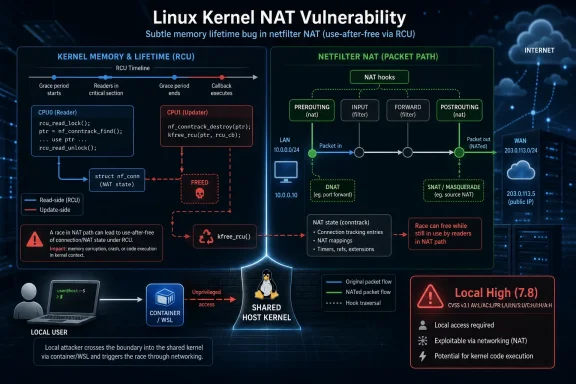 A Local Kernel Bug Lands in the Most Networked Part of Linux
Netfilter is one of those subsystems most users never name but many systems rely on every minute. It is the Linux kernel framework behind packet filtering, NAT, connection tracking, and much of the firewall behavior exposed through iptables, nftables, container runtimes, VPN appliances, and host security products.CVE-2026-53000 concerns how netfilter NAT releases internal hook operations. The fix changes the lifetime handling of NAT hook structures so they are released using
kfree_rcu, a kernel mechanism that defers freeing memory until readers that may still hold references are safely out of the way. In plainer English: the kernel had a path where a structure could become visible to code that might inspect active hooks, while its lifetime was not yet being managed conservatively enough.That sounds narrow, but kernel vulnerabilities often begin in narrowness. The affected files listed in the CVE record sit in IPv4 NAT, IPv6 NAT, and the NAT core. Those are not experimental corners of the tree; they are part of the everyday machinery of Linux networking.
The CVE’s own description points to a change introduced in Linux 5.14: userspace gained the ability to dump active netfilter hooks. Historically, the data path did not use the original
nf_hook_ops structures after registration in the way that would make this a problem. But observability changed the assumptions. Once userspace can ask the kernel to show active hooks, memory that used to be safely ignored becomes part of a new interface contract.The Vulnerability Is About Time, Not Packets
The important word in this bug is not NAT. It is lifetime.Modern kernels are full of objects that may be read by one CPU while another CPU is updating or tearing them down. Linux uses RCU, short for read-copy-update, to make that concurrency workable. The basic idea is that readers can move quickly without heavy locking, while writers defer reclamation until it is safe to assume old readers have finished.
CVE-2026-53000 is the sort of issue that appears when an object’s lifetime model no longer matches its visibility. The original netfilter NAT hook structures were not historically part of the hot-path reader story in the same way as ordinary base hooks. NAT hooks are special because they are called indirectly through a central NAT dispatcher, and according to the CVE text they were not yet visible to the nfnetlink hook dump subsystem.
That “not yet” is doing a lot of work. The fix is forward-looking as much as corrective: if NAT hooks become exposed to the hook-dump subsystem, their backing operations need RCU-style deferred freeing too. The CVE also notes that an error path in
nf_nat_register_fn() can partially expose hooks, which broadens the concern from a future cleanup to a present correctness issue.This is how many kernel vulnerabilities are born: not from one obviously reckless line of code, but from a contract that shifts under a subsystem. A data structure that was once private becomes inspectable. A diagnostic interface becomes a security boundary. An error path that was once improbable becomes reachable enough to deserve a CVE.
A High Score Without a Remote Trigger Is Still a Serious Signal
Kernel.org assigned the vulnerability a CVSS 3.1 score of 7.8, categorized as High. The vector is local attack, low complexity, low privileges required, no user interaction, unchanged scope, and high impact to confidentiality, integrity, and availability.That combination is familiar to anyone who has managed Linux fleets for more than a release cycle. It says an attacker generally needs some local foothold first, but if the vulnerable condition can be exploited, the prize is potentially kernel-level impact. In the CVSS model, local does not mean low value; it means the exploit begins after access has already been obtained.
This distinction matters in 2026 because “local” has become slippery. A local attacker may be a malicious tenant inside a container host, a compromised low-privilege service account, a workload escape attempt, a user with shell access to a shared system, or an untrusted process in a developer environment. On a laptop, local may mean malware running as a normal user. On a server, it may mean the weakest service account on a box that also terminates traffic for something important.
The NVD page, at the time reflected in the submitted record, had not yet provided its own NIST CVSS score. That is not unusual for recently published kernel CVEs, especially amid ongoing NVD enrichment delays and workflow changes. For operators, the actionable data point is the CNA score from kernel.org, plus the affected-version information and stable fixes.
The absence of a NIST-enriched score should not be misread as absence of risk. It means the public database pipeline has not finished adding its own assessment. The upstream maintainer already treated the issue as security-relevant and assigned a high-impact vector.
Why Windows People Should Not Scroll Past a Linux Kernel CVE
A WindowsForum audience could be forgiven for seeing “Linux kernel” and mentally filing this under someone else’s patch Tuesday. That reflex is increasingly obsolete.Windows estates now contain Linux in ways that are easy to underestimate. Developers use Windows Subsystem for Linux. Security teams run Linux-based scanners. DevOps teams build and test containers from Windows workstations before shipping them to Linux hosts. Small businesses run firewalls, NAS boxes, hypervisors, Kubernetes nodes, and edge appliances that are Linux underneath even when their management console is browser-based and vendor-branded.
WSL is not a one-to-one substitute for a general-purpose Linux server kernel, and exposure depends on Microsoft’s kernel packaging, installed WSL version, feature use, and the distribution model in play. But the broader point stands: Windows environments are no longer Windows-only environments. The attack surface lives across the seams.
For sysadmins, the question is not whether this CVE can be exploited against every Windows desktop. It cannot be responsibly described that way from the public record. The question is whether any Linux kernel in your estate is new enough to be affected, old enough not to be fixed, and exposed to untrusted local users or workloads that can interact with netfilter-related facilities.
That includes systems running container networking, NAT rules, VPN forwarding, namespace-heavy workloads, or firewall management layers. Netfilter is frequently touched indirectly. Administrators may never run a raw netfilter command and still depend on it through Docker, Kubernetes, firewalld, nftables, iptables compatibility layers, or appliance orchestration code.
Version Numbers Tell a More Complicated Story Than “5.14 and Later”
The CVE record says Linux 5.14 is affected and versions before 5.14 are unaffected. That makes sense in light of the described change: the ability to dump active netfilter hooks from userspace arrived in v5.14, changing what could observe the hook structures.The same record also lists fixed boundaries that include stable-series versions. It identifies 6.18.33 and earlier within the 6.18 stable line as unaffected, 7.0.10 and earlier within the 7.0 line as unaffected, and 7.1 as the original commit for the fix. It also lists three specific stable Git commits as references.
Those version fields can look odd to readers accustomed to product-style advisories. Kernel CVE records often mix Git commit ranges, stable backports, and semantic version-style affected statements. The result is accurate for maintainers but less comfortable for administrators who just want to know whether a package on Ubuntu, Debian, Fedora, Arch, SUSE, Red Hat, Oracle, Amazon Linux, or an appliance image is fixed.
The practical answer is to trust your distribution’s security advisory and kernel package changelog, not just the upstream mainline version number. Vendors backport fixes aggressively. A system may report an older-looking kernel version while carrying the patch. Conversely, a custom kernel, vendor appliance, or pinned cloud image may lag behind upstream stable even if its version string appears modern.
This is where vulnerability scanners often get noisy. A scanner that keys only on version strings may flag a backported kernel as vulnerable. A scanner that relies only on NVD enrichment may lag the upstream record. A mature patch process correlates CVE data, distro advisories, package release notes, and actual build metadata.
The Netfilter Hook Dump Detail Is the Real Security Story
The most interesting part of CVE-2026-53000 is the role of introspection. The kernel gained a way for userspace to dump active netfilter hooks. That is a useful capability for diagnostics, tooling, and transparency. It is also a reminder that visibility features can turn internal assumptions into externally relevant contracts.Before that change, the original hook operations used at registration were not part of the active data path in a way that made immediate freeing dangerous to the same degree. Once another subsystem can look back into the tail of the pointer-array blob used by the data path, memory lifetime rules have to be stricter. NAT hooks, because of their indirect dispatch model, sat at the edge of that rule.
Security engineering is full of these edge cases. The first implementation may be safe because no one can observe a stale pointer. A later diagnostic feature may make observation possible. A future feature may expand the set of hooks visible to userspace. An error path may expose a partially registered structure earlier than expected.
None of that implies negligence. It illustrates why kernel development is relentlessly adversarial, even when no attacker is present. The code is being attacked by time, by new features, by concurrency, by backports, and by every subsystem that makes previously private state more visible.
The move to
kfree_rcu is a conservative fix because it aligns object reclamation with the possibility of concurrent readers. It does not merely silence a compiler warning or reshuffle code. It changes the memory-safety posture around objects that may be observed outside their original lifecycle assumptions.Local Privilege Bugs Are the Currency of Real Intrusions
Security teams sometimes triage local privilege vulnerabilities too casually. The argument is familiar: if an attacker already has local access, the system is already compromised. That view is tidy, and often wrong.Real intrusions are staged. Attackers frequently begin with low privilege, then chain misconfigurations, credential theft, kernel bugs, container escapes, and lateral movement. A local kernel vulnerability can be the difference between nuisance and root, between one compromised service and a compromised host, between a container breach and a platform breach.
The CVSS vector for CVE-2026-53000 says privileges are required, but only low privileges. It also says no user interaction is needed. That makes the vulnerability relevant wherever untrusted or semi-trusted local execution exists.
Shared development hosts are one example. Container build workers are another. University systems, CI runners, jump boxes, bastion hosts, and multi-user research boxes all fit the pattern. So do internet-facing services that may be exploitable for code execution under a restricted account before privilege escalation is attempted.
The public CVE text does not provide a proof of concept, exploitation recipe, or confirmed exploitation in the wild. That restraint matters. But defenders do not need public exploit code to justify patching a high-scored local kernel memory-lifetime bug in a networking subsystem.
Containers Make “Local” Feel Remote
Containerization blurs the perimeter around local kernel bugs. A container is not a VM; it shares the host kernel. That is the entire performance and operational bargain. It is also why kernel CVEs matter so much to Kubernetes and container-platform operators.A workload running in a container may be unprivileged from the host’s perspective, but it is still executing code that relies on host kernel isolation. If an exploit can cross from low-privilege code to kernel impact, the boundary that mattered most was never the container image. It was the kernel.
Netfilter is especially relevant in container environments because container networking frequently depends on NAT, packet filtering, connection tracking, and rules generated by orchestration systems. The vulnerable code path described here is not “Docker bug” or “Kubernetes bug,” but it sits under the network behavior those platforms use.
That does not mean every container host is exploitable through CVE-2026-53000. Public information does not support that sweeping claim. It does mean container operators should treat kernel remediation as part of workload isolation, not merely as host hygiene.
The uncomfortable operational truth is that kernel patching remains one of the hardest tasks in otherwise automated infrastructure. Containers can be rebuilt quickly. Nodes can be drained and replaced. But stateful workloads, maintenance windows, appliance images, and custom drivers still create inertia. Attackers love inertia.
The NVD Record Shows the New Normal of Vulnerability Data
This CVE also says something about the changing vulnerability-data ecosystem. The submitted record shows NVD received the CVE on June 24, 2026, and the record was modified on June 28, 2026, with kernel.org supplying the CVSS 3.1 vector. NVD’s own CVSS fields were not yet assessed in the provided data.That gap is increasingly normal. The CVE record, the CNA’s assessment, distribution advisories, vendor patches, EPSS-style exploit prediction, CISA KEV status, and scanner output can all arrive on different timelines. Treating NVD as the single source of operational truth was always a simplification; in 2026 it is an increasingly fragile one.
For Windows-heavy organizations that have recently pulled Linux visibility into Microsoft Defender, SIEM pipelines, asset inventories, and patch dashboards, this matters. A dashboard may show a CVE before a full NVD analysis exists. Another may wait for enrichment and miss early action windows. A third may overstate exposure by ignoring backports.
The answer is not to abandon CVE feeds. It is to understand what each feed is telling you. NVD is a database. Kernel.org is upstream authority for the Linux kernel. Your distribution is the authority for whether its shipped package contains the fix. Your asset inventory is the authority for whether the vulnerable kernel is actually present and reachable in your environment.
In other words: vulnerability management has become evidence management. CVE-2026-53000 is a small case study in that larger shift.
Backports Are Where the Real Patch Decision Happens
The kernel’s upstream stable commits are useful, but most administrators will not apply them directly. They will consume the fix through distribution kernels, cloud images, appliance firmware, or vendor-managed platforms. That indirection is both a blessing and a source of confusion.Enterprise distributions routinely carry security fixes without moving to a new upstream kernel major version. A Red Hat-family system, a Debian stable machine, or an Ubuntu LTS server may have a kernel version that looks ancient by mainline standards but includes selected patches. That is not a workaround; it is the enterprise Linux model.
The reverse problem is more dangerous. Embedded and appliance vendors often fork kernels, apply product-specific patches, and release updates on their own cadence. A firewall, NAS, SD-WAN box, or industrial gateway may be Linux-based and netfilter-dependent while giving the customer little visibility into kernel commit status. In those cases, the vendor advisory is not a nicety. It is the only practical map.
Cloud-managed environments sit somewhere in between. If you run managed Kubernetes, you may depend on the provider’s node images and maintenance windows. If you run self-managed clusters, you own the node image pipeline. If you run containers on developer workstations, kernel exposure may depend on WSL, virtualization layers, or a local Linux VM.
The key is to avoid version-string theater. Do not ask only “is this kernel 5.14 or later?” Ask whether the specific fix has landed in the kernel package you actually boot, and whether a reboot or node recycle has happened since the package arrived.
The Windows Subsystem Angle Requires Precision, Not Alarm
WSL deserves a careful mention because it is the most obvious Linux-on-Windows bridge for many readers. Microsoft ships and updates the WSL kernel separately from traditional Linux distributions, and users can run a real Linux environment integrated deeply into a Windows workstation.That does not automatically mean CVE-2026-53000 is exploitable on every WSL installation. Exposure depends on the WSL kernel version, enabled features, installed tooling, privileges, and whether relevant netfilter NAT code paths are reachable. WSL networking behavior has also evolved over time, and not every Linux kernel feature is exposed in the same way as on a general-purpose server.
Still, WSL should not be invisible to patch management. Developer workstations are high-value targets because they often hold source code, credentials, SSH keys, package tokens, cloud CLIs, and access to production-adjacent systems. A Linux kernel vulnerability in a developer environment deserves more respect than it would have received when WSL was treated as a toy shell.
Organizations that manage Windows endpoints should verify how WSL updates are delivered, whether users can pin or customize WSL kernels, and how endpoint security tooling inventories that kernel. The answer may differ between consumer machines, unmanaged developer laptops, Intune-managed fleets, and locked-down enterprise workstations.
The right posture is not panic. It is inventory. If you do not know which WSL kernels are running across your Windows fleet, CVE-2026-53000 is a useful excuse to find out.
Error Paths Are Where Kernel Assumptions Go to Die
The CVE description’s reference to “partial exposition of the hooks from error path” is easy to glide past, but it is one of the most revealing details. Error paths are notoriously difficult to reason about because they run when initialization, registration, allocation, or validation has not completed normally. Objects may be half-built, partially published, or in the middle of rollback.Security bugs often hide there because developers and reviewers naturally spend more mental energy on the successful path. The normal flow says: allocate, initialize, register, use, unregister, free. The error flow says: allocate, partially initialize, fail in the third helper, unwind two steps, skip one cleanup under one condition, and hope no observer saw the intermediate state.
In a concurrent kernel, that hope is not a strategy. If an object can be observed during partial registration, its lifetime must be safe for observation even if the registration ultimately fails. That is the logic behind defensive memory reclamation here.
The lesson generalizes beyond netfilter. As operating systems expose more introspection to userspace, more internal states become observable. Tracing, diagnostics, eBPF-adjacent tooling, netlink interfaces, live telemetry, and security agents all increase the pressure on old assumptions. Observability is valuable, but it widens the surface where memory lifetime must be exact.
This is one reason kernel CVEs can feel abstract and operationally urgent at the same time. The bug may not describe a familiar misconfiguration, but the class of mistake maps directly to exploitation patterns defenders already understand: stale pointers, use-after-free conditions, race windows, and privilege escalation.
Security Teams Need a Better Triage Script Than “Is It Internet-Facing?”
Many vulnerability programs still start with a blunt filter: internet-facing first, everything else later. That heuristic is useful, but it is insufficient for kernel bugs. CVE-2026-53000 is not described as remotely exploitable over the network, yet it sits in network code and carries high potential impact after local access.A better triage script starts with where untrusted code runs. Multi-tenant systems, container hosts, CI runners, shared jump boxes, developer workstations, and servers that run risky parsers or exposed services deserve faster attention. The exposure is not merely whether port 443 is open. It is whether an attacker can plausibly get low-privilege execution and then attempt escalation.
Next comes kernel freshness and reboot reality. Linux administrators know the ritual: the package is patched, the running kernel is not. A fix installed on disk does not protect the host until the machine boots into it, unless a live patching mechanism covers the specific vulnerability. For fleets, “patched” must mean “running fixed code,” not “update available” or “package downloaded.”
Then comes compensating control. Locking down unprivileged user namespaces, reducing local shell access, tightening container privileges, limiting
CAP_NET_ADMIN, hardening seccomp profiles, and isolating risky workloads can reduce exploitability. But these controls are not substitutes for applying a kernel fix; they are the layers that buy time while the change window is negotiated.Finally comes vendor dependency. If the vulnerable kernel lives inside an appliance, the remediation path may be a firmware update, not a package update. If it lives inside a managed node image, remediation may be a node pool rollout. If it lives in WSL, remediation may depend on Microsoft’s WSL update channel and endpoint policy.
The Patch Is Small; the Asset Question Is Not
The code-level fix may be conceptually small: release NAT hook operations with RCU-aware freeing and handle partial exposure correctly. The operational fix is broader because it forces administrators to identify every place where Linux kernel networking is part of the estate.That includes obvious servers and less obvious dependencies. Virtualization hosts, container nodes, build runners, developer machines, lab systems, edge routers, home-lab firewalls, NAS devices, and security appliances all belong in the search. For Windows-centric shops, the inventory gap is often not the domain controllers or workstations. It is the Linux box that “just runs the build agents” or the appliance that “just does VPN.”
There is also a timing issue. The CVE was published on June 24, 2026, with a modification on June 28 adding or reflecting the CVSS data in the submitted record. That is recent enough that downstream advisories may still be catching up. Early in a CVE’s life, the absence of a vendor advisory may mean “not affected,” “analysis pending,” or “not yet published.” Those are very different states.
The safest near-term move is to track upstream and distribution advisories while prioritizing hosts where local untrusted code is realistic. If a system runs a fixed stable kernel or a vendor-backported fix, document the evidence. If it cannot be patched immediately, document why and reduce local attack paths.
That discipline matters because auditors and scanners will eventually catch up. When they do, teams that already mapped exposure will have an answer better than a screenshot of a red dashboard.
The Practical Read for WindowsForum Readers
CVE-2026-53000 is not a reason to unplug Linux hosts or distrust every NAT rule. It is a reason to treat kernel networking bugs as first-class operational events, even in estates that think of themselves as Windows-first. The most useful response is concrete and boring, which is usually how good infrastructure security looks from the outside.- Confirm whether any Linux kernels you operate are in the affected range beginning with 5.14 and whether your vendor has backported the relevant fix.
- Prioritize patching systems that run untrusted local code, containers, CI jobs, shared shell users, VPN services, firewall workloads, or developer tooling.
- Verify the running kernel after updates, because installing a fixed package without rebooting or live patching leaves the vulnerable code in memory.
- Treat WSL as part of endpoint inventory rather than an invisible developer convenience, especially on machines with production credentials or source access.
- For appliances and managed platforms, look for vendor firmware or node-image advisories instead of assuming upstream kernel version numbers answer the question.
- Do not wait for NVD’s own enrichment if upstream kernel.org data, distribution advisories, and your asset inventory already show exposure.
References
- Primary source: NVD / Linux Kernel
Published: 2026-06-28T01:44:38-07:00
NVD - CVE-2026-53000
 nvd.nist.gov
- Security advisory: MSRC
Published: 2026-06-28T01:44:38-07:00
Original feed URL
Security Update Guide - Microsoft Security Response Center
 msrc.microsoft.com
- Official source: nist.gov
National Vulnerability Database
NIST maintains the National Vulnerability Database (NVD), a repository of information on software and hardware flaws that can compromise computer security. This is a key piece of the nation’s cybersecurity infrastructure.www.nist.gov - Related coverage: labs.cloudsecurityalliance.org
CSA research note ai vuln discovery velocity disclosure crisis 20260524 csa styled
PDF documentlabs.cloudsecurityalliance.org
