

CVE-2026-53225 is a Linux kernel SCTP vulnerability disclosed in late June 2026 that fixes an uninitialized-memory read in
CVE-2026-53225 is not the kind of vulnerability that will dominate a Patch Tuesday news cycle. It does not arrive with a flashy wormable rating, a browser exploit chain, or a consumer-facing panic button. Its description is almost aggressively kernel-developerish: “sctp: fix uninit-value in
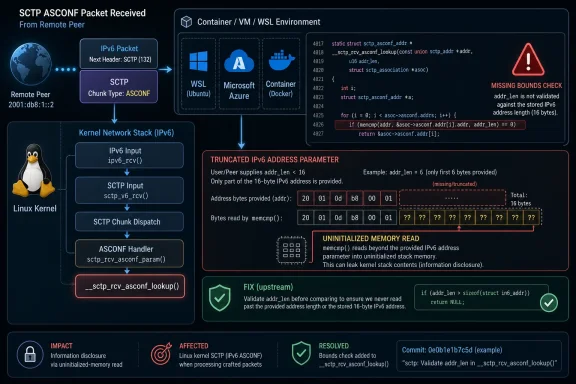
That phrasing hides the interesting part. The bug lives in the Linux kernel’s implementation of SCTP, the Stream Control Transmission Protocol, specifically in the handling of ASCONF chunks used for dynamic address reconfiguration. In plain English, a peer can send a malformed SCTP control message that says, in effect, “an IPv6 address parameter follows,” but then fails to provide the full address bytes the kernel path expects to read.
The reported impact is an unauthenticated SCTP peer causing the receive path to read up to 16 bytes of uninitialized memory past a truncated ASCONF address parameter. That is not the same thing as remote code execution, and no one should inflate it into one without evidence. But in kernel security, “just an uninitialized read” is not nothing; it is a class of bug that often matters because it shows where packet parsing trusts attacker-controlled length fields too much.
The most important detail is architectural rather than dramatic. A neighboring SCTP lookup path already used a safer parameter-walking routine, while this path open-coded the fetch and failed to verify that the whole address parameter was actually inside the chunk. The fix is the sort of correction that sounds obvious after the fact: check that the full parameter is present before calling the helper that reads it.
The feature implicated here is ASCONF, or Address Configuration Change, part of SCTP’s support for dynamic address reconfiguration. SCTP’s design includes multi-homing and association management features that are more sophisticated than the usual TCP connection model. Those features are useful, but they also create complicated parser paths for chunks, parameters, address families, and association lookup state.
CVE-2026-53225 appears in a no-association lookup path. That matters because the vulnerable path can be reached before a normal association has been established in the way administrators might intuitively imagine. A malformed trailing ASCONF chunk with a declared IPv6 address parameter can push the kernel into reading bytes that were not actually supplied as part of the parameter.
The bug is therefore not “any random web request compromises Linux.” It is closer to this: if a system is reachable over SCTP, and the relevant kernel code path is present, a remote peer can send a deliberately malformed SCTP packet that triggers an unintended kernel read. That is a meaningful distinction for defenders. Scope the exposure first; do not blindly treat every Linux host as equally affected in practice.
Microsoft ships and supports Linux in several contexts: Azure infrastructure, Linux virtual machines, container hosts, Azure Linux, WSL, appliance-like services, and enterprise environments where Windows and Linux are managed as one operational estate. When a Linux kernel CVE appears in Microsoft’s orbit, it does not mean the Windows NT kernel suddenly inherited SCTP parsing code. It means Microsoft has products, services, or documentation pipelines that must account for Linux kernel security state.
That distinction is especially important for Windows administrators who now also own the Linux layers beneath their tooling. WSL made Linux local and convenient. Containers made Linux images a routine part of Windows developer workflows. Azure made Linux a first-class enterprise operating system for Microsoft customers. The old mental model — Microsoft patches Windows, Linux vendors patch Linux — is too tidy for the systems people actually run.
The disclaimer text attached to the Microsoft page is standard legal framing, not a technical assessment. It says the Knowledge Base information is provided as-is and without warranty. The actionable security story is not in the disclaimer; it is in the vulnerability metadata, the upstream kernel fix, and distribution-specific patch status.
That matters because IPv6 addresses are 16 bytes. If the packet stops after the smaller parameter header, but the parser proceeds as if a full IPv6 address is available, the read crosses into bytes that are not part of the supplied parameter. In a memory-sanitizer report, that shows up as an uninitialized-value bug.
The fix aligns this path with a safer pattern already used elsewhere in SCTP: validate the complete parameter boundary before consuming it. This is exactly the kind of bug that modern kernel fuzzing, sanitizer builds, and syzkaller-style automated testing are good at finding. It is also exactly the kind of bug that persists in older, less-traveled protocol paths because human reviewers tend to focus on the common routes.
The uncomfortable truth is that packet parsing code is a hostile environment. Every length field is a claim, not a fact. Every helper call that assumes a structure is fully present is an implicit trust decision. CVE-2026-53225 is small because the fix is small, but it illustrates a kernel rule that remains stubbornly relevant: never let the packet tell you how much safe memory exists.
A moderate rating makes sense from the available description. The bug is remotely triggerable by an unauthenticated SCTP peer, which is not trivial. But the described impact is an uninitialized read of up to 16 bytes in the receive path, not a write primitive, privilege escalation, or confirmed kernel crash.
That does not mean defenders should ignore it. Kernel information leaks can sometimes become useful in larger exploit chains, especially when paired with memory corruption bugs that need address-space layout hints. But a 16-byte uninitialized read inside the kernel receive path is not automatically equivalent to a clean user-visible information disclosure. The practical exploit value depends on what can be observed, how the read influences behavior, and whether any leaked state is exposed back to the attacker.
This is where CVE writeups can frustrate security teams. The CVE tells you enough to understand the bug class and affected subsystem, but not always enough to model every operational consequence. Sensible triage lands in the middle: treat it as real, patch it through the normal kernel update process, and prioritize Internet-reachable SCTP endpoints or systems in telecom-like roles.
That answer is distribution-specific. Debian’s tracker, for example, listed different states across bullseye, bookworm, trixie, forky, and sid, with fixed status appearing in newer kernel package lines. SUSE’s page showed broad analysis across its enterprise and micro product families, including general support, long-term service, and end-of-life groupings.
This is a reminder that upstream Linux kernel version numbers rarely map cleanly to enterprise risk. A server running a numerically older kernel may already contain a backported security fix. A server running a newer-looking kernel from a vendor branch may still be waiting for the relevant patch. The packaging layer is where the real answer lives.
Administrators should therefore resist the temptation to search only for the upstream commit ID and compare it to
Windows admins running Linux guests in Hyper-V, WSL, or Azure should apply the same discipline. The host Windows update cadence is not the guest Linux update cadence. WSL distributions update through their own package managers, and Azure Linux or third-party images depend on their own vendor pipelines. If SCTP is enabled and reachable in those environments, the fix belongs in the Linux patch workflow, not in a Windows Update expectation.
But “unlikely” is not “impossible,” and WSL’s networking model has evolved over the years. Developers increasingly run complex stacks locally, including service meshes, emulated infrastructure, and test harnesses that bind unusual protocols. If a WSL workload or associated Linux environment uses SCTP intentionally, especially for telecom simulation or protocol testing, then the vulnerability becomes more relevant.
The bigger lesson for WSL is operational. Developers often treat WSL distributions as disposable, but long-lived WSL environments accumulate packages, services, and kernels like any other system. If a distribution is used for serious work, it needs the same maintenance habits as a small Linux server: update packages, understand exposed services, and avoid assuming the Windows host has automatically solved guest-layer vulnerabilities.
For WindowsForum’s audience, that is the shift worth noticing. The boundary between “Windows user” and “Linux operator” has thinned. A CVE in a Linux network subsystem may not affect Notepad, Explorer, or the Windows kernel, but it may still affect the developer workstation, CI runner, container host, or lab VM sitting beside them.
In those settings, CVE-2026-53225 deserves a straightforward but serious review. Is SCTP loaded? Are SCTP sockets reachable from untrusted or semi-trusted networks? Are ASCONF features in play? Are perimeter filters blocking unsolicited SCTP traffic? Is the kernel maintained by a vendor that has already backported the fix?
The advisory’s unauthenticated-peer language is the point that should catch an operator’s eye. Authentication at the application layer may not help if the kernel protocol parser can be reached before the application’s trust model has a chance to act. Network exposure, not user login state, is the first line of triage.
That does not automatically make the bug critical. It means the risk model belongs to the network boundary. An internal-only SCTP endpoint behind strict ACLs is in a different category from an externally reachable signaling node. A lab box with SCTP modules loaded but no listening service is different again. The fix may be the same, but urgency is not.
That is a feature, not a nuisance. Security culture often rewards dramatic vulnerabilities, but a mature kernel project improves by grinding down entire bug classes. An uninitialized read in SCTP’s ASCONF lookup path may not make headlines, yet fixing it removes undefined behavior from a remote packet parser. That is exactly the sort of boring work that keeps an operating system trustworthy.
The recurrence of SCTP memory-sanitizer findings also tells us something about protocol complexity. SCTP is not abandoned, but it is less exercised than TCP or UDP by the average developer workload. Less common paths get fewer casual test miles. Automated fuzzing helps compensate by generating weird inputs no normal peer would send.
There is a tendency among some administrators to dismiss sanitizer-found bugs as “only theoretical.” That is too glib. Fuzzers are often the first reliable witnesses to edge conditions that attackers can later study. A sanitizer report is not an exploit, but it is evidence that the kernel processed hostile input in a way the programmer did not fully constrain.
For many organizations, the harder part is inventory. SCTP is easy to overlook because it is not the protocol most vulnerability dashboards are tuned to discuss. Administrators may know where their web servers and SSH endpoints are, but not where SCTP is enabled by dependency, appliance configuration, or a telecom application stack.
Linux also complicates “is it fixed?” checks because vendors backport. A kernel package may retain an older base version while carrying the security patch. That is good engineering and bad for superficial compliance scripts. Security teams should verify against vendor advisories or package changelogs instead of assuming upstream version arithmetic tells the whole story.
Microsoft shops have an additional coordination challenge. If Linux workloads are spread across Azure, WSL, Hyper-V guests, Kubernetes nodes, and third-party appliances, no single patch button covers all of them. The work is less glamorous than the CVE headline: identify affected assets, apply vendor updates, reboot cleanly, and document exceptions.
The concrete readout is simple:
__sctp_rcv_asconf_lookup(), where a malformed ASCONF chunk can make the receive path read beyond a truncated IPv6 address parameter. The bug is narrow, but the lesson is broad: kernel networking code still contains old protocol corners where one missing bounds check can turn an obscure feature into a security advisory. For WindowsForum readers, the practical issue is not desktop Windows panic; it is the Linux substrate now sitting under WSL, containers, appliances, Azure workloads, telecom stacks, and hybrid infrastructure.
 A Small SCTP Bug Lands in a Very Large Kernel
CVE-2026-53225 is not the kind of vulnerability that will dominate a Patch Tuesday news cycle. It does not arrive with a flashy wormable rating, a browser exploit chain, or a consumer-facing panic button. Its description is almost aggressively kernel-developerish: “sctp: fix uninit-value in __sctp_rcv_asconf_lookup().”That phrasing hides the interesting part. The bug lives in the Linux kernel’s implementation of SCTP, the Stream Control Transmission Protocol, specifically in the handling of ASCONF chunks used for dynamic address reconfiguration. In plain English, a peer can send a malformed SCTP control message that says, in effect, “an IPv6 address parameter follows,” but then fails to provide the full address bytes the kernel path expects to read.
The reported impact is an unauthenticated SCTP peer causing the receive path to read up to 16 bytes of uninitialized memory past a truncated ASCONF address parameter. That is not the same thing as remote code execution, and no one should inflate it into one without evidence. But in kernel security, “just an uninitialized read” is not nothing; it is a class of bug that often matters because it shows where packet parsing trusts attacker-controlled length fields too much.
The most important detail is architectural rather than dramatic. A neighboring SCTP lookup path already used a safer parameter-walking routine, while this path open-coded the fetch and failed to verify that the whole address parameter was actually inside the chunk. The fix is the sort of correction that sounds obvious after the fact: check that the full parameter is present before calling the helper that reads it.
The Attack Surface Is Niche, Not Imaginary
SCTP has always lived in a strange place in the networking stack. It is a real transport protocol with serious deployments, especially in telecom and signaling environments, but it never became the default substrate of the consumer Internet in the way TCP and UDP did. That gives bugs like CVE-2026-53225 a peculiar profile: obscure to most users, potentially relevant to operators who know exactly why SCTP is enabled.The feature implicated here is ASCONF, or Address Configuration Change, part of SCTP’s support for dynamic address reconfiguration. SCTP’s design includes multi-homing and association management features that are more sophisticated than the usual TCP connection model. Those features are useful, but they also create complicated parser paths for chunks, parameters, address families, and association lookup state.
CVE-2026-53225 appears in a no-association lookup path. That matters because the vulnerable path can be reached before a normal association has been established in the way administrators might intuitively imagine. A malformed trailing ASCONF chunk with a declared IPv6 address parameter can push the kernel into reading bytes that were not actually supplied as part of the parameter.
The bug is therefore not “any random web request compromises Linux.” It is closer to this: if a system is reachable over SCTP, and the relevant kernel code path is present, a remote peer can send a deliberately malformed SCTP packet that triggers an unintended kernel read. That is a meaningful distinction for defenders. Scope the exposure first; do not blindly treat every Linux host as equally affected in practice.
Microsoft’s Name on a Linux CVE Is the New Normal
The user-submitted source points to Microsoft’s Security Response Center page for CVE-2026-53225, which may look odd at first glance. This is a Linux kernel issue, after all. But Microsoft’s security universe has not been Windows-only for a long time.Microsoft ships and supports Linux in several contexts: Azure infrastructure, Linux virtual machines, container hosts, Azure Linux, WSL, appliance-like services, and enterprise environments where Windows and Linux are managed as one operational estate. When a Linux kernel CVE appears in Microsoft’s orbit, it does not mean the Windows NT kernel suddenly inherited SCTP parsing code. It means Microsoft has products, services, or documentation pipelines that must account for Linux kernel security state.
That distinction is especially important for Windows administrators who now also own the Linux layers beneath their tooling. WSL made Linux local and convenient. Containers made Linux images a routine part of Windows developer workflows. Azure made Linux a first-class enterprise operating system for Microsoft customers. The old mental model — Microsoft patches Windows, Linux vendors patch Linux — is too tidy for the systems people actually run.
The disclaimer text attached to the Microsoft page is standard legal framing, not a technical assessment. It says the Knowledge Base information is provided as-is and without warranty. The actionable security story is not in the disclaimer; it is in the vulnerability metadata, the upstream kernel fix, and distribution-specific patch status.
The Bug Is a Bounds Check Failure Wearing a Protocol Hat
At the code level, CVE-2026-53225 is a parser validation problem. The vulnerable function checked that the ASCONF chunk could contain an ADDIP header and a parameter header. It did not sufficiently check that the declared address parameter itself was fully present before handing control to a helper that reads the full address.That matters because IPv6 addresses are 16 bytes. If the packet stops after the smaller parameter header, but the parser proceeds as if a full IPv6 address is available, the read crosses into bytes that are not part of the supplied parameter. In a memory-sanitizer report, that shows up as an uninitialized-value bug.
The fix aligns this path with a safer pattern already used elsewhere in SCTP: validate the complete parameter boundary before consuming it. This is exactly the kind of bug that modern kernel fuzzing, sanitizer builds, and syzkaller-style automated testing are good at finding. It is also exactly the kind of bug that persists in older, less-traveled protocol paths because human reviewers tend to focus on the common routes.
The uncomfortable truth is that packet parsing code is a hostile environment. Every length field is a claim, not a fact. Every helper call that assumes a structure is fully present is an implicit trust decision. CVE-2026-53225 is small because the fix is small, but it illustrates a kernel rule that remains stubbornly relevant: never let the packet tell you how much safe memory exists.
Severity Looks Moderate Because Exploitability Looks Constrained
SUSE’s public tracking rated the issue as moderate at the time its CVE page was created and updated in late June 2026. Debian’s tracker showed a mixed state across releases, with some stable kernels still listed as vulnerable and newer tracked versions marked fixed. Those details will continue to move as distributions backport patches into their maintained kernel packages.A moderate rating makes sense from the available description. The bug is remotely triggerable by an unauthenticated SCTP peer, which is not trivial. But the described impact is an uninitialized read of up to 16 bytes in the receive path, not a write primitive, privilege escalation, or confirmed kernel crash.
That does not mean defenders should ignore it. Kernel information leaks can sometimes become useful in larger exploit chains, especially when paired with memory corruption bugs that need address-space layout hints. But a 16-byte uninitialized read inside the kernel receive path is not automatically equivalent to a clean user-visible information disclosure. The practical exploit value depends on what can be observed, how the read influences behavior, and whether any leaked state is exposed back to the attacker.
This is where CVE writeups can frustrate security teams. The CVE tells you enough to understand the bug class and affected subsystem, but not always enough to model every operational consequence. Sensible triage lands in the middle: treat it as real, patch it through the normal kernel update process, and prioritize Internet-reachable SCTP endpoints or systems in telecom-like roles.
The Distribution Matrix Matters More Than the CVE Page
For most administrators, the important question is not whether CVE-2026-53225 exists. It does. The question is whether the kernel you are actually running contains the vulnerable code and whether your vendor has shipped the backport.That answer is distribution-specific. Debian’s tracker, for example, listed different states across bullseye, bookworm, trixie, forky, and sid, with fixed status appearing in newer kernel package lines. SUSE’s page showed broad analysis across its enterprise and micro product families, including general support, long-term service, and end-of-life groupings.
This is a reminder that upstream Linux kernel version numbers rarely map cleanly to enterprise risk. A server running a numerically older kernel may already contain a backported security fix. A server running a newer-looking kernel from a vendor branch may still be waiting for the relevant patch. The packaging layer is where the real answer lives.
Administrators should therefore resist the temptation to search only for the upstream commit ID and compare it to
uname -r. That can mislead. The better method is to use the distribution’s advisory tooling, package changelog, security tracker, or vendor scanner. In enterprise Linux, the kernel version string is often more of a family name than a complete statement of contents.Windows admins running Linux guests in Hyper-V, WSL, or Azure should apply the same discipline. The host Windows update cadence is not the guest Linux update cadence. WSL distributions update through their own package managers, and Azure Linux or third-party images depend on their own vendor pipelines. If SCTP is enabled and reachable in those environments, the fix belongs in the Linux patch workflow, not in a Windows Update expectation.
WSL Users Are Mostly Watching From the Sidelines
For typical WSL users, CVE-2026-53225 is unlikely to be a five-alarm event. WSL is usually used for local development, shell tooling, package builds, scripting, and container-adjacent workflows. Most WSL instances are not exposing SCTP services to untrusted remote peers on the public Internet.But “unlikely” is not “impossible,” and WSL’s networking model has evolved over the years. Developers increasingly run complex stacks locally, including service meshes, emulated infrastructure, and test harnesses that bind unusual protocols. If a WSL workload or associated Linux environment uses SCTP intentionally, especially for telecom simulation or protocol testing, then the vulnerability becomes more relevant.
The bigger lesson for WSL is operational. Developers often treat WSL distributions as disposable, but long-lived WSL environments accumulate packages, services, and kernels like any other system. If a distribution is used for serious work, it needs the same maintenance habits as a small Linux server: update packages, understand exposed services, and avoid assuming the Windows host has automatically solved guest-layer vulnerabilities.
For WindowsForum’s audience, that is the shift worth noticing. The boundary between “Windows user” and “Linux operator” has thinned. A CVE in a Linux network subsystem may not affect Notepad, Explorer, or the Windows kernel, but it may still affect the developer workstation, CI runner, container host, or lab VM sitting beside them.
Telecom and Appliance Operators Should Read This More Closely
The systems most likely to care about SCTP are not ordinary laptops. They are telecom systems, signaling gateways, network appliances, specialized middleware, and environments where SCTP’s multi-homing and message-oriented semantics are part of the application design. Those are also the environments where “niche protocol” does not mean “disabled.”In those settings, CVE-2026-53225 deserves a straightforward but serious review. Is SCTP loaded? Are SCTP sockets reachable from untrusted or semi-trusted networks? Are ASCONF features in play? Are perimeter filters blocking unsolicited SCTP traffic? Is the kernel maintained by a vendor that has already backported the fix?
The advisory’s unauthenticated-peer language is the point that should catch an operator’s eye. Authentication at the application layer may not help if the kernel protocol parser can be reached before the application’s trust model has a chance to act. Network exposure, not user login state, is the first line of triage.
That does not automatically make the bug critical. It means the risk model belongs to the network boundary. An internal-only SCTP endpoint behind strict ACLs is in a different category from an externally reachable signaling node. A lab box with SCTP modules loaded but no listening service is different again. The fix may be the same, but urgency is not.
Kernel Fuzzing Keeps Finding the Corners Humans Miss
The reference to KMSAN-style uninitialized-value detection is not incidental. Kernel Memory Sanitizer and related fuzzing infrastructure have changed how Linux networking bugs surface. They do not only find spectacular crashes; they also find quiet parser mistakes that might otherwise sit untouched for years.That is a feature, not a nuisance. Security culture often rewards dramatic vulnerabilities, but a mature kernel project improves by grinding down entire bug classes. An uninitialized read in SCTP’s ASCONF lookup path may not make headlines, yet fixing it removes undefined behavior from a remote packet parser. That is exactly the sort of boring work that keeps an operating system trustworthy.
The recurrence of SCTP memory-sanitizer findings also tells us something about protocol complexity. SCTP is not abandoned, but it is less exercised than TCP or UDP by the average developer workload. Less common paths get fewer casual test miles. Automated fuzzing helps compensate by generating weird inputs no normal peer would send.
There is a tendency among some administrators to dismiss sanitizer-found bugs as “only theoretical.” That is too glib. Fuzzers are often the first reliable witnesses to edge conditions that attackers can later study. A sanitizer report is not an exploit, but it is evidence that the kernel processed hostile input in a way the programmer did not fully constrain.
Patch Management Still Beats Panic
The correct operational response to CVE-2026-53225 is not exotic. Update the affected Linux kernel through the supported distribution channel, reboot or live-patch where appropriate, and validate that systems using SCTP are no longer on vulnerable package builds. If the system cannot be patched immediately, reduce SCTP exposure through firewalling and network segmentation.For many organizations, the harder part is inventory. SCTP is easy to overlook because it is not the protocol most vulnerability dashboards are tuned to discuss. Administrators may know where their web servers and SSH endpoints are, but not where SCTP is enabled by dependency, appliance configuration, or a telecom application stack.
Linux also complicates “is it fixed?” checks because vendors backport. A kernel package may retain an older base version while carrying the security patch. That is good engineering and bad for superficial compliance scripts. Security teams should verify against vendor advisories or package changelogs instead of assuming upstream version arithmetic tells the whole story.
Microsoft shops have an additional coordination challenge. If Linux workloads are spread across Azure, WSL, Hyper-V guests, Kubernetes nodes, and third-party appliances, no single patch button covers all of them. The work is less glamorous than the CVE headline: identify affected assets, apply vendor updates, reboot cleanly, and document exceptions.
The Lesson Hidden in Sixteen Bytes
CVE-2026-53225 is a small vulnerability with a precise fix, but it lands in a part of the stack where small mistakes can carry strategic weight. It reminds us that the kernel is still parsing attacker-controlled bytes at line rate, across protocols many organizations barely remember they enabled.The concrete readout is simple:
- Systems that do not expose SCTP to untrusted peers are unlikely to face the same practical risk as SCTP-facing servers or appliances.
- The vulnerable condition involves a truncated ASCONF address parameter, especially the path where an IPv6 address parameter is declared but not fully present.
- The reported impact is an uninitialized read of up to 16 bytes in the Linux kernel receive path, not a confirmed remote code execution condition.
- Distribution status matters more than raw upstream kernel numbers because enterprise vendors routinely backport fixes.
- Windows administrators should care when they operate Linux through WSL, Azure, Hyper-V, containers, or mixed infrastructure.
- Short-term mitigation, where patching must wait, is to restrict SCTP exposure to trusted networks and known peers.
References
- Primary source: MSRC
Published: 2026-06-28T02:06:33-07:00
Security Update Guide - Microsoft Security Response Center
 msrc.microsoft.com
- Related coverage: spinics.net
Re: [PATCH net] sctp: fix return value check in __sctp_rcv_asconf_lookup — Linux SCTP
Linux SCTP: Re: [PATCH net] sctp: fix return value check in __sctp_rcv_asconf_lookupwww.spinics.net
