

CVE-2026-53292 is a newly published Linux kernel denial-of-service vulnerability, disclosed through kernel.org and added to NVD on June 26, 2026, in the Phonet networking code path where a failed autobind operation could trigger a kernel BUG and panic the system. The bug is small, old, and almost comically specific; the lesson is not. Linux still carries deep protocol machinery from earlier mobile-networking eras, and fuzzers are still finding places where “this should never happen” was encoded as “crash the kernel.”
That makes CVE-2026-53292 less a headline-grabbing remote compromise than a reminder of how kernel hardening actually advances: one assertion removed, one error path made boring, one panic converted into an errno. For administrators, the practical question is whether their kernels include the vulnerable Phonet code and whether untrusted users or containers can reach the relevant socket path. For everyone else, it is another case study in why bug classes that look minor in a diff can still matter in production.
The vulnerable code lives in
Obscurity, however, is not the same thing as absence. Kernel attack surface often comes from compiled-in subsystems, loadable modules, protocol families, and socket APIs that ordinary users never think about until a fuzzer or a low-privilege process finds them. CVE-2026-53292 sits precisely in that uncomfortable zone.
The crash path begins in
That was the mistake.
The fix is direct: if bind returns
The Dangerous Glamour of
Kernel developers have spent years pushing back against casual use of
That distinction matters more in kernel space than almost anywhere else. A userspace program that aborts on a bad assumption may take down a service. A kernel that deliberately traps on a bad assumption can take down the host.
CVE-2026-53292 is not about memory corruption in the usual sense. The description does not claim arbitrary code execution, privilege escalation, or data exposure. It is about availability: a path that should have returned an error instead hits a kernel BUG, producing a panic.
That may sound low drama until the affected machine is a shared workstation, a build host, a CI runner, a lab server, or a virtualization node with local users. “Local denial of service” is often dismissed in consumer vulnerability summaries, but in multi-user and container-heavy environments, local crashability can become an operational incident.
The old kernel instinct was to treat impossible states as evidence that something had gone terribly wrong. The modern hardening instinct is more pragmatic: if userspace can make the kernel reach the state, the kernel must survive it.
Fuzzers do not care whether a subsystem is fashionable. They care whether an interface accepts inputs and whether those inputs can drive the program into an unexpected state. Socket APIs are especially fertile territory because they combine state machines, address families, binding rules, send paths, and decades of compatibility baggage.
The call trace in the disclosure shows the path through
This is why the bug’s narrowness should not be mistaken for irrelevance. Kernel security is full of obscure surfaces that become relevant only when an attacker or a fuzzer has the patience to enumerate them. A subsystem can be unused by an organization’s applications and still be present enough to matter.
The patch also illustrates a healthy kernel process. A bot found the crash, a human patch landed, the stable tree received fixes, and a CVE record was published. The ecosystem is noisy, but the machinery worked.
Before the patch,
The fixed logic adds the missing condition. Only when the port is non-zero should the code treat
That difference is small in code but large in behavior. A failed send becomes a failed send, not a host crash. Callers already handle non-zero returns from
This is the best kind of kernel security fix: it makes the exceptional path less exceptional. It does not rely on administrators setting a sysctl, deploying a policy engine, or identifying exploit signatures. It simply stops weaponizing the kernel’s own assertion.
The record also lists fixed stable commits and indicates that later kernel lines, including the relevant 7.0 stable state and 7.1 onward, are not affected. As always with kernel CVEs, the cleanest operational answer is not to memorize commit hashes but to consume vendor kernel updates and verify whether your distribution has backported the patch.
That last point matters because Linux version numbers alone can mislead. Enterprise distributions routinely backport individual security fixes into older long-term kernels while keeping the visible kernel version largely unchanged. A system running an older-looking kernel may be patched; a custom-built kernel with a newer base may still need scrutiny if it carries the vulnerable code without the fix.
The affected file is
This is especially true because the NVD entry was published without a CVSS score at the time described by the user-provided record. A missing score does not mean “not vulnerable.” It means enrichment had not yet caught up with publication.
But modern Windows environments are rarely Windows-only. They run Linux containers on developer workstations, Linux guests under Hyper-V, Linux appliances in network racks, Linux-based storage and security tools, WSL instances, CI systems, Kubernetes nodes, and cloud workloads managed by the same administrators who patch Windows Server. A Linux denial-of-service issue can become a Windows operations problem when it crashes the build runner, monitoring node, appliance VM, or developer environment that the Windows estate depends on.
WSL deserves a careful distinction. WSL 2 uses a Microsoft-provided Linux kernel, and its exposure depends on what kernel version is installed, what configuration Microsoft ships, and whether the relevant address family is available inside the environment. The presence of a Linux CVE does not automatically mean every Windows 11 laptop is exposed in a practical way.
Still, the broader lesson applies. Windows administrators increasingly need to understand Linux kernel advisories well enough to triage them. The industry has blurred the old boundary between “Windows patching” and “Linux patching,” especially in shops that use Windows endpoints but Linux-heavy developer and cloud infrastructure.
The smart response is not panic. It is inventory. If your environment has Linux kernels under Windows-hosted virtualization, WSL, containers, network appliances, or cloud images, those assets belong in the vulnerability-management program rather than an informal “someone else handles that” bucket.
On a single-user desktop, the practical risk may be low unless malicious local code is already running. On a shared Linux system, the story changes. A low-privilege user who can crash the kernel can deny service to everyone else.
In containerized environments, the answer depends on namespace behavior, kernel configuration, seccomp policies, capabilities, and whether the relevant socket family is reachable from inside a container. Container isolation does not magically erase kernel attack surface. Containers share the host kernel, which is why local kernel denial-of-service bugs can matter even when the vulnerable action starts inside what looks like a confined workload.
That is the uncomfortable truth about kernel CVEs in obscure subsystems. The exploitability question is not simply “do we use Phonet?” It is “can an untrusted process reach the vulnerable code on a kernel we operate?” Those are different questions, and the second one is the one security teams need to answer.
For many organizations, the answer will be that regular kernel updates are sufficient. For high-density multi-tenant Linux hosts, hardened container platforms, and shared academic or research systems, the advisory deserves closer attention.
This creates a practical headache for vulnerability scanners and patch dashboards. Many organizations still sort queues by CVSS, then work downward. A newly published kernel CVE with no score can be under-prioritized simply because the scoring field is empty.
That is a process bug on the defender side. For kernel issues, especially those published by kernel.org with upstream fixes, administrators should look at affected code, exploit preconditions, reachable attack surface, and vendor patch status. CVSS is useful, but it is not an oracle.
CVE-2026-53292 is a good example. It is unlikely to deserve the same urgency as a remotely exploitable unauthenticated RCE in an internet-facing service. But it also should not disappear into a “no score, no action” pile if the organization operates shared Linux hosts where untrusted users can execute code.
The lack of a score is a reason to do human triage, not a reason to stop triage.
If you build kernels yourself, the audit is more direct. Check whether
If you run immutable images or appliance-style Linux systems, the question becomes who owns the kernel. Network appliances, security products, backup platforms, and storage devices often embed Linux while abstracting it away from the customer. Those vendors need to answer whether their shipped kernels include the vulnerable code and whether the patch will be delivered in firmware or software updates.
Cloud users should also avoid false assumptions. Managed services may abstract kernel maintenance, but self-managed virtual machines and Kubernetes worker nodes remain the customer’s responsibility unless a provider explicitly says otherwise. For container hosts, patching the host kernel is what matters; rebuilding application images will not fix a host kernel bug.
There may also be mitigation through configuration. If Phonet is built as a module and not loaded, or if the address family is unavailable under your security policy, practical exposure may be reduced. But mitigation-by-obscurity is a poor substitute for a patched kernel when the update is available.
That long tail is one of Linux’s strengths. The kernel supports astonishingly diverse devices and workloads because it rarely discards code simply because it is unfashionable. But the same long tail is also a security burden. Every supported protocol family, driver, filesystem, and compatibility layer becomes something that must be fuzzed, reviewed, maintained, and eventually patched.
This is not unique to Linux. Windows has its own compatibility layers, legacy components, and obscure APIs that persist because someone, somewhere, depends on them. The difference is that Linux’s development process often exposes the archaeology more visibly: public mailing lists, bot reports, stable commits, and CVE records show the machinery in motion.
The lesson for defenders is not to demand that every obscure subsystem vanish. It is to align kernel configuration with actual need. A minimal server kernel, a hardened container host, and a developer workstation do not necessarily need the same protocol families enabled.
In practice, most organizations consume vendor kernels rather than curating every option themselves. But for security-sensitive Linux fleets, reducing unused kernel attack surface remains one of the few strategies that works across bug classes.
That is especially important for denial-of-service bugs. A crash fix that is tiny and well-scoped can often be backported with less risk than a major feature change. The patch here changes error handling in one function and preserves existing caller expectations by returning a normal failure instead of panicking.
Stable backports are also why “upgrade to the latest mainline kernel” is not always the right enterprise answer. A distribution-maintained long-term kernel with the security fix may be preferable to a self-selected newer kernel without the organization’s normal support and testing pipeline.
The operational discipline is familiar but still worth stating. Track vendor kernel updates, stage them, reboot deliberately, and verify the running kernel after maintenance. Kernel fixes do not protect a host until the fixed kernel is actually booted.
Linux patch management remains less convenient than updating a userspace package because reboots are often involved. That friction is one reason local denial-of-service bugs can linger longer than they should.
That makes CVE-2026-53292 less a headline-grabbing remote compromise than a reminder of how kernel hardening actually advances: one assertion removed, one error path made boring, one panic converted into an errno. For administrators, the practical question is whether their kernels include the vulnerable Phonet code and whether untrusted users or containers can reach the relevant socket path. For everyone else, it is another case study in why bug classes that look minor in a diff can still matter in production.
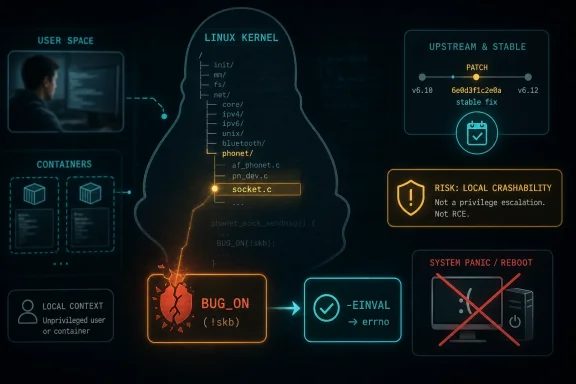 A One-Line Assumption Turned Into a Kernel Panic
The vulnerable code lives in net/phonet/socket.c, inside the Linux kernel’s Phonet socket implementation. Phonet is not a mainstream protocol for most servers or desktops; it was originally associated with Nokia cellular modem-style communication, and on many systems it is obscure enough that administrators may never knowingly encounter it.Obscurity, however, is not the same thing as absence. Kernel attack surface often comes from compiled-in subsystems, loadable modules, protocol families, and socket APIs that ordinary users never think about until a fuzzer or a low-privilege process finds them. CVE-2026-53292 sits precisely in that uncomfortable zone.
The crash path begins in
pn_socket_sendmsg(), which can call pn_socket_autobind() when a Phonet socket needs to be bound automatically before sending. The autobind function calls pn_socket_bind() with port zero, then interprets one particular error code, -EINVAL, as evidence that the socket must already have been bound. On that assumption, the code checked that a Phonet port existed and used BUG_ON() if it did not.That was the mistake.
pn_socket_bind() can also return -EINVAL when the socket state is not TCP_CLOSE, even if no previous bind occurred and the stored Phonet port is still zero. In that state, the assertion is false, BUG_ON() fires, and the kernel panics from a path that can reportedly be reached by user-triggered socket operations.The fix is direct: if bind returns
-EINVAL but the port is still zero, treat that as a normal error and return it instead of crashing. In other words, the patch changes the kernel’s response from “the machine should die because this invariant failed” to “the operation failed, report an error to the caller.”The Dangerous Glamour of BUG_ON()
Kernel developers have spent years pushing back against casual use of BUG_ON(), and this CVE shows why. An assertion is useful when it catches impossible internal corruption during development. It becomes dangerous when it remains in reachable runtime code where a malformed state, rare interleaving, or user-controlled input can turn an ordinary failure into a system-wide denial of service.That distinction matters more in kernel space than almost anywhere else. A userspace program that aborts on a bad assumption may take down a service. A kernel that deliberately traps on a bad assumption can take down the host.
CVE-2026-53292 is not about memory corruption in the usual sense. The description does not claim arbitrary code execution, privilege escalation, or data exposure. It is about availability: a path that should have returned an error instead hits a kernel BUG, producing a panic.
That may sound low drama until the affected machine is a shared workstation, a build host, a CI runner, a lab server, or a virtualization node with local users. “Local denial of service” is often dismissed in consumer vulnerability summaries, but in multi-user and container-heavy environments, local crashability can become an operational incident.
The old kernel instinct was to treat impossible states as evidence that something had gone terribly wrong. The modern hardening instinct is more pragmatic: if userspace can make the kernel reach the state, the kernel must survive it.
Syzbot Did What Production Rarely Has Time to Do
The report credits syzbot, the automated bug-finding infrastructure tied to the Syzkaller kernel fuzzer. That detail is important because this is exactly the sort of bug fuzzing is good at finding: not a famous protocol flaw, not a glamorous exploit chain, but a weird state transition buried in a neglected corner of kernel networking.Fuzzers do not care whether a subsystem is fashionable. They care whether an interface accepts inputs and whether those inputs can drive the program into an unexpected state. Socket APIs are especially fertile territory because they combine state machines, address families, binding rules, send paths, and decades of compatibility baggage.
The call trace in the disclosure shows the path through
pn_socket_sendmsg(), sock_sendmsg_nosec(), __sock_sendmsg(), and eventually __sys_sendto(). That is not an exotic kernel-internal-only path. It is the familiar userspace-to-kernel send operation, routed through an uncommon address family.This is why the bug’s narrowness should not be mistaken for irrelevance. Kernel security is full of obscure surfaces that become relevant only when an attacker or a fuzzer has the patience to enumerate them. A subsystem can be unused by an organization’s applications and still be present enough to matter.
The patch also illustrates a healthy kernel process. A bot found the crash, a human patch landed, the stable tree received fixes, and a CVE record was published. The ecosystem is noisy, but the machinery worked.
The Patch Is Small Because the Bug Is Conceptual
The code change is not a sweeping redesign of Phonet. It does not remove the address family, rewrite the socket state machine, or add a complicated mitigation. It changes the interpretation of an error path.Before the patch,
-EINVAL from pn_socket_bind() was treated as a special case: if binding failed that way, the code assumed the socket had already been bound. It then asserted that the Phonet port was non-zero. The problem was that -EINVAL was overloaded; it could mean “already bound,” but it could also mean “wrong socket state.”The fixed logic adds the missing condition. Only when the port is non-zero should the code treat
-EINVAL as the benign “already bound” case. If the port remains zero, the function returns the error normally.That difference is small in code but large in behavior. A failed send becomes a failed send, not a host crash. Callers already handle non-zero returns from
pn_socket_autobind() by converting them into ordinary error behavior, so the visible change is primarily the removal of the panic.This is the best kind of kernel security fix: it makes the exceptional path less exceptional. It does not rely on administrators setting a sysctl, deploying a policy engine, or identifying exploit signatures. It simply stops weaponizing the kernel’s own assertion.
The Affected Range Reaches Back to Kernel Antiquity
The CVE record ties the vulnerable code lineage to the original Phonet socket glue, with affected history going back to Linux 2.6.28. That is old enough to span multiple eras of Linux deployment: netbooks, early Android, embedded appliances, cloud expansion, containerization, and today’s heterogeneous edge fleets.The record also lists fixed stable commits and indicates that later kernel lines, including the relevant 7.0 stable state and 7.1 onward, are not affected. As always with kernel CVEs, the cleanest operational answer is not to memorize commit hashes but to consume vendor kernel updates and verify whether your distribution has backported the patch.
That last point matters because Linux version numbers alone can mislead. Enterprise distributions routinely backport individual security fixes into older long-term kernels while keeping the visible kernel version largely unchanged. A system running an older-looking kernel may be patched; a custom-built kernel with a newer base may still need scrutiny if it carries the vulnerable code without the fix.
The affected file is
net/phonet/socket.c, so administrators who build custom kernels can check whether Phonet support is enabled and whether the patch is present. For mainstream distributions, the right move is to watch the vendor advisory stream rather than treating the upstream CVE record as the only source of truth.This is especially true because the NVD entry was published without a CVSS score at the time described by the user-provided record. A missing score does not mean “not vulnerable.” It means enrichment had not yet caught up with publication.
Windows Shops Should Still Care About a Linux Phonet Bug
At first glance, this looks like the wrong vulnerability for a WindowsForum audience. It is a Linux kernel issue in a niche networking subsystem, not a Windows kernel flaw, not a Microsoft Patch Tuesday item, and not a new ransomware vector against Active Directory.But modern Windows environments are rarely Windows-only. They run Linux containers on developer workstations, Linux guests under Hyper-V, Linux appliances in network racks, Linux-based storage and security tools, WSL instances, CI systems, Kubernetes nodes, and cloud workloads managed by the same administrators who patch Windows Server. A Linux denial-of-service issue can become a Windows operations problem when it crashes the build runner, monitoring node, appliance VM, or developer environment that the Windows estate depends on.
WSL deserves a careful distinction. WSL 2 uses a Microsoft-provided Linux kernel, and its exposure depends on what kernel version is installed, what configuration Microsoft ships, and whether the relevant address family is available inside the environment. The presence of a Linux CVE does not automatically mean every Windows 11 laptop is exposed in a practical way.
Still, the broader lesson applies. Windows administrators increasingly need to understand Linux kernel advisories well enough to triage them. The industry has blurred the old boundary between “Windows patching” and “Linux patching,” especially in shops that use Windows endpoints but Linux-heavy developer and cloud infrastructure.
The smart response is not panic. It is inventory. If your environment has Linux kernels under Windows-hosted virtualization, WSL, containers, network appliances, or cloud images, those assets belong in the vulnerability-management program rather than an informal “someone else handles that” bucket.
The Real Risk Is Local Crashability, Not Internet Worms
Nothing in the disclosure suggests CVE-2026-53292 is remotely exploitable over the network in the classic sense. The path described involves local socket operations and a user-triggerable kernel panic. That places it in the denial-of-service category, with impact shaped heavily by who can create Phonet sockets and under what confinement.On a single-user desktop, the practical risk may be low unless malicious local code is already running. On a shared Linux system, the story changes. A low-privilege user who can crash the kernel can deny service to everyone else.
In containerized environments, the answer depends on namespace behavior, kernel configuration, seccomp policies, capabilities, and whether the relevant socket family is reachable from inside a container. Container isolation does not magically erase kernel attack surface. Containers share the host kernel, which is why local kernel denial-of-service bugs can matter even when the vulnerable action starts inside what looks like a confined workload.
That is the uncomfortable truth about kernel CVEs in obscure subsystems. The exploitability question is not simply “do we use Phonet?” It is “can an untrusted process reach the vulnerable code on a kernel we operate?” Those are different questions, and the second one is the one security teams need to answer.
For many organizations, the answer will be that regular kernel updates are sufficient. For high-density multi-tenant Linux hosts, hardened container platforms, and shared academic or research systems, the advisory deserves closer attention.
NVD’s Missing Score Is a Triage Problem, Not a Verdict
The NVD record described by the user shows no CVSS 4.0, 3.x, or 2.0 score from NIST at publication time. That is increasingly common in a vulnerability ecosystem where publication and enrichment are not the same event. A CVE can be real, patched, and operationally relevant before the downstream database has assigned a severity number.This creates a practical headache for vulnerability scanners and patch dashboards. Many organizations still sort queues by CVSS, then work downward. A newly published kernel CVE with no score can be under-prioritized simply because the scoring field is empty.
That is a process bug on the defender side. For kernel issues, especially those published by kernel.org with upstream fixes, administrators should look at affected code, exploit preconditions, reachable attack surface, and vendor patch status. CVSS is useful, but it is not an oracle.
CVE-2026-53292 is a good example. It is unlikely to deserve the same urgency as a remotely exploitable unauthenticated RCE in an internet-facing service. But it also should not disappear into a “no score, no action” pile if the organization operates shared Linux hosts where untrusted users can execute code.
The lack of a score is a reason to do human triage, not a reason to stop triage.
Where the Fix Meets Real Patch Management
For administrators, the first step is to determine whether Linux systems in scope are using a kernel that includes Phonet and lacks the fix. Most organizations should not start by hand-applying upstream commits; they should check their distribution’s security channels, vendor advisories, and kernel package changelogs.If you build kernels yourself, the audit is more direct. Check whether
CONFIG_PHONET is enabled, inspect net/phonet/socket.c, and confirm that pn_socket_autobind() no longer treats -EINVAL alone as proof that a socket is already bound. The fixed behavior requires checking that the Phonet port is non-zero before returning success for the “already bound” case.If you run immutable images or appliance-style Linux systems, the question becomes who owns the kernel. Network appliances, security products, backup platforms, and storage devices often embed Linux while abstracting it away from the customer. Those vendors need to answer whether their shipped kernels include the vulnerable code and whether the patch will be delivered in firmware or software updates.
Cloud users should also avoid false assumptions. Managed services may abstract kernel maintenance, but self-managed virtual machines and Kubernetes worker nodes remain the customer’s responsibility unless a provider explicitly says otherwise. For container hosts, patching the host kernel is what matters; rebuilding application images will not fix a host kernel bug.
There may also be mitigation through configuration. If Phonet is built as a module and not loaded, or if the address family is unavailable under your security policy, practical exposure may be reduced. But mitigation-by-obscurity is a poor substitute for a patched kernel when the update is available.
Old Mobile Plumbing Still Runs Through Modern Kernels
Part of what makes this CVE interesting is the subsystem itself. Phonet is not TCP, UDP, Bluetooth, Wi-Fi, or the networking code most administrators track. It is legacy-ish mobile plumbing, the kind of code that survives because the kernel serves many hardware histories at once.That long tail is one of Linux’s strengths. The kernel supports astonishingly diverse devices and workloads because it rarely discards code simply because it is unfashionable. But the same long tail is also a security burden. Every supported protocol family, driver, filesystem, and compatibility layer becomes something that must be fuzzed, reviewed, maintained, and eventually patched.
This is not unique to Linux. Windows has its own compatibility layers, legacy components, and obscure APIs that persist because someone, somewhere, depends on them. The difference is that Linux’s development process often exposes the archaeology more visibly: public mailing lists, bot reports, stable commits, and CVE records show the machinery in motion.
The lesson for defenders is not to demand that every obscure subsystem vanish. It is to align kernel configuration with actual need. A minimal server kernel, a hardened container host, and a developer workstation do not necessarily need the same protocol families enabled.
In practice, most organizations consume vendor kernels rather than curating every option themselves. But for security-sensitive Linux fleets, reducing unused kernel attack surface remains one of the few strategies that works across bug classes.
The Fix Also Shows Why Stable Kernels Matter
The CVE record points to stable-tree fixes, which is exactly where administrators should want this kind of repair to land. Kernel security is not only about the mainline branch; it is about getting small, safe fixes into the kernels people actually run.That is especially important for denial-of-service bugs. A crash fix that is tiny and well-scoped can often be backported with less risk than a major feature change. The patch here changes error handling in one function and preserves existing caller expectations by returning a normal failure instead of panicking.
Stable backports are also why “upgrade to the latest mainline kernel” is not always the right enterprise answer. A distribution-maintained long-term kernel with the security fix may be preferable to a self-selected newer kernel without the organization’s normal support and testing pipeline.
The operational discipline is familiar but still worth stating. Track vendor kernel updates, stage them, reboot deliberately, and verify the running kernel after maintenance. Kernel fixes do not protect a host until the fixed kernel is actually booted.
Linux patch management remains less convenient than updating a userspace package because reboots are often involved. That friction is one reason local denial-of-service bugs can linger longer than they should.
The Small CVE That Rewards Boring Discipline
This is not the kind of vulnerability that should send administrators into emergency weekend response mode across every environment. It is the kind that rewards teams with accurate inventory, boring patch cadence, and a sane view of local attack surface.- CVE-2026-53292 is a Linux kernel Phonet vulnerability where a failed autobind path could trigger
BUG_ON()and panic the kernel. - The issue was reported by syzbot and fixed by returning a normal error when
pn_socket_bind()fails with-EINVALwhile no Phonet port has been assigned. - The known impact is denial of service through a user-triggerable crash path, not a documented remote code execution or data theft vulnerability.
- The affected code lineage reaches back to Linux 2.6.28, but real exposure depends on kernel configuration, vendor backports, and whether the vulnerable socket path is reachable.
- Windows-centric teams should still account for Linux kernels in WSL, Hyper-V guests, appliances, CI systems, containers, and cloud workloads.
- The absence of an NVD CVSS score at publication should not be treated as evidence that the vulnerability is harmless.
References
- Primary source: NVD / Linux Kernel
Published: 2026-06-28T01:02:55-07:00
NVD - CVE-2026-53292
 nvd.nist.gov
- Security advisory: MSRC
Published: 2026-06-28T01:02:55-07:00
Original feed URL
Security Update Guide - Microsoft Security Response Center
 msrc.microsoft.com
- Official source: nist.gov
National Vulnerability Database
NIST maintains the National Vulnerability Database (NVD), a repository of information on software and hardware flaws that can compromise computer security. This is a key piece of the nation’s cybersecurity infrastructure.www.nist.gov - Related coverage: cve.imfht.com
CVE-2026-43092: xsk: validate MTU against usable frame size on bind - Vulnerability Platform
[-] Overview A validation missing vulnerability exists in the operation of the Linux kernel's AF_XDP (XDP sockets) module. The current implementation allo cve.imfht.com
- Related coverage: labs.cloudsecurityalliance.org
CSA research note ai vuln discovery velocity disclosure crisis 20260524 csa styled
PDF documentlabs.cloudsecurityalliance.org
