

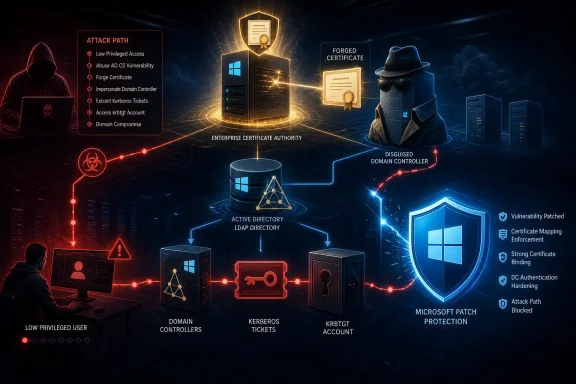
The vulnerability deserves immediate attention from Windows Server administrators because it is not another certificate template misconfiguration requiring years of accumulated PKI mistakes. Certighost is a product flaw in the way vulnerable Enterprise Certification Authorities handle a particular directory lookup path. In a qualifying environment, a regular authenticated domain user can abuse it with no administrator interaction.
Microsoft assigned CVE-2026-54121 a CVSS 3.1 score of 8.8, High severity, reflecting network reachability, low required privileges, no user interaction, and high impact on confidentiality, integrity, and availability. That score is technically sound, but it can understate the operational danger of an attack path that reaches a Domain Controller identity and potentially the krbtgt account.
The public disclosure on July 24, 2026 includes a working proof of concept, raising the urgency for organizations that have not yet applied the security updates released on July 14, 2026. The good news is that Microsoft’s fix addresses the broken trust decision at the center of the issue. The less comfortable reality is that many organizations treat their internal PKI as background infrastructure, leaving AD CS servers out of the fastest patching rings.
Overview: Why Certighost Matters
Active Directory Certificate Services, commonly shortened to AD CS, provides the certificate authority infrastructure used by Windows domains for encryption, smart-card and certificate authentication, device identity, VPN access, Wi-Fi authentication, code signing, and internal TLS. An Enterprise CA is trusted by the domain, which makes it a highly consequential security asset.
A certificate issued by an Enterprise CA is not merely a document or a browser artifact. In the wrong circumstances, it can be an identity credential. Windows can use certificates with PKINIT, the Kerberos extension for public-key authentication, to obtain a Ticket Granting Ticket without presenting a conventional password.
That capability is useful for legitimate scenarios. It is also why AD CS weaknesses routinely become domain-wide escalation opportunities. If an attacker can convince a trusted CA to issue a certificate containing the identity of a privileged user, server, or Domain Controller, the attacker may be able to authenticate as that identity.
Certighost differs from familiar AD CS escalation paths such as overly permissive certificate templates, uncontrolled subject alternative names, or dangerous enrollment agent settings. Its core problem lies in a CA-side enrollment fallback, making it particularly important for environments that may believe their certificate templates have already been thoroughly audited.
The flaw is best understood as a trust-boundary failure:
- The CA accepted a request-supplied target for a remote directory lookup.
- It did not adequately verify that the target was an actual Domain Controller.
- A hostile endpoint could provide identity data belonging to a real Domain Controller.
- The CA could then use that data when issuing an authentication certificate.
In short, the CA trusted an endpoint because it behaved enough like a domain principal, rather than verifying that it was the Domain Controller it claimed to represent.
The Vulnerable “Chase” Enrollment Path
A rarely discussed compatibility mechanism
The vulnerable behavior is associated with an AD CS enrollment fallback often described as a chase. In specific cross-domain or referral-style enrollment scenarios, the CA may need to perform an additional directory lookup to resolve information about the requesting identity.
Two certificate request attributes influence that operation:
cdc— the client Domain Controller or host that the CA should contact.rmd— the remote-domain identity or principal that the CA should resolve.
On a vulnerable CA, an attacker could submit a crafted certificate request that supplied both values. The crucial weakness was that the CA treated the supplied cdc host name as a viable lookup destination before proving it corresponded to a legitimate Domain Controller in Active Directory.
This is more than a routine input-validation mistake. The vulnerable flow crossed a critical security boundary: information from an untrusted certificate request helped determine where a trusted certificate authority obtained identity data.
What the CA trusted incorrectly
Under the vulnerable logic, the CA could make network connections to the host named in the cdc request attribute. The attacker could operate services that mimicked the directory and authentication interfaces the CA expected to use.
The hostile endpoint did not need to be a real Domain Controller. It needed to satisfy enough of the protocol flow to be treated as a valid domain principal. A machine account created by an ordinary domain user could provide a foothold for that stage in many default-configured domains.
The attacker-controlled service could then return identity information associated with a real Domain Controller, including values such as:
- The Domain Controller’s security identifier, or SID.
- Its DNS host name.
- Other identity data relevant to certificate construction and Kerberos certificate mapping.
The CA’s signature transforms that returned data into the dangerous part of the chain. Once the CA issues a certificate that Windows maps to a Domain Controller identity, the attack moves from a manipulated enrollment request to a trusted authentication credential.
From Low Privilege to Domain Compromise
The importance of machine account creation
One notable condition in the published Certighost chain is the ability for a normal user to create a machine account. In many Active Directory deployments, the ms-DS-MachineAccountQuota setting retains its familiar default value of 10.
That setting permits authenticated domain users to join a limited number of machines to the domain. It is not automatically a vulnerability; organizations have historically relied on it for legitimate workstation deployment workflows. But it can become an enabling condition when a separate weakness lets a machine identity satisfy an authentication check intended for a Domain Controller.
The public proof of concept uses this ability to create a machine account and register the service principal names needed by the malicious endpoint. That lets the attacker-controlled host participate in the CA’s challenge-and-response sequence as an authentic domain principal.
This is a valuable reminder that secure defaults are contextual. A default that is broadly useful in ordinary deployment scenarios can amplify risk when combined with a flaw in a trusted service.
The attack chain at a high level
The published proof of concept automates a complete escalation path. Administrators do not need to reproduce it to understand why the vulnerability is serious:
- An attacker starts with a low-privileged, authenticated domain account.
- The attacker identifies an accessible Enterprise CA and a target Domain Controller.
- The attacker creates a machine account where domain policy permits it.
- The attacker operates controlled services that answer the CA’s remote lookup and authentication activity.
- A crafted certificate request supplies attacker-controlled
cdcandrmdvalues. - The CA performs its vulnerable chase lookup and receives identity data for the target Domain Controller.
- The CA issues a certificate that can authenticate as that Domain Controller.
- The attacker uses the certificate to obtain Kerberos credentials for the Domain Controller account.
- With that identity, the attacker can use directory replication privileges to retrieve sensitive Active Directory secrets.
The final stage is the reason the flaw can become catastrophic. Domain Controllers ordinarily possess the permissions necessary for directory replication. If an attacker successfully impersonates one, they may be able to perform DCSync operations and extract password material, including the secret for the krbtgt account.
Why krbtgt is the real prize
The krbtgt account is central to Kerberos in an Active Directory domain. Its secret is used by the Key Distribution Center to protect Ticket Granting Tickets. An attacker who obtains the relevant key material can potentially forge Kerberos tickets that remain valid across the domain.
This is the territory associated with Golden Ticket persistence. Restoring confidence after a krbtgt compromise requires careful incident response, including sequential password resets for the account, review of Domain Admin and replication privileges, threat hunting, and validation that no persistence mechanism remains.
That is why Certighost should not be framed simply as a certificate issuance issue. It is an Active Directory forest security issue. The CA is the entry point, but the potential blast radius includes every system that trusts the compromised domain.
What Microsoft Changed in the July Update
Microsoft’s July 2026 security update changes the CA-side handling of the chase path. The essential improvement is straightforward: the CA must validate the request-supplied cdc target against Active Directory before continuing the remote lookup.
Verifying that the target is actually a Domain Controller
The patched behavior checks that the supplied host maps to a real Domain Controller computer object in the directory. The validation is designed to prevent an arbitrary machine or attacker-controlled service from being accepted as a legitimate chase target.
The updated processing includes safeguards that reject inappropriate targets before the remote lookup proceeds, including:
- Empty values.
- Overly long host values.
- Raw IPv4 or IPv6 address literals.
- Characters that could interfere with LDAP filter construction.
- Host names that do not resolve to exactly one matching Domain Controller computer object.
The validation specifically checks the Domain Controller account state associated with the SERVER_TRUST_ACCOUNT flag. That matters because a normal computer account and a Domain Controller account are not interchangeable, even though both are domain principals.
SID comparison provides a second line of defense
The patch does more than verify the destination. It also adds a follow-on comparison intended to ensure that the object resolved through the lookup matches the expected security identity.
This is an important design choice. Verifying only that a host is a legitimate Domain Controller would reduce the immediate attack surface, but a robust fix should also protect against object substitution and unusual lookup behavior later in the flow.
The updated design therefore closes two related gaps:
- Target authenticity — the CA should communicate only with a verified Domain Controller during the chase.
- Object authenticity — the identity resolved during that process must match the expected principal rather than attacker-supplied data.
For administrators, the practical conclusion is uncomplicated: install the July 2026 security update on every Windows system hosting an affected AD CS role. The vulnerability is fixed in the CA-side components, not by making a certificate template slightly more restrictive.
A Critical Caveat: “Any Domain User” Has Preconditions
The claim that “any domain user can seize the domain” accurately conveys the potential impact in a vulnerable lab or a common configuration, but it should not be interpreted as an unconditional statement about every Windows network.
Certighost requires a meaningful set of conditions. At minimum, an organization must have an affected AD CS deployment and an enrollment path that permits the necessary certificate request. The published proof of concept also depends on environmental details including an accessible Enterprise CA, a usable machine certificate template, and a chain that can create or otherwise obtain an acceptable machine identity.
The default machine-account quota is highly relevant, but it is not the only possible path. Organizations that have set ms-DS-MachineAccountQuota to zero reduce one easy enabler, although that change does not replace patching and should not be mistaken for a complete remedy.
Likewise, a domain with AD CS installed is not necessarily exploitable in exactly the same way as the published demonstration. Template permissions, enrollment configuration, CA placement, domain topology, firewall rules, and service hardening can affect exploitability.
However, those qualifications should not become an excuse for delay. The vulnerability has a public proof of concept, the required privileges are low, and the attack targets a foundational trust service. Any organization that runs Enterprise CAs should assume it needs to assess and patch promptly.
Immediate Actions for Windows Administrators
1. Identify all AD CS hosts
Start by inventorying every system that hosts an AD CS role. Do not limit the search to the most visible issuing CA. A forgotten subordinate CA, lab CA connected to production trust, or legacy CA on an older Windows Server release can be the overlooked weak point.
Prioritize systems running:
- Enterprise Certification Authorities
- Enterprise Subordinate CAs
- AD CS installations that issue machine or client authentication certificates
- CAs that serve multiple domains or trusted forests
- CAs used by VPN, Wi-Fi, smart card, device-management, or server-authentication workflows
A standalone CA generally does not integrate with Active Directory in the same way as an Enterprise CA, but every AD CS installation should still be included in the review until its role and exposure are confirmed.
2. Apply the July 2026 security update
The primary remediation is to install Microsoft’s July 14, 2026 security update on affected Windows Server systems. Organizations should use their established servicing process, but Certificate Authorities deserve accelerated treatment because an attacker does not need to wait for a user to open a file, visit a website, or approve a prompt.
After patching:
- Confirm the latest cumulative update is installed on each CA.
- Restart the CA service or the server when required by servicing guidance.
- Verify that certificate enrollment still works for expected users and devices.
- Record the patch status in the organization’s PKI inventory.
Do not rely on the absence of an active alert or an observed exploit attempt. Public proof-of-concept code shortens the interval between disclosure and opportunistic testing.
3. Use the temporary mitigation only when patching cannot happen immediately
If emergency patching is genuinely delayed, administrators can disable the vulnerable chase behavior by clearing the EDITF_ENABLECHASECLIENTDC policy flag and restarting the Certificate Services service:
certutil -setreg policy\EditFlags -EDITF_ENABLECHASECLIENTDC
Restart-Service CertSvc -Force
This is a temporary mitigation, not a substitute for the July update. It removes the optional fallback path used by the demonstrated exploit, but it can also affect valid enrollment operations that depend on that behavior.
Before applying it to a production CA, administrators should test it against a representative environment and document the pre-change configuration. Enrollment flows involving remote domains, trusted forests, or unusual Domain Controller referral behavior deserve particular attention.
The operational risks include:
- Failed certificate requests for legitimate users or devices.
- Unexpected effects in multi-domain or multi-forest enrollment scenarios.
- Configuration drift if the setting is later restored by automation, an image baseline, or an administrator who does not understand the security implication.
- A false sense of security if the CA remains unpatched.
Once the July update is installed and validated, organizations should revisit the temporary setting as part of normal change control rather than assuming it must remain permanently disabled.
4. Tighten machine-account creation policy
Review the domain’s machine account quota and the processes that rely on it. If ordinary users do not need the ability to join computers to the domain, setting ms-DS-MachineAccountQuota to 0 can eliminate an unnecessary privilege path.
That hardening step should be planned carefully. Some organizations use delegated processes, self-service provisioning, or legacy deployment tools that expect users to join machines. A better model is often to grant machine-join rights explicitly to designated groups or deployment accounts rather than allowing broad default access.
Reducing the quota does not patch Certighost. It does, however, remove a key convenience used in the published attack chain and improves Active Directory hygiene more broadly.
Detection and Incident Response Considerations
Look for suspicious certificate enrollment activity
Detection is challenging because the exploit uses legitimate domain protocols and a legitimate CA. The goal is not merely to spot “bad certificates,” but to identify certificate activity that does not fit expected administrative and device-enrollment patterns.
Security teams should review CA request and issuance records for:
- Certificate requests made by unusual low-privileged accounts.
- Machine certificate enrollment associated with unexpected computer objects.
- Requests containing nonstandard enrollment attributes.
- Newly created machine accounts followed shortly by certificate issuance.
- Certificates issued with Domain Controller-like identity fields where the requester does not match the expected server.
- Enrollment activity from unusual network locations or administrative workstations.
Preserve CA logs before rotating or overwriting them. CA databases and issuance records can provide crucial forensic evidence if administrators need to determine whether a suspicious certificate was issued before patching.
Monitor Active Directory signals as well
Because Certighost can transition from certificate enrollment to Domain Controller impersonation, directory and Kerberos telemetry matters just as much as CA logging.
High-priority signals include:
- New computer accounts created by ordinary users.
- Unusual service principal name registrations.
- Certificate-based authentication for Domain Controller computer accounts from unexpected hosts.
- Directory replication requests originating from systems that are not known Domain Controllers.
- Access to sensitive account secrets, especially the
krbtgtaccount. - Sudden changes in privileged group membership, trust configuration, or delegation settings following anomalous enrollment activity.
A successful attack may not look like a noisy malware outbreak. It can resemble legitimate PKI activity followed by legitimate Kerberos and directory-replication operations. Correlating events across the CA, Domain Controllers, and identity monitoring platform is therefore essential.
Treat suspected exploitation as a domain-level incident
If there is credible evidence that a forged certificate was issued for a Domain Controller identity, response should escalate immediately. Revoking a certificate alone may be insufficient if the attacker already obtained Kerberos credentials or replicated secrets.
A defensible response plan may include:
- Isolate the affected CA and preserve relevant logs and database records.
- Identify, revoke, and publish revocation information for suspicious certificates.
- Investigate whether DCSync or equivalent replication activity occurred.
- Reset compromised machine and service account passwords.
- Reset the
krbtgtaccount password twice using an established domain recovery procedure if its secret may have been exposed. - Review Domain Admin, Enterprise Admin, replication, delegation, and PKI administrative permissions.
- Hunt for persistence mechanisms such as rogue certificates, delegated rights, modified templates, scheduled tasks, or unauthorized trust changes.
- Reassess the integrity of the CA hierarchy and consider rebuilding or reissuing certificates where trust cannot be confidently restored.
The key principle is simple: a certificate authority that issued a certificate for a Domain Controller identity may have enabled an attacker to undermine the core identity boundary of the domain.
The Larger Lesson for AD CS Security
Certighost reinforces the uncomfortable truth that internal PKI is identity infrastructure. It should receive the same patch urgency, monitoring coverage, backup protection, administrative separation, and change-control discipline as Domain Controllers.
For years, AD CS security discussions have centered on dangerous templates and configuration mistakes. Those remain important. But CVE-2026-54121 shows that even a carefully managed certificate template environment can be exposed by vulnerable CA behavior below the configuration layer.
A mature AD CS security program should include:
- Rapid patching for CAs and supporting identity systems.
- Separate administrative tiers for PKI management.
- Restricted network access to CA hosts.
- Continuous review of certificate template permissions and enrollment rights.
- Auditing of certificate issuance, revocation, and CA configuration changes.
- Controlled machine-account creation and delegation practices.
- Tested incident-response procedures for certificate-based identity compromise.
- Regular recovery exercises for Domain Controller and CA compromise scenarios.
The strength of Microsoft’s July fix is that it corrects the underlying authorization decision rather than merely blocking one proof-of-concept input. By validating that a chase target is a genuine Domain Controller and checking the resolved identity, the patched CA restores the trust boundary that the vulnerable workflow failed to enforce.
The risk is that AD CS servers are often missed by routine Windows patch management because they are perceived as stable, specialized infrastructure. Certighost makes that assumption untenable. In a Windows domain, the Enterprise CA is not an appliance sitting beside identity services. It is part of the identity system itself, and CVE-2026-54121 should be handled with that level of urgency.
References
- New "Certighost" Flaw Lets Any Domain User Seize Full Windows Domain cyberkendra.com · 2026-07-24T17:54:00+00:00