

CVE-2026-54171 highlights a deceptively simple but consequential weakness in the Ruby HTTP client library Excon: when applications automatically followed an HTTP redirect, the library’s redirect middleware could carry sensitive request headers to a destination that was never meant to receive them. The issue is fixed in Excon 1.5.0, and teams running Ruby workloads on Windows, Linux, containers, or cloud platforms should treat the upgrade as a priority wherever automated redirects and credential-bearing outbound requests can intersect.
HTTP redirects are routine. An application requests one URL, receives a
The danger begins when a redirect crosses a trust boundary.
An initial request may be sent to an approved service and include credentials or session material in headers. If the server responds with a redirect to another host, a client library must decide which parts of the original request are safe to retain. Replaying every header can expose secrets to the redirect target. Removing too much can break legitimate application behavior.
Before Excon 1.5.0, the library’s
The result is tracked as CVE-2026-54171, rated Moderate with a CVSS v3.1 score of 6.5. Its impact is centered on confidentiality: a successful exploit can cause sensitive header values to be delivered to an unintended endpoint, while the advisory does not identify a direct integrity or availability impact.
Although Excon is not a Windows component and this is not a Windows operating system vulnerability, Windows environments can still be affected in several practical ways:
Consider a Ruby application that calls a trusted internal API:
The request may contain headers such as:
If that endpoint returns a redirect to another URL, an HTTP client may issue a second request automatically. The redirect may be legitimate, such as a handoff to a trusted storage service. But it may also be unsafe if:
That change matters because modern API authentication frequently uses headers other than the standard
The vulnerability’s severity profile reflects several conditions:
The attacker’s objective is not necessarily to compromise Excon itself. Instead, the attacker needs a route to make the application request a URL that redirects to infrastructure under attacker control.
This is a crucial distinction. Organizations often place trusted domains on allowlists, but a trusted hostname does not guarantee every redirect issued by that hostname is trustworthy.
A broad credential header should rarely accompany a redirected download request. Even if the destination is a legitimate cloud domain, a redirect path may cross services with different authentication requirements and logging controls.
On Windows build servers, this may include:
The related code changes remove Excon’s cookie-capture middleware from the standard load path and delete the associated middleware implementation. The maintainers’ reasoning is sound. A general-purpose HTTP library cannot reliably know which initial hosts and eventual redirect targets should be trusted to receive cookies.
Cookies can be particularly dangerous because they may represent:
This can introduce compatibility consequences. Some applications may have relied on headers or cookies being retained through redirects to complete legitimate workflows. Those applications should not simply re-enable broad forwarding. They should implement narrowly scoped logic that considers:
However, security teams should be aware that published vulnerability metadata has shown a version-range inconsistency. The advisory data identifies versions below 1.4.2 as affected while also identifying 1.5.0 as the patched release. Other vulnerability records describe the issue as affecting releases prior to 1.5.0.
That inconsistency should not delay remediation or become a reason to preserve Excon 1.4.2. The secure operational decision is clear:
Look for an entry resembling:
A project can declare a broad dependency constraint in
Useful commands include:
On PowerShell, a direct lockfile inspection can be performed with:
This can help identify which gem requires Excon. The dependency may originate from a cloud SDK, infrastructure provider, storage integration, API client, or other operational library.
Do not assume a project is safe merely because its own Ruby source does not contain
For projects that specify Excon directly, use an explicit minimum version:
Then update the resolved dependency:
When Excon is transitive, update the parent dependency or adjust the dependency resolution according to the application’s compatibility requirements.
Rebuild and redeploy:
Test at least these redirect combinations:
If systems used an affected Excon release with automatic redirects and sensitive headers, assess whether redirect targets could have been attacker-controlled or logged by third parties. Where exposure is plausible, rotate:
Examples of potentially sensitive proprietary names include:
Applications that fetch URLs supplied by users should apply strict controls:
Security reviews should therefore include:
When a client follows a redirect, it is not merely changing a URL. It may be changing:
For organizations operating Ruby workloads on Windows, the immediate response is uncomplicated: identify every resolved Excon dependency, upgrade to 1.5.0 or later, rebuild deployed artifacts, and test redirect flows with credentials present. The broader response is more valuable still: treat every automated redirect as a deliberate trust transition, not as a transparent continuation of the original request.
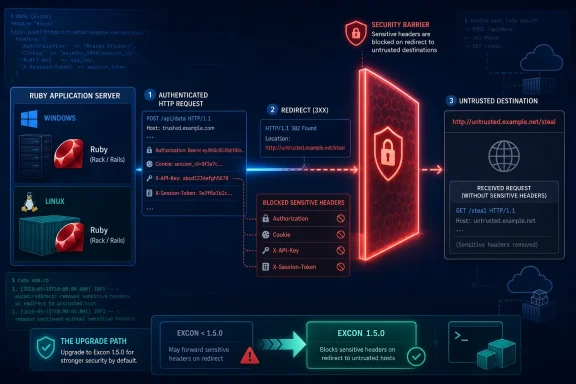 Overview: A Redirect Can Become a Data-Disclosure Boundary Failure
HTTP redirects are routine. An application requests one URL, receives a 3xx response with a Location header, and follows the new address automatically. This behavior supports canonical URLs, login handoffs, API endpoint migrations, regional routing, object storage downloads, and many other common workflows.The danger begins when a redirect crosses a trust boundary.
An initial request may be sent to an approved service and include credentials or session material in headers. If the server responds with a redirect to another host, a client library must decide which parts of the original request are safe to retain. Replaying every header can expose secrets to the redirect target. Removing too much can break legitimate application behavior.
Before Excon 1.5.0, the library’s
RedirectFollower middleware removed only a limited set of headers. It did not remove several additional headers commonly used to transmit API credentials, session identifiers, cookies, and anti-forgery tokens. It also lacked a facility for applications to define their own header-removal list for redirect handling.The result is tracked as CVE-2026-54171, rated Moderate with a CVSS v3.1 score of 6.5. Its impact is centered on confidentiality: a successful exploit can cause sensitive header values to be delivered to an unintended endpoint, while the advisory does not identify a direct integrity or availability impact.
What Excon Is and Why Windows Administrators Should Care
Excon is a Ruby HTTP client library used by applications and dependencies to make outbound HTTP and HTTPS requests. It is common in Ruby tooling, automation frameworks, cloud integrations, service clients, and applications that interact with REST APIs or object storage.Although Excon is not a Windows component and this is not a Windows operating system vulnerability, Windows environments can still be affected in several practical ways:
- Ruby web applications hosted on Windows Server may use Excon directly.
- Windows-based build agents may run Ruby dependency installers, deployment tools, or infrastructure automation.
- Developer workstations can execute Ruby scripts that make authenticated API calls.
- Cross-platform CI/CD pipelines may package vulnerable Ruby dependencies into containers or deployment artifacts from Windows hosts.
- Security teams may see the CVE in Microsoft Security Response Center feeds or vulnerability dashboards because those platforms aggregate third-party vulnerability information.
Authorization, Cookie, or custom API-key headers.The Core Technical Problem
At its heart, CVE-2026-54171 concerns the difference between an original request target and a redirect target.Consider a Ruby application that calls a trusted internal API:
[url unfurl="true"]https://api.example.internal/v1/export[/url]The request may contain headers such as:
Code:
Authorization: Bearer <access-token>
X-API-Key: <service-key>
Cookie: session=<session-value>
X-CSRF-Token: <anti-forgery-token>- The original endpoint has an open redirect weakness.
- DNS, routing, or service configuration has been compromised.
- A third-party service has changed its redirect behavior.
- An application accepts a user-controlled URL that ultimately redirects.
- A download, callback, metadata, or proxy URL is indirectly influenced by an attacker.
- A previously trusted domain redirects to a less-trusted external destination.
Headers Added to the Redaction List
The Excon 1.5.0 fix expands the list of headers removed when the redirect middleware constructs the next request. The redaction list includes:AuthorizationCookieCookie2HostProxy-ConnectionProxy-AuthorizationX-API-KeyX-Auth-TokenX-CSRF-TokenX-Session-ID
Authorization, proxy-related headers, and Host was therefore broadened to include cookies and several highly recognizable custom authentication and session headers.That change matters because modern API authentication frequently uses headers other than the standard
Authorization field. A service may rely on X-API-Key, X-Auth-Token, or an organization-specific header such as X-Internal-Service-Key. The latter example is especially important because it demonstrates why redirects should be treated as a strict security boundary rather than a convenience feature.Why the Vulnerability Is Rated Moderate
A CVSS score of 6.5 can look less urgent than critical remote-code-execution vulnerabilities, but the rating should not be mistaken for a lack of real-world significance. Credential exposure can be a serious incident, especially when the leaked header grants machine-to-machine access to sensitive systems.The vulnerability’s severity profile reflects several conditions:
- Network attack vector: The issue is triggered through HTTP redirect behavior.
- Low attack complexity: Once an attacker can influence a redirect destination, the basic attack does not require a complicated exploit chain.
- No privileges required: The attacker does not necessarily need an account on the vulnerable application.
- User interaction required: The application or a user-driven workflow must initiate a request that follows the redirect.
- High confidentiality impact: Sensitive headers may be exposed.
- No direct integrity impact: The flaw primarily discloses information rather than changing data.
- No direct availability impact: It does not inherently crash or disable the affected software.
Practical Exploitation Scenarios
The risk becomes clearer when viewed through realistic deployment patterns.API Client Redirects
An application uses Excon to call a partner API with a bearer token and custom API key. The partner endpoint later responds with a redirect due to a configuration mistake or a manipulated routing rule. If the client follows the redirect while retaining sensitive headers, the receiving server can collect them.The attacker’s objective is not necessarily to compromise Excon itself. Instead, the attacker needs a route to make the application request a URL that redirects to infrastructure under attacker control.
Open Redirects in Trusted Services
A trusted domain may host an endpoint that redirects to a supplied destination parameter. If an application sends credentials to that endpoint and follows its redirect automatically, the open redirect can turn into a credential forwarding mechanism.This is a crucial distinction. Organizations often place trusted domains on allowlists, but a trusted hostname does not guarantee every redirect issued by that hostname is trustworthy.
Cloud and Object Storage Workflows
Applications often obtain time-limited download URLs, upload URLs, or regional service endpoints through redirects. This is a valid pattern, but it creates complexity when the initial request includes credentials intended only for the first API host.A broad credential header should rarely accompany a redirected download request. Even if the destination is a legitimate cloud domain, a redirect path may cross services with different authentication requirements and logging controls.
CI/CD and Infrastructure Automation
Automation scripts often have privileged tokens because they deploy software, read packages, call cloud APIs, or update infrastructure. A Ruby dependency using vulnerable redirect handling can therefore become part of a supply-chain security concern.On Windows build servers, this may include:
- Ruby-based release automation.
- Configuration-management tooling.
- Internal package publishing scripts.
- Artifact retrieval tasks.
- Cloud provisioning jobs.
- Automated API smoke tests.
The Excon 1.5.0 Fix Goes Beyond a Short Header List
The patch’s most visible improvement is the larger redaction list, but its design choices reveal a broader security lesson: automatic forwarding of cookies during redirects is risky as a universal default.The related code changes remove Excon’s cookie-capture middleware from the standard load path and delete the associated middleware implementation. The maintainers’ reasoning is sound. A general-purpose HTTP library cannot reliably know which initial hosts and eventual redirect targets should be trusted to receive cookies.
Cookies can be particularly dangerous because they may represent:
- Authenticated browser-like sessions.
- Stateful API sessions.
- Single sign-on tokens.
- Load-balancer affinity data.
- Application-specific identity context.
- Temporary authorization grants.
A Safer Default
The revised behavior favors safety by stripping sensitive headers rather than assuming the redirect destination deserves the same credentials as the original endpoint.This can introduce compatibility consequences. Some applications may have relied on headers or cookies being retained through redirects to complete legitimate workflows. Those applications should not simply re-enable broad forwarding. They should implement narrowly scoped logic that considers:
- The original hostname.
- The redirect destination hostname.
- The URL scheme.
- The port.
- The authentication method.
- The specific header being considered.
- Whether the redirect crosses an organizational or service boundary.
Affected Versions and a Version-Range Caveat
The remediation target is straightforward: upgrade Excon to version 1.5.0 or later.However, security teams should be aware that published vulnerability metadata has shown a version-range inconsistency. The advisory data identifies versions below 1.4.2 as affected while also identifying 1.5.0 as the patched release. Other vulnerability records describe the issue as affecting releases prior to 1.5.0.
That inconsistency should not delay remediation or become a reason to preserve Excon 1.4.2. The secure operational decision is clear:
This conservative approach also makes sense because the actual corrective commit is associated with the 1.5.0 release line and contains the expanded redirect-header redaction behavior.Treat every Excon release earlier than 1.5.0 as requiring review, and upgrade to 1.5.0 or newer.
How to Identify Exposure in Ruby Projects
A dependency scan is the first step, but it is not enough. Teams must determine whether Excon is used directly or pulled in transitively through another Ruby gem.Check the Resolved Dependency Version
For Bundler-managed applications, inspect the lockfile:Gemfile.lockLook for an entry resembling:
excon (1.4.2)A project can declare a broad dependency constraint in
Gemfile while Gemfile.lock still resolves an older vulnerable version. The lockfile is generally the more useful indicator of what the deployed application actually installs.Useful commands include:
Code:
bundle info excon
bundle list | findstr exconSelect-String -Path .\Gemfile.lock -Pattern "excon"Find Direct and Transitive Uses
Run:bundle why exconThis can help identify which gem requires Excon. The dependency may originate from a cloud SDK, infrastructure provider, storage integration, API client, or other operational library.
Do not assume a project is safe merely because its own Ruby source does not contain
require "excon". A transitive dependency may instantiate Excon internally.Search for Redirect Configuration
The CVE is particularly relevant where applications use or enable redirect following. Search code and configuration for patterns such as:follow_redirectsredirects_remainingRedirectFollowerExcon.defaultsExcon.newExcon.getExcon.post- URL parameters derived from request input
- Remote file download functionality
- Webhook fetch or callback logic
Recommended Remediation Steps
The strongest mitigation is to update Excon and validate redirect behavior after deployment.1. Upgrade to Excon 1.5.0 or Later
Update the application’s dependency declaration and lockfile so the resolved Excon release is at least 1.5.0.For projects that specify Excon directly, use an explicit minimum version:
gem "excon", ">= 1.5.0"Then update the resolved dependency:
bundle update exconWhen Excon is transitive, update the parent dependency or adjust the dependency resolution according to the application’s compatibility requirements.
2. Rebuild Deployment Artifacts
Updating a repository is not sufficient if CI/CD systems reuse cached gems, prebuilt images, workspace artifacts, or vendor directories.Rebuild and redeploy:
- Windows application packages.
- Container images.
- Ruby bundle caches.
- Build-agent dependency caches.
- Offline deployment bundles.
- Serverless packages.
- Internal gem mirrors where applicable.
3. Test Redirect Paths Deliberately
Regression testing should verify both expected functionality and the absence of sensitive forwarding.Test at least these redirect combinations:
- Same host, same scheme.
- Same host, different path.
- Different host under the same organization.
- Different subdomain.
- Different scheme, including HTTPS-to-HTTP behavior where such a path is even permitted.
- Trusted service to third-party service.
- Redirects initiated by user-influenced URLs.
- Multi-hop redirect chains.
Authorization, cookies, proxy credentials, API keys, session identifiers, and application-specific secrets are absent from redirected requests unless an explicit policy permits them.4. Rotate Secrets if Exposure Is Plausible
A software update stops future accidental forwarding. It does not revoke data that may already have been exposed.If systems used an affected Excon release with automatic redirects and sensitive headers, assess whether redirect targets could have been attacker-controlled or logged by third parties. Where exposure is plausible, rotate:
- API keys.
- Bearer tokens.
- OAuth client secrets.
- Service-account credentials.
- Session-signing keys where relevant.
- Proxy credentials.
- Deployment tokens.
- Cloud access credentials.
Risks That Remain After the Upgrade
Excon 1.5.0 materially improves the default safety of redirect processing, but it cannot eliminate every application-specific risk.Proprietary Header Names Still Need Attention
The new redaction list covers many common headers. It cannot predict every custom convention used by enterprises and SaaS providers.Examples of potentially sensitive proprietary names include:
X-Company-TokenX-Service-CredentialX-Partner-KeyApi-KeyTokenClient-SecretX-Forwarded-Client-Cert
Redirects Should Not Replace Destination Validation
Header redaction is a containment control, not a substitute for validating remote destinations.Applications that fetch URLs supplied by users should apply strict controls:
- Use an allowlist of approved hostnames.
- Resolve and validate DNS carefully.
- Block loopback, link-local, and private-network targets where appropriate.
- Restrict redirects by host and scheme.
- Limit the number of redirects.
- Avoid forwarding credentials by default.
- Separate authenticated API traffic from generic URL-fetching features.
Logging Can Preserve the Evidence of a Leak
A redirected request can expose a secret to logs even if the destination does not deliberately store it. Reverse proxies, web servers, debugging tools, observability platforms, and request-capture services may retain headers.Security reviews should therefore include:
- Application logs.
- Proxy logs.
- API gateway records.
- Debug tracing output.
- Error-reporting tools.
- Third-party monitoring agents.
- Network capture systems.
- Build logs from CI/CD pipelines.
The Larger Lesson for HTTP Client Security
CVE-2026-54171 is not an exotic parsing bug or a complex memory-corruption flaw. It is a reminder that redirects are security-sensitive control-flow changes.When a client follows a redirect, it is not merely changing a URL. It may be changing:
- The server receiving the request.
- The organization processing the data.
- The TLS certificate and network route.
- The authentication model.
- The logging and retention environment.
- The legal and compliance boundary for customer data.
For organizations operating Ruby workloads on Windows, the immediate response is uncomplicated: identify every resolved Excon dependency, upgrade to 1.5.0 or later, rebuild deployed artifacts, and test redirect flows with credentials present. The broader response is more valuable still: treat every automated redirect as a deliberate trust transition, not as a transparent continuation of the original request.
References
- Primary source: MSRC
Published: 2026-07-23T01:44:10-07:00
Security Update Guide - Microsoft Security Response Center
 msrc.microsoft.com
- Official source: learn.microsoft.com
HttpClientFactory logging redacts header values by default - .NET | Microsoft Learn
Learn about the .NET 9 breaking change in networking where HttpClientFactory logging redacts all header values by default.learn.microsoft.com
