

Microsoft has published CVE-2026-56165, described as a Microsoft Account Remote Code Execution Vulnerability, creating an immediate need for administrators, security teams, and Windows users to distinguish what is confirmed from what remains undisclosed. A remote code execution classification is inherently serious: if exploitation is possible, an attacker may be able to run code in a target security context without physically accessing the affected device or service. Yet the public information currently available for this CVE is notably sparse, making disciplined risk assessment more important than speculation.
The advisory was published on July 23, 2026. Its public-facing description identifies Microsoft Account as the affected technology area and lists remote code execution as the potential impact. However, the available material does not establish an exploit chain, affected Windows versions, required attacker privileges, user-interaction requirements, a CVSS severity score, a proof-of-concept status, or whether Microsoft has observed exploitation in the wild.
That absence of detail should not be mistaken for evidence that the issue is minor. It means organizations should treat CVE-2026-56165 as an emerging Microsoft Account security event: validate exposure, watch for official remediation guidance, and ensure that identity controls are operating as intended.
CVE-2026-56165 is assigned to a vulnerability categorized as a Microsoft Account Remote Code Execution Vulnerability. Microsoft Account, often abbreviated as MSA, is the consumer identity system used for Windows sign-in, Microsoft Store access, consumer Microsoft 365 subscriptions, Xbox services, OneDrive personal accounts, Outlook.com, and numerous other Microsoft-connected experiences.
The wording matters. A vulnerability title that contains “Microsoft Account” does not automatically mean every PC signed in with a Microsoft Account is remotely vulnerable to full device takeover. It also does not prove that an attacker can compromise an account merely by knowing an email address or sending a phishing message.
Instead, the title establishes a more limited but still significant fact: Microsoft has identified a security issue associated with the Microsoft Account ecosystem where the maximum potential impact is categorized as remote code execution.
Remote code execution, commonly shortened to RCE, is one of the most consequential vulnerability classes in modern computing. Successful RCE can enable an attacker to execute commands, launch tools, manipulate files, install malware, or establish persistence within the context of a compromised process, service, device, or cloud workload.
The final practical impact depends on several technical factors that are not yet publicly established for CVE-2026-56165:
For home users, Microsoft Account can be tied to Windows sign-in, cloud backup, OneDrive synchronization, Microsoft Store entitlements, device encryption recovery keys, gaming profiles, and passwordless authentication. For developers and service operators, Microsoft Account can also appear in sign-in flows, token issuance, account linking, OAuth-style authorization interactions, and application integrations.
That broad footprint creates a challenge when assessing an advisory named after Microsoft Account. The affected surface could plausibly involve:
The available CVE title does not reveal which of these possibilities applies.
The important distinction is that the text explains the purpose of the metric. It does not, by itself, reveal the metric value assigned to CVE-2026-56165.
The advisory’s publication through Microsoft’s security update process is itself a meaningful indicator that the issue has entered a formal vulnerability-management workflow. However, defenders should not infer a specific Report Confidence rating, exploit maturity, or attack prevalence unless the advisory explicitly provides it.
An RCE vulnerability associated with an identity platform therefore deserves scrutiny beyond a traditional application bug.
Possible outcomes could range from limited execution within a constrained process to a much broader security event. In the most serious theoretical cases, attackers might be able to:
Microsoft Account generally serves consumer identity scenarios. Microsoft Entra ID serves organizational identity, including work and school accounts, Microsoft 365 tenants, device management, conditional access, and enterprise application access.
An advisory specifically naming Microsoft Account should not automatically be treated as a direct Microsoft Entra ID vulnerability. That said, many organizations operate in mixed environments where users sign into personal Microsoft services on managed devices, use consumer accounts for Store access, or connect personal accounts to applications.
Security teams should therefore avoid assuming they are unaffected simply because the organization’s primary workforce identity platform is Microsoft Entra ID.
An organization could wrongly treat the CVE as a conventional Windows Patch Tuesday item and search only for a cumulative update. Another organization could assume it is a cloud-only concern and fail to review Microsoft Account use on client endpoints. A third could see the term “Microsoft Account” and decide the issue is irrelevant to managed enterprise systems.
All three assumptions could prove incorrect.
Organizations should maintain clear policy controls for personal account use on managed endpoints. The goal is not necessarily to ban all Microsoft Account activity; it is to establish where it is permitted, what data may be synchronized, and how exceptions are reviewed.
CVE-2026-56165 reinforces the broader lesson that identity integrations are part of the attack surface. They deserve the same asset inventory discipline applied to browsers, VPN clients, remote-access tools, and endpoint agents.
This is especially important for unmanaged or lightly managed Windows devices. Consumer systems frequently lag behind enterprise patching standards, even though Microsoft Account features are often more deeply used in those environments.
A standard-user configuration cannot make an RCE harmless. Malware operating in a standard user context can still steal accessible data, modify user files, surveil activity, or attempt lateral movement. But limiting rights can make full-system compromise more difficult.
On the positive side, withholding exploit mechanics can slow opportunistic attackers and reduce the likelihood that a low-skill actor can immediately reproduce an attack from a public proof of concept. This can give vendors and defenders valuable time to deploy updates, service-side protections, or configuration changes.
On the other hand, limited detail makes external verification harder. Independent researchers, security vendors, and enterprise teams may not be able to test whether their environments are vulnerable. Asset owners may also struggle to decide whether a patch window should be accelerated.
This tension is common in responsible vulnerability disclosure. It is particularly acute for identity-related flaws because detailed documentation can reveal valuable information about authentication boundaries, token handling, account-recovery flows, or service trust relationships.
The correct operational posture is therefore neither panic nor complacency. It is measured urgency: track the advisory, verify the organization’s Microsoft Account footprint, and be ready to act on updated vendor guidance.
Those statements are not supported by the information currently available.
This is more than a communications concern. Incorrect assumptions can create disruption, undermine trust in security guidance, and lead teams to overlook the systems that are actually at risk.
For Windows users, the immediate priorities are straightforward: keep supported software updated, protect Microsoft Accounts with strong multifactor authentication, review account activity, and remain skeptical of unexpected sign-in prompts, links, downloads, and recovery requests.
For enterprises, the priority is to understand where Microsoft Account functionality exists across managed endpoints and applications, validate patch and endpoint-monitoring coverage, maintain least-privilege controls, and prepare for a rapid response when Microsoft supplies affected-product and remediation details.
The security significance of CVE-2026-56165 will ultimately be determined not by its title alone, but by the attack vector, privileges required, affected components, and availability of a fix. Until those facts are available, the most effective response is a calm, evidence-driven posture that treats identity infrastructure as a critical part of the Windows attack surface.
The advisory was published on July 23, 2026. Its public-facing description identifies Microsoft Account as the affected technology area and lists remote code execution as the potential impact. However, the available material does not establish an exploit chain, affected Windows versions, required attacker privileges, user-interaction requirements, a CVSS severity score, a proof-of-concept status, or whether Microsoft has observed exploitation in the wild.
That absence of detail should not be mistaken for evidence that the issue is minor. It means organizations should treat CVE-2026-56165 as an emerging Microsoft Account security event: validate exposure, watch for official remediation guidance, and ensure that identity controls are operating as intended.
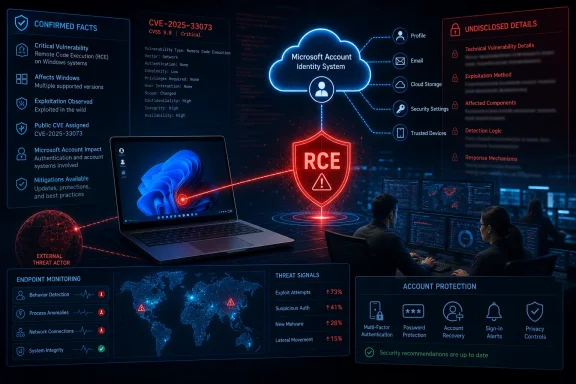 Overview: What CVE-2026-56165 Means
CVE-2026-56165 is assigned to a vulnerability categorized as a Microsoft Account Remote Code Execution Vulnerability. Microsoft Account, often abbreviated as MSA, is the consumer identity system used for Windows sign-in, Microsoft Store access, consumer Microsoft 365 subscriptions, Xbox services, OneDrive personal accounts, Outlook.com, and numerous other Microsoft-connected experiences.The wording matters. A vulnerability title that contains “Microsoft Account” does not automatically mean every PC signed in with a Microsoft Account is remotely vulnerable to full device takeover. It also does not prove that an attacker can compromise an account merely by knowing an email address or sending a phishing message.
Instead, the title establishes a more limited but still significant fact: Microsoft has identified a security issue associated with the Microsoft Account ecosystem where the maximum potential impact is categorized as remote code execution.
Remote code execution, commonly shortened to RCE, is one of the most consequential vulnerability classes in modern computing. Successful RCE can enable an attacker to execute commands, launch tools, manipulate files, install malware, or establish persistence within the context of a compromised process, service, device, or cloud workload.
The final practical impact depends on several technical factors that are not yet publicly established for CVE-2026-56165:
- Whether the vulnerable component runs on a Windows client, a Microsoft-hosted service, a browser-facing application, or another endpoint.
- Whether exploitation requires authentication.
- Whether a victim must click, open, approve, or install something.
- Whether an attacker needs to be on the same network, in a particular tenant, or able to interact with a specific Microsoft Account workflow.
- Whether exploitation occurs in a low-privilege context or can lead to broader system or account compromise.
- Whether a patch, service-side mitigation, configuration change, or account security action is required.
Background: Microsoft Account Is an Identity Layer, Not a Single Application
Microsoft Account is often discussed as if it were one program installed on a Windows PC. In reality, it is an identity and authentication platform that connects many services, applications, and devices.For home users, Microsoft Account can be tied to Windows sign-in, cloud backup, OneDrive synchronization, Microsoft Store entitlements, device encryption recovery keys, gaming profiles, and passwordless authentication. For developers and service operators, Microsoft Account can also appear in sign-in flows, token issuance, account linking, OAuth-style authorization interactions, and application integrations.
That broad footprint creates a challenge when assessing an advisory named after Microsoft Account. The affected surface could plausibly involve:
- A Windows sign-in or account-linking workflow.
- A cloud-hosted service that processes account-related requests.
- A web-facing endpoint involved in authentication or authorization.
- A desktop component that handles account tokens, callbacks, or embedded sign-in content.
- An application programming interface that trusts or transforms identity-related data.
- A consumer service integration that uses Microsoft Account credentials or authorization artifacts.
The available CVE title does not reveal which of these possibilities applies.
The Report Confidence Language Requires Careful Interpretation
The supplied advisory material includes explanatory text for a metric that measures confidence in the existence of a vulnerability and the credibility of its technical details. That language corresponds to the older CVSS Report Confidence concept, a temporal metric intended to indicate how well the vulnerability has been corroborated.The important distinction is that the text explains the purpose of the metric. It does not, by itself, reveal the metric value assigned to CVE-2026-56165.
What Report Confidence Measures
Report Confidence helps security teams understand whether a vulnerability is:- Unconfirmed, where the vulnerability claim may not yet be validated.
- Uncorroborated, where a report exists but technical evidence is limited or independently unverified.
- Confirmed, where the vendor or a reliable authority has validated the issue.
The advisory’s publication through Microsoft’s security update process is itself a meaningful indicator that the issue has entered a formal vulnerability-management workflow. However, defenders should not infer a specific Report Confidence rating, exploit maturity, or attack prevalence unless the advisory explicitly provides it.
Why Technical Detail Affects Operational Urgency
Sparse advisories often create a difficult moment for security operations teams. The potential impact may sound urgent, while the practical exposure remains unclear. This uncertainty can lead to two opposite mistakes:- Overreaction, such as disabling useful account services or making untested configuration changes that disrupt users without reducing the actual attack surface.
- Underreaction, such as assuming no action is needed because a full proof of concept, CVSS vector, or detailed exploit narrative has not been released.
Why Remote Code Execution in an Identity Context Is Especially Sensitive
Identity systems sit at the center of modern Windows usage. They influence who can authenticate, which services a user can reach, how trust is extended between devices and cloud services, and what data can be synchronized or recovered.An RCE vulnerability associated with an identity platform therefore deserves scrutiny beyond a traditional application bug.
Potential Consequences Depend on the Execution Context
If CVE-2026-56165 permits code execution, its real-world impact would depend heavily on where that code runs and what permissions are attached to the vulnerable component.Possible outcomes could range from limited execution within a constrained process to a much broader security event. In the most serious theoretical cases, attackers might be able to:
- Run malicious code under the permissions of a signed-in user.
- Abuse trusted account or token-processing workflows.
- Gain access to local data available to the compromised process.
- Install persistence mechanisms if elevated rights are also obtained.
- Pivot toward synchronized files, saved credentials, or linked consumer services.
- Target developers or users of applications that embed Microsoft Account authentication.
Consumer and Enterprise Identity Are Not Interchangeable
A crucial point for IT administrators is that Microsoft Account and Microsoft Entra ID are separate identity systems, even though Windows and Microsoft applications may present both in familiar sign-in experiences.Microsoft Account generally serves consumer identity scenarios. Microsoft Entra ID serves organizational identity, including work and school accounts, Microsoft 365 tenants, device management, conditional access, and enterprise application access.
An advisory specifically naming Microsoft Account should not automatically be treated as a direct Microsoft Entra ID vulnerability. That said, many organizations operate in mixed environments where users sign into personal Microsoft services on managed devices, use consumer accounts for Store access, or connect personal accounts to applications.
Security teams should therefore avoid assuming they are unaffected simply because the organization’s primary workforce identity platform is Microsoft Entra ID.
What Is Known and What Remains Unverified
A clear separation between facts and assumptions is essential in vulnerability reporting.Confirmed From the Available Advisory Material
The following points are established by the published advisory information:- The vulnerability identifier is CVE-2026-56165.
- The vulnerability is associated with Microsoft Account.
- The listed impact is Remote Code Execution.
- The publication date is July 23, 2026.
- The advisory includes information describing how vulnerability-report confidence metrics are intended to be interpreted.
Not Publicly Established in the Available Material
The currently available information does not establish:- A CVSS base score or severity rating.
- The attack vector, such as network, adjacent network, local, or physical.
- Whether the attacker must be authenticated.
- Whether user interaction is required.
- The affected product versions, operating systems, services, apps, or components.
- The vulnerable code path or weakness category.
- Whether exploitation requires a malicious link, file, web request, token, account action, or application integration.
- Whether exploitation has been detected in real-world attacks.
- Whether public exploit code exists.
- Whether a customer-installed update is available.
- Whether mitigation has already been applied through a Microsoft-hosted service change.
The Key Risk: Security Teams May Misclassify Their Exposure
The largest immediate operational danger around CVE-2026-56165 may be misclassification.An organization could wrongly treat the CVE as a conventional Windows Patch Tuesday item and search only for a cumulative update. Another organization could assume it is a cloud-only concern and fail to review Microsoft Account use on client endpoints. A third could see the term “Microsoft Account” and decide the issue is irrelevant to managed enterprise systems.
All three assumptions could prove incorrect.
Questions Administrators Should Answer Now
Without attempting to guess the exploit path, IT teams can perform a focused exposure review:- Where are Microsoft Accounts permitted on managed Windows devices?
Identify whether personal Microsoft Accounts are used for sign-in, OneDrive Personal, Microsoft Store, gaming-related services, device setup, or application authentication. - Which applications incorporate consumer Microsoft sign-in?
Review internally developed apps, desktop utilities, public-facing sites, and third-party applications that support Microsoft Account login. - Are managed devices fully current on Windows, browser, and application updates?
A vulnerability title may name an identity service while the vulnerable code exists in a client component, embedded web runtime, or supporting library. - Do users have unnecessary local administrator privileges?
Least privilege does not prevent every RCE event, but it can reduce the impact of code execution in a user context. - Are endpoint detection and response tools functioning correctly?
High-quality telemetry, behavioral alerts, and rapid isolation capability are valuable even when a vulnerability’s technical details are incomplete. - Are account-security controls enforced?
Multifactor authentication, passwordless sign-in, suspicious-activity notifications, recovery method reviews, and sign-in monitoring remain fundamental safeguards.
Consumer Accounts on Corporate Devices Need Governance
The presence of Microsoft Account functionality in Windows creates useful conveniences, but it can complicate enterprise governance. Personal OneDrive, Store applications, consumer email, and consumer authentication may introduce data-handling and support concerns even outside the scope of a specific CVE.Organizations should maintain clear policy controls for personal account use on managed endpoints. The goal is not necessarily to ban all Microsoft Account activity; it is to establish where it is permitted, what data may be synchronized, and how exceptions are reviewed.
CVE-2026-56165 reinforces the broader lesson that identity integrations are part of the attack surface. They deserve the same asset inventory discipline applied to browsers, VPN clients, remote-access tools, and endpoint agents.
Practical Defensive Actions While Details Are Limited
The lack of detailed exploit information means that mitigation should focus on resilient, low-regret security practices rather than unverified emergency measures.Keep Supported Systems and Applications Updated
Organizations should ensure that Windows devices, Microsoft Edge, supported browsers, Microsoft Store applications, and identity-related applications are receiving their normal security updates. If Microsoft later identifies a client-side component, a current servicing baseline will make deployment faster and reduce the chance that older vulnerabilities compound the risk.This is especially important for unmanaged or lightly managed Windows devices. Consumer systems frequently lag behind enterprise patching standards, even though Microsoft Account features are often more deeply used in those environments.
Reduce Privilege Where Possible
Remote code execution is more damaging when the compromised process has broad permissions. Users should normally work from standard accounts, while administrative tasks should use separate administrative identities and appropriate elevation controls.A standard-user configuration cannot make an RCE harmless. Malware operating in a standard user context can still steal accessible data, modify user files, surveil activity, or attempt lateral movement. But limiting rights can make full-system compromise more difficult.
Strengthen Microsoft Account Hygiene
Users and administrators should verify that Microsoft Accounts have:- Strong, unique passwords where passwords remain in use.
- Multifactor authentication or passwordless sign-in enabled.
- Current recovery email addresses and phone numbers.
- No unknown devices or unfamiliar sign-in activity.
- No unnecessary legacy app passwords or outdated account connections.
- Minimal exposure of recovery information to social-engineering attacks.
Monitor for Unusual Account and Endpoint Behavior
Security teams should watch for signals that may become relevant if further technical details emerge:- Unexpected sign-in prompts or repeated account-linking attempts.
- Abnormal child processes launched by browsers, sign-in helpers, or Microsoft-related desktop components.
- New persistence mechanisms on endpoints.
- Unexpected changes to account recovery methods.
- Suspicious downloads or scripts initiated immediately after authentication-related activity.
- Sign-ins from unfamiliar locations, devices, or client applications.
Why the Lack of a Public Exploit Narrative Is a Strength and a Risk
Limited disclosure has two opposing effects.On the positive side, withholding exploit mechanics can slow opportunistic attackers and reduce the likelihood that a low-skill actor can immediately reproduce an attack from a public proof of concept. This can give vendors and defenders valuable time to deploy updates, service-side protections, or configuration changes.
On the other hand, limited detail makes external verification harder. Independent researchers, security vendors, and enterprise teams may not be able to test whether their environments are vulnerable. Asset owners may also struggle to decide whether a patch window should be accelerated.
This tension is common in responsible vulnerability disclosure. It is particularly acute for identity-related flaws because detailed documentation can reveal valuable information about authentication boundaries, token handling, account-recovery flows, or service trust relationships.
The correct operational posture is therefore neither panic nor complacency. It is measured urgency: track the advisory, verify the organization’s Microsoft Account footprint, and be ready to act on updated vendor guidance.
Risks of Misinformation Around CVE-2026-56165
High-impact vulnerability labels often spread faster than technical facts. “Remote code execution” can quickly become distorted into claims of universal device compromise, silent account takeover, unavoidable infection, or a zero-click attack against every Windows user.Those statements are not supported by the information currently available.
Claims That Should Be Treated With Caution
Until official technical details establish otherwise, the following claims should be considered unverified:- “Every Windows PC using a Microsoft Account is vulnerable.”
- “Attackers can take over any Microsoft Account remotely.”
- “The vulnerability is zero-click.”
- “The vulnerability is actively exploited.”
- “A particular Windows update definitively patches the CVE.”
- “Disabling Microsoft Account sign-in is an official workaround.”
- “The issue affects Microsoft Entra ID tenants.”
- “The vulnerability enables administrator or SYSTEM-level execution.”
This is more than a communications concern. Incorrect assumptions can create disruption, undermine trust in security guidance, and lead teams to overlook the systems that are actually at risk.
What a Complete Advisory Should Eventually Clarify
As the CVE record matures, administrators should look for several specific data points.Technical Scope
A complete update should identify the affected product or service and clarify whether the issue is:- Client-side or cloud-service-side.
- Limited to a particular Windows version or app version.
- Connected to a browser, embedded authentication component, service endpoint, or API.
- Relevant to personal Microsoft Accounts, specific account workflows, or certain regions and service configurations.
Exploit Conditions
The advisory should ideally state whether successful exploitation requires:- Network access or an authenticated session.
- Victim interaction.
- A malicious file, webpage, message, request, or application.
- Specific account permissions.
- A target device configured with a particular feature or integration.
Remediation
The most actionable information will be the fix mechanism. This may include:- A Windows cumulative update.
- An application or Microsoft Store update.
- A browser or web runtime update.
- A server-side service mitigation.
- A configuration change.
- A temporary workaround for affected customers.
The Bottom Line for Windows Users and IT Teams
CVE-2026-56165 is a real Microsoft Account security advisory with remote code execution listed as its potential impact, but the current public information is insufficient to define the affected surface or exploitability. That combination warrants attention, not guesswork.For Windows users, the immediate priorities are straightforward: keep supported software updated, protect Microsoft Accounts with strong multifactor authentication, review account activity, and remain skeptical of unexpected sign-in prompts, links, downloads, and recovery requests.
For enterprises, the priority is to understand where Microsoft Account functionality exists across managed endpoints and applications, validate patch and endpoint-monitoring coverage, maintain least-privilege controls, and prepare for a rapid response when Microsoft supplies affected-product and remediation details.
The security significance of CVE-2026-56165 will ultimately be determined not by its title alone, but by the attack vector, privileges required, affected components, and availability of a fix. Until those facts are available, the most effective response is a calm, evidence-driven posture that treats identity infrastructure as a critical part of the Windows attack surface.
References
- Primary source: MSRC
Published: 2026-07-23T07:00:00-07:00
Security Update Guide - Microsoft Security Response Center
 msrc.microsoft.com
- Official source: learn.microsoft.com
What's new in the Remote Desktop client for Windows - Remote Desktop client | Microsoft Learn
Learn about recent changes to the Remote Desktop client for Windowslearn.microsoft.com - Related coverage: caloes.ca.gov
</rdf:Alt> </dc:title> <dc:description> <rdf:Alt> <rdf:li xml:lang="x-default"/> </rdf:Alt> </dc:description> <dc:creator> <rdf:Seq> <rdf:li>(Contra
</rdf:Alt> </dc:description> <dc:creator> <rdf:Seq> <rdf:li>(Contractor) Melanie, Barlow@CalOESwww.caloes.ca.gov