

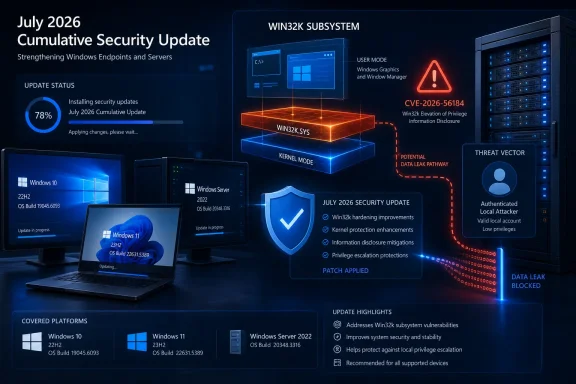
Microsoft’s July 14, 2026 security updates fix CVE-2026-56184, a Win32k information disclosure vulnerability that could allow an authenticated local attacker to read sensitive information from an affected Windows system. Microsoft rates the flaw 5.5 out of 10 under CVSS 3.1—Medium severity—but the practical response is straightforward: deploy the July cumulative update for every supported affected Windows build.
According to Microsoft’s Security Update Guide, the vulnerability is a local issue, not a network-reachable one. The published CVSS vector requires low privileges, has low attack complexity, requires no additional user interaction, and affects confidentiality only. In plain terms, an attacker must first be able to run code or sign in with a standard account on the target PC or server; CVE-2026-56184 is not a standalone route into an organization from the internet.
NIST’s National Vulnerability Database, which has ingested Microsoft’s record but has not yet completed its own enrichment, describes the issue as exposure of sensitive information to an unauthorized actor in Windows Win32k. The weakness is categorized as CWE-200, the broad class for unintended disclosure of sensitive information.
That distinction matters. A 5.5 local disclosure bug should not displace remediation of Microsoft’s remotely exploitable July vulnerabilities, but it should not be waved away either. Win32k is part of the Windows graphics and window-management subsystem, a deeply privileged area that has repeatedly been valuable in post-compromise attack chains. Information disclosure can expose memory contents, addresses, or other data that helps bypass defenses and makes a separate privilege-escalation or code-execution exploit more reliable.
Microsoft lists Windows 10, Windows 11, Windows Server 2022, and Windows Server 2025 among the affected products. The fix is delivered through the normal July 14 cumulative updates rather than as a separate standalone Win32k package.
The relevant patched build thresholds are:
Microsoft’s Windows 11 documentation identifies KB5101650 as the July cumulative update for version 24H2 and version 25H2, while KB5101649 covers Windows 11 26H1. For Windows Server, KB5099540 is the corresponding Windows Server 2022 release and KB5099536 covers Windows Server 2025.
Administrators should verify installed build numbers rather than relying solely on an update’s successful installation status. On a client device,
But local vulnerabilities are often relevant after initial access. A phishing payload, malicious installer, browser exploit, compromised remote-support session, or abused standard user account can all produce the required foothold. At that point, an information disclosure flaw may help an attacker inspect protected data or weaken the uncertainty that exploit mitigations are meant to create.
The CVSS vector also indicates no user interaction is required once the attacker has the necessary local access. That is an important operational nuance. It does not mean a victim can be compromised merely by receiving a file or browsing a website; it means the vulnerability itself does not depend on a separate user action after the attacker reaches the local execution stage.
For security teams, the right prioritization is therefore contextual:
Microsoft has not publicly provided root-cause details for CVE-2026-56184 beyond the information-disclosure classification. There is no responsible basis, at this stage, to claim that it leaks kernel pointers, bypasses a particular mitigation, or can be paired with a known privilege-escalation technique. NIST’s record likewise identifies the impact and affected build ranges but provides no exploit narrative.
That limited disclosure is normal for a newly patched Windows vulnerability. It is also why defenders should avoid turning the absence of a public proof of concept into a reason to defer deployment. Patch Tuesday disclosures often start with sparse technical detail, while reverse engineering and patch comparison work can follow quickly.
Microsoft’s public record currently identifies the vulnerability as vendor-confirmed. It does not, however, describe it as publicly disclosed before the patch release or as exploited in the wild. The available information supports treating CVE-2026-56184 as a patch-management issue, not as evidence of an active Win32k exploitation campaign.
Windows Server 2022 also carries a known issue involving certain BitLocker Group Policy configurations. In the specific scenario documented by Microsoft—BitLocker on the OS drive, a customized TPM platform validation profile including PCR7, Secure Boot/PCR7 conditions, and a device receiving the newer Windows boot manager—the first restart can require BitLocker recovery. Microsoft advises enterprises to audit the relevant policy configuration and suspend and resume protectors if needed before deployment.
Windows 11 24H2 and 25H2 administrators should also review the separate availability concern for a limited set of Dell systems with Intel processors. Microsoft says the update may be withheld from those devices because of a Dell-reported incompatibility that can cause unexpected shutdowns, reduced performance, heat, and battery drain. That safeguard is a reminder to distinguish a device not receiving an update from a compliant device: if the update is on hold, it is not patched for CVE-2026-56184.
For most organizations, this is a conventional cumulative-update deployment: validate on representative hardware and line-of-business software, watch the known-issue guidance, and move the update through the established rings without separating out a single Medium-rated CVE.
The next meaningful development will be whether Microsoft expands its advisory with technical details or whether researchers publish analysis of the patched Win32k changes. Until then, the practical measure is simple: get July’s cumulative update installed, verify the resulting build, and treat the CVE as one more reason not to leave standard-user footholds unpatched.
According to Microsoft’s Security Update Guide, the vulnerability is a local issue, not a network-reachable one. The published CVSS vector requires low privileges, has low attack complexity, requires no additional user interaction, and affects confidentiality only. In plain terms, an attacker must first be able to run code or sign in with a standard account on the target PC or server; CVE-2026-56184 is not a standalone route into an organization from the internet.
NIST’s National Vulnerability Database, which has ingested Microsoft’s record but has not yet completed its own enrichment, describes the issue as exposure of sensitive information to an unauthorized actor in Windows Win32k. The weakness is categorized as CWE-200, the broad class for unintended disclosure of sensitive information.
That distinction matters. A 5.5 local disclosure bug should not displace remediation of Microsoft’s remotely exploitable July vulnerabilities, but it should not be waved away either. Win32k is part of the Windows graphics and window-management subsystem, a deeply privileged area that has repeatedly been valuable in post-compromise attack chains. Information disclosure can expose memory contents, addresses, or other data that helps bypass defenses and makes a separate privilege-escalation or code-execution exploit more reliable.
 The Patch Is in July’s Cumulative Updates
Microsoft lists Windows 10, Windows 11, Windows Server 2022, and Windows Server 2025 among the affected products. The fix is delivered through the normal July 14 cumulative updates rather than as a separate standalone Win32k package.The relevant patched build thresholds are:
| Product | Patched build | July 14 update |
|---|---|---|
| Windows 10 21H2 | 19044.7548 | KB5099539 |
| Windows 10 22H2 | 19045.7548 | KB5099539 |
| Windows 11 24H2 | 26100.8875 | KB5101650 |
| Windows 11 25H2 | 26200.8875 | KB5101650 |
| Windows 11 26H1 | 28000.2525 | KB5101649 |
| Windows Server 2022 | 20348.5386 | KB5099540 |
| Windows Server 2025 | 26100.33158 | KB5099536 |
Administrators should verify installed build numbers rather than relying solely on an update’s successful installation status. On a client device,
winver is the quick check; at scale, Configuration Manager, Intune reporting, Windows Update for Business reports, WSUS compliance data, and endpoint-management inventory should provide the more useful view.Local Does Not Mean Low Priority Everywhere
Microsoft’s scoring is appropriately bounded: CVE-2026-56184 needs a local foothold and cannot directly change data, execute code, or take down a machine. That means it is not an emergency patching event on the same level as an unauthenticated remote code execution flaw in a server-facing service.But local vulnerabilities are often relevant after initial access. A phishing payload, malicious installer, browser exploit, compromised remote-support session, or abused standard user account can all produce the required foothold. At that point, an information disclosure flaw may help an attacker inspect protected data or weaken the uncertainty that exploit mitigations are meant to create.
The CVSS vector also indicates no user interaction is required once the attacker has the necessary local access. That is an important operational nuance. It does not mean a victim can be compromised merely by receiving a file or browsing a website; it means the vulnerability itself does not depend on a separate user action after the attacker reaches the local execution stage.
For security teams, the right prioritization is therefore contextual:
- Systems used for administration, development, security operations, financial workflows, and privileged remote access deserve quicker deployment because local access on those systems can expose material of unusually high value.
- Shared workstations, VDI estates, jump servers, lab machines, and multi-user server environments deserve attention because an ordinary authenticated account may already exist on the system.
- Endpoints exposed to common initial-access routes should be updated promptly, since CVE-2026-56184 can become a useful supporting component in a broader intrusion.
Win32k’s Privileged Position Raises the Stakes
The term Win32k usually refers to the kernel-side infrastructure behind Windows graphical operations, including windowing and graphics-related functions. Its proximity to the operating system kernel is why Win32k bugs command attention even when the individual CVE is not rated Critical.Microsoft has not publicly provided root-cause details for CVE-2026-56184 beyond the information-disclosure classification. There is no responsible basis, at this stage, to claim that it leaks kernel pointers, bypasses a particular mitigation, or can be paired with a known privilege-escalation technique. NIST’s record likewise identifies the impact and affected build ranges but provides no exploit narrative.
That limited disclosure is normal for a newly patched Windows vulnerability. It is also why defenders should avoid turning the absence of a public proof of concept into a reason to defer deployment. Patch Tuesday disclosures often start with sparse technical detail, while reverse engineering and patch comparison work can follow quickly.
Microsoft’s public record currently identifies the vulnerability as vendor-confirmed. It does not, however, describe it as publicly disclosed before the patch release or as exploited in the wild. The available information supports treating CVE-2026-56184 as a patch-management issue, not as evidence of an active Win32k exploitation campaign.
The July Release Carries Its Own Deployment Considerations
The July 14 cumulative updates include broader changes beyond the Win32k fix, and those changes should be part of normal rollout planning. Microsoft’s release notes flag a security hardening change affecting applications that use sockets over unregistered third-party TDI transports; those applications can stop functioning after the update. Registered transports are unaffected.Windows Server 2022 also carries a known issue involving certain BitLocker Group Policy configurations. In the specific scenario documented by Microsoft—BitLocker on the OS drive, a customized TPM platform validation profile including PCR7, Secure Boot/PCR7 conditions, and a device receiving the newer Windows boot manager—the first restart can require BitLocker recovery. Microsoft advises enterprises to audit the relevant policy configuration and suspend and resume protectors if needed before deployment.
Windows 11 24H2 and 25H2 administrators should also review the separate availability concern for a limited set of Dell systems with Intel processors. Microsoft says the update may be withheld from those devices because of a Dell-reported incompatibility that can cause unexpected shutdowns, reduced performance, heat, and battery drain. That safeguard is a reminder to distinguish a device not receiving an update from a compliant device: if the update is on hold, it is not patched for CVE-2026-56184.
For most organizations, this is a conventional cumulative-update deployment: validate on representative hardware and line-of-business software, watch the known-issue guidance, and move the update through the established rings without separating out a single Medium-rated CVE.
The Important Number Is the Build Number
CVE-2026-56184 does not demand panic, but it does close a gap in Windows systems where an already-authorized local attacker could obtain sensitive information. The patch is already in the July 14, 2026 cumulative updates, and the remediation target is unambiguous: Windows 10 at build 19044.7548 or 19045.7548, Windows 11 at the applicable July build, Windows Server 2022 at 20348.5386, and Windows Server 2025 at 26100.33158.The next meaningful development will be whether Microsoft expands its advisory with technical details or whether researchers publish analysis of the patched Win32k changes. Until then, the practical measure is simple: get July’s cumulative update installed, verify the resulting build, and treat the CVE as one more reason not to leave standard-user footholds unpatched.
References
- Primary source: MSRC
Published: 2026-07-14T07:00:00-07:00
Security Update Guide - Microsoft Security Response Center
 msrc.microsoft.com
