

Microsoft’s July 14, 2026 security updates fix CVE-2026-56189, a Windows Media Foundation memory-corruption flaw that can let an attacker execute code after a user interacts with malicious media content. Despite Microsoft’s “Remote Code Execution Vulnerability” product title, the technical record classifies the attack vector as local: this is not a wormable network-service bug or an unauthenticated attack against a listening Windows port.
Microsoft published the advisory at 7:00 a.m. Pacific time on July 14. The National Vulnerability Database’s record, sourced from Microsoft, describes a heap-based buffer overflow in Windows Media Foundation and assigns CVSS 3.1 score 7.8, High, with the vector
That distinction matters for Patch Tuesday triage. CVE-2026-56189 is serious endpoint risk, not an exposed-service emergency. Organizations should deploy the July Windows cumulative updates promptly, especially across user workstations and shared systems that process media from email, chat, browsers, removable drives, file shares, or collaboration platforms. But this is not the same operational priority as a remotely reachable flaw in SMB, RDP, DHCP, HTTP.sys, or a server-side media pipeline.
Microsoft’s vulnerability names can be deceptively compact. “Remote Code Execution” identifies the potential outcome—arbitrary code running in the context of a vulnerable process—not necessarily the attacker’s network position.
For CVE-2026-56189, the local attack-vector rating and required user interaction substantially constrain the initial compromise path. A likely attack scenario would involve a crafted media file delivered through a familiar social-engineering channel: an attachment, a download presented as video or audio, a file in a shared folder, or content placed where a user is persuaded to handle it. The public advisory does not spell out a precise file format, application, or triggering sequence, so administrators should avoid assuming that a particular player or codec is the only concern.
The underlying weakness is cataloged as CWE-122, a heap-based buffer overflow. These flaws occur when software writes beyond the memory allocated for an object in heap memory. In a successful exploit, that corruption can potentially redirect program behavior and hand control to attacker-supplied code. Modern Windows mitigations make reliable exploitation more difficult than merely causing an application crash, but Microsoft’s rating reflects that the possible confidentiality, integrity, and availability impact is high.
The CVSS vector also makes two important points clear. Attack complexity is rated Low, meaning the published assessment does not require an unusually fragile race, a rare configuration, or a complicated multi-stage precondition. At the same time,
For the most common client fleets, the relevant milestones are straightforward:
There is an easy trap here for Windows 10 estates. Windows 10 version 22H2 exited standard support on October 14, 2025. KB5099539 is relevant to systems enrolled in Microsoft’s Extended Security Updates program as well as supported LTSC variants, but an unmanaged, non-ESU Windows 10 22H2 PC should not be assumed to receive the fix merely because Windows Update is enabled. The vulnerability is another concrete reason to inventory those machines and finish their migration or ESU enrollment plan.
Windows 11 version 23H2 does not appear in the currently published affected-product set for this CVE. That is an unusual but welcome narrowing of scope; it should not be interpreted as a reason to defer its ordinary July security update, which addresses other vulnerabilities.
They do not lower the need to patch. Public disclosure on Patch Tuesday gives attackers a confirmed target, patch diffs can accelerate vulnerability research, and media files remain an effective delivery mechanism because they blend into normal user behavior. A vulnerability requiring a click can still be operationally valuable to an attacker who already has a convincing lure, a foothold in a collaboration tenant, or access to an internal file share.
For enterprise patch managers, this should be placed in the normal accelerated monthly deployment ring rather than treated as a reason to interrupt every change-control process. Pilot the July cumulative updates on representative endpoint hardware and applications, then move quickly to broad deployment. Pay special attention to kiosk devices, shared workstations, media-production systems, training-room PCs, and any environment where untrusted audio or video files are routinely handled.
Administrators using WSUS, Microsoft Configuration Manager, Microsoft Intune, or third-party patch platforms should verify successful installation from the device’s installed-update history and build number rather than relying only on an update’s approval state. Offline imaging workflows also deserve a check: the July Windows 11 updates include servicing-stack and Secure Boot-related deployment guidance, so security remediation should not be separated from image-maintenance validation.
Until patched, the useful controls are the familiar ones: filter risky inbound content, preserve attachment and download scanning, limit execution from user-writable locations, and reinforce caution around unexpected shared files and media attachments. Microsoft Defender, SmartScreen, browser download protections, mail security gateways, and application-control policies can reduce the chance that a lure reaches its intended target, but none is a substitute for correcting the vulnerable code.
CVE-2026-56189 is best understood as a high-impact, user-assisted Windows endpoint flaw. The next milestone for most organizations is simple: confirm July 14’s cumulative update is installed across affected Windows Media Foundation systems, then use build compliance—not reassuring CVSS labels alone—to prove the exposure has been removed.
Microsoft published the advisory at 7:00 a.m. Pacific time on July 14. The National Vulnerability Database’s record, sourced from Microsoft, describes a heap-based buffer overflow in Windows Media Foundation and assigns CVSS 3.1 score 7.8, High, with the vector
AV:L/AC:L/PR:N/UI:R/S:U/C:H/I:H/A:H. In plain terms, an attacker needs no account or prior privileges, but needs the victim to open, play, preview, or otherwise process attacker-controlled content through a vulnerable path.That distinction matters for Patch Tuesday triage. CVE-2026-56189 is serious endpoint risk, not an exposed-service emergency. Organizations should deploy the July Windows cumulative updates promptly, especially across user workstations and shared systems that process media from email, chat, browsers, removable drives, file shares, or collaboration platforms. But this is not the same operational priority as a remotely reachable flaw in SMB, RDP, DHCP, HTTP.sys, or a server-side media pipeline.
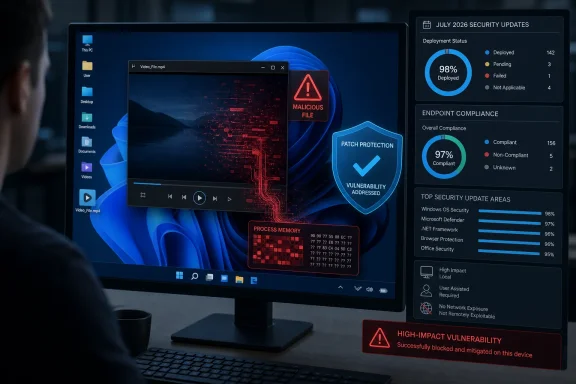 “Remote Code Execution” Describes the Result, Not the Route In
Microsoft’s vulnerability names can be deceptively compact. “Remote Code Execution” identifies the potential outcome—arbitrary code running in the context of a vulnerable process—not necessarily the attacker’s network position.For CVE-2026-56189, the local attack-vector rating and required user interaction substantially constrain the initial compromise path. A likely attack scenario would involve a crafted media file delivered through a familiar social-engineering channel: an attachment, a download presented as video or audio, a file in a shared folder, or content placed where a user is persuaded to handle it. The public advisory does not spell out a precise file format, application, or triggering sequence, so administrators should avoid assuming that a particular player or codec is the only concern.
The underlying weakness is cataloged as CWE-122, a heap-based buffer overflow. These flaws occur when software writes beyond the memory allocated for an object in heap memory. In a successful exploit, that corruption can potentially redirect program behavior and hand control to attacker-supplied code. Modern Windows mitigations make reliable exploitation more difficult than merely causing an application crash, but Microsoft’s rating reflects that the possible confidentiality, integrity, and availability impact is high.
The CVSS vector also makes two important points clear. Attack complexity is rated Low, meaning the published assessment does not require an unusually fragile race, a rare configuration, or a complicated multi-stage precondition. At the same time,
UI:R means user interaction remains a material security boundary. Security teams should therefore treat media-handling workflows and attachment controls as useful compensating layers while patches move through testing and deployment.The July Builds That Close the Gap
Microsoft’s Security Update Guide lists a broad spread of affected Windows releases, including legacy client editions still receiving paid or long-term servicing, current Windows 11 releases, and Windows Server generations. The practical remediation is to install the applicable July 14 cumulative or security update and verify the resulting OS build—not to hunt for a separate Media Foundation package.For the most common client fleets, the relevant milestones are straightforward:
- Windows 11 version 24H2 should reach OS Build 26100.8875 through KB5101650.
- Windows 11 version 25H2 should reach OS Build 26200.8875 through KB5101650.
- Windows 11 version 26H1 should reach OS Build 28000.2525 through KB5101649.
- Windows 10 version 22H2 should reach OS Build 19045.7548 through KB5099539 where the device is eligible for Extended Security Updates.
- Windows 10 Enterprise LTSC 2021 should reach OS Build 19044.7548 through KB5099539.
There is an easy trap here for Windows 10 estates. Windows 10 version 22H2 exited standard support on October 14, 2025. KB5099539 is relevant to systems enrolled in Microsoft’s Extended Security Updates program as well as supported LTSC variants, but an unmanaged, non-ESU Windows 10 22H2 PC should not be assumed to receive the fix merely because Windows Update is enabled. The vulnerability is another concrete reason to inventory those machines and finish their migration or ESU enrollment plan.
Windows 11 version 23H2 does not appear in the currently published affected-product set for this CVE. That is an unusual but welcome narrowing of scope; it should not be interpreted as a reason to defer its ordinary July security update, which addresses other vulnerabilities.
No Known Exploitation Does Not Mean No Action
As of July 15, Microsoft has not indicated that CVE-2026-56189 is publicly disclosed or actively exploited. NIST’s NVD record also carries CISA’s SSVC assessment indicating no known exploitation and that the flaw is not considered automatable. Those details lower the urgency relative to confirmed zero-days, especially on tightly controlled server fleets.They do not lower the need to patch. Public disclosure on Patch Tuesday gives attackers a confirmed target, patch diffs can accelerate vulnerability research, and media files remain an effective delivery mechanism because they blend into normal user behavior. A vulnerability requiring a click can still be operationally valuable to an attacker who already has a convincing lure, a foothold in a collaboration tenant, or access to an internal file share.
For enterprise patch managers, this should be placed in the normal accelerated monthly deployment ring rather than treated as a reason to interrupt every change-control process. Pilot the July cumulative updates on representative endpoint hardware and applications, then move quickly to broad deployment. Pay special attention to kiosk devices, shared workstations, media-production systems, training-room PCs, and any environment where untrusted audio or video files are routinely handled.
Administrators using WSUS, Microsoft Configuration Manager, Microsoft Intune, or third-party patch platforms should verify successful installation from the device’s installed-update history and build number rather than relying only on an update’s approval state. Offline imaging workflows also deserve a check: the July Windows 11 updates include servicing-stack and Secure Boot-related deployment guidance, so security remediation should not be separated from image-maintenance validation.
Media Handling Is the Short-Term Exposure Point
There is no published workaround that replaces the security update. Disabling a random media player, removing a codec pack, or blocking one extension would be speculative and could create a false sense of coverage because Windows Media Foundation is a platform component used by multiple applications and Windows features.Until patched, the useful controls are the familiar ones: filter risky inbound content, preserve attachment and download scanning, limit execution from user-writable locations, and reinforce caution around unexpected shared files and media attachments. Microsoft Defender, SmartScreen, browser download protections, mail security gateways, and application-control policies can reduce the chance that a lure reaches its intended target, but none is a substitute for correcting the vulnerable code.
CVE-2026-56189 is best understood as a high-impact, user-assisted Windows endpoint flaw. The next milestone for most organizations is simple: confirm July 14’s cumulative update is installed across affected Windows Media Foundation systems, then use build compliance—not reassuring CVSS labels alone—to prove the exposure has been removed.
References
- Primary source: MSRC
Published: 2026-07-14T07:00:00-07:00
Security Update Guide - Microsoft Security Response Center
 msrc.microsoft.com
- Official source: support.microsoft.com
July 14, 2026-KB5100998 Cumulative Update for .NET Framework 3.5 and 4.8.1 for Windows 11, version 25H2 and Microsoft server operating system 24H2 | Microsoft Support
July 14, 2026-KB5100998 Cumulative Update for .NET Framework 3.5 and 4.8.1 for Windows 11, version 25H2 and Microsoft server operating system 24H2support.microsoft.com - Official source: learn.microsoft.com
