

Microsoft has published CVE-2026-56642, a high-severity remote code execution vulnerability labeled “Microsoft Fabric Data Warehouse Remote Code Execution Vulnerability.” The July 14 advisory describes a stack-based buffer overflow that an authorized attacker could exploit over a network, potentially gaining code execution with high impact to confidentiality, integrity, and availability.
Microsoft’s Security Response Center is the originating authority for the advisory. The National Vulnerability Database, which ingested Microsoft’s record on July 14, assigns the vendor-provided CVSS 3.1 score of 8.8 High: network reachable, low attack complexity, low privileges required, no user interaction, and complete compromise potential across the three primary impact categories.
For Microsoft Fabric administrators, the key operational message is immediate even though the advisory’s technical detail remains sparse: identify every Fabric Data Warehouse environment, review who can authenticate and execute workloads against it, and watch Microsoft’s Security Update Guide for explicit remediation and service-status guidance.
CVE-2026-56642 is not described as an anonymous, internet-wide compromise. Microsoft’s description says an attacker must be authorized, and the CVSS vector records Privileges Required as Low. That distinction matters, but it should not be mistaken for a low-risk condition.
In a Fabric deployment, “low privilege” can still mean a broad population: workspace contributors, users granted SQL permissions, service principals used by automated pipelines, and identities inherited through over-permissive Microsoft Entra ID groups. A vulnerability that starts from a valid identity is particularly relevant in data platforms, where operational convenience often produces standing access that outlives the project or employee that originally needed it.
The advisory says the flaw is a stack-based buffer overflow, categorized as CWE-121. In plain terms, Microsoft has identified a memory-safety issue where crafted input can overwrite data on a program stack. The published record does not explain the affected component, the triggering request, the necessary permission boundary, or the execution context that successful exploitation would reach. Those omissions mean administrators should avoid filling in the gaps with assumptions.
The practical assessment is therefore narrower than the CVSS number alone: the vulnerability is serious because a valid but comparatively limited account may be enough to turn access to a managed analytics service into code execution. But neither Microsoft nor NVD has published technical evidence that the flaw is being exploited in the wild, nor has either provided proof-of-concept code or a detailed attack path.
Those are not interchangeable products.
Microsoft Fabric Data Warehouse is a managed analytics and warehousing service within Microsoft Fabric, built around T-SQL, OneLake storage, warehouse items, SQL analytics endpoints, workspace roles, and Fabric capacity. Azure Service Fabric, in contrast, is a distributed-systems platform for deploying and running microservices and containerized applications. A Service Fabric runtime version is a plausible patch-management target for a customer-managed cluster; it is not a normal version identifier that a Fabric Data Warehouse tenant administrator would inspect in the Fabric portal.
NVD currently marks the CVE as awaiting enrichment, which may explain the mismatch: its affected-product data could be incomplete, translated incorrectly from source metadata, or awaiting correction. But the discrepancy is consequential enough that security teams should not silently map a Fabric Data Warehouse advisory to every Azure Service Fabric cluster—or declare a Fabric tenant protected simply because an internal Service Fabric deployment runs version 8.0.206.113 or later.
Until Microsoft reconciles the advisory title, affected-product list, and remediation path, treat the CVE as a Fabric Data Warehouse exposure for triage purposes, while keeping the software-version claim in the “unconfirmed” column. This is a case where a vulnerability scanner’s product mapping deserves manual review rather than automatic closure.
That does not remove customer responsibility. A managed-service fix addresses the vulnerable platform component; it does not undo risky identities, excessive workspace membership, exposed service principals, or suspicious activity that may have preceded remediation. Fabric’s own security model places meaningful authority in workspace roles and granular SQL permissions, including the ability to create or alter objects, run queries, administer warehouse functions, and access protected datasets.
Administrators should use this disclosure to review the routes through which an authenticated user or application reaches Warehouse and SQL analytics endpoint resources. The immediate focus should be on identities that are both low-friction and high-value:
This distinction matters when teams assess blast radius. Dynamic data masking, for example, can reduce accidental exposure in application queries, but Microsoft cautions that it is not intended to protect against a malicious user with query access who can make inferences from results. Similarly, row-level security can constrain ordinary access paths without necessarily containing a successful compromise of the service component enforcing those paths.
The correct response is defense in depth: least-privilege permissions to reduce the number of identities that could plausibly satisfy the vulnerability’s “authorized attacker” condition; logging and detection to surface misuse; data protections to constrain exposure; and Microsoft’s eventual service-side remediation to remove the flaw itself.
Technical certainty is lower. The public record currently lacks a vulnerable request format, exploit demonstration, detailed affected-build guidance that cleanly matches the named product, acknowledgment of public exploit code, or a statement of active exploitation. That is not evidence of safety; it is evidence that defenders should prioritize disciplined exposure reduction and monitoring over speculative incident narratives.
For Windows and enterprise IT teams, this is not a Patch Tuesday item to push through WSUS, Intune, or Windows Update. It is a cloud-service security event with an unresolved product-mapping problem. Microsoft’s next update—particularly clarification of whether CVE-2026-56642 affects Fabric Data Warehouse, Azure Service Fabric, or both—will determine whether the action is service validation, runtime patching, or a more urgent investigation of authenticated activity.
Microsoft’s Security Response Center is the originating authority for the advisory. The National Vulnerability Database, which ingested Microsoft’s record on July 14, assigns the vendor-provided CVSS 3.1 score of 8.8 High: network reachable, low attack complexity, low privileges required, no user interaction, and complete compromise potential across the three primary impact categories.
For Microsoft Fabric administrators, the key operational message is immediate even though the advisory’s technical detail remains sparse: identify every Fabric Data Warehouse environment, review who can authenticate and execute workloads against it, and watch Microsoft’s Security Update Guide for explicit remediation and service-status guidance.
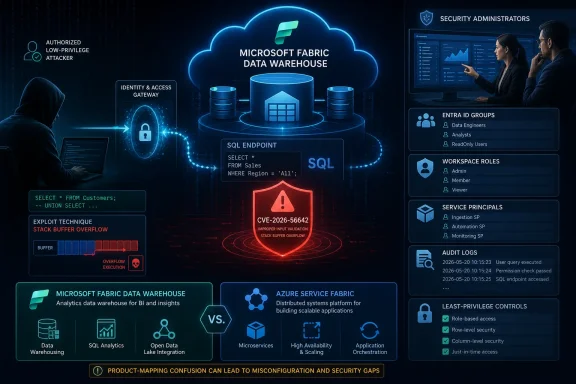 The attacker needs access, but not much else
CVE-2026-56642 is not described as an anonymous, internet-wide compromise. Microsoft’s description says an attacker must be authorized, and the CVSS vector records Privileges Required as Low. That distinction matters, but it should not be mistaken for a low-risk condition.In a Fabric deployment, “low privilege” can still mean a broad population: workspace contributors, users granted SQL permissions, service principals used by automated pipelines, and identities inherited through over-permissive Microsoft Entra ID groups. A vulnerability that starts from a valid identity is particularly relevant in data platforms, where operational convenience often produces standing access that outlives the project or employee that originally needed it.
The advisory says the flaw is a stack-based buffer overflow, categorized as CWE-121. In plain terms, Microsoft has identified a memory-safety issue where crafted input can overwrite data on a program stack. The published record does not explain the affected component, the triggering request, the necessary permission boundary, or the execution context that successful exploitation would reach. Those omissions mean administrators should avoid filling in the gaps with assumptions.
The practical assessment is therefore narrower than the CVSS number alone: the vulnerability is serious because a valid but comparatively limited account may be enough to turn access to a managed analytics service into code execution. But neither Microsoft nor NVD has published technical evidence that the flaw is being exploited in the wild, nor has either provided proof-of-concept code or a detailed attack path.
A product-version mismatch needs Microsoft to clarify it
There is an important inconsistency in the public record. Microsoft’s advisory title and vulnerability description name Microsoft Fabric Data Warehouse. Yet the affected-software data currently displayed by NVD identifies “Service Fabric” and lists versions earlier than 8.0.206.113 as affected.Those are not interchangeable products.
Microsoft Fabric Data Warehouse is a managed analytics and warehousing service within Microsoft Fabric, built around T-SQL, OneLake storage, warehouse items, SQL analytics endpoints, workspace roles, and Fabric capacity. Azure Service Fabric, in contrast, is a distributed-systems platform for deploying and running microservices and containerized applications. A Service Fabric runtime version is a plausible patch-management target for a customer-managed cluster; it is not a normal version identifier that a Fabric Data Warehouse tenant administrator would inspect in the Fabric portal.
NVD currently marks the CVE as awaiting enrichment, which may explain the mismatch: its affected-product data could be incomplete, translated incorrectly from source metadata, or awaiting correction. But the discrepancy is consequential enough that security teams should not silently map a Fabric Data Warehouse advisory to every Azure Service Fabric cluster—or declare a Fabric tenant protected simply because an internal Service Fabric deployment runs version 8.0.206.113 or later.
Until Microsoft reconciles the advisory title, affected-product list, and remediation path, treat the CVE as a Fabric Data Warehouse exposure for triage purposes, while keeping the software-version claim in the “unconfirmed” column. This is a case where a vulnerability scanner’s product mapping deserves manual review rather than automatic closure.
Managed service does not mean hands-off security
The fact that Fabric Data Warehouse is managed by Microsoft changes the response model. There may be no Windows update, KB package, MSI installer, or self-managed server binary for a tenant to deploy. If the vulnerable component is entirely service-side, Microsoft may be able to remediate it without a customer maintenance window.That does not remove customer responsibility. A managed-service fix addresses the vulnerable platform component; it does not undo risky identities, excessive workspace membership, exposed service principals, or suspicious activity that may have preceded remediation. Fabric’s own security model places meaningful authority in workspace roles and granular SQL permissions, including the ability to create or alter objects, run queries, administer warehouse functions, and access protected datasets.
Administrators should use this disclosure to review the routes through which an authenticated user or application reaches Warehouse and SQL analytics endpoint resources. The immediate focus should be on identities that are both low-friction and high-value:
- Review workspace Admin, Member, and Contributor assignments, especially groups with nested or broad Entra ID membership.
- Audit service principals, managed identities, and automation accounts that connect to Fabric through pipelines, deployment tooling, or T-SQL endpoints.
- Reduce database and warehouse permissions to the minimum required, with particular scrutiny of
CONTROLand other elevated permissions. - Confirm that audit logging is enabled and retained for workspace changes, SQL activity, identity changes, and unusual data-access patterns.
- Rotate or revoke credentials for dormant automation identities rather than merely documenting their ownership.
Do not confuse data controls with a code-execution boundary
Fabric Data Warehouse supports row-level security, column-level security, dynamic data masking, auditing, encryption, and customer-managed keys. Those are valuable controls for limiting who can see particular data and for protecting stored information. They are not substitutes for patching a code-execution flaw in the underlying service.This distinction matters when teams assess blast radius. Dynamic data masking, for example, can reduce accidental exposure in application queries, but Microsoft cautions that it is not intended to protect against a malicious user with query access who can make inferences from results. Similarly, row-level security can constrain ordinary access paths without necessarily containing a successful compromise of the service component enforcing those paths.
The correct response is defense in depth: least-privilege permissions to reduce the number of identities that could plausibly satisfy the vulnerability’s “authorized attacker” condition; logging and detection to surface misuse; data protections to constrain exposure; and Microsoft’s eventual service-side remediation to remove the flaw itself.
Confidence is high in the disclosure, lower in the mechanics
The wording supplied with the advisory’s exploitability material is essentially a warning against overreading early vulnerability metadata. The existence of the vulnerability is credible: Microsoft is the CVE’s assigning and reporting authority, and NVD has published Microsoft’s description, CVSS vector, and CWE classification.Technical certainty is lower. The public record currently lacks a vulnerable request format, exploit demonstration, detailed affected-build guidance that cleanly matches the named product, acknowledgment of public exploit code, or a statement of active exploitation. That is not evidence of safety; it is evidence that defenders should prioritize disciplined exposure reduction and monitoring over speculative incident narratives.
For Windows and enterprise IT teams, this is not a Patch Tuesday item to push through WSUS, Intune, or Windows Update. It is a cloud-service security event with an unresolved product-mapping problem. Microsoft’s next update—particularly clarification of whether CVE-2026-56642 affects Fabric Data Warehouse, Azure Service Fabric, or both—will determine whether the action is service validation, runtime patching, or a more urgent investigation of authenticated activity.
References
- Primary source: MSRC
Published: 2026-07-14T07:00:00-07:00
- Official source: microsoft.com
- Official source: learn.microsoft.com
Vulnerabilities in my organization - Microsoft Defender Vulnerability Management | Microsoft Learn
Lists the common vulnerabilities and exposures (CVE) ID of weaknesses found in the software running in your organization. Discovered by the Microsoft Defender vulnerability management capabilities.learn.microsoft.com
