

Microsoft’s July 14, 2026 security updates fix CVE-2026-57088, an elevation-of-privilege flaw in the Extensible Storage Engine (ESENT) that affects Windows Server 2019, Windows Server 2022, and Windows Server 2025, along with Windows 10 version 1809. The practical response is straightforward: deploy the latest cumulative update and verify that affected machines have reached their patched build numbers.
Microsoft describes the issue as improper access control in ESENT. An authorized attacker with local access could exploit the flaw to elevate privileges, potentially moving from a limited account to much broader control of the compromised system. The vulnerability carries a CVSS 3.1 score of 7.8, rated High.
The National Vulnerability Database record, sourced from Microsoft’s disclosure, lists the issue as local, low-complexity, requiring low privileges, and requiring no user interaction. That matters in post-compromise scenarios: this is not an internet-facing remote-code-execution bug, but it could be valuable to an attacker who has already obtained a foothold through malware, a malicious insider account, stolen credentials, or another locally executed exploit chain.
The fixed build thresholds published with CVE-2026-57088 are unusually useful for administrators because they make compliance validation concrete. Systems below these revisions remain affected:
Microsoft Support documents identify all three packages as July 14 cumulative security updates. They are available through Windows Update, Windows Update for Business, Microsoft Update Catalog, and Windows Server Update Services, subject to the normal product and classification settings.
For managed estates, the build number is the better validation point than merely confirming a KB approval. A superseding cumulative update will also resolve the issue, provided it advances the OS beyond the listed fixed revision. That distinction is important for rings that deferred the July release but have since installed a later cumulative update.
Windows Server 2019 and Windows 10 Enterprise LTSC 2019 deserve particular attention. Their shared 17763 servicing branch remains widely deployed in infrastructure roles where legacy applications and slow refresh cycles are common, precisely the environments where local privilege escalation can become a serious lateral-movement problem.
That architecture helps explain why a defect in ESENT should not be treated as a niche database-administration problem. The engine is intended for applications that need lightweight structured storage without running a separate database service. A local privilege boundary error in a broadly available Windows component can therefore be relevant even where administrators have never intentionally deployed an “ESENT application.”
Microsoft has not published technical exploit details, a proof of concept, or a mitigation other than installing the security update. The available public description should not be stretched into a claim that attackers can simply feed a malformed database file to any Windows machine, nor does it establish that specific Microsoft applications are exposed in a particular configuration. Those are unanswered implementation questions.
In this case, vendor acknowledgement and a released fix make the existence of CVE-2026-57088 confirmed in the everyday operational sense. Microsoft assigned the CVE, supplied the affected-product ranges, and shipped patches on July 14. But the NVD has not yet completed its own enrichment or issued a separate CVSS 4.0 assessment.
CISA’s Stakeholder-Specific Vulnerability Categorization entry currently marks exploitation as “none” and automation as “no,” while assessing the potential technical impact as total. Those are useful triage signals, but they are not a guarantee that exploitation will remain absent. Local escalation vulnerabilities can become more valuable after patch release, when researchers and adversaries can compare vulnerable and fixed code.
The cautious interpretation is that this is confirmed and patched, but not publicly known to be exploited as of the July 14 disclosure. That makes it a high-priority hygiene item rather than an incident-driven emergency by itself.
Server teams should prioritize systems with any of the following characteristics:
Those details do not change the need to remediate CVE-2026-57088, but they reinforce the case for normal deployment discipline: test representative workloads, confirm BitLocker recovery procedures, stage changes in rings, and verify the installed OS revision after reboot. Server 2025 administrators using offline media should also follow Microsoft’s package-order guidance for KB5099536 rather than assuming a single MSU workflow applies everywhere.
For security teams, the immediate milestone is simple: bring Windows Server 2019 to build 17763.9020, Windows Server 2022 to 20348.5386, and Windows Server 2025 to 26100.33158 or later. Until more technical detail emerges, that build-level confirmation is the most reliable answer to CVE-2026-57088.
Microsoft describes the issue as improper access control in ESENT. An authorized attacker with local access could exploit the flaw to elevate privileges, potentially moving from a limited account to much broader control of the compromised system. The vulnerability carries a CVSS 3.1 score of 7.8, rated High.
The National Vulnerability Database record, sourced from Microsoft’s disclosure, lists the issue as local, low-complexity, requiring low privileges, and requiring no user interaction. That matters in post-compromise scenarios: this is not an internet-facing remote-code-execution bug, but it could be valuable to an attacker who has already obtained a foothold through malware, a malicious insider account, stolen credentials, or another locally executed exploit chain.
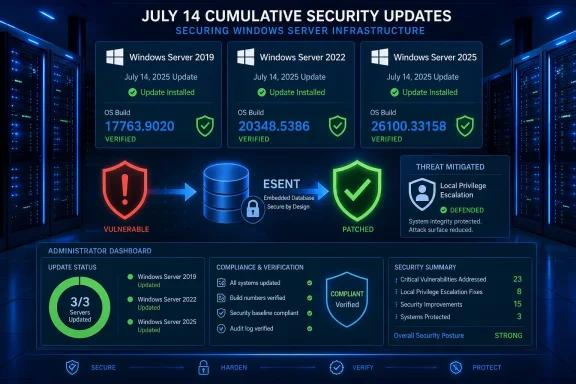 The Patch Is in July’s Cumulative Updates
The fixed build thresholds published with CVE-2026-57088 are unusually useful for administrators because they make compliance validation concrete. Systems below these revisions remain affected:| Product | Patched build | July 14 update |
|---|---|---|
| Windows 10 version 1809 / Windows Server 2019 | 17763.9020 | KB5099538 |
| Windows Server 2022 | 20348.5386 | KB5099540 |
| Windows Server 2025 | 26100.33158 | KB5099536 |
For managed estates, the build number is the better validation point than merely confirming a KB approval. A superseding cumulative update will also resolve the issue, provided it advances the OS beyond the listed fixed revision. That distinction is important for rings that deferred the July release but have since installed a later cumulative update.
Windows Server 2019 and Windows 10 Enterprise LTSC 2019 deserve particular attention. Their shared 17763 servicing branch remains widely deployed in infrastructure roles where legacy applications and slow refresh cycles are common, precisely the environments where local privilege escalation can become a serious lateral-movement problem.
ESENT Is a Windows Building Block, Not a Standalone Database Server
ESENT, also known as ESE or historically “JET Blue,” is a Windows component that provides an embedded transactional database engine. Microsoft’s developer documentation describes it as a user-mode storage technology accessed through a DLL loaded inside an application’s process, with indexed storage, transaction logging, crash recovery, and ACID properties.That architecture helps explain why a defect in ESENT should not be treated as a niche database-administration problem. The engine is intended for applications that need lightweight structured storage without running a separate database service. A local privilege boundary error in a broadly available Windows component can therefore be relevant even where administrators have never intentionally deployed an “ESENT application.”
Microsoft has not published technical exploit details, a proof of concept, or a mitigation other than installing the security update. The available public description should not be stretched into a claim that attackers can simply feed a malformed database file to any Windows machine, nor does it establish that specific Microsoft applications are exposed in a particular configuration. Those are unanswered implementation questions.
“Report Confidence” Is Not an Exploitation Rating
The explanatory text often attached to this CVE refers to Report Confidence, a temporal CVSS metric measuring confidence that a vulnerability exists and that the technical report is credible. It is not a measure of whether malware groups are exploiting the flaw, and it is not the same as an exploitability score.In this case, vendor acknowledgement and a released fix make the existence of CVE-2026-57088 confirmed in the everyday operational sense. Microsoft assigned the CVE, supplied the affected-product ranges, and shipped patches on July 14. But the NVD has not yet completed its own enrichment or issued a separate CVSS 4.0 assessment.
CISA’s Stakeholder-Specific Vulnerability Categorization entry currently marks exploitation as “none” and automation as “no,” while assessing the potential technical impact as total. Those are useful triage signals, but they are not a guarantee that exploitation will remain absent. Local escalation vulnerabilities can become more valuable after patch release, when researchers and adversaries can compare vulnerable and fixed code.
The cautious interpretation is that this is confirmed and patched, but not publicly known to be exploited as of the July 14 disclosure. That makes it a high-priority hygiene item rather than an incident-driven emergency by itself.
Patch Faster Where a Low-Privilege Foothold Is Plausible
The CVSS vector provides the key prioritization clues. Attackers need local access and some existing privileges, but the attack complexity is low and no user action is required. The result is an issue that rises in importance on systems exposed to untrusted users, third-party software, development tools, remote desktop access, or workloads where service accounts and interactive administrators coexist.Server teams should prioritize systems with any of the following characteristics:
- Windows Server hosts that accept interactive RDP access from broad administrative or support groups should be patched promptly.
- Shared servers, jump hosts, VDI infrastructure, and developer build systems deserve accelerated deployment because a low-privilege account may be easier to obtain there.
- Servers running applications under constrained service identities should be evaluated for whether an escalation to SYSTEM or administrative context could enable credential theft, persistence, or movement to other systems.
- Windows 10 version 1809 estates should verify whether they are using Enterprise LTSC 2019 and confirm that their servicing process has delivered build 17763.9020 or later.
July’s Servicing Notes Add Deployment Checks
The July cumulative updates contain other changes that may matter during rollout. Microsoft notes a security hardening change around third-party TDI transport registration that can affect applications using sockets over unregistered third-party TDI transports. The Server 2022 update also carries a known issue in which a limited set of machines with an unrecommended BitLocker Group Policy configuration may request a recovery key on first restart.Those details do not change the need to remediate CVE-2026-57088, but they reinforce the case for normal deployment discipline: test representative workloads, confirm BitLocker recovery procedures, stage changes in rings, and verify the installed OS revision after reboot. Server 2025 administrators using offline media should also follow Microsoft’s package-order guidance for KB5099536 rather than assuming a single MSU workflow applies everywhere.
For security teams, the immediate milestone is simple: bring Windows Server 2019 to build 17763.9020, Windows Server 2022 to 20348.5386, and Windows Server 2025 to 26100.33158 or later. Until more technical detail emerges, that build-level confirmation is the most reliable answer to CVE-2026-57088.
References
- Primary source: MSRC
Published: 2026-07-14T07:00:00-07:00
Security Update Guide - Microsoft Security Response Center
 msrc.microsoft.com
- Official source: learn.microsoft.com
Extensible Storage Engine - Win32 apps | Microsoft Learn
Learn more about: Extensible Storage Enginelearn.microsoft.com
