

Microsoft has listed CVE-2026-57100 as an elevation-of-privilege vulnerability in the Microsoft Entra Provisioning Service, with the public advisory pointing administrators to MSRC’s Security Update Guide rather than a traditional Windows patch package or detailed exploit narrative. That sparseness is the story. In cloud identity, the absence of a downloadable fix does not mean the absence of operational risk. It means defenders have to treat Microsoft’s service-side remediation, tenant telemetry, and identity hygiene as the new patch surface.
CVE-2026-57100 lands in an uncomfortable category for enterprise defenders: a vulnerability in the machinery that creates, synchronizes, and maintains identities. The affected product name is not Windows, Exchange, SQL Server, or another familiar patch-management target. It is Microsoft Entra Provisioning Service, a cloud identity component that many organizations experience indirectly through user lifecycle automation.
That matters because provisioning is not merely an administrative convenience. It is where employees become accounts, accounts become group memberships, applications receive entitlements, and offboarding either happens cleanly or leaves behind dangerous residue. An elevation-of-privilege flaw in that layer does not need to look like classic code execution to be serious.
The advisory language also puts defenders in the world of measured uncertainty. The user-facing MSRC page identifies the vulnerability class and product, but the public technical detail appears limited. That is typical of sensitive identity-service bugs, where exploit mechanics can be more dangerous than helpful if published before global remediation and monitoring have caught up.
This is where CVSS’s Report Confidence concept becomes more than scoring trivia. A vendor-acknowledged CVE carries a different operational weight than a rumor, a proof-of-concept blog post, or a scanner finding derived from inference. Microsoft’s acknowledgement tells defenders the vulnerability is real, even if the public explanation stops short of showing where the trapdoor was.
That hierarchy is outdated. Provisioning is where authorization becomes operational reality. A bad grant, a stale connector, or a mis-scoped synchronization rule can quietly move a user into the wrong application role long before anyone attempts a suspicious login.
Microsoft Entra Provisioning Service sits in precisely that sensitive lane. It automates identity lifecycle tasks across Microsoft and third-party applications, including creating users, updating attributes, assigning access, and disabling accounts. If an attacker can influence that process through an elevation-of-privilege path, the blast radius may be measured not in servers compromised but in identities reshaped.
The important distinction is that privilege in Entra is not only a role name like Global Administrator. Privilege can be the ability to alter a service principal, change a group that drives app access, manipulate a synchronization flow, or modify an attribute that another system trusts. Modern identity systems are dense with these indirect trust paths.
That is why a provisioning-service CVE deserves attention even when the advisory lacks a cinematic exploit chain. Attackers do not need drama. They need a place where one authority is trusted by another authority, preferably at machine speed and with limited human review.
Cloud identity vulnerabilities disrupt that ritual. There may be no MSI to deploy, no cumulative update to stage, and no server reboot to schedule. Microsoft can fix the service centrally, leaving customers with a different problem: determining whether their tenants were exposed, whether compensating controls mattered, and whether suspicious provisioning activity occurred before the fix.
This is not a complaint about cloud services. Centralized remediation is often faster and safer than hoping every customer patches correctly. But it changes the defender’s burden from “install this update” to “understand your dependency on a platform you do not fully operate.”
The result is a strange asymmetry. Microsoft may be able to remediate the vulnerable code path quickly, while customers still need days or weeks to audit downstream effects. A service-side fix closes the door. It does not automatically tell you whether anyone walked through it.
For WindowsForum readers who live in hybrid environments, that point is especially important. Entra is not separate from Windows administration anymore. It is the identity fabric behind Intune enrollment, Microsoft 365 access, Azure resources, line-of-business SaaS, device compliance decisions, and increasingly AI agent and automation workflows.
That framing is useful because defenders often misread sparse advisories in opposite ways. Some dismiss them because there is no public exploit code. Others panic because Microsoft used a severe-sounding category like elevation of privilege. Neither reaction is disciplined.
A vendor-published CVE generally means the existence of the vulnerability is no longer speculative. Microsoft has seen enough to assign, publish, and track the issue. The uncertainty is not whether administrators should care; it is how they should prioritize investigation without full exploit mechanics.
The second half of the metric is just as important. Limited public detail may reduce opportunistic copycat exploitation, but it also reduces defender visibility. If you do not know the vulnerable code path, you cannot write a precise detection rule from first principles. You have to fall back on behavioral monitoring, audit logs, least privilege, and anomaly detection.
That is the awkward bargain in modern vulnerability disclosure. Less detail can protect customers from immediate weaponization, but it can also leave customers dependent on the vendor’s assessment. In identity infrastructure, where logs are often noisy and retention windows vary wildly, that dependency is not trivial.
In Entra, elevation of privilege can be more abstract and more consequential. The boundary might be between a provisioning connector and an application role, between an app registration and a service principal, between a synced group and a privileged cloud function, or between a workflow identity and the directory objects it can mutate.
This makes Entra vulnerabilities difficult to explain and easy to underestimate. A flaw may not hand an attacker a shell. It may instead let them alter the conditions under which access is granted. In many environments, that is better than a shell because it can look like normal administration.
The lesson from prior Entra research is that Microsoft’s identity ecosystem contains powerful internal service principals, legacy APIs, cross-tenant assumptions, and application permissions that can interact in surprising ways. Not every finding becomes a catastrophic tenant-wide compromise, but the pattern is clear: identity bugs often hide in the seams between services.
CVE-2026-57100 should be read through that lens. The specific exploit path is not public in the advisory material, but the product area tells us where defenders should look: provisioning configuration, connector permissions, application assignments, privileged group membership changes, and unexpected lifecycle events.
A tenant that limits provisioning connectors to narrow application roles, keeps privileged groups out of automated assignment paths, and reviews service principals regularly has a different exposure profile than a tenant where old integrations have accumulated broad directory permissions. The vulnerability may be the same. The reachable blast radius is not.
This is why identity hygiene is not a compliance slogan. It is vulnerability mitigation before the CVE exists. When a provisioning service flaw appears, the most important question becomes what that service was allowed to touch.
Many organizations will discover that the answer is broader than expected. Provisioning projects are often implemented under deadline pressure. Administrators grant wide permissions to make an integration work, leave temporary exceptions in place, and move on when user creation finally succeeds. Years later, those permissions become part of the attack surface.
The danger is compounded by mergers, SaaS sprawl, and hybrid identity. Every additional application that trusts Entra attributes or group membership turns provisioning into a control plane. Every helpdesk workflow that can trigger access changes becomes part of the same story.
At the same time, enterprise review cycles have not kept pace. Many organizations still audit identities quarterly, review app permissions annually, and investigate service principals only when a security tool complains. That cadence is badly matched to an identity platform that changes continuously.
Provisioning is especially vulnerable to this mismatch. A new SaaS application can be onboarded in an afternoon. A SCIM connector can begin modifying accounts almost immediately. The security review of what that connector can do may be shallow, delayed, or absent.
CVE-2026-57100 is therefore not just a point vulnerability. It is a reminder that Microsoft’s identity platform is now a living administrative substrate. The old habit of treating cloud identity configuration as static documentation is no longer defensible.
The practical response is not to slow every business request to a crawl. It is to build review into the workflow: permission justification, owner assignment, logging verification, expiration dates for elevated connector rights, and automated detection for unusual provisioning changes.
The uncomfortable reality is that many tenants do not retain the right logs for long enough. By the time a cloud identity advisory becomes visible to security teams, the most relevant evidence may already be gone. This is particularly painful for provisioning issues, where suspicious activity may look like ordinary lifecycle automation unless preserved and correlated.
Administrators should not wait for exploit code to start asking operational questions. Were there unexpected changes to provisioning configurations? Did any application suddenly receive new users, altered attributes, or expanded group assignments? Were privileged groups modified through service accounts or connectors rather than normal admin paths?
Those questions are tedious, but they are the difference between “Microsoft patched it” and “we know our tenant is clean.” In identity security, assurance is not created by the vendor’s fix alone. It is created by tracing the effects inside your own environment.
This is also where Microsoft’s cloud-first model can be both a help and a hindrance. Entra produces rich telemetry, but customers must license, retain, route, and analyze it. The logs exist in theory. Whether they exist for your incident-response window is a budget and architecture decision made months earlier.
Provisioning is attractive because it is trusted by design. It is supposed to create accounts. It is supposed to update attributes. It is supposed to add users to applications. A malicious change that rides through that machinery may not look malicious until someone examines why the machinery made the change.
This is the same logic that has made OAuth consent abuse, service principal abuse, and application permission sprawl so persistent. Attackers prefer durable access that blends into administrative reality. A compromised user session is useful; a manipulated identity workflow is strategic.
The most dangerous identity attacks are not always the loudest. They may create an account that looks legitimate, add a credential to an application, widen an entitlement, or alter a group that downstream systems treat as authoritative. Each individual event can be explained away. The chain is the attack.
That is why an Entra Provisioning Service elevation-of-privilege advisory deserves a more mature response than “watch for exploitation in the wild.” By the time exploitation is obvious, the attacker may already have converted a transient flaw into persistent access.
A user provisioned into the wrong group may receive access to Intune-managed device policies. A mis-scoped application role may expose SharePoint data. A manipulated service principal may touch Azure resources. A stale account may still authenticate to a Windows-adjacent management tool.
This is the operational reality of Microsoft’s ecosystem in 2026. Windows is no longer bounded by the machine in front of the user. The Windows estate is managed, authenticated, licensed, secured, and monitored through cloud identity decisions.
That means Entra advisories should appear in the same risk conversations as Windows cumulative updates and Defender alerts. They may not require the same deployment mechanics, but they affect the same enterprise. A tenant-level identity issue can be more damaging than a single endpoint vulnerability because the trust relationships are upstream.
For smaller organizations, this is a governance challenge. The same person may be the Windows admin, Microsoft 365 admin, and security admin. For larger organizations, it is a coordination challenge. The people who understand provisioning may not be the people who own incident response.
The old identity model assumed that most accounts mapped to people. The new model includes service principals, managed identities, automation accounts, bots, agents, and application identities that may act continuously. Provisioning and deprovisioning those identities safely is harder than handling a normal employee lifecycle.
An elevation-of-privilege flaw in provisioning infrastructure therefore points toward a larger strategic problem. The number of identities is growing. The percentage of identities that are non-human is growing. The number of systems that trust attributes, groups, and claims is growing.
That growth makes least privilege more important but also harder to verify. It is easy to say a connector should have only the permissions it needs. It is harder to know what it needs when business processes, SaaS applications, and automation flows keep changing.
CVE-2026-57100 may be a single advisory, but it belongs to this broader shift. Identity is becoming programmable infrastructure. Programmable infrastructure needs software-engineering discipline, not just admin goodwill.
The most responsible reading is that Microsoft has identified and addressed, or is addressing, a privilege boundary issue in a service many customers rely on without thinking about daily. Customers should use the advisory as a forcing function to inspect the trust they have delegated to provisioning automation. The fix may live in Microsoft’s cloud, but the consequences — good or bad — live in each tenant’s design.
The future of Windows administration is not less identity-centric; it is more so. As Entra becomes the control plane for users, devices, applications, agents, and workloads, vulnerabilities like CVE-2026-57100 will feel less like side notes in the Security Update Guide and more like previews of the next decade of enterprise risk.
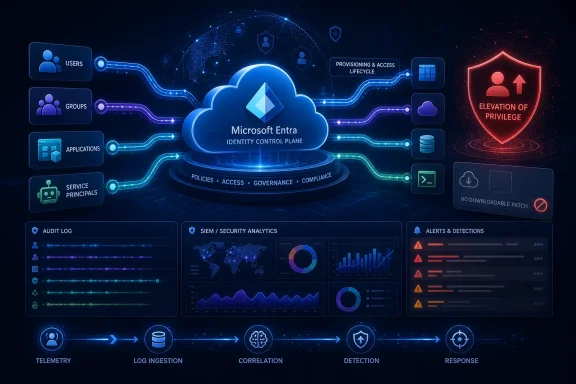 Microsoft’s Quiet Entra Advisory Says More Than It First Appears To
CVE-2026-57100 lands in an uncomfortable category for enterprise defenders: a vulnerability in the machinery that creates, synchronizes, and maintains identities. The affected product name is not Windows, Exchange, SQL Server, or another familiar patch-management target. It is Microsoft Entra Provisioning Service, a cloud identity component that many organizations experience indirectly through user lifecycle automation.That matters because provisioning is not merely an administrative convenience. It is where employees become accounts, accounts become group memberships, applications receive entitlements, and offboarding either happens cleanly or leaves behind dangerous residue. An elevation-of-privilege flaw in that layer does not need to look like classic code execution to be serious.
The advisory language also puts defenders in the world of measured uncertainty. The user-facing MSRC page identifies the vulnerability class and product, but the public technical detail appears limited. That is typical of sensitive identity-service bugs, where exploit mechanics can be more dangerous than helpful if published before global remediation and monitoring have caught up.
This is where CVSS’s Report Confidence concept becomes more than scoring trivia. A vendor-acknowledged CVE carries a different operational weight than a rumor, a proof-of-concept blog post, or a scanner finding derived from inference. Microsoft’s acknowledgement tells defenders the vulnerability is real, even if the public explanation stops short of showing where the trapdoor was.
The Provisioning Layer Is Now Part of the Privilege Boundary
For years, many IT teams treated identity provisioning as plumbing. HR systems, directory sync engines, SCIM connectors, enterprise applications, and cloud directories were wired together, tested once, and then left to hum beneath the organization. Security attention went to authentication prompts, conditional access rules, MFA enrollment, and privileged role assignment.That hierarchy is outdated. Provisioning is where authorization becomes operational reality. A bad grant, a stale connector, or a mis-scoped synchronization rule can quietly move a user into the wrong application role long before anyone attempts a suspicious login.
Microsoft Entra Provisioning Service sits in precisely that sensitive lane. It automates identity lifecycle tasks across Microsoft and third-party applications, including creating users, updating attributes, assigning access, and disabling accounts. If an attacker can influence that process through an elevation-of-privilege path, the blast radius may be measured not in servers compromised but in identities reshaped.
The important distinction is that privilege in Entra is not only a role name like Global Administrator. Privilege can be the ability to alter a service principal, change a group that drives app access, manipulate a synchronization flow, or modify an attribute that another system trusts. Modern identity systems are dense with these indirect trust paths.
That is why a provisioning-service CVE deserves attention even when the advisory lacks a cinematic exploit chain. Attackers do not need drama. They need a place where one authority is trusted by another authority, preferably at machine speed and with limited human review.
Cloud Patching Has Broken the Old Admin Ritual
The classic Windows security response had a comforting rhythm. Patch Tuesday arrived, admins reviewed KB numbers, pilots installed updates, reboots were negotiated, and dashboards turned from red to green. The work was messy, but the artifact was tangible.Cloud identity vulnerabilities disrupt that ritual. There may be no MSI to deploy, no cumulative update to stage, and no server reboot to schedule. Microsoft can fix the service centrally, leaving customers with a different problem: determining whether their tenants were exposed, whether compensating controls mattered, and whether suspicious provisioning activity occurred before the fix.
This is not a complaint about cloud services. Centralized remediation is often faster and safer than hoping every customer patches correctly. But it changes the defender’s burden from “install this update” to “understand your dependency on a platform you do not fully operate.”
The result is a strange asymmetry. Microsoft may be able to remediate the vulnerable code path quickly, while customers still need days or weeks to audit downstream effects. A service-side fix closes the door. It does not automatically tell you whether anyone walked through it.
For WindowsForum readers who live in hybrid environments, that point is especially important. Entra is not separate from Windows administration anymore. It is the identity fabric behind Intune enrollment, Microsoft 365 access, Azure resources, line-of-business SaaS, device compliance decisions, and increasingly AI agent and automation workflows.
Report Confidence Is a Warning Label, Not an Academic Metric
The text supplied with this CVE describes a CVSS metric that measures confidence in a vulnerability’s existence and the credibility of known technical details. In plain English, it asks: how sure are we that this thing is real, and how much does the world know about how it works?That framing is useful because defenders often misread sparse advisories in opposite ways. Some dismiss them because there is no public exploit code. Others panic because Microsoft used a severe-sounding category like elevation of privilege. Neither reaction is disciplined.
A vendor-published CVE generally means the existence of the vulnerability is no longer speculative. Microsoft has seen enough to assign, publish, and track the issue. The uncertainty is not whether administrators should care; it is how they should prioritize investigation without full exploit mechanics.
The second half of the metric is just as important. Limited public detail may reduce opportunistic copycat exploitation, but it also reduces defender visibility. If you do not know the vulnerable code path, you cannot write a precise detection rule from first principles. You have to fall back on behavioral monitoring, audit logs, least privilege, and anomaly detection.
That is the awkward bargain in modern vulnerability disclosure. Less detail can protect customers from immediate weaponization, but it can also leave customers dependent on the vendor’s assessment. In identity infrastructure, where logs are often noisy and retention windows vary wildly, that dependency is not trivial.
Elevation of Privilege Is Different When the Target Is Identity
On a Windows endpoint, elevation of privilege often means a local user becomes SYSTEM or escapes a sandbox. That is serious, but the mental model is familiar. There is a machine, a user, a boundary, and a higher-privileged context.In Entra, elevation of privilege can be more abstract and more consequential. The boundary might be between a provisioning connector and an application role, between an app registration and a service principal, between a synced group and a privileged cloud function, or between a workflow identity and the directory objects it can mutate.
This makes Entra vulnerabilities difficult to explain and easy to underestimate. A flaw may not hand an attacker a shell. It may instead let them alter the conditions under which access is granted. In many environments, that is better than a shell because it can look like normal administration.
The lesson from prior Entra research is that Microsoft’s identity ecosystem contains powerful internal service principals, legacy APIs, cross-tenant assumptions, and application permissions that can interact in surprising ways. Not every finding becomes a catastrophic tenant-wide compromise, but the pattern is clear: identity bugs often hide in the seams between services.
CVE-2026-57100 should be read through that lens. The specific exploit path is not public in the advisory material, but the product area tells us where defenders should look: provisioning configuration, connector permissions, application assignments, privileged group membership changes, and unexpected lifecycle events.
The Risk Is Not Just Microsoft’s Code; It Is Your Tenant’s Shape
A cloud service vulnerability has a baseline severity, but customer impact is rarely uniform. Two tenants can use the same Entra feature and face very different levels of risk depending on connector scope, privilege design, logging retention, and administrative discipline.A tenant that limits provisioning connectors to narrow application roles, keeps privileged groups out of automated assignment paths, and reviews service principals regularly has a different exposure profile than a tenant where old integrations have accumulated broad directory permissions. The vulnerability may be the same. The reachable blast radius is not.
This is why identity hygiene is not a compliance slogan. It is vulnerability mitigation before the CVE exists. When a provisioning service flaw appears, the most important question becomes what that service was allowed to touch.
Many organizations will discover that the answer is broader than expected. Provisioning projects are often implemented under deadline pressure. Administrators grant wide permissions to make an integration work, leave temporary exceptions in place, and move on when user creation finally succeeds. Years later, those permissions become part of the attack surface.
The danger is compounded by mergers, SaaS sprawl, and hybrid identity. Every additional application that trusts Entra attributes or group membership turns provisioning into a control plane. Every helpdesk workflow that can trigger access changes becomes part of the same story.
Microsoft’s Security Model Is Moving Faster Than Enterprise Review Cycles
Microsoft has spent the past several years moving customers toward Entra-centric administration. Azure AD became Microsoft Entra ID, identity governance expanded, Conditional Access matured, workload identity controls improved, and Microsoft 365 increasingly assumed that cloud identity is the front door.At the same time, enterprise review cycles have not kept pace. Many organizations still audit identities quarterly, review app permissions annually, and investigate service principals only when a security tool complains. That cadence is badly matched to an identity platform that changes continuously.
Provisioning is especially vulnerable to this mismatch. A new SaaS application can be onboarded in an afternoon. A SCIM connector can begin modifying accounts almost immediately. The security review of what that connector can do may be shallow, delayed, or absent.
CVE-2026-57100 is therefore not just a point vulnerability. It is a reminder that Microsoft’s identity platform is now a living administrative substrate. The old habit of treating cloud identity configuration as static documentation is no longer defensible.
The practical response is not to slow every business request to a crawl. It is to build review into the workflow: permission justification, owner assignment, logging verification, expiration dates for elevated connector rights, and automated detection for unusual provisioning changes.
The Logs Are the Patch After the Patch
When Microsoft fixes a service-side vulnerability, customers still need evidence. That evidence lives in Entra audit logs, provisioning logs, sign-in logs, application audit trails, and whatever data has been exported into SIEM or long-term storage.The uncomfortable reality is that many tenants do not retain the right logs for long enough. By the time a cloud identity advisory becomes visible to security teams, the most relevant evidence may already be gone. This is particularly painful for provisioning issues, where suspicious activity may look like ordinary lifecycle automation unless preserved and correlated.
Administrators should not wait for exploit code to start asking operational questions. Were there unexpected changes to provisioning configurations? Did any application suddenly receive new users, altered attributes, or expanded group assignments? Were privileged groups modified through service accounts or connectors rather than normal admin paths?
Those questions are tedious, but they are the difference between “Microsoft patched it” and “we know our tenant is clean.” In identity security, assurance is not created by the vendor’s fix alone. It is created by tracing the effects inside your own environment.
This is also where Microsoft’s cloud-first model can be both a help and a hindrance. Entra produces rich telemetry, but customers must license, retain, route, and analyze it. The logs exist in theory. Whether they exist for your incident-response window is a budget and architecture decision made months earlier.
Attackers Love the Boring Middle of the Identity Stack
Security teams tend to focus on obvious choke points: login prompts, MFA fatigue, administrator accounts, risky sign-ins, and endpoint malware. Attackers focus on whatever works. Increasingly, that means the boring middle of identity operations.Provisioning is attractive because it is trusted by design. It is supposed to create accounts. It is supposed to update attributes. It is supposed to add users to applications. A malicious change that rides through that machinery may not look malicious until someone examines why the machinery made the change.
This is the same logic that has made OAuth consent abuse, service principal abuse, and application permission sprawl so persistent. Attackers prefer durable access that blends into administrative reality. A compromised user session is useful; a manipulated identity workflow is strategic.
The most dangerous identity attacks are not always the loudest. They may create an account that looks legitimate, add a credential to an application, widen an entitlement, or alter a group that downstream systems treat as authoritative. Each individual event can be explained away. The chain is the attack.
That is why an Entra Provisioning Service elevation-of-privilege advisory deserves a more mature response than “watch for exploitation in the wild.” By the time exploitation is obvious, the attacker may already have converted a transient flaw into persistent access.
Windows Administrators Cannot Delegate This Entirely to Cloud Teams
On paper, CVE-2026-57100 belongs to the cloud identity team. In practice, Windows administrators, endpoint managers, Microsoft 365 admins, Azure operators, and security engineers all have dependencies on Entra provisioning decisions.A user provisioned into the wrong group may receive access to Intune-managed device policies. A mis-scoped application role may expose SharePoint data. A manipulated service principal may touch Azure resources. A stale account may still authenticate to a Windows-adjacent management tool.
This is the operational reality of Microsoft’s ecosystem in 2026. Windows is no longer bounded by the machine in front of the user. The Windows estate is managed, authenticated, licensed, secured, and monitored through cloud identity decisions.
That means Entra advisories should appear in the same risk conversations as Windows cumulative updates and Defender alerts. They may not require the same deployment mechanics, but they affect the same enterprise. A tenant-level identity issue can be more damaging than a single endpoint vulnerability because the trust relationships are upstream.
For smaller organizations, this is a governance challenge. The same person may be the Windows admin, Microsoft 365 admin, and security admin. For larger organizations, it is a coordination challenge. The people who understand provisioning may not be the people who own incident response.
The AI Agent Era Raises the Stakes for Provisioning Bugs
Microsoft has been threading identity through automation, copilots, agents, and workload identities. That direction is not unique to Microsoft, but Microsoft’s enterprise footprint makes it especially consequential. If more non-human actors receive identities, permissions, and lifecycle workflows, provisioning becomes even more central.The old identity model assumed that most accounts mapped to people. The new model includes service principals, managed identities, automation accounts, bots, agents, and application identities that may act continuously. Provisioning and deprovisioning those identities safely is harder than handling a normal employee lifecycle.
An elevation-of-privilege flaw in provisioning infrastructure therefore points toward a larger strategic problem. The number of identities is growing. The percentage of identities that are non-human is growing. The number of systems that trust attributes, groups, and claims is growing.
That growth makes least privilege more important but also harder to verify. It is easy to say a connector should have only the permissions it needs. It is harder to know what it needs when business processes, SaaS applications, and automation flows keep changing.
CVE-2026-57100 may be a single advisory, but it belongs to this broader shift. Identity is becoming programmable infrastructure. Programmable infrastructure needs software-engineering discipline, not just admin goodwill.
The Entra Provisioning Warning Should Change This Week’s Admin Checklist
The right response to CVE-2026-57100 is not theatrical panic. It is a focused identity-control review prompted by a vendor-confirmed vulnerability in a sensitive service. Microsoft’s service-side posture matters, but tenant-side assurance still belongs to customers.- Organizations should verify whether they use Microsoft Entra provisioning for Microsoft or third-party applications and identify which connectors have broad directory or application permissions.
- Administrators should review recent provisioning logs and Entra audit activity for unexpected user creation, attribute changes, group membership updates, or application assignment changes.
- Security teams should check whether provisioning-related logs are retained long enough for meaningful investigation and exported to the systems used during incidents.
- Tenant owners should review service principals, app registrations, credentials, and owners associated with provisioning workflows, especially older integrations that may have escaped recent scrutiny.
- Privileged groups and administrative roles should not be populated through loosely governed provisioning rules unless the business case is explicit and monitored.
- Incident-response plans should treat cloud identity advisories as first-class security events even when there is no local Windows patch to deploy.
Sparse Disclosure Is Not the Same as Low Risk
The public record around CVE-2026-57100 appears deliberately restrained: product, vulnerability class, and vendor acknowledgement, without a detailed exploit recipe. That restraint should not be mistaken for reassurance. In identity infrastructure, the gap between “few details are public” and “nothing important happened” is large enough to drive an incident through.The most responsible reading is that Microsoft has identified and addressed, or is addressing, a privilege boundary issue in a service many customers rely on without thinking about daily. Customers should use the advisory as a forcing function to inspect the trust they have delegated to provisioning automation. The fix may live in Microsoft’s cloud, but the consequences — good or bad — live in each tenant’s design.
The future of Windows administration is not less identity-centric; it is more so. As Entra becomes the control plane for users, devices, applications, agents, and workloads, vulnerabilities like CVE-2026-57100 will feel less like side notes in the Security Update Guide and more like previews of the next decade of enterprise risk.
References
- Primary source: MSRC
Published: 2026-07-02T07:00:00-07:00
Security Update Guide - Microsoft Security Response Center
 msrc.microsoft.com
- Related coverage: aha.org
- Related coverage: techradar.com
This serious Microsoft Entra flaw could have let hackers infiltrate any user, so patch now | TechRadar
Researchers found a potent combination of critical flaws and legacy serviceswww.techradar.com - Related coverage: thehackerwire.com
- Related coverage: vulnerability.circl.lu
Vulnerability-Lookup
Vulnerability-Lookup - Fast vulnerability lookup correlation from different sources.vulnerability.circl.lu - Related coverage: threats.kaspersky.com
Kaspersky Threats — KLA91067
threats.kaspersky.com
- Related coverage: itpro.com
A terrifying Microsoft flaw could’ve allowed hackers to compromise ‘every Entra ID tenant in the world’ | IT Pro
The Entra ID vulnerability could have allowed full access to virtually all Azure customer accountswww.itpro.com - Related coverage: semperis.com
- Related coverage: stackoverflow.com
security - Microsoft CVRF API - Stack Overflow
It has come to my attention that, starting from February 9, 2021,
Microsoft Security Response Center has removed registrations requirements to their CVRF API.
That could be a nice way tostackoverflow.com
- Related coverage: datacomm.com
- Official source: learn.microsoft.com
api microsoft errors - Microsoft Q&A
Hello, Could you please check this issue? From yesterday I tried for many times to reach these URLs but I received 503 and 404 Errors. • https://api.msrc.microsoft.com/ • https://api.msrc.microsoft.com/Updates There is any changement in…learn.microsoft.com - Related coverage: bleepingcomputer.com
- Related coverage: rapid7.com
Rapid7 Vulnerability Database
Rapid7's VulnDB is curated repository of vetted computer software exploits and exploitable vulnerabilities.www.rapid7.com - Related coverage: deepwiki.com
microsoft/MSRC-Microsoft-Security-Updates-API | DeepWiki
The MsrcSecurityUpdates PowerShell module provides programmatic access to Microsoft Security Response Center (MSRC) vulnerability data through the Microsoft Security Updates API. This module enables sdeepwiki.com - Related coverage: sentinelone.com
CVE-2026-26118: Azure MCP Server SSRF Vulnerability
CVE-2026-26118 is a server-side request forgery vulnerability in Azure MCP Server. Learn about its impact, affected versions, and mitigation methods.www.sentinelone.com
- Related coverage: sra.io
