

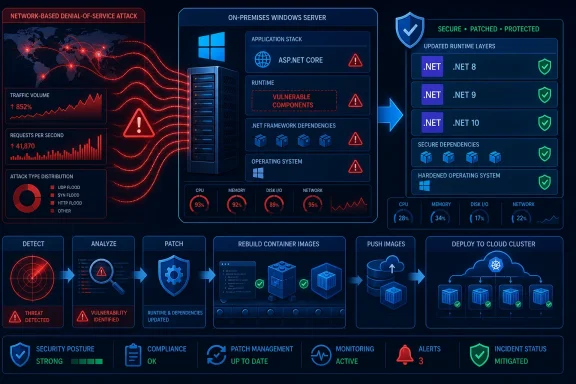
Microsoft’s Security Response Center rates the flaw as Important with a CVSS 3.1 base score of 7.5. The advisory describes a type confusion weakness—accessing a resource with an incompatible type—in .NET Core. The National Vulnerability Database’s record says the defect can be exploited remotely to deny service, with no confidentiality or integrity impact identified.
Microsoft published the advisory on July 14, 2026, as part of its monthly servicing release. The .NET team’s July servicing post lists CVE-2026-57108 among the vulnerabilities addressed across .NET 8.0, .NET 9.0, and .NET 10.0.
The risk is availability, not a foothold
This is not an elevation-of-privilege or remote-code-execution bug. The stated effect is availability: a specially crafted network request may cause an exposed .NET service to crash, hang, or otherwise become unable to serve legitimate traffic. That distinction matters, but it should not translate into complacency for organizations operating public-facing ASP.NET Core services, APIs, webhook receivers, or internal line-of-business applications with broad network exposure.
Microsoft’s CVSS vector assigns Network attack vector, Low attack complexity, No privileges required, and No user interaction. In plain operational terms, the attacker does not need an account on the target application and does not need to persuade a user to open a file or click a link. A reachable endpoint is the meaningful precondition.
The vulnerability is also scored with no expected loss of data confidentiality or integrity. That reduces its usefulness as an intrusion primitive compared with a code-execution flaw, but service disruption can be costly on its own. An outage against authentication, payments, order processing, field operations, or a customer-facing portal can be sufficient to create an incident.
CISA’s supplemental vulnerability status information currently marks exploitation as “none,” while characterizing exploitation as automatable and the technical impact as partial. That is useful context rather than a reason to defer patching: no known in-the-wild exploitation is not the same as a difficult-to-weaponize flaw, particularly when the published scoring says a network attacker needs no credentials.
Patch levels to verify in production
The affected ranges recorded by Microsoft cover .NET 8.0 versions before 8.0.29, .NET 9.0 versions before 9.0.18, and .NET 10.0 versions before 10.0.6. Microsoft’s July 2026 servicing announcement distributes .NET 8.0.29, .NET 9.0.18, and .NET 10.0.10; those current releases include the CVE-2026-57108 fix.
The apparent difference between the .NET 10 fixed baseline and the July release number is not a contradiction. The advisory’s affected range indicates that 10.0.6 or later is no longer vulnerable, while the July servicing channel has moved forward to 10.0.10. For standardization and the benefit of all July fixes, organizations should deploy the current servicing release rather than hunt for the minimum non-vulnerable version.
Administrators should treat the remediation path according to how the application is deployed:
- Framework-dependent Windows applications need the corrected shared runtime installed on every host that runs the application.
- Self-contained .NET applications must be rebuilt or republished with an updated SDK/runtime payload, because installing a newer shared runtime on the server does not replace the runtime bundled beside the executable.
- Windows and Linux container workloads need fresh base images, rebuilt application images, registry publication, and redeployment to the cluster or hosting platform.
- Azure App Service and other managed hosts still warrant version and deployment-slot verification, especially where applications pin a runtime or ship self-contained artifacts.
On a Windows server, dotnet --info is a quick starting point for determining the installed runtimes and SDKs. It is not, however, a full inventory of risk. A build agent can have a current SDK while a production VM remains on an older shared runtime; similarly, a container image may preserve an old runtime even after its host operating system and development workstation are updated.
Why containers and self-contained apps are the trap
The biggest remediation mistake with a .NET servicing CVE is assuming that Windows Update or a runtime installer protects every application automatically. It protects framework-dependent workloads that actually use the shared runtime it updates. It does not retroactively alter immutable container layers, deployment packages, or self-contained executables.
That distinction is especially important for organizations that build once and deploy broadly. A vulnerable .NET runtime may be embedded in an application artifact distributed to Windows Server IIS farms, Azure Kubernetes Service, on-premises Kubernetes clusters, developer test environments, and edge devices. Each image tag and release package needs to be traced back to its runtime version.
For container teams, the proper response is not merely to restart pods. Rebuild from an updated Microsoft .NET runtime or ASP.NET Core runtime base image, verify the image digest in the registry, deploy it through the normal release process, and confirm old replicas have drained. Restarting instances built from the same vulnerable image only returns the vulnerable code to service.
Teams using self-contained publishing should similarly review CI pipelines. The job that creates the final artifact must acquire an updated SDK or runtime pack before publishing; updating a machine after the artifact has already been produced will not correct the binaries already sitting in a release share or package repository.
Exposure determines the order of work
Microsoft has not publicly detailed a request pattern, affected API, or temporary mitigation for CVE-2026-57108. That lack of technical disclosure limits defensive tuning: there is no documented signature to hand to a web application firewall and no supported configuration switch that substitutes for the update.
Until patch deployment is complete, organizations should prioritize systems according to reachable attack surface. Internet-facing ASP.NET Core endpoints belong first in line, followed by partner-accessible services and internal applications accessible across large, less-trusted network segments. Services limited to localhost or tightly controlled management networks carry less immediate exposure, though they should remain in the normal patch queue.
Rate limiting, request-size controls, upstream reverse proxies, health probes, and sufficient instance capacity can reduce the blast radius of many denial-of-service events. They are resilience measures, not CVE-specific fixes. Because the underlying flaw is in the runtime and Microsoft has not published exploitation mechanics, it would be unwise to claim that any one gateway rule neutralizes the vulnerability.
Administrators should also watch operational telemetry after rollout. Unexpected process exits, application-pool recycles, Kubernetes restarts, elevated 5xx responses, and sudden memory or CPU anomalies may indicate either an attempted disruption or an unrelated application regression. The update’s goal is to remove the vulnerable condition; monitoring remains necessary to distinguish a security event from ordinary service instability.
A small advisory with a large deployment surface
CVE-2026-57108 is a reminder that a runtime vulnerability has a different footprint from a Windows-only patch. The affected component can sit inside IIS-hosted applications, Windows services, desktop-connected backend systems, container images, cloud deployments, and self-contained releases, often managed by different teams with different patch processes.
The immediate checkpoint is clear: production workloads should be on .NET 8.0.29, .NET 9.0.18, or the current .NET 10 servicing release, with any embedded runtime artifacts rebuilt and redeployed. Microsoft has confirmed the fix; the remaining work is making sure every running application is actually using it.
References
- CVE-2026-57108 .NET Denial of Service Vulnerability MSRC · 2026-07-14T07:00:00-07:00