

Microsoft has identified CVE-2026-58281 as a remote code execution vulnerability in Chromium-based Microsoft Edge, but the available advisory material does not disclose the affected versions, attack path, severity, exploitation status, technical root cause, release date, or the update that resolves it. That makes the identifier important without making every alarming interpretation justified. The right response is to verify browser servicing immediately while resisting the temptation to turn a sparse record into a fully formed exploit narrative. What Microsoft has not yet said is as operationally important as what it has.
The official title, “Microsoft Edge (Chromium-based) Remote Code Execution Vulnerability,” establishes two load-bearing facts. The issue concerns Microsoft’s Chromium-based browser, and Microsoft classifies its potential impact as remote code execution.
That is meaningful because code execution sits above lesser browser failures such as a crash, information disclosure, or a user-interface flaw. Successful exploitation could reportedly allow attacker-controlled instructions to run within the context reached by the vulnerable component, depending on conditions that are not present in the supplied material.
Those conditions matter enormously. A browser vulnerability might require a victim to visit malicious content, open a specially constructed file, interact with a prompt, install something, or encounter compromised content through an otherwise legitimate site. It might execute code only inside a restricted renderer, or it might affect a more privileged browser process. It might be reliable enough for mass exploitation, or practical only under narrow laboratory conditions.
The advisory excerpt does not answer any of those questions. It does not identify an attack vector, required privileges, user-interaction requirement, attack complexity, scope change, affected browser channel, operating system, or vulnerable component.
It also does not state whether exploitation has been detected in the wild. Nothing in the supplied material establishes the existence of public proof-of-concept code, weaponized exploit tooling, targeted attacks, or inclusion in a broader exploit chain.
This distinction is not semantic hair-splitting. “Remote code execution” describes the security impact that may follow successful exploitation; it does not, by itself, describe how easy exploitation is, what privileges the code receives, or whether a working attack exists outside the vendor’s testing environment.
Vendors commonly limit vulnerability detail when disclosure could make exploit development easier. Browser flaws are particularly sensitive because attackers can compare vulnerable and corrected code, study changed behavior, and work backward from a patch. A technically rich advisory can become an acceleration kit if a large share of the installed base has not updated.
There is, however, another possibility: the underlying public record may simply be incomplete. The supplied source contains the vulnerability title and a generic explanation of a report-confidence metric, but it does not include the selected confidence value or the other fields needed to reconstruct Microsoft’s full assessment.
That means the absence of detail cannot be used to infer either danger or safety. It does not prove Microsoft is withholding a critical exploit primitive, but neither does it prove the vulnerability is difficult to exploit.
For administrators, unknown must remain unknown until Microsoft publishes the relevant field or the organization obtains it from an authoritative management feed. Filling gaps with assumptions can produce two equally damaging outcomes: panic-driven emergency changes without evidence, or a delayed update because nobody has yet seen a dramatic technical write-up.
The correct operational reading is narrower. CVE-2026-58281 exists in Microsoft’s security ecosystem, concerns Chromium-based Edge, and carries a remote-code-execution impact label. Everything beyond that must be attributed, verified, or explicitly described as unconfirmed.
That definition is useful because it separates confidence in the report from severity of the vulnerability. A highly damaging theory can carry weak confidence, while a modest flaw can be completely confirmed. Report confidence does not tell an administrator how much damage an exploit would cause.
It also does not measure exploitation activity. A vulnerability can be confirmed without being exploited in the wild, and an attack can reportedly be observed before the public receives a detailed root-cause analysis. Confidence, exploit maturity, impact, and remediation status are different dimensions.
Most importantly, the provided excerpt defines the metric but does not show which value Microsoft assigned to CVE-2026-58281. The generic explanation ends by noting that higher certainty increases urgency and that available technical knowledge may also help would-be attackers, but it does not establish whether this specific record is unconfirmed, corroborated, or confirmed.
Readers should not infer a value merely because the definition appears on the page. Microsoft’s Security Update Guide uses reusable explanatory language for assessment fields; the presence of that language is not itself the vulnerability’s rating.
That is an especially important discipline for automated summaries. A scraper, search engine, or AI-generated report may capture the descriptive text while missing the selected field presented elsewhere in a dynamic page. The result can look complete while omitting the one word that gives the paragraph its actual meaning.
CVE-2026-58281 is therefore also a lesson in source handling. Security teams should preserve the difference between a field’s definition and its assigned value, and between a page title and a full advisory record.
Some Edge vulnerabilities originate in shared Chromium code and reach Microsoft users through the same broad code lineage used by other Chromium browsers. Other vulnerabilities can be specific to Edge features, Microsoft integrations, browser services, or the way Microsoft builds and exposes a shared component.
The title alone does not establish which category applies to CVE-2026-58281. It does not identify the affected subsystem or say whether another Chromium vendor assigned, disclosed, or corrected the underlying defect first.
That prevents several common but unsupported claims. It would be premature to say that every Chromium browser is affected. It would be equally premature to say the flaw is unique to Edge. Both conclusions require component and affected-product information that the supplied record does not contain.
The practical consequence is that administrators cannot substitute another vendor’s browser bulletin for Microsoft’s Edge guidance. Even when browsers share upstream code, each vendor packages fixes on its own servicing path, may apply additional patches, and may expose different product-specific functionality.
Microsoft’s Edge security release documentation shows the general pattern: Edge updates can incorporate Chromium security corrections, while Microsoft also identifies fixes specific to Edge. That dual structure is why security teams need to track the browser as a product rather than treating “Chromium” as a single universally synchronized installation.
It is also why checking only Windows operating-system patch compliance is insufficient. Edge has its own updater and management controls, and enterprises can alter how browser updates are discovered, approved, delayed, or deployed.
A Windows endpoint can therefore look current in one dashboard while running a browser build that has not completed its own servicing cycle. The reverse can also occur: Edge may update independently even when an operating-system maintenance window has not yet arrived.
Chromium uses a multiprocess design, sandboxing, and Site Isolation as layers intended to restrict what compromised web content can reach. Chromium’s own security documentation explicitly treats renderer compromise as part of the browser threat model, rather than assuming all renderer vulnerabilities can be prevented.
This architecture changes how an RCE label should be interpreted. If code execution occurs in a sandboxed renderer, an attacker may need a second vulnerability to escape that sandbox or reach higher-privilege resources. If the vulnerable code runs in a more privileged process, the consequences may be broader.
CVE-2026-58281’s available title does not identify the process boundary involved. It therefore cannot support a claim that exploitation immediately grants system-level control, nor can it support reassurance that the sandbox contains the entire risk.
Even a contained renderer compromise may still matter. Depending on the bug and surrounding defenses, malicious code inside a browser process could become part of a chain, target information available to that process, manipulate page behavior, or provide the first stage for a separate privilege-boundary exploit.
Conversely, architecture is not a substitute for patching. Sandboxing and Site Isolation are damage-limitation systems, not warranties that a known code-execution defect is harmless. Chromium’s security model is explicitly defense in depth: each layer exists because another layer may fail.
That produces a useful framing for IT decision-makers. The browser’s mitigations should reduce confidence in catastrophic speculation, but they should not reduce the priority of getting a supported security correction deployed once Microsoft identifies it.
The source also does not list channels. Microsoft supports multiple Edge release tracks for different testing and deployment needs, and organizations may have more than one track in use across production, pilots, application-validation labs, and developer systems.
No channel should be declared affected or unaffected on the basis of the vulnerability title alone. The same caution applies to supported operating systems and device types, because the supplied material contains no platform matrix.
Administrators should therefore avoid creating a guessed compliance rule such as “anything below version X is vulnerable.” There is no grounded value for X in the fact table. An invented threshold would produce false positives, false negatives, or both.
Instead, exposure work should begin with inventory. Organizations need to know which endpoints have Edge installed, which channel each device follows, which update policies apply, whether Edge Update is functioning, and when the browser last completed an update check.
That inventory remains useful even before a corrected version is known. It identifies systems likely to miss an urgent browser release because their updater is disabled, their proxy blocks servicing traffic, their management assignment is stale, or their deployment ring has been left paused.
Once Microsoft publishes or exposes a specific correction, the same inventory can be converted into a precise compliance query. Until then, it is an audit of update readiness rather than proof of CVE remediation.
Microsoft’s official Edge update-policy documentation allows administrators to control whether updates are always permitted, applied only through automatic checks, restricted to manual installation, or disabled. Those controls are legitimate management tools, but every exception creates a place where a security correction can stall.
The most dangerous configuration is not necessarily an explicit “updates disabled” policy. It may be a historical policy that nobody remembers, a device that has fallen out of management, a gold image with stale settings, or a deployment workflow that assumes Edge is serviced by the same mechanism as Windows.
Security incidents repeatedly exploit this difference between intended state and effective state. A policy console may say automatic updates are enabled while the endpoint cannot reach the update service. A deployment may report success even though the user has not restarted the browser process needed to activate corrected code.
Long-running sessions complicate verification. Browsers can remain open across sleep cycles, remote sessions, and user switching, preserving older processes after update files have arrived. The organization must distinguish between an update being downloaded, installed on disk, and active in the running browser.
The same servicing discipline should extend to Edge-powered components embedded in applications. Microsoft manages WebView2 Runtime updating through related Edge Update controls, but the fact table does not identify WebView2 as affected by CVE-2026-58281. It should not be added to the affected-product list without Microsoft saying so.
Still, reviewing related updater policy is sensible because it exposes whether the organization’s browser-servicing design has fragmented. The objective is not to declare every Chromium-derived component vulnerable; it is to ensure that each component can receive its own vendor-supplied correction when required.
The answer is not to abandon testing. It is to adjust the depth and duration of testing to the combination of impact, exploit evidence, exposure, asset criticality, and confidence in rollback.
Because the source does not disclose exploitation status or a corrected release, CVE-2026-58281 alone cannot justify a claim that every organization must bypass all controls. It does justify ensuring that Edge security updates are not being intentionally or accidentally suppressed while the advisory record is being completed.
A well-run environment can do both jobs at once. Security staff can monitor Microsoft’s Security Update Guide and Edge security release notes while endpoint teams test the current vendor release against authentication flows, line-of-business sites, extensions, kiosk configurations, printing, downloads, and browser-based management tools.
The critical mistake is serial processing: waiting for a perfect technical explanation before even checking whether the update mechanism works. By the time exploit write-ups become detailed, defenders may have lost the advantage created by limited disclosure.
Browser patching also has a different risk profile from major operating-system upgrades. Edge receives frequent releases, and application compatibility programs should already be designed around that cadence. An organization that requires a lengthy bespoke project for every browser security release has a servicing architecture problem larger than this CVE.
Security operations teams should not invent them. Generic searches for every Edge crash or every unusual script engine event will create noise without demonstrating exploitation of CVE-2026-58281.
The more defensible approach is to hunt for consequences that would matter regardless of the exact browser bug. That includes anomalous processes launched from browser context, unexpected executable or script creation, suspicious persistence following browser activity, credential access, security-control tampering, and unusual outbound connections associated with a browser session.
Those detections cannot be labeled as CVE-2026-58281-specific. They are post-exploitation and behavioral controls that might detect a successful browser compromise, another browser vulnerability, malicious downloads, extension abuse, or ordinary malware execution.
Administrators should also preserve useful telemetry. Browser crash data, endpoint detection events, process trees, downloaded-file metadata, web-proxy records, and update logs may become more valuable if Microsoft or a research team later publishes a component name or exploitation pattern.
This is another place where precise language matters. “No detections” means the organization’s existing controls did not identify covered behavior. It does not mean the vulnerability was not exploitable, no attempt occurred, or every device was protected.
CVE-2026-58281 shows the weakness of that pipeline. Its title supports a strong, concise statement about product and impact, while the supplied body supports an explanation of how Microsoft thinks about report confidence. It does not support the detailed exploitation stories that readers naturally expect after seeing the phrase “remote code execution.”
This is where good security journalism and good incident management converge. Both should distinguish verified facts from interpretation, explain why the missing fields matter, and avoid treating technical possibility as observed compromise.
A severity number, if later supplied, will help prioritization but will not eliminate judgment. Scores compress assumptions about exploitability and impact into a standardized format; they do not know whether an organization exposes sensitive browser sessions, delays updates, runs strong endpoint controls, or has users operating with excessive local privileges.
Likewise, a statement that exploitation has not been observed would not mean exploitation is impossible. It would describe what the vendor knows or is prepared to state at that point in time.
The practical measure remains exposure duration. An organization that updates quickly, restarts browser processes, verifies compliance, and watches for abnormal behavior is better positioned than one that spends hours debating whether the missing details make the vulnerability more or less frightening.
It also gives each part of the organization a clear job. Endpoint teams verify servicing. Application owners prepare rapid compatibility checks. Security operations monitor browser-originated behavior. Vulnerability management waits for authoritative version mapping instead of publishing a guessed rule. Leadership receives an impact statement without being told that an unverified attack campaign is underway.
The browser has become one of the most exposed execution environments on a Windows device, but its security model is built around layered defenses, frequent servicing, and the expectation that individual components will sometimes fail. CVE-2026-58281 should be handled in that same spirit: neither minimized because details are scarce nor sensationalized because its title says remote code execution. The decisive next information will be Microsoft’s affected-version, remediation, severity, and exploitation guidance; until that arrives, the best defense is a browser estate that is inventoried, update-ready, observable, and capable of moving faster than the exploit ecosystem once the missing details become public.
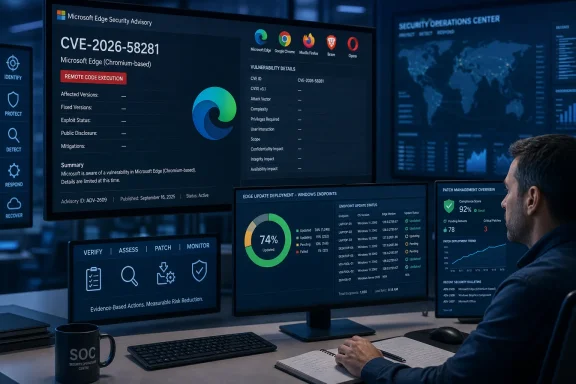 The Headline Establishes Impact, Not an Attack Story
The official title, “Microsoft Edge (Chromium-based) Remote Code Execution Vulnerability,” establishes two load-bearing facts. The issue concerns Microsoft’s Chromium-based browser, and Microsoft classifies its potential impact as remote code execution.That is meaningful because code execution sits above lesser browser failures such as a crash, information disclosure, or a user-interface flaw. Successful exploitation could reportedly allow attacker-controlled instructions to run within the context reached by the vulnerable component, depending on conditions that are not present in the supplied material.
Those conditions matter enormously. A browser vulnerability might require a victim to visit malicious content, open a specially constructed file, interact with a prompt, install something, or encounter compromised content through an otherwise legitimate site. It might execute code only inside a restricted renderer, or it might affect a more privileged browser process. It might be reliable enough for mass exploitation, or practical only under narrow laboratory conditions.
The advisory excerpt does not answer any of those questions. It does not identify an attack vector, required privileges, user-interaction requirement, attack complexity, scope change, affected browser channel, operating system, or vulnerable component.
It also does not state whether exploitation has been detected in the wild. Nothing in the supplied material establishes the existence of public proof-of-concept code, weaponized exploit tooling, targeted attacks, or inclusion in a broader exploit chain.
This distinction is not semantic hair-splitting. “Remote code execution” describes the security impact that may follow successful exploitation; it does not, by itself, describe how easy exploitation is, what privileges the code receives, or whether a working attack exists outside the vendor’s testing environment.
A Sparse Advisory Is Not a Low-Risk Advisory
Security teams sometimes read a short vendor entry as evidence that an issue is routine. In browser security, brevity can mean almost the opposite: defenders have received the identifier and impact category before the technical story is safe or ready to publish.Vendors commonly limit vulnerability detail when disclosure could make exploit development easier. Browser flaws are particularly sensitive because attackers can compare vulnerable and corrected code, study changed behavior, and work backward from a patch. A technically rich advisory can become an acceleration kit if a large share of the installed base has not updated.
There is, however, another possibility: the underlying public record may simply be incomplete. The supplied source contains the vulnerability title and a generic explanation of a report-confidence metric, but it does not include the selected confidence value or the other fields needed to reconstruct Microsoft’s full assessment.
That means the absence of detail cannot be used to infer either danger or safety. It does not prove Microsoft is withholding a critical exploit primitive, but neither does it prove the vulnerability is difficult to exploit.
For administrators, unknown must remain unknown until Microsoft publishes the relevant field or the organization obtains it from an authoritative management feed. Filling gaps with assumptions can produce two equally damaging outcomes: panic-driven emergency changes without evidence, or a delayed update because nobody has yet seen a dramatic technical write-up.
The correct operational reading is narrower. CVE-2026-58281 exists in Microsoft’s security ecosystem, concerns Chromium-based Edge, and carries a remote-code-execution impact label. Everything beyond that must be attributed, verified, or explicitly described as unconfirmed.
Microsoft’s Confidence Explanation Is Easy to Misread
The source material devotes its available explanatory text to report confidence: the degree of certainty that a vulnerability exists and the credibility of the known technical details. Microsoft explains that vulnerabilities can begin as suspected undesirable behavior, later gain corroborating research, and finally become confirmed through vendor acknowledgement or reproducible technical evidence.That definition is useful because it separates confidence in the report from severity of the vulnerability. A highly damaging theory can carry weak confidence, while a modest flaw can be completely confirmed. Report confidence does not tell an administrator how much damage an exploit would cause.
It also does not measure exploitation activity. A vulnerability can be confirmed without being exploited in the wild, and an attack can reportedly be observed before the public receives a detailed root-cause analysis. Confidence, exploit maturity, impact, and remediation status are different dimensions.
Most importantly, the provided excerpt defines the metric but does not show which value Microsoft assigned to CVE-2026-58281. The generic explanation ends by noting that higher certainty increases urgency and that available technical knowledge may also help would-be attackers, but it does not establish whether this specific record is unconfirmed, corroborated, or confirmed.
Readers should not infer a value merely because the definition appears on the page. Microsoft’s Security Update Guide uses reusable explanatory language for assessment fields; the presence of that language is not itself the vulnerability’s rating.
That is an especially important discipline for automated summaries. A scraper, search engine, or AI-generated report may capture the descriptive text while missing the selected field presented elsewhere in a dynamic page. The result can look complete while omitting the one word that gives the paragraph its actual meaning.
CVE-2026-58281 is therefore also a lesson in source handling. Security teams should preserve the difference between a field’s definition and its assigned value, and between a page title and a full advisory record.
“Chromium-Based” Defines the Code Family, Not the Responsible Patch Stream
The parenthetical phrase in Microsoft’s title is not decorative. Modern Edge is built on Chromium, which means its security posture combines a shared browser engine with Microsoft-specific integration, packaging, policies, services, and release engineering.Some Edge vulnerabilities originate in shared Chromium code and reach Microsoft users through the same broad code lineage used by other Chromium browsers. Other vulnerabilities can be specific to Edge features, Microsoft integrations, browser services, or the way Microsoft builds and exposes a shared component.
The title alone does not establish which category applies to CVE-2026-58281. It does not identify the affected subsystem or say whether another Chromium vendor assigned, disclosed, or corrected the underlying defect first.
That prevents several common but unsupported claims. It would be premature to say that every Chromium browser is affected. It would be equally premature to say the flaw is unique to Edge. Both conclusions require component and affected-product information that the supplied record does not contain.
The practical consequence is that administrators cannot substitute another vendor’s browser bulletin for Microsoft’s Edge guidance. Even when browsers share upstream code, each vendor packages fixes on its own servicing path, may apply additional patches, and may expose different product-specific functionality.
Microsoft’s Edge security release documentation shows the general pattern: Edge updates can incorporate Chromium security corrections, while Microsoft also identifies fixes specific to Edge. That dual structure is why security teams need to track the browser as a product rather than treating “Chromium” as a single universally synchronized installation.
It is also why checking only Windows operating-system patch compliance is insufficient. Edge has its own updater and management controls, and enterprises can alter how browser updates are discovered, approved, delayed, or deployed.
A Windows endpoint can therefore look current in one dashboard while running a browser build that has not completed its own servicing cycle. The reverse can also occur: Edge may update independently even when an operating-system maintenance window has not yet arrived.
Remote Code Execution Does Not Automatically Mean Full Windows Compromise
Browser RCE is serious because browsers process complex, attacker-influenced content while holding access to authenticated sessions, downloaded files, extensions, enterprise applications, and locally exposed services. But a browser is not one undivided process with unrestricted access to the machine.Chromium uses a multiprocess design, sandboxing, and Site Isolation as layers intended to restrict what compromised web content can reach. Chromium’s own security documentation explicitly treats renderer compromise as part of the browser threat model, rather than assuming all renderer vulnerabilities can be prevented.
This architecture changes how an RCE label should be interpreted. If code execution occurs in a sandboxed renderer, an attacker may need a second vulnerability to escape that sandbox or reach higher-privilege resources. If the vulnerable code runs in a more privileged process, the consequences may be broader.
CVE-2026-58281’s available title does not identify the process boundary involved. It therefore cannot support a claim that exploitation immediately grants system-level control, nor can it support reassurance that the sandbox contains the entire risk.
Even a contained renderer compromise may still matter. Depending on the bug and surrounding defenses, malicious code inside a browser process could become part of a chain, target information available to that process, manipulate page behavior, or provide the first stage for a separate privilege-boundary exploit.
Conversely, architecture is not a substitute for patching. Sandboxing and Site Isolation are damage-limitation systems, not warranties that a known code-execution defect is harmless. Chromium’s security model is explicitly defense in depth: each layer exists because another layer may fail.
That produces a useful framing for IT decision-makers. The browser’s mitigations should reduce confidence in catastrophic speculation, but they should not reduce the priority of getting a supported security correction deployed once Microsoft identifies it.
The Missing Version Data Blocks Precise Exposure Mapping
The largest operational gap is the absence of affected and corrected version information in the supplied material. Without those values, an administrator cannot prove that an installed Edge instance is vulnerable or fixed solely by comparing its version number with this excerpt.The source also does not list channels. Microsoft supports multiple Edge release tracks for different testing and deployment needs, and organizations may have more than one track in use across production, pilots, application-validation labs, and developer systems.
No channel should be declared affected or unaffected on the basis of the vulnerability title alone. The same caution applies to supported operating systems and device types, because the supplied material contains no platform matrix.
Administrators should therefore avoid creating a guessed compliance rule such as “anything below version X is vulnerable.” There is no grounded value for X in the fact table. An invented threshold would produce false positives, false negatives, or both.
Instead, exposure work should begin with inventory. Organizations need to know which endpoints have Edge installed, which channel each device follows, which update policies apply, whether Edge Update is functioning, and when the browser last completed an update check.
That inventory remains useful even before a corrected version is known. It identifies systems likely to miss an urgent browser release because their updater is disabled, their proxy blocks servicing traffic, their management assignment is stale, or their deployment ring has been left paused.
Once Microsoft publishes or exposes a specific correction, the same inventory can be converted into a precise compliance query. Until then, it is an audit of update readiness rather than proof of CVE remediation.
Enterprise Update Control Can Become a Vulnerability Multiplier
Consumer browser updates tend to be quiet and automatic. Enterprise browsers often live inside a thicket of Group Policy, mobile-device management, endpoint-management tooling, proxy rules, maintenance windows, test rings, rollback controls, and change-approval procedures.Microsoft’s official Edge update-policy documentation allows administrators to control whether updates are always permitted, applied only through automatic checks, restricted to manual installation, or disabled. Those controls are legitimate management tools, but every exception creates a place where a security correction can stall.
The most dangerous configuration is not necessarily an explicit “updates disabled” policy. It may be a historical policy that nobody remembers, a device that has fallen out of management, a gold image with stale settings, or a deployment workflow that assumes Edge is serviced by the same mechanism as Windows.
Security incidents repeatedly exploit this difference between intended state and effective state. A policy console may say automatic updates are enabled while the endpoint cannot reach the update service. A deployment may report success even though the user has not restarted the browser process needed to activate corrected code.
Long-running sessions complicate verification. Browsers can remain open across sleep cycles, remote sessions, and user switching, preserving older processes after update files have arrived. The organization must distinguish between an update being downloaded, installed on disk, and active in the running browser.
The same servicing discipline should extend to Edge-powered components embedded in applications. Microsoft manages WebView2 Runtime updating through related Edge Update controls, but the fact table does not identify WebView2 as affected by CVE-2026-58281. It should not be added to the affected-product list without Microsoft saying so.
Still, reviewing related updater policy is sensible because it exposes whether the organization’s browser-servicing design has fragmented. The objective is not to declare every Chromium-derived component vulnerable; it is to ensure that each component can receive its own vendor-supplied correction when required.
Patch First, Investigate in Parallel
The lack of exploit details creates a familiar tension. Change-management teams want a severity score, affected-build list, regression assessment, and tested deployment package. Security teams see “remote code execution” and want the shortest possible exposure window.The answer is not to abandon testing. It is to adjust the depth and duration of testing to the combination of impact, exploit evidence, exposure, asset criticality, and confidence in rollback.
Because the source does not disclose exploitation status or a corrected release, CVE-2026-58281 alone cannot justify a claim that every organization must bypass all controls. It does justify ensuring that Edge security updates are not being intentionally or accidentally suppressed while the advisory record is being completed.
A well-run environment can do both jobs at once. Security staff can monitor Microsoft’s Security Update Guide and Edge security release notes while endpoint teams test the current vendor release against authentication flows, line-of-business sites, extensions, kiosk configurations, printing, downloads, and browser-based management tools.
The critical mistake is serial processing: waiting for a perfect technical explanation before even checking whether the update mechanism works. By the time exploit write-ups become detailed, defenders may have lost the advantage created by limited disclosure.
Browser patching also has a different risk profile from major operating-system upgrades. Edge receives frequent releases, and application compatibility programs should already be designed around that cadence. An organization that requires a lengthy bespoke project for every browser security release has a servicing architecture problem larger than this CVE.
Hunting Must Not Pretend to Know the Exploit
CVE-driven detection often begins with technical artifacts: a malicious file pattern, crash signature, process sequence, network indicator, exploit-kit domain, or characteristic child process. None of those indicators appears in the supplied source material.Security operations teams should not invent them. Generic searches for every Edge crash or every unusual script engine event will create noise without demonstrating exploitation of CVE-2026-58281.
The more defensible approach is to hunt for consequences that would matter regardless of the exact browser bug. That includes anomalous processes launched from browser context, unexpected executable or script creation, suspicious persistence following browser activity, credential access, security-control tampering, and unusual outbound connections associated with a browser session.
Those detections cannot be labeled as CVE-2026-58281-specific. They are post-exploitation and behavioral controls that might detect a successful browser compromise, another browser vulnerability, malicious downloads, extension abuse, or ordinary malware execution.
Administrators should also preserve useful telemetry. Browser crash data, endpoint detection events, process trees, downloaded-file metadata, web-proxy records, and update logs may become more valuable if Microsoft or a research team later publishes a component name or exploitation pattern.
This is another place where precise language matters. “No detections” means the organization’s existing controls did not identify covered behavior. It does not mean the vulnerability was not exploitable, no attempt occurred, or every device was protected.
Action checklist for admins
- Confirm that Microsoft Edge Update is enabled and functioning on managed and unmanaged Windows endpoints.
- Inventory installed Edge channels and versions, but do not invent an affected-version threshold from the sparse advisory.
- Review Group Policy, device-management, proxy, and endpoint-tool settings that can disable, defer, suppress, or manually gate Edge updates.
- Monitor Microsoft’s Security Update Guide and Edge security release documentation for the affected and corrected versions tied to CVE-2026-58281.
- Validate that updated browser files are active by checking for devices and sessions still running older processes.
- Test the vendor’s current security release against critical web applications, extensions, authentication workflows, kiosk deployments, and managed-browser policies.
- Hunt for suspicious activity originating from browser processes without claiming that generic behavior is specific evidence of CVE-2026-58281.
- Record exceptions and isolate systems that cannot receive supported browser updates promptly.
Disclosure Discipline Matters More Than a Speculative Score
The modern vulnerability ecosystem rewards speed, but it often confuses speed with completeness. A CVE title is copied into scanners, news feeds, ticketing systems, dashboards, and generated summaries before the underlying advisory has yielded its full set of machine-readable fields.CVE-2026-58281 shows the weakness of that pipeline. Its title supports a strong, concise statement about product and impact, while the supplied body supports an explanation of how Microsoft thinks about report confidence. It does not support the detailed exploitation stories that readers naturally expect after seeing the phrase “remote code execution.”
This is where good security journalism and good incident management converge. Both should distinguish verified facts from interpretation, explain why the missing fields matter, and avoid treating technical possibility as observed compromise.
A severity number, if later supplied, will help prioritization but will not eliminate judgment. Scores compress assumptions about exploitability and impact into a standardized format; they do not know whether an organization exposes sensitive browser sessions, delays updates, runs strong endpoint controls, or has users operating with excessive local privileges.
Likewise, a statement that exploitation has not been observed would not mean exploitation is impossible. It would describe what the vendor knows or is prepared to state at that point in time.
The practical measure remains exposure duration. An organization that updates quickly, restarts browser processes, verifies compliance, and watches for abnormal behavior is better positioned than one that spends hours debating whether the missing details make the vulnerability more or less frightening.
What Windows Teams Can State Without Overreaching
For readers who need to brief management, open an incident ticket, or set an initial response level, the defensible summary is deliberately constrained:- CVE-2026-58281 is titled “Microsoft Edge (Chromium-based) Remote Code Execution Vulnerability.”
- The available material identifies remote code execution as the potential impact.
- The supplied source does not identify affected or corrected versions.
- It does not establish active exploitation, public exploit availability, or a technical root cause.
- The report-confidence text explains the metric generally but does not provide this vulnerability’s selected confidence value.
- Administrators should verify Edge update health now and apply Microsoft’s corresponding correction when authoritative release information is available.
It also gives each part of the organization a clear job. Endpoint teams verify servicing. Application owners prepare rapid compatibility checks. Security operations monitor browser-originated behavior. Vulnerability management waits for authoritative version mapping instead of publishing a guessed rule. Leadership receives an impact statement without being told that an unverified attack campaign is underway.
The browser has become one of the most exposed execution environments on a Windows device, but its security model is built around layered defenses, frequent servicing, and the expectation that individual components will sometimes fail. CVE-2026-58281 should be handled in that same spirit: neither minimized because details are scarce nor sensationalized because its title says remote code execution. The decisive next information will be Microsoft’s affected-version, remediation, severity, and exploitation guidance; until that arrives, the best defense is a browser estate that is inventoried, update-ready, observable, and capable of moving faster than the exploit ecosystem once the missing details become public.
References
- Primary source: MSRC
Published: 2026-07-11T07:00:00-07:00
Security Update Guide - Microsoft Security Response Center
 msrc.microsoft.com
- Official source: learn.microsoft.com
Microsoft Edge Update Policy Documentation | Microsoft Learn
Documentation for all policies supported by the Microsoft Edge Updaterlearn.microsoft.com - Related coverage: chromium.org