

Microsoft published CVE-2026-58293 on July 3, 2026, as a high-severity remote code execution vulnerability in Chromium-based Microsoft Edge, tied to control of a file path and addressed by Edge version 150.0.4078.48. The most important thing about this advisory is not that Edge has another browser RCE; it is that Microsoft is telling defenders the bug is real while still revealing very little about how it works. That combination — confirmed vulnerability, limited public detail, browser exposure, and a fresh update — is exactly the kind of patch signal enterprise IT should treat as operationally urgent rather than intellectually interesting.
The available public record is thin but meaningful. Microsoft’s Security Update Guide identifies the affected product as Microsoft Edge Chromium-based, while vulnerability aggregators including Vulners mirror the CVE as a CWE-73 issue, commonly described as external control of file name or path, with a CVSS 3.1 score reported as 8.1. Microsoft’s Edge release materials and the Microsoft Update Catalog show Edge 150.0.4078.48 landing on July 2, 2026, immediately before the CVE’s public disclosure, making the update path straightforward even if the exploit mechanics remain deliberately sparse.
The modern browser advisory has become a strange kind of public document. It is simultaneously a warning, a legal marker, a patch routing signal, and a disclosure artifact — but rarely a satisfying technical explanation on day one. CVE-2026-58293 fits that pattern almost perfectly.
Microsoft’s public wording gives defenders the category that matters: remote code execution in Chromium-based Edge. The vulnerability is not described as a privacy quirk, a cosmetic spoof, or a crash-only denial of service. It sits in the class of bugs that, if successfully exploited, can move attacker-controlled input into attacker-controlled execution, subject to the exact constraints of the browser process, sandbox, and operating system policy.
But the advisory does not hand over a recipe. That is by design. Browser vendors have learned the hard way that disclosure timing is a security control in its own right, especially when a fix is available but global patch adoption is still uneven. The first few days after a browser CVE goes public are not a seminar; they are a race between automatic updates, enterprise rings, exploit developers, and incident responders.
The user-facing detail that deserves attention is Microsoft’s report-confidence framing. In CVSS language, report confidence is about how certain we are that the vulnerability exists and how credible the technical details are. A confirmed vendor advisory carries more weight than rumor or independent speculation, even when the root cause remains largely undescribed to the public.
That matters because administrators often mistake “not much detail” for “not much risk.” In browser security, the opposite can be true. Sparse public detail from a vendor can mean the vulnerability has been validated, fixed, and disclosed in a controlled way, while the deeper mechanics are being withheld long enough to give patching a chance.
Browsers are enormous brokers between hostile content and local resources. They parse downloads, open PDFs, register protocol handlers, cache data, manage profiles, launch helper processes, mediate extensions, and sometimes hand files to other applications. A flaw in how a path is chosen, normalized, constrained, or passed between components can become a primitive for doing something the attacker should not be able to do.
That does not mean CVE-2026-58293 is automatically a one-click system takeover. The public material does not prove that. What it does suggest is that Microsoft found or accepted a file-path-control issue serious enough to classify as remote code execution rather than merely information disclosure or tampering.
The distinction is important. A path-control bug becomes a remote code execution bug only when the surrounding system gives that path enough power. That might involve loading a file as code, planting content where another component will execute it, confusing a privileged broker, or combining a path mistake with another browser behavior. Without Microsoft’s full root-cause detail, those remain plausible classes rather than confirmed mechanics.
Still, WindowsForum readers should not dismiss the category because it lacks the drama of a memory corruption phrase like “use after free.” Path validation bugs are old, but old bug classes survive because modern systems keep reinventing the boundaries they are supposed to enforce. Edge is not just a renderer around web pages; it is a Windows-integrated application platform with enterprise policy hooks, identity features, PDF handling, web apps, profile storage, and update plumbing.
That evolution is good news and bad news. The good news is that exploiting a modern browser is generally more expensive than it used to be. Attackers often need chains, renderer compromise, sandbox bypasses, social engineering, or carefully selected target configurations. The bad news is that enterprise browsers now sit at the intersection of almost every sensitive workflow.
Edge is not an optional accessory on Windows fleets. It is the default browser on many managed endpoints, the PDF viewer in countless workflows, the launcher for internal web apps, the authentication surface for Microsoft 365, and the place where users download the very files they should be suspicious of. A vulnerability in Edge is therefore not confined to “web browsing” in the consumer sense. It touches identity, document handling, SaaS access, and endpoint management.
That is why the reported CVSS details matter. A network-reachable vulnerability with no privileges required and user interaction required is the classic browser-risk shape. The attacker usually needs the user to open a page, click a link, view a document, or otherwise let web content reach the vulnerable code path. That is not the same as wormable server-side RCE, but it is absolutely within the operating model of phishing crews, malvertising operators, and targeted intrusion teams.
Admins sometimes reserve urgency for bugs marked “exploited in the wild.” That is understandable, but it is also reactive. By the time a browser bug appears in active exploitation lists, the safe deployment window has already narrowed. A confirmed Edge RCE with a clean fixed build available is the kind of update that should move through rings quickly unless there is a demonstrated compatibility blocker.
That does not mean every operational detail is known. It means the existence of the vulnerability should not be treated as speculative. The patch is the vendor’s acknowledgement that the defect is real enough to warrant remediation, even if Microsoft has chosen not to publish a technical write-up.
This is where vulnerability management programs can get weirdly backwards. Teams often want rich exploit detail before they prioritize a patch. But rich exploit detail is exactly what attackers want too. If a vendor-confirmed RCE in a ubiquitous browser has a fix, the absence of public exploit code is not a reason to wait; it is the reason to move before exploit code appears.
Report confidence also helps separate CVE-2026-58293 from the noise of vulnerability feeds. Security teams are drowning in identifiers, duplicate advisories, machine-generated summaries, and vendor-severity mismatches. A confirmed Microsoft Edge CVE attached to a current Stable build is not just another row in a scanner dashboard. It is a discrete endpoint action item.
The right question is not whether every affected endpoint is guaranteed to be exploitable in a real-world campaign. The right question is whether leaving a known vulnerable browser build in service buys anything worth the exposure. For most organizations, the answer is no.
But that separation also creates a management trap. Some organizations still mentally file Edge under “Windows updates,” even though Edge servicing has a separate operational reality. If WSUS, Configuration Manager, Intune, third-party patching, firewall rules, update policies, or golden-image practices interfere with Edge’s updater, browser patch levels can drift even when Windows itself looks current.
The Microsoft Update Catalog entries for Edge 150.0.4078.48 are especially relevant for locked-down environments. They show that the fixed build is not merely a consumer auto-update event; it is a packageable enterprise update. That gives administrators fewer excuses, but it also means they need to know which channel their fleet is on.
Stable and Extended Stable deserve separate attention. Extended Stable exists to reduce change velocity, not to suspend security reality. When a security build lands for both channels, organizations using Extended Stable still need to validate and deploy it as a security update, not treat it as a feature release they can leisurely defer.
For home users, the advice is simple: open Edge, check the About page, and let the browser update. For administrators, it is more structured: inventory versions, confirm channel policy, verify update reachability, check failed install telemetry, and pay special attention to VDI images, kiosk systems, lab machines, and servers where Edge is present but rarely opened.
That matters for CVE-2026-58293 because a file-path-control vulnerability lives in a world shaped by configuration. Public advisories almost never enumerate every enterprise policy combination that could influence exploitability. A feature that is obscure on a home PC may be heavily used in a managed fleet.
Consider the mundane surfaces: file downloads, temporary directories, PDF handling, profile paths, mounted network locations, redirected folders, shell integration, and web apps installed as desktop-like applications. Each exists because users need convenience. Each also creates opportunities for security assumptions to cross process, privilege, and trust boundaries.
This is not an argument that CVE-2026-58293 is known to exploit any one of those features. It is an argument that Edge’s attack surface is broader than the phrase “visit a malicious website” suggests. When a browser handles local paths, the line between web content and endpoint state becomes a security boundary, not an implementation detail.
Enterprise hardening can reduce some risk, but it cannot replace patching. Disabling unnecessary extensions, restricting downloads, enforcing SmartScreen, isolating high-risk browsing, and using attack surface reduction rules can all help. None of those controls should be treated as a substitute for getting to the fixed Edge build.
Then the patch diff lands. Chromium-derived products create an ecosystem in which fixes, code changes, and behavior differences can be studied. Even when Microsoft-specific details are not fully public, attackers can compare builds, watch for changed components, and infer vulnerable logic from the shape of the fix.
This is why delayed patching is especially dangerous for browsers. A security update is not merely a shield; it is also a public hint that something changed. Responsible disclosure assumes defenders will use that head start. Attackers assume some percentage of the world will not.
Security teams should resist the urge to wait for proof-of-concept code before acting. Proof-of-concept publication is often treated like a starting gun, but for capable actors it may be closer to the midpoint of the race. The more widely deployed the product, the more valuable the time between advisory and exploit commoditization becomes.
Edge’s automatic updater narrows that window for many consumer systems. Enterprise controls can widen it again. That is the uncomfortable irony: the organizations with the most to protect are often the ones most capable of slowing down their own browser updates.
That should change how organizations measure patch performance. It is not enough to know that Windows cumulative updates are mostly deployed by the end of the month. Browser RCEs deserve their own service-level target, their own exception process, and their own failure reporting. A fleet with fully patched Windows and stale Edge is not fully patched in any meaningful endpoint-security sense.
The operational target should be boring: fast rings for a pilot group, broad deployment after basic validation, and exception tracking for systems that miss the update. Edge updates are frequent enough that this process should already exist. If every Edge security release feels like a special project, the browser servicing model is broken.
There is also a cultural point here. Users have been trained to fear Windows reboots, but browser restarts are often the actual blocker for security updates. Edge can download an update and still require a restart to apply it. In environments with long-lived browser sessions, shared workstations, or kiosk workflows, “installed” and “running the fixed build” may not be the same thing.
Administrators should verify the active version, not merely the presence of an update package. That means looking at endpoint inventory, browser version telemetry, and update compliance signals that reflect reality. A patched installer sitting on disk does not mitigate a vulnerable process still running in memory.
For CVE-2026-58293, the minimum viable defender package is present: product, impact, severity, publication date, and fixed build context. The advisory tells organizations that Chromium-based Edge is affected and that remote code execution is the security consequence. Third-party mirrors add the reported CWE and CVSS context, while Microsoft’s release ecosystem identifies Edge 150.0.4078.48 as the current update line.
That is enough for patch prioritization. It is not enough for a detailed exploit simulation, but most organizations do not need one to make the first decision. They need to know whether to accelerate deployment. They should.
Detection is the harder part. Without public exploit details, defenders cannot write precise behavioral analytics for CVE-2026-58293 specifically. They can, however, look for the usual browser-exploitation aftermath: suspicious child processes from Edge, unexpected script interpreters, odd file writes in user-writable locations, credential access after browser activity, and endpoint alerts clustered around web sessions.
Security operations teams should also watch vendor and government channels for any change in exploitation status. If CISA or Microsoft later flags active exploitation, the priority moves from “urgent patch” to “assume exposure and hunt.” But waiting for that escalation before updating would be a poor reading of the risk.
The lesson is not that Edge is uniquely unsafe. Chromium-based browsers are among the most aggressively maintained consumer and enterprise software platforms in the world, and that maintenance produces a steady stream of advisories because the attack surface is vast and continuously scrutinized. The real lesson is that browser patching has become continuous infrastructure work, not a monthly chore.
Microsoft’s advisory gives administrators enough confidence to act without giving attackers a complete map. That is the bargain. The organizations that benefit from it will be the ones that can turn a terse CVE entry into a verified fleet-wide update before the technical details become common knowledge.
The available public record is thin but meaningful. Microsoft’s Security Update Guide identifies the affected product as Microsoft Edge Chromium-based, while vulnerability aggregators including Vulners mirror the CVE as a CWE-73 issue, commonly described as external control of file name or path, with a CVSS 3.1 score reported as 8.1. Microsoft’s Edge release materials and the Microsoft Update Catalog show Edge 150.0.4078.48 landing on July 2, 2026, immediately before the CVE’s public disclosure, making the update path straightforward even if the exploit mechanics remain deliberately sparse.
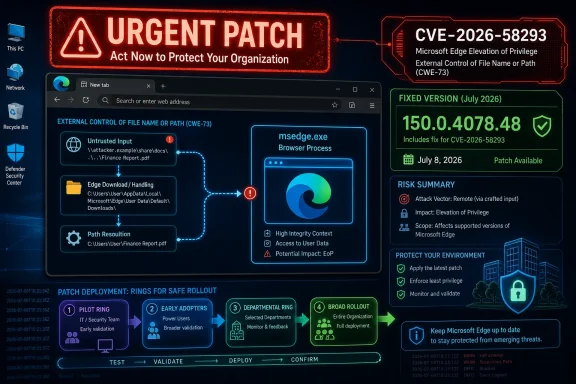 Microsoft Is Saying Less Because the Patch Is the Message
The modern browser advisory has become a strange kind of public document. It is simultaneously a warning, a legal marker, a patch routing signal, and a disclosure artifact — but rarely a satisfying technical explanation on day one. CVE-2026-58293 fits that pattern almost perfectly.Microsoft’s public wording gives defenders the category that matters: remote code execution in Chromium-based Edge. The vulnerability is not described as a privacy quirk, a cosmetic spoof, or a crash-only denial of service. It sits in the class of bugs that, if successfully exploited, can move attacker-controlled input into attacker-controlled execution, subject to the exact constraints of the browser process, sandbox, and operating system policy.
But the advisory does not hand over a recipe. That is by design. Browser vendors have learned the hard way that disclosure timing is a security control in its own right, especially when a fix is available but global patch adoption is still uneven. The first few days after a browser CVE goes public are not a seminar; they are a race between automatic updates, enterprise rings, exploit developers, and incident responders.
The user-facing detail that deserves attention is Microsoft’s report-confidence framing. In CVSS language, report confidence is about how certain we are that the vulnerability exists and how credible the technical details are. A confirmed vendor advisory carries more weight than rumor or independent speculation, even when the root cause remains largely undescribed to the public.
That matters because administrators often mistake “not much detail” for “not much risk.” In browser security, the opposite can be true. Sparse public detail from a vendor can mean the vulnerability has been validated, fixed, and disclosed in a controlled way, while the deeper mechanics are being withheld long enough to give patching a chance.
A File Path Bug Sounds Boring Until the Browser Touches the Filesystem
The reported CWE classification is the most interesting breadcrumb. CWE-73, external control of file name or path, describes situations where software uses externally influenced input to select a file or path in a way that can violate the developer’s assumptions. In a server application, that often evokes path traversal. In a browser, the implications are more subtle and potentially more dangerous.Browsers are enormous brokers between hostile content and local resources. They parse downloads, open PDFs, register protocol handlers, cache data, manage profiles, launch helper processes, mediate extensions, and sometimes hand files to other applications. A flaw in how a path is chosen, normalized, constrained, or passed between components can become a primitive for doing something the attacker should not be able to do.
That does not mean CVE-2026-58293 is automatically a one-click system takeover. The public material does not prove that. What it does suggest is that Microsoft found or accepted a file-path-control issue serious enough to classify as remote code execution rather than merely information disclosure or tampering.
The distinction is important. A path-control bug becomes a remote code execution bug only when the surrounding system gives that path enough power. That might involve loading a file as code, planting content where another component will execute it, confusing a privileged broker, or combining a path mistake with another browser behavior. Without Microsoft’s full root-cause detail, those remain plausible classes rather than confirmed mechanics.
Still, WindowsForum readers should not dismiss the category because it lacks the drama of a memory corruption phrase like “use after free.” Path validation bugs are old, but old bug classes survive because modern systems keep reinventing the boundaries they are supposed to enforce. Edge is not just a renderer around web pages; it is a Windows-integrated application platform with enterprise policy hooks, identity features, PDF handling, web apps, profile storage, and update plumbing.
The Browser RCE Has Changed, but the Patch Race Has Not
A decade ago, “browser RCE” often meant a direct memory-safety bug in the rendering engine followed by a sandbox escape if the attacker wanted full system control. Chromium’s architecture has made that path harder, though not impossible. Today, high-impact browser vulnerabilities can also live in the seams: file handling, IPC boundaries, GPU process behavior, media stacks, extension surfaces, and enterprise integrations.That evolution is good news and bad news. The good news is that exploiting a modern browser is generally more expensive than it used to be. Attackers often need chains, renderer compromise, sandbox bypasses, social engineering, or carefully selected target configurations. The bad news is that enterprise browsers now sit at the intersection of almost every sensitive workflow.
Edge is not an optional accessory on Windows fleets. It is the default browser on many managed endpoints, the PDF viewer in countless workflows, the launcher for internal web apps, the authentication surface for Microsoft 365, and the place where users download the very files they should be suspicious of. A vulnerability in Edge is therefore not confined to “web browsing” in the consumer sense. It touches identity, document handling, SaaS access, and endpoint management.
That is why the reported CVSS details matter. A network-reachable vulnerability with no privileges required and user interaction required is the classic browser-risk shape. The attacker usually needs the user to open a page, click a link, view a document, or otherwise let web content reach the vulnerable code path. That is not the same as wormable server-side RCE, but it is absolutely within the operating model of phishing crews, malvertising operators, and targeted intrusion teams.
Admins sometimes reserve urgency for bugs marked “exploited in the wild.” That is understandable, but it is also reactive. By the time a browser bug appears in active exploitation lists, the safe deployment window has already narrowed. A confirmed Edge RCE with a clean fixed build available is the kind of update that should move through rings quickly unless there is a demonstrated compatibility blocker.
Report Confidence Is the Quiet Metric That Separates Rumor From Work
The text supplied with the advisory points to one of the least glamorous but most useful CVSS concepts: confidence in the vulnerability report. In practical terms, it asks whether defenders are dealing with a rumor, a plausible but unconfirmed claim, or a vendor-confirmed flaw with credible details. CVE-2026-58293 belongs in the last bucket because Microsoft has published the advisory and shipped an update.That does not mean every operational detail is known. It means the existence of the vulnerability should not be treated as speculative. The patch is the vendor’s acknowledgement that the defect is real enough to warrant remediation, even if Microsoft has chosen not to publish a technical write-up.
This is where vulnerability management programs can get weirdly backwards. Teams often want rich exploit detail before they prioritize a patch. But rich exploit detail is exactly what attackers want too. If a vendor-confirmed RCE in a ubiquitous browser has a fix, the absence of public exploit code is not a reason to wait; it is the reason to move before exploit code appears.
Report confidence also helps separate CVE-2026-58293 from the noise of vulnerability feeds. Security teams are drowning in identifiers, duplicate advisories, machine-generated summaries, and vendor-severity mismatches. A confirmed Microsoft Edge CVE attached to a current Stable build is not just another row in a scanner dashboard. It is a discrete endpoint action item.
The right question is not whether every affected endpoint is guaranteed to be exploitable in a real-world campaign. The right question is whether leaving a known vulnerable browser build in service buys anything worth the exposure. For most organizations, the answer is no.
Edge’s Chromium Base Makes the Fix Both Easier and More Complicated
Microsoft Edge’s Chromium foundation gives users and administrators one obvious advantage: browser security fixes can move fast and independently of the monthly Windows cumulative update cycle. Edge has its own update channel, its own enterprise deployment artifacts, and its own release cadence. That is a major improvement over the era when browser security was more tightly bound to operating system servicing.But that separation also creates a management trap. Some organizations still mentally file Edge under “Windows updates,” even though Edge servicing has a separate operational reality. If WSUS, Configuration Manager, Intune, third-party patching, firewall rules, update policies, or golden-image practices interfere with Edge’s updater, browser patch levels can drift even when Windows itself looks current.
The Microsoft Update Catalog entries for Edge 150.0.4078.48 are especially relevant for locked-down environments. They show that the fixed build is not merely a consumer auto-update event; it is a packageable enterprise update. That gives administrators fewer excuses, but it also means they need to know which channel their fleet is on.
Stable and Extended Stable deserve separate attention. Extended Stable exists to reduce change velocity, not to suspend security reality. When a security build lands for both channels, organizations using Extended Stable still need to validate and deploy it as a security update, not treat it as a feature release they can leisurely defer.
For home users, the advice is simple: open Edge, check the About page, and let the browser update. For administrators, it is more structured: inventory versions, confirm channel policy, verify update reachability, check failed install telemetry, and pay special attention to VDI images, kiosk systems, lab machines, and servers where Edge is present but rarely opened.
The Worst Edge Bugs Hide in the Places Enterprises Customize
The ordinary consumer browser is already complicated. The managed enterprise browser is something else entirely. It carries policy templates, extension allowlists, identity integrations, download restrictions, site lists, IE mode remnants, proxy rules, certificate stores, data loss prevention hooks, and sometimes third-party security overlays.That matters for CVE-2026-58293 because a file-path-control vulnerability lives in a world shaped by configuration. Public advisories almost never enumerate every enterprise policy combination that could influence exploitability. A feature that is obscure on a home PC may be heavily used in a managed fleet.
Consider the mundane surfaces: file downloads, temporary directories, PDF handling, profile paths, mounted network locations, redirected folders, shell integration, and web apps installed as desktop-like applications. Each exists because users need convenience. Each also creates opportunities for security assumptions to cross process, privilege, and trust boundaries.
This is not an argument that CVE-2026-58293 is known to exploit any one of those features. It is an argument that Edge’s attack surface is broader than the phrase “visit a malicious website” suggests. When a browser handles local paths, the line between web content and endpoint state becomes a security boundary, not an implementation detail.
Enterprise hardening can reduce some risk, but it cannot replace patching. Disabling unnecessary extensions, restricting downloads, enforcing SmartScreen, isolating high-risk browsing, and using attack surface reduction rules can all help. None of those controls should be treated as a substitute for getting to the fixed Edge build.
The Silence Around Exploitation Is Useful, Not Comforting
At the time of disclosure, the public material around CVE-2026-58293 does not establish active exploitation. That is good news, but it is not a verdict on future risk. Browser vulnerabilities often go through a short phase where only the vendor, the reporter, and a handful of attentive researchers understand the likely exploit path.Then the patch diff lands. Chromium-derived products create an ecosystem in which fixes, code changes, and behavior differences can be studied. Even when Microsoft-specific details are not fully public, attackers can compare builds, watch for changed components, and infer vulnerable logic from the shape of the fix.
This is why delayed patching is especially dangerous for browsers. A security update is not merely a shield; it is also a public hint that something changed. Responsible disclosure assumes defenders will use that head start. Attackers assume some percentage of the world will not.
Security teams should resist the urge to wait for proof-of-concept code before acting. Proof-of-concept publication is often treated like a starting gun, but for capable actors it may be closer to the midpoint of the race. The more widely deployed the product, the more valuable the time between advisory and exploit commoditization becomes.
Edge’s automatic updater narrows that window for many consumer systems. Enterprise controls can widen it again. That is the uncomfortable irony: the organizations with the most to protect are often the ones most capable of slowing down their own browser updates.
Patch Management Has to Treat Browsers Like Tier-One Infrastructure
For years, security programs have said that browsers are critical applications. CVE-2026-58293 is a reminder that many still do not manage them that way. A browser is not a productivity app in the same risk category as a screenshot tool or a media player. It is an always-exposed interpreter for untrusted code and content.That should change how organizations measure patch performance. It is not enough to know that Windows cumulative updates are mostly deployed by the end of the month. Browser RCEs deserve their own service-level target, their own exception process, and their own failure reporting. A fleet with fully patched Windows and stale Edge is not fully patched in any meaningful endpoint-security sense.
The operational target should be boring: fast rings for a pilot group, broad deployment after basic validation, and exception tracking for systems that miss the update. Edge updates are frequent enough that this process should already exist. If every Edge security release feels like a special project, the browser servicing model is broken.
There is also a cultural point here. Users have been trained to fear Windows reboots, but browser restarts are often the actual blocker for security updates. Edge can download an update and still require a restart to apply it. In environments with long-lived browser sessions, shared workstations, or kiosk workflows, “installed” and “running the fixed build” may not be the same thing.
Administrators should verify the active version, not merely the presence of an update package. That means looking at endpoint inventory, browser version telemetry, and update compliance signals that reflect reality. A patched installer sitting on disk does not mitigate a vulnerable process still running in memory.
Microsoft’s Sparse Advisory Still Gives Defenders Enough to Act
There is a temptation to criticize Microsoft for not publishing more detail. In a perfect world, every vulnerability advisory would explain the root cause, exploit preconditions, affected components, mitigations, and detection ideas in language suitable for both defenders and researchers. In the real world, too much too soon can accelerate exploitation.For CVE-2026-58293, the minimum viable defender package is present: product, impact, severity, publication date, and fixed build context. The advisory tells organizations that Chromium-based Edge is affected and that remote code execution is the security consequence. Third-party mirrors add the reported CWE and CVSS context, while Microsoft’s release ecosystem identifies Edge 150.0.4078.48 as the current update line.
That is enough for patch prioritization. It is not enough for a detailed exploit simulation, but most organizations do not need one to make the first decision. They need to know whether to accelerate deployment. They should.
Detection is the harder part. Without public exploit details, defenders cannot write precise behavioral analytics for CVE-2026-58293 specifically. They can, however, look for the usual browser-exploitation aftermath: suspicious child processes from Edge, unexpected script interpreters, odd file writes in user-writable locations, credential access after browser activity, and endpoint alerts clustered around web sessions.
Security operations teams should also watch vendor and government channels for any change in exploitation status. If CISA or Microsoft later flags active exploitation, the priority moves from “urgent patch” to “assume exposure and hunt.” But waiting for that escalation before updating would be a poor reading of the risk.
The Admin Checklist Hidden Inside This Edge CVE
CVE-2026-58293 is not a mystery novel for defenders to solve before acting; it is a servicing event with a security clock attached. The practical response is narrow, measurable, and familiar, which is exactly why it should be done quickly.- Organizations should confirm that managed Windows, macOS, and Linux endpoints running Microsoft Edge have moved to version 150.0.4078.48 or a later fixed build.
- Administrators should verify both Stable and Extended Stable channel devices, because the channel name does not remove the need to deploy security fixes.
- Security teams should treat stale Edge installs on servers, VDI images, kiosks, and shared machines as real exposure, even if users do not think of those systems as browsing endpoints.
- Help desks should encourage users to restart Edge after updating, because a downloaded browser update may not protect a still-running vulnerable process.
- Incident responders should monitor for suspicious Edge child processes, unusual file creation paths, and post-browser-exploitation behavior while public technical details remain limited.
- Patch managers should record this event as another reason to track browser compliance separately from Windows cumulative update compliance.
The Browser Is Now the Patch Tuesday That Never Ends
CVE-2026-58293 lands in the uncomfortable space where the security industry now lives: the vulnerability is confirmed, the fix is available, the public details are incomplete, and the affected application is everywhere. That is not an exception anymore. It is the normal operating condition for defending modern browsers.The lesson is not that Edge is uniquely unsafe. Chromium-based browsers are among the most aggressively maintained consumer and enterprise software platforms in the world, and that maintenance produces a steady stream of advisories because the attack surface is vast and continuously scrutinized. The real lesson is that browser patching has become continuous infrastructure work, not a monthly chore.
Microsoft’s advisory gives administrators enough confidence to act without giving attackers a complete map. That is the bargain. The organizations that benefit from it will be the ones that can turn a terse CVE entry into a verified fleet-wide update before the technical details become common knowledge.
References
- Primary source: MSRC
Published: 2026-07-03T07:00:00-07:00
Loading…
msrc.microsoft.com - Related coverage: securityvulnerability.io
CVE-2026-58294 : Remote Code Execution Vulnerability in Microsoft Edge by Microsoft
Learn about the remote code execution vulnerability affecting Microsoft Edge. Stay informed about CVE-2026-58294 and enhance your cybersecurity measures.securityvulnerability.io - Related coverage: sentinelone.com
CVE-2026-45495: Microsoft Edge Chromium RCE Vulnerability
CVE-2026-45495 is a remote code execution vulnerability in Microsoft Edge Chromium. Learn about its impact, affected versions, and mitigation methods.www.sentinelone.com
- Related coverage: hkcert.org
Microsoft Edge Multiple Vulnerabilities
Multiple vulnerabilities were identified in Microsoft Edge. A remote attacker could exploit some of these vulnerabilities to trigger remote code execution, denial of service condition, security restriction bypass, data manipulation, sensitive informationwww.hkcert.org - Related coverage: threats.kaspersky.com
Kaspersky Threats — KLA91012
threats.kaspersky.com
- Related coverage: cve.circl.lu
Vulnerability-Lookup
Vulnerability-Lookup - Fast vulnerability lookup correlation from different sources.cve.circl.lu
- Related coverage: aha.org
h isac tlp white microsoft edge addresses exploited zero day vulnerability cve 2024 7971 8 23 2024
PDF documentwww.aha.org
- Related coverage: www2.gov.bc.ca
- Related coverage: hivepro.com
Loading…
www.hivepro.com - Related coverage: osv.dev
Loading…
osv.dev - Related coverage: test.osv.dev
Loading…
test.osv.dev - Official source: learn.microsoft.com
Microsoft Edge release notes for Stable Channel | Microsoft Learn
Microsoft Edge release note for the Stable Channellearn.microsoft.com - Related coverage: techspot.com
Microsoft Edge Download Free - 150.0.4078.48 | TechSpot
Download Microsoft Edge - Edge browser lets you enjoy extended battery life and get to what you are looking for quickly.www.techspot.com - Official source: developer.microsoft.com
Microsoft Edge WebDriver | Microsoft Edge Developer
 developer.microsoft.com
- Official source: catalog.update.microsoft.com
Microsoft Update Catalog
www.catalog.update.microsoft.com - Related coverage: windowsforum.com
CVE-2026-57992: Edge Stable 150.0.4078.48 RCE Patch Gap for Windows | Windows Forum
Microsoft has listed CVE-2026-57992 as a Microsoft Edge Chromium-based remote code execution vulnerability in the Security Update Guide, with Edge Stable...windowsforum.com