

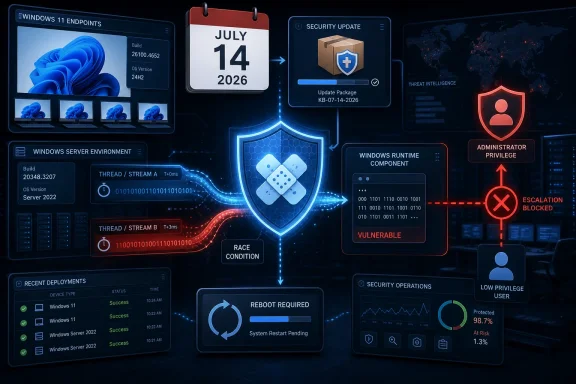
Microsoft’s Security Update Guide describes the defect as a race condition in Windows Runtime: concurrent operations can improperly share a resource because synchronization is inadequate. The National Vulnerability Database records the issue as CWE-362, “Concurrent Execution using Shared Resource with Improper Synchronization,” and confirms Microsoft’s assessment that exploitation requires local access and low-level privileges but no user interaction.
That combination makes this a post-compromise escalation flaw, not an initial remote entry point. It will not, by itself, allow an unauthenticated attacker on the internet to take over a PC. But it can turn a foothold obtained through malware, a malicious local application, compromised credentials, or a chained vulnerability into full control of the affected device.
CISA’s SSVC enrichment currently lists exploitation as none, automation as no, and technical impact as total. In practical terms, there is no public indication that CVE-2026-58527 is under active attack as of July 15, but a successful exploit could undermine the security boundary that normally separates a standard user or low-privilege process from more powerful Windows contexts.
July’s cumulative updates are the fix
The remediation is included in the July 14 Windows cumulative updates. Administrators should treat the build number as the useful compliance checkpoint, especially where update rings, WSUS approvals, offline images, or third-party patch-management tools can delay deployment.
Microsoft’s published affected-build information indicates that the following releases are vulnerable before these patched builds:
| Product | Patched July 14, 2026 build | Cumulative update |
|---|---|---|
| Windows 11, version 24H2 | 26100.8875 | KB5101650 |
| Windows 11, version 25H2 | 26200.8875 | KB5101650 |
| Windows 11, version 26H1 | 28000.2525 | KB5101649 |
| Windows Server 2022 | 20348.5386 | KB5099540 |
| Windows Server 2025, including Server Core | 26100.33158 | KB5099536 |
Windows 11 24H2 and 25H2 are covered by the same KB5101650 package, while 26H1 receives KB5101649. Windows Server 2022 and Windows Server 2025 have their own cumulative updates, KB5099540 and KB5099536, respectively. The updates are available through Windows Update, Windows Update for Business, Microsoft Update Catalog, and Windows Server Update Services where the appropriate product and security-update classifications are enabled.
There is one minor data-quality wrinkle for vulnerability-management teams: the affected-product data replicated by NVD describes Windows 11 25H2 with an anomalous “less than 10.0.26100.8875” boundary, even though Microsoft’s July KB5101650 release documentation identifies the actual patched 25H2 build as 26200.8875. Use the Microsoft release build for compliance reporting rather than assuming that a raw version-range field is sufficient.
A race condition makes timing part of the attack
A race condition is a software defect in which two or more operations run in an unexpected order. If a security-sensitive resource is checked, modified, or released at precisely the wrong moment, the attacker may be able to take advantage of a state the software did not intend to expose.
Microsoft has not published proof-of-concept code, a vulnerable function, or a detailed exploit path for CVE-2026-58527. That restraint matters: administrators should avoid filling the gap with assumptions about a specific Windows Runtime API, application package type, or malware family. The available facts support a local privilege-escalation scenario; they do not establish a remote exploit, drive-by compromise, or a vulnerability in every application that uses Windows Runtime components.
The CVSS vector nevertheless explains why the issue deserves prompt attention. The attack complexity is low, privileges required are low, user interaction is not required, and successful exploitation can affect confidentiality, integrity, and availability at a high level. A standard user account is not a meaningful safety boundary if malware running under it can leverage a reliable elevation path.
For enterprise defenders, the risk is clearest on multi-user systems, developer workstations, shared endpoints, virtual desktop infrastructure, jump hosts, and servers where a lower-privileged service account already has a presence. Endpoint protection, application control, credential hygiene, and least-privilege policies still reduce the likelihood of an attacker getting the required starting point. They do not replace the operating-system update.
Patch validation needs to include the reboot
Consumer Windows 11 devices configured for automatic updates should receive the appropriate July cumulative update through the normal servicing path. Users who manually manage updates should install the latest available cumulative update and restart the system, then verify the Windows version with winver or through Settings.
For managed fleets, the task is more than simply approving the KB. Confirm that devices have actually installed the package, completed any required restart, and reported the target OS build. Devices that download the update but remain pending reboot should remain in the exposure population.
Microsoft says Windows Server 2022’s KB5099540 includes the July security fixes alongside quality changes and a servicing stack update. Server 2025’s KB5099536 follows the same combined servicing model. That matters for offline servicing and golden-image maintenance: patching a reference image is useful, but it does not protect already-deployed systems until their own cumulative update and reboot cycle are complete.
The July releases also introduce a separate networking hardening change around unregistered third-party TDI transports. Microsoft warns that applications using sockets over those unregistered transports can stop working after the update. That is unrelated to CVE-2026-58527, but it is a valid reason for organizations with legacy networking software to use their normal pilot ring rather than blindly broad-deploying the package.
No workaround means patching is the decision
Microsoft has not listed a configuration workaround or mitigation for CVE-2026-58527. There is no registry change, service disablement, policy toggle, or Windows Runtime feature removal that Microsoft recommends in place of installing the update.
That leaves a straightforward response: prioritize the July cumulative updates for the listed Windows 11 and Server versions, validate the post-install build, and investigate endpoints where deployment remains blocked. Security teams should also review EDR alerts for suspicious local privilege escalation behavior, particularly where standard-user processes spawn elevated tools, alter protected system locations, or gain access to credential material.
CVE-2026-58527 is not an emergency internet-facing wormable flaw. It is still the kind of vulnerability that makes an existing compromise substantially worse. For systems below Windows 11 build 26100.8875 or 26200.8875, Windows 11 26H1 build 28000.2525, Windows Server 2022 build 20348.5386, or Windows Server 2025 build 26100.33158, the practical next step is to move to the July 14, 2026 cumulative update and confirm that the reboot actually happened.
References
- CVE-2026-58527 Windows Runtime Elevation of Privilege Vulnerability MSRC · 2026-07-14T07:00:00-07:00