

Microsoft has listed CVE-2026-6276, a libcurl cookie-leak vulnerability disclosed by the curl project on April 29, 2026, in which applications reusing the same libcurl easy handle after a custom Host header could send cookies intended for one host to another. The flaw is narrow, but it lands in a library that hides in plain sight across Windows tooling, developer stacks, appliances, agents, and enterprise software. That combination is why a “low” severity label from the upstream project should not translate into a shrug from administrators. The bug is less about one spectacular exploit than about the brittle trust assumptions inside modern HTTP plumbing.
CVE-2026-6276 is not the kind of vulnerability that produces instant panic on a Patch Tuesday dashboard. It does not describe remote code execution in the Windows kernel, a wormable SMB condition, or a browser zero-day already being chained in the wild. It describes something more prosaic: libcurl could, in a particular sequence of requests, keep stale host information and attach the wrong cookies to a later HTTP request.
That sounds like a developer footnote until you remember what libcurl is. It is not merely the
The curl project says the vulnerable range runs from curl 7.71.0 through 8.19.0, with 8.20.0 carrying the fix. It also says the command-line curl tool itself is not affected by this issue. The danger sits in applications using libcurl in a specific way: setting a custom
That distinction matters for WindowsForum readers because Windows has normalized curl as a system utility. Every modern Windows 10 and Windows 11 installation includes Microsoft’s own curl build, and many third-party Windows applications bring their own libcurl copy. A Windows machine may therefore contain multiple curl-family components at once, each with a different version, patch cadence, TLS backend, and owner.
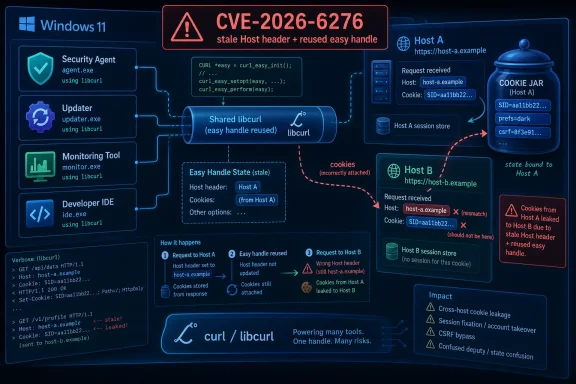
The vulnerable sequence is simple enough to explain. An application uses libcurl and sets a custom
That is a classic state reuse bug. The mistake is not that cookies exist, or that
This is why the flaw is categorized as an origin-validation problem by the curl advisory, while NVD analysis has also framed it through the lens of cleartext transmission. Both descriptions capture a piece of the story. The practical issue is that a security boundary drawn by hostname becomes unreliable when request state is stale.
The bug also illustrates why HTTP client libraries are riskier than they look. They preserve connections, cookies, redirects, authentication state, proxies, DNS behavior, and TLS parameters across operations. That is precisely what makes them useful, and precisely why a single stale field can have security consequences.
That split is a recurring source of confusion. An administrator can run
The upstream curl advisory makes the most important narrowing statement: the curl command-line tool is not affected. That is good news for Windows admins who use
That sentence is the part enterprise IT should underline. Vulnerability management systems often surface “curl” findings as if there is a single thing to patch. In practice, there may be several: the Windows inbox binary, a developer-installed copy, a package-manager copy, a vendor-bundled DLL, a static library inside an executable, and a Linux copy inside WSL or a container image.
Microsoft’s involvement therefore changes the operational framing. It brings the CVE into the Windows security orbit, but remediation still depends on asset discovery, software inventory, vendor updates, and a willingness to look beyond the obvious
Those constraints reduce exploitability. An attacker generally needs the vulnerable application to perform the right sequence of requests, reuse the same easy handle, carry meaningful cookies, and send traffic in a context where the leak is observable or useful. That is not a universal remote compromise.
But vulnerability severity is not the same thing as remediation priority. A low-severity bug in a ubiquitous library can still become a messy operational problem because it produces ambiguous scanner output, uncertain application exposure, and vendor lag. The risk is concentrated in specific software patterns rather than uniformly spread across all systems.
This is also why different tools and databases may appear to disagree. Upstream says low. Some vulnerability scanners classify the affected libcurl version range more aggressively, including high CVSS-style scores that emphasize network reachability and automated detection. NVD’s metrics can differ from a project’s qualitative severity because the scoring model rewards different assumptions.
For administrators, the useful conclusion is not “panic” or “ignore.” It is “triage by usage.” Systems that merely expose a non-affected command-line curl are not the same as services that embed libcurl in a proxy-like workflow, manipulate host headers, share handles, and carry authentication cookies.
That is difficult to answer from the outside. Many Windows programs ship
Sysadmins should expect scanner results to be noisy. A version-based scanner can correctly identify libcurl 8.19.0 or older and still not know whether the application uses custom
This is where Windows shops often need a two-track response. The first track is conventional patching: update anything that ships libcurl to 8.20.0 or a vendor-patched build. The second track is vendor pressure: ask whether the product uses libcurl in a way that matches the advisory, not merely whether some library file exists on disk.
That second question is more work, but it is also more honest. CVE-2026-6276 is not a generic “curl equals vulnerable” story. It is a story about host-header manipulation, cookie scope, and handle reuse. The closer a product sits to HTTP routing, testing, API brokering, debugging, scanning, or proxy behavior, the more attention it deserves.
The easy handle abstraction is convenient because it lets an application preserve settings across transfers. That convenience becomes risky when code treats an easy handle as a general-purpose reusable object without carefully clearing request-specific state. Headers, cookies, authentication options, proxy behavior, DNS overrides, and protocol settings can all become footguns if a handle outlives the assumptions under which it was configured.
Custom
HTTPS reduces the common impact of this particular bug because SNI must align with the intended virtual host for many real-world scenarios. But that should not become an excuse to ignore the pattern. Internal tools, lab environments, legacy endpoints, and cleartext service networks still exist, especially inside enterprises that have accumulated years of automation.
A mature application should treat reusable HTTP client state as privileged. If code deliberately changes host identity for one request, it should reset or isolate the client context before moving to the next. The patch fixes libcurl’s side of this case; good engineering reduces the chance that the next stale-state bug matters.
A scanner can tell you that a host contains a vulnerable libcurl version. It usually cannot tell you whether the affected code path is reachable, whether the application uses a cookie engine, whether custom
This gap creates a familiar tension between security teams and operations teams. Security wants the version gone because unresolved CVEs accumulate into measurable risk. Operations wants to avoid emergency changes for a bug that may not be exploitable in their environment. Both instincts are reasonable.
The practical compromise is to patch opportunistically while prioritizing exposed patterns. Internet-facing services that act as HTTP clients on behalf of users deserve a faster look. Developer tools, test harnesses, scanners, API gateways, and agents that intentionally manipulate headers deserve more scrutiny than a desktop app with a dormant bundled DLL.
The wrong answer is to waive every finding because upstream says “low.” The other wrong answer is to force outage-risking emergency maintenance on every Windows endpoint because a scanner says “high.” CVE-2026-6276 rewards context, which is exactly what automated severity labels are worst at providing.
In many enterprise environments, cookies are not only browser artifacts. API clients use them. Legacy services use them. Admin consoles use them. Appliances and management tools use them. Automation that began as a quick test often becomes production glue.
That is why a cookie leak bug in libcurl should not be dismissed as a browser problem. The affected library sits beneath software that may never render a web page. It simply speaks HTTP, manages cookies, and follows application instructions.
The deeper lesson is that origin boundaries are not magic. They are implemented by code that compares hosts, parses headers, stores cookies, handles redirects, and decides what state to attach to the next request. If one layer keeps stale identity, the boundary can fail even when the application appears to be doing something ordinary.
CVE-2026-6276 is a reminder that “client-side” does not mean “low impact by default.” The client decides which secrets to send. A confused client can leak them.
Curl sits awkwardly across both worlds. Microsoft ships a Windows curl build. Git for Windows may ship its own. Programming environments may ship another. Security tools may ship another. Appliance management clients may ship yet another. A single endpoint can therefore have a patched Microsoft curl and an unpatched vendor libcurl at the same time.
This is not a Microsoft failure so much as a modern software reality. Open-source components are copied, forked, vendored, statically linked, and forgotten. The same dependency can be responsibly maintained in one product and stale in another installed on the same machine.
The presence of an MSRC entry is still useful. It gives Windows-focused security teams a canonical item to track. It also helps explain to management why a curl advisory belongs in a Windows risk register. But it should not lull anyone into thinking Windows Update will close every instance of the vulnerability.
For enterprise IT, the better posture is software composition awareness. Know which products bundle libcurl. Know which teams own them. Know which vendors provide component-level advisories. Know which scanner findings are tied to OS files and which are tied to application directories.
On Windows desktops and servers, administrators should resist the temptation to manually replace random
For internally developed software, this is a good moment to inspect dependency management. If an application statically links libcurl, normal endpoint scanning may never catch it. If build pipelines pin curl versions, they may need explicit bumps. If software bills of materials exist, this is the kind of CVE that tests whether they are useful or merely decorative.
The advisory also gives a tactical workaround: avoid custom
The healthiest response is to treat the fix as routine but the inventory as strategic. Updating to 8.20.0 closes this bug. Learning where libcurl lives closes a larger blind spot.
That does not mean every such tool is vulnerable. It means the bug aligns with behaviors found in infrastructure software more than in ordinary user workflows. A browser is not the issue here. A specialized HTTP client built on libcurl might be.
One plausible risk pattern is a multi-tenant or multi-target tool that authenticates to one host, stores cookies, then probes another host using the same libcurl handle. If stale host context causes cookies to accompany the second request, a service controlled by an attacker or a lower-trust environment could receive secrets intended for a higher-trust one.
Another pattern is internal automation that relies on cleartext HTTP because it runs “inside the network.” That phrase has aged badly. Internal networks now contain developer laptops, contractors, cloud connectors, lab systems, and compromised hosts. Cleartext cookie leakage inside that environment is not harmless simply because it does not cross the public internet.
The curl project’s low severity rating reflects probability and constraints. The enterprise risk calculation should add environment and consequence. If the leaked cookie gates something sensitive, the bug becomes more important in that specific place.
Next, ask whether any affected software performs unusual HTTP host manipulation. If the answer is no, the finding may still deserve cleanup but not a weekend emergency. If the answer is yes, especially in a service that handles credentials or cross-host requests, move it up the queue.
Developers should audit handle reuse. A new easy handle per security boundary may be less efficient, but it is easier to reason about. If performance requires reuse, code should explicitly clear or reset state that belongs to one request context before another begins.
Security teams should also watch how tools report this CVE. A finding that says “libcurl before 8.20.0” is not the same as proof of cookie leakage. It is proof of exposure to a vulnerable component, which then needs prioritization.
 A Small Cookie Bug Becomes a Supply-Chain Problem
CVE-2026-6276 is not the kind of vulnerability that produces instant panic on a Patch Tuesday dashboard. It does not describe remote code execution in the Windows kernel, a wormable SMB condition, or a browser zero-day already being chained in the wild. It describes something more prosaic: libcurl could, in a particular sequence of requests, keep stale host information and attach the wrong cookies to a later HTTP request.That sounds like a developer footnote until you remember what libcurl is. It is not merely the
curl command that admins type when they want to test an endpoint. It is a transfer library embedded inside a long tail of commercial products, scripts, monitoring agents, CI tooling, cloud clients, installers, updaters, and security software.The curl project says the vulnerable range runs from curl 7.71.0 through 8.19.0, with 8.20.0 carrying the fix. It also says the command-line curl tool itself is not affected by this issue. The danger sits in applications using libcurl in a specific way: setting a custom
Host: header for one HTTP request, then reusing the same easy handle for another request without that header.That distinction matters for WindowsForum readers because Windows has normalized curl as a system utility. Every modern Windows 10 and Windows 11 installation includes Microsoft’s own curl build, and many third-party Windows applications bring their own libcurl copy. A Windows machine may therefore contain multiple curl-family components at once, each with a different version, patch cadence, TLS backend, and owner.
The Stale Host Is the Real Vulnerability
Cookies are scoped by host because the web depends on that boundary. A session cookie for one service should not leak to a different service merely because two requests pass through the same client library. CVE-2026-6276 is interesting because it shows how that boundary can be undermined not by a malicious server setting a bad cookie, but by client-side state getting out of sync with the request being sent.The vulnerable sequence is simple enough to explain. An application uses libcurl and sets a custom
Host: header, usually for cleartext HTTP testing, virtual-host routing, debugging, or special gateway behavior. Later, the same easy handle is reused for another HTTP request, but the custom host header is no longer set. In affected versions, libcurl could nevertheless carry forward stale host context for cookie handling and attach cookies meant for the earlier host.That is a classic state reuse bug. The mistake is not that cookies exist, or that
Host: headers can be customized, or that libcurl encourages connection reuse for performance. The mistake is that the library’s internal model of “which host am I dealing with?” could lag behind the application’s next request.This is why the flaw is categorized as an origin-validation problem by the curl advisory, while NVD analysis has also framed it through the lens of cleartext transmission. Both descriptions capture a piece of the story. The practical issue is that a security boundary drawn by hostname becomes unreliable when request state is stale.
The bug also illustrates why HTTP client libraries are riskier than they look. They preserve connections, cookies, redirects, authentication state, proxies, DNS behavior, and TLS parameters across operations. That is precisely what makes them useful, and precisely why a single stale field can have security consequences.
Microsoft’s Entry Is a Signal, Not the Whole Story
The user-facing Microsoft Security Response Center page for CVE-2026-6276 is a sign that Microsoft is tracking the vulnerability, but it should not be read as proof that every affected libcurl copy on a Windows system is Microsoft’s responsibility. In the Windows ecosystem, curl is both a Microsoft-shipped utility and a third-party dependency that countless vendors package independently.That split is a recurring source of confusion. An administrator can run
curl --version from C:\Windows\System32 and learn something useful about Microsoft’s bundled command-line build. But that does not reveal the libcurl version statically or dynamically linked into a backup client, endpoint detection agent, container tool, Git distribution, VPN client, game launcher, observability collector, or line-of-business application.The upstream curl advisory makes the most important narrowing statement: the curl command-line tool is not affected. That is good news for Windows admins who use
curl.exe interactively or in scripts. But the same advisory immediately reminds readers that libcurl is used by many applications and is not always advertised as such.That sentence is the part enterprise IT should underline. Vulnerability management systems often surface “curl” findings as if there is a single thing to patch. In practice, there may be several: the Windows inbox binary, a developer-installed copy, a package-manager copy, a vendor-bundled DLL, a static library inside an executable, and a Linux copy inside WSL or a container image.
Microsoft’s involvement therefore changes the operational framing. It brings the CVE into the Windows security orbit, but remediation still depends on asset discovery, software inventory, vendor updates, and a willingness to look beyond the obvious
curl.exe in System32.Low Severity Does Not Mean Low Relevance
The curl project rates CVE-2026-6276 as low severity, and that rating is defensible. The bug requires a particular libcurl usage pattern. CustomHost: headers are not typical in everyday HTTPS client code. When HTTPS is involved, setting only the Host: header is not enough to select a virtual host cleanly because Server Name Indication has its own role in TLS negotiation.Those constraints reduce exploitability. An attacker generally needs the vulnerable application to perform the right sequence of requests, reuse the same easy handle, carry meaningful cookies, and send traffic in a context where the leak is observable or useful. That is not a universal remote compromise.
But vulnerability severity is not the same thing as remediation priority. A low-severity bug in a ubiquitous library can still become a messy operational problem because it produces ambiguous scanner output, uncertain application exposure, and vendor lag. The risk is concentrated in specific software patterns rather than uniformly spread across all systems.
This is also why different tools and databases may appear to disagree. Upstream says low. Some vulnerability scanners classify the affected libcurl version range more aggressively, including high CVSS-style scores that emphasize network reachability and automated detection. NVD’s metrics can differ from a project’s qualitative severity because the scoring model rewards different assumptions.
For administrators, the useful conclusion is not “panic” or “ignore.” It is “triage by usage.” Systems that merely expose a non-affected command-line curl are not the same as services that embed libcurl in a proxy-like workflow, manipulate host headers, share handles, and carry authentication cookies.
The Windows Angle Is Hidden in Application Inventory
On Windows, the most obvious curl binary is often the least interesting part of this CVE. Microsoft’s shippedcurl.exe matters for baseline hygiene, but upstream says the command-line tool is not affected by this flaw. The more interesting question is which Windows applications include libcurl and how they use it.That is difficult to answer from the outside. Many Windows programs ship
libcurl.dll beside their executable. Others link it statically, leaving no obvious DLL name for inventory tools to find. Some products use libcurl only for updates, telemetry, license checks, webhooks, or cloud synchronization, meaning the vulnerable code path may be present but rarely exercised.Sysadmins should expect scanner results to be noisy. A version-based scanner can correctly identify libcurl 8.19.0 or older and still not know whether the application uses custom
Host: headers, reuses easy handles across hosts, or stores sensitive cookies. Conversely, an application may be genuinely exposed even if the vulnerable library is buried inside a vendor package that normal file searches miss.This is where Windows shops often need a two-track response. The first track is conventional patching: update anything that ships libcurl to 8.20.0 or a vendor-patched build. The second track is vendor pressure: ask whether the product uses libcurl in a way that matches the advisory, not merely whether some library file exists on disk.
That second question is more work, but it is also more honest. CVE-2026-6276 is not a generic “curl equals vulnerable” story. It is a story about host-header manipulation, cookie scope, and handle reuse. The closer a product sits to HTTP routing, testing, API brokering, debugging, scanning, or proxy behavior, the more attention it deserves.
Developers Own Part of the Fix
For developers, the fix is not only “upgrade libcurl,” although that is the cleanest answer. The advisory’s recommendations are straightforward: move to curl and libcurl 8.20.0, apply the patch and rebuild, or avoid customHost: headers. But the bug should also prompt a review of how applications manage libcurl handles and cookies.The easy handle abstraction is convenient because it lets an application preserve settings across transfers. That convenience becomes risky when code treats an easy handle as a general-purpose reusable object without carefully clearing request-specific state. Headers, cookies, authentication options, proxy behavior, DNS overrides, and protocol settings can all become footguns if a handle outlives the assumptions under which it was configured.
Custom
Host: headers deserve special suspicion. They are useful in test harnesses, synthetic monitoring, reverse-proxy validation, old virtual-host setups, and debugging strange routing paths. They are also one of those knobs that blur the line between “the URL says this” and “the request says that.” Whenever those differ, cookie logic becomes more delicate.HTTPS reduces the common impact of this particular bug because SNI must align with the intended virtual host for many real-world scenarios. But that should not become an excuse to ignore the pattern. Internal tools, lab environments, legacy endpoints, and cleartext service networks still exist, especially inside enterprises that have accumulated years of automation.
A mature application should treat reusable HTTP client state as privileged. If code deliberately changes host identity for one request, it should reset or isolate the client context before moving to the next. The patch fixes libcurl’s side of this case; good engineering reduces the chance that the next stale-state bug matters.
The Scanner Will Be Both Right and Misleading
Vulnerability scanners are already flagging libcurl versions earlier than 8.20.0. That is not wrong. Version-based detection is often the only scalable way to spot vulnerable open-source components across fleets. But for CVE-2026-6276, a scanner finding is the start of analysis rather than the end.A scanner can tell you that a host contains a vulnerable libcurl version. It usually cannot tell you whether the affected code path is reachable, whether the application uses a cookie engine, whether custom
Host: headers are ever set, or whether an attacker can influence the second request. Those are application-behavior questions.This gap creates a familiar tension between security teams and operations teams. Security wants the version gone because unresolved CVEs accumulate into measurable risk. Operations wants to avoid emergency changes for a bug that may not be exploitable in their environment. Both instincts are reasonable.
The practical compromise is to patch opportunistically while prioritizing exposed patterns. Internet-facing services that act as HTTP clients on behalf of users deserve a faster look. Developer tools, test harnesses, scanners, API gateways, and agents that intentionally manipulate headers deserve more scrutiny than a desktop app with a dormant bundled DLL.
The wrong answer is to waive every finding because upstream says “low.” The other wrong answer is to force outage-risking emergency maintenance on every Windows endpoint because a scanner says “high.” CVE-2026-6276 rewards context, which is exactly what automated severity labels are worst at providing.
The Cookie Jar Is Where Boundaries Become Real
Cookies are old technology, but they still carry modern trust. They hold sessions, CSRF tokens, routing hints, feature flags, device identifiers, and authentication state. Even when a leaked cookie cannot immediately compromise an account, it can expose internal structure or enable confusing secondary effects.In many enterprise environments, cookies are not only browser artifacts. API clients use them. Legacy services use them. Admin consoles use them. Appliances and management tools use them. Automation that began as a quick test often becomes production glue.
That is why a cookie leak bug in libcurl should not be dismissed as a browser problem. The affected library sits beneath software that may never render a web page. It simply speaks HTTP, manages cookies, and follows application instructions.
The deeper lesson is that origin boundaries are not magic. They are implemented by code that compares hosts, parses headers, stores cookies, handles redirects, and decides what state to attach to the next request. If one layer keeps stale identity, the boundary can fail even when the application appears to be doing something ordinary.
CVE-2026-6276 is a reminder that “client-side” does not mean “low impact by default.” The client decides which secrets to send. A confused client can leak them.
Microsoft’s Ecosystem Makes Patch Ownership Messy
Windows administrators have become used to Microsoft Update as the center of gravity for remediation. That model works for the operating system and many Microsoft components. It works less well for open-source libraries embedded by independent vendors, developer tools, and self-contained runtimes.Curl sits awkwardly across both worlds. Microsoft ships a Windows curl build. Git for Windows may ship its own. Programming environments may ship another. Security tools may ship another. Appliance management clients may ship yet another. A single endpoint can therefore have a patched Microsoft curl and an unpatched vendor libcurl at the same time.
This is not a Microsoft failure so much as a modern software reality. Open-source components are copied, forked, vendored, statically linked, and forgotten. The same dependency can be responsibly maintained in one product and stale in another installed on the same machine.
The presence of an MSRC entry is still useful. It gives Windows-focused security teams a canonical item to track. It also helps explain to management why a curl advisory belongs in a Windows risk register. But it should not lull anyone into thinking Windows Update will close every instance of the vulnerability.
For enterprise IT, the better posture is software composition awareness. Know which products bundle libcurl. Know which teams own them. Know which vendors provide component-level advisories. Know which scanner findings are tied to OS files and which are tied to application directories.
The Patch Is Easy; the Discovery Is Not
Upstream fixed the issue in curl 8.20.0, released the same day as the public advisory. For projects that dynamically link against a maintained libcurl package, the remediation path is relatively painless: update the dependency and rebuild or redeploy. For projects that vendor libcurl, it depends on whether the vendor moves quickly.On Windows desktops and servers, administrators should resist the temptation to manually replace random
libcurl.dll files unless a vendor explicitly supports that route. DLL swapping can break applications, invalidate signatures, interfere with installers, or create mismatched ABI expectations. The right fix is usually a vendor update.For internally developed software, this is a good moment to inspect dependency management. If an application statically links libcurl, normal endpoint scanning may never catch it. If build pipelines pin curl versions, they may need explicit bumps. If software bills of materials exist, this is the kind of CVE that tests whether they are useful or merely decorative.
The advisory also gives a tactical workaround: avoid custom
Host: headers. That may be viable for internal tools, tests, and automation. It is less useful for products whose core behavior depends on host-header control.The healthiest response is to treat the fix as routine but the inventory as strategic. Updating to 8.20.0 closes this bug. Learning where libcurl lives closes a larger blind spot.
The Real Risk Lives in Edge Cases
The most exploitable scenarios for CVE-2026-6276 are likely to be weird, and weird is where enterprises tend to accumulate technical debt. Think internal HTTP services that still run without TLS, tools that spoof hostnames for testing, agents that talk to multiple backends through a shared client object, or scanners that intentionally manipulate request headers.That does not mean every such tool is vulnerable. It means the bug aligns with behaviors found in infrastructure software more than in ordinary user workflows. A browser is not the issue here. A specialized HTTP client built on libcurl might be.
One plausible risk pattern is a multi-tenant or multi-target tool that authenticates to one host, stores cookies, then probes another host using the same libcurl handle. If stale host context causes cookies to accompany the second request, a service controlled by an attacker or a lower-trust environment could receive secrets intended for a higher-trust one.
Another pattern is internal automation that relies on cleartext HTTP because it runs “inside the network.” That phrase has aged badly. Internal networks now contain developer laptops, contractors, cloud connectors, lab systems, and compromised hosts. Cleartext cookie leakage inside that environment is not harmless simply because it does not cross the public internet.
The curl project’s low severity rating reflects probability and constraints. The enterprise risk calculation should add environment and consequence. If the leaked cookie gates something sensitive, the bug becomes more important in that specific place.
This Is How to Read the Advisory Without Overreacting
The useful response to CVE-2026-6276 is disciplined and boring, which is often what good security looks like. Start with known curl and libcurl instances, then separate command-line curl from embedded libcurl. Confirm whether vendors have shipped updates based on curl 8.20.0 or backported the fix.Next, ask whether any affected software performs unusual HTTP host manipulation. If the answer is no, the finding may still deserve cleanup but not a weekend emergency. If the answer is yes, especially in a service that handles credentials or cross-host requests, move it up the queue.
Developers should audit handle reuse. A new easy handle per security boundary may be less efficient, but it is easier to reason about. If performance requires reuse, code should explicitly clear or reset state that belongs to one request context before another begins.
Security teams should also watch how tools report this CVE. A finding that says “libcurl before 8.20.0” is not the same as proof of cookie leakage. It is proof of exposure to a vulnerable component, which then needs prioritization.
The April Advisory Leaves a June Chore List
By early June 2026, the responsible path is no longer waiting for clarity; the advisory, fixed version, affected range, and high-level conditions are known. The remaining work is local: finding the copies, mapping owners, and deciding which findings are urgent.- Organizations should upgrade curl and libcurl components to 8.20.0 or vendor-patched builds when those components are embedded in supported software.
- Administrators should not assume Microsoft’s bundled
curl.exetells the whole story, because third-party Windows applications may carry separate libcurl builds. - Security teams should prioritize products that reuse libcurl handles across multiple hosts, manipulate custom
Host:headers, or handle authentication cookies. - Developers should treat custom host headers as security-sensitive state and avoid carrying them across requests through reusable client objects.
- Scanner results should be triaged by application behavior rather than accepted blindly as either catastrophic or irrelevant.
- Vendor responses matter because many affected Windows copies of libcurl will be patched through application updates, not Windows Update.
References
- Primary source: MSRC
Published: 2026-06-03T01:50:39-07:00
Security Update Guide - Microsoft Security Response Center
 msrc.microsoft.com
- Related coverage: sentinelone.com
CVE-2026-6276: Haxx Curl Information Disclosure Flaw
CVE-2026-6276 is an information disclosure vulnerability in Haxx Curl. Learn about its impact, affected versions, and mitigation methods.www.sentinelone.com
- Related coverage: vulnerability.circl.lu
Vulnerability-Lookup
Vulnerability-Lookup - Fast vulnerability lookup correlation from different sources.vulnerability.circl.lu - Related coverage: osv.dev

OSV - Open Source Vulnerabilities
Comprehensive vulnerability database for your open source projects and dependencies.
osv.dev
- Related coverage: redpacketsecurity.com
HackerOne Bug Bounty Disclosure: cve-stale-custom-cookie-host-causes-cookie-leak-arkss - RedPacket Security
Companycurlwww.redpacketsecurity.com - Related coverage: mondoo.com
CVE-2026-6276 | Mondoo Vulnerability Intelligence
CVE-2026-6276 - HIGH severity: stale custom cookie host causes cookie leakmondoo.com
- Related coverage: cs.uic.edu
- Related coverage: curl.se
curl shipped by Microsoft
curl.se
- Official source: answers.microsoft.com
Windows 10 Pro Version 1909 - What Is "curl.exe" - Microsoft Q&A
I found a suspicious file on my system after December 2019's Patch Tuesday. My OS: Windows 10 Pro Version 1909 (Fully updated and patched. Third-party security software installed. Windows Security used as a backup.) Filename: curl.exe File Location(s):…answers.microsoft.com - Official source: learn.microsoft.com
Windows 10 Pro Version 1909 - What Is "curl.exe" - Microsoft Q&A
I found a suspicious file on my system after December 2019's Patch Tuesday. My OS: Windows 10 Pro Version 1909 (Fully updated and patched. Third-party security software installed. Windows Security used as a backup.) Filename: curl.exe File Location(s):…learn.microsoft.com - Related coverage: borncity.com
curl vulnerability still unpatched by MicrosoftBorn's Tech and Windows World
[German]There is a vulnerability in the library and tool curl in older versions, which was closed by the project on October 11, 2023 with version 8.4.0.borncity.com
