

CVE-2026-7168 is a medium-severity libcurl vulnerability disclosed by the curl project on April 29, 2026, in which applications reusing a libcurl handle across two different HTTP proxies can leak a Digest
The mechanical flaw in CVE-2026-7168 is almost deceptively narrow. A libcurl-using application authenticates to one HTTP proxy using Digest authentication, then changes the proxy host and performs a second transfer through a different proxy while reusing the same easy handle. Under the vulnerable condition, libcurl can send the
That header is not a password in the crude sense of a reusable plaintext secret. Digest authentication was designed to avoid sending the password itself over the wire. But the header still carries authenticated state, and the curl advisory is explicit that a malicious second proxy could use the leaked material to impersonate the client when communicating with the first proxy.
That makes this a boundary-crossing bug. The client thought it was talking to proxy A, then proxy B, with separate authentication contexts. The library blurred that boundary by allowing state associated with A to ride along to B.
The mitigating detail is important: the second proxy does not automatically learn the name or address of the first proxy from the leaked request details. That limits exploitability. But mitigated is not the same as harmless, especially in managed networks where proxy names, routing conventions, and authentication realms are often guessable by insiders or discoverable through surrounding infrastructure.
This Is a libcurl Problem, Not a
The curl project says CVE-2026-7168 affects libcurl versions from 7.12.0 through 8.19.0, and that versions before 7.12.0 and 8.20.0 or later are not affected. The project also says the issue was reported on April 27, 2026, and fixed with curl 8.20.0 on April 29, coordinated with the advisory publication.
For Windows users, the first instinct is to type
But CVE-2026-7168 is specifically described as a libcurl issue that does not affect the curl command-line tool. That distinction matters. The command-line executable is the visible part of the iceberg; libcurl is the library embedded by other software, including installers, updaters, agents, device-management utilities, backup tools, monitoring collectors, and application runtimes.
The Windows relevance therefore depends less on whether a helpdesk technician ever runs
That specificity is why the severity is medium rather than critical. It is also why security teams should resist both extremes: dismissing it because the conditions are narrow, or treating it like a universal credential dump. The right posture is to ask whether your environment has the kind of software that rotates proxies, fails over between proxies, or brokers traffic across multiple proxy endpoints while maintaining long-lived libcurl handles.
Those patterns are not exotic. Enterprise software often supports primary and secondary proxies. Security products may relay traffic through different inspection paths. Cloud agents may use one proxy for metadata retrieval and another for package downloads. Internal developer tools may switch proxies depending on destination, environment, or customer tenant.
The bug becomes most interesting in exactly those places where proxying is supposed to be invisible. The more automated and abstracted the network path, the harder it is for administrators to know when one application is silently moving from proxy A to proxy B without rebuilding its authentication state.
The vulnerability is classified as authentication bypass by capture-replay, which fits the underlying concern: authenticated material intended for one party can be replayed or misused by another. That does not mean every leaked header yields instant access. It means the library has allowed authentication state to escape its intended context.
In older network designs, a user’s machine might have had one configured proxy and one predictable path out of the organization. In modern fleets, proxy selection can be dynamic. Developers run local proxies. VPN clients install traffic-steering components. Endpoint detection tools inspect outbound flows. Containers and build systems inherit proxy variables. Cloud workloads may have one policy for package mirrors and another for external APIs.
That is how a bug in a decades-old authentication mode becomes relevant again. The technology is old, but the deployment patterns around it have become more complex, not less.
That distinction is worth making because Windows administrators have learned, painfully, that “Microsoft CVE page exists” can mean several different things. Sometimes Microsoft owns the affected code. Sometimes Microsoft ships a third-party component. Sometimes Microsoft is publishing VEX-style information about whether a component is affected in a particular product context. Sometimes the answer varies by product, channel, and build.
Here, the useful mental model is open-source component risk. Microsoft ships curl with Windows, and many Microsoft-adjacent environments contain libcurl through development tools, Linux containers, WSL distributions, package managers, Git tooling, language runtimes, and third-party agents. The vulnerability follows the component and the usage pattern, not the Microsoft logo.
That is why blindly asking “Is Windows affected?” is less useful than asking “Where do we use libcurl, which version is it, and can any of those applications reuse handles across different Digest-authenticated proxies?” The second question is harder. It is also the only one that maps to the bug.
That mitigation is unusually concrete. It gives developers something precise to inspect: code paths that call libcurl, configure proxy authentication, switch proxy host settings, and reuse handles. It also gives administrators a practical question to ask vendors: does your product use libcurl with Digest-authenticated proxies, and have you incorporated the 8.20.0 fix or equivalent patch?
The operational problem is that libcurl rarely lives in one place. On Windows, the inbox
This is where many organizations lose time. They chase the visible binary in
For WindowsForum’s sysadmin audience, the more relevant targets are managed endpoints, build servers, jump boxes, CI runners, developer workstations, and packaged enterprise software. These machines are more likely to have proxy variables, vendor agents, internal package repositories, and custom network routing. They are also more likely to use software that embeds libcurl rather than shelling out to the Windows curl command-line tool.
Security teams should pay special attention to environments where the proxy itself is treated as a security control. If an organization uses authenticated proxies to enforce egress policy, log user activity, or separate network zones, a cross-proxy authentication leak is not just a library bug. It is a failure mode in the control plane.
The practical risk rises if an attacker can influence the second proxy endpoint. That might mean a malicious internal proxy, a compromised failover proxy, a developer-controlled proxy in a test environment, or a configuration path that lets a lower-trust component redirect traffic. The bug is narrow, but enterprise networks are full of weird paths.
The reachability question is the hard part. Is libcurl actually used? Does the product enable HTTP proxy Digest authentication? Does it ever switch proxy hosts on a reused handle? Can an attacker control or observe the second proxy? Is there compensating network isolation? These are not questions most version-based scanners can answer automatically.
VEX data is supposed to help here by allowing vendors to say whether a vulnerability is exploitable in a particular product. But VEX only works when it is timely, specific, and consumed by tools that administrators trust. Otherwise it becomes one more feed in an already crowded vulnerability-management pipeline.
The most mature response is to split the issue into two queues. Patch or upgrade anything you own and build. Ask vendors for product-specific status on anything they ship. Suppress nothing merely because the CVSS score says medium, but escalate nothing merely because the affected version range looks ancient and scary.
Cookies, authentication headers, connection pools, DNS cache entries, TLS sessions, proxy settings, and protocol negotiation all create state. Most of the time, that state is useful. Sometimes it crosses a boundary the caller assumed was clean.
CVE-2026-7168 fits a class of bugs where the vulnerability is not in a cryptographic primitive or a spectacular memory corruption flaw, but in lifecycle management. Something should have been reset when the context changed. It was not. The resulting leak is small in bytes but large in implication.
For developers, the lesson is to treat proxy changes as security-boundary changes. If a handle authenticated to one proxy, moving that handle to another proxy should be viewed with the same suspicion as reusing a browser session across tenants. Convenience is not a security model.
Instead, start with software inventory. Identify systems and products that include libcurl, especially those that bundle their own DLLs or ship network agents. Prioritize servers and endpoints that operate behind authenticated proxies. Look at build infrastructure and automation runners, because those environments often combine proxy gymnastics with long-lived processes.
Then move to vendor pressure. If a product embeds libcurl, the vendor should be able to say whether it uses the vulnerable proxy-authentication pattern and whether it has updated to curl 8.20.0 or backported the patch. Vague statements about “monitoring the issue” are not enough if the product handles outbound traffic through enterprise proxies.
Finally, give developers the mitigation language they need. If they cannot update immediately, they should avoid reusing libcurl handles when changing proxy hosts. That is not as good as patching, but it is directly aligned with the trigger condition.
Proxy-Authorization header from the first proxy to the second. It is not a Windows remote-code-execution emergency, and it does not affect the curl command-line tool in the ordinary way most users invoke curl.exe. But it does matter for Windows administrators because curl is now part of the platform’s plumbing, and libcurl is often buried inside applications that never advertise its presence. The real story is not panic; it is inventory, proxy hygiene, and the uncomfortable fact that modern authentication state still leaks in surprisingly old-fashioned ways.
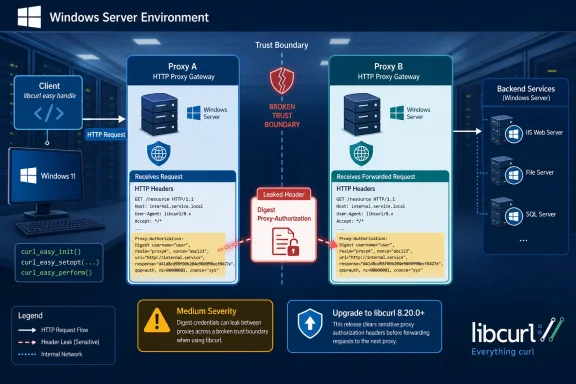 The Bug Is Small, but the Trust Boundary Is Not
The mechanical flaw in CVE-2026-7168 is almost deceptively narrow. A libcurl-using application authenticates to one HTTP proxy using Digest authentication, then changes the proxy host and performs a second transfer through a different proxy while reusing the same easy handle. Under the vulnerable condition, libcurl can send the Proxy-Authorization header intended for the first proxy to the second proxy.That header is not a password in the crude sense of a reusable plaintext secret. Digest authentication was designed to avoid sending the password itself over the wire. But the header still carries authenticated state, and the curl advisory is explicit that a malicious second proxy could use the leaked material to impersonate the client when communicating with the first proxy.
That makes this a boundary-crossing bug. The client thought it was talking to proxy A, then proxy B, with separate authentication contexts. The library blurred that boundary by allowing state associated with A to ride along to B.
The mitigating detail is important: the second proxy does not automatically learn the name or address of the first proxy from the leaked request details. That limits exploitability. But mitigated is not the same as harmless, especially in managed networks where proxy names, routing conventions, and authentication realms are often guessable by insiders or discoverable through surrounding infrastructure.
This Is a libcurl Problem, Not a curl.exe Meltdown
The curl project says CVE-2026-7168 affects libcurl versions from 7.12.0 through 8.19.0, and that versions before 7.12.0 and 8.20.0 or later are not affected. The project also says the issue was reported on April 27, 2026, and fixed with curl 8.20.0 on April 29, coordinated with the advisory publication.For Windows users, the first instinct is to type
curl --version, compare numbers, and assume the machine is either safe or doomed. That instinct is only partly useful. Windows 10 and Windows 11 include a Microsoft-built curl command-line tool, and the curl project’s own Windows page has long noted that Microsoft manages the version shipped as part of the operating system.But CVE-2026-7168 is specifically described as a libcurl issue that does not affect the curl command-line tool. That distinction matters. The command-line executable is the visible part of the iceberg; libcurl is the library embedded by other software, including installers, updaters, agents, device-management utilities, backup tools, monitoring collectors, and application runtimes.
The Windows relevance therefore depends less on whether a helpdesk technician ever runs
curl.exe, and more on whether an application on the system uses a vulnerable libcurl build in the vulnerable pattern. That is the difference between a desktop curiosity and an enterprise exposure.The Exploit Chain Needs a Particular Kind of Mess
CVE-2026-7168 is not the sort of vulnerability that lets an attacker fling a packet at a Windows host and seize the machine. It requires a very specific sequence: Digest proxy authentication, successful use of one proxy, a switch to another proxy, and reuse of the same libcurl handle. Remove any one of those ingredients, and the bug becomes irrelevant.That specificity is why the severity is medium rather than critical. It is also why security teams should resist both extremes: dismissing it because the conditions are narrow, or treating it like a universal credential dump. The right posture is to ask whether your environment has the kind of software that rotates proxies, fails over between proxies, or brokers traffic across multiple proxy endpoints while maintaining long-lived libcurl handles.
Those patterns are not exotic. Enterprise software often supports primary and secondary proxies. Security products may relay traffic through different inspection paths. Cloud agents may use one proxy for metadata retrieval and another for package downloads. Internal developer tools may switch proxies depending on destination, environment, or customer tenant.
The bug becomes most interesting in exactly those places where proxying is supposed to be invisible. The more automated and abstracted the network path, the harder it is for administrators to know when one application is silently moving from proxy A to proxy B without rebuilding its authentication state.
Digest Authentication Shows Its Age Under Modern Deployment Pressure
Digest authentication occupies an awkward place in 2026. It is better than Basic authentication because it avoids sending the raw password, yet it is still bound to assumptions about realms, nonces, request construction, and stateful exchanges that are easy to mishandle in complex client libraries.The vulnerability is classified as authentication bypass by capture-replay, which fits the underlying concern: authenticated material intended for one party can be replayed or misused by another. That does not mean every leaked header yields instant access. It means the library has allowed authentication state to escape its intended context.
In older network designs, a user’s machine might have had one configured proxy and one predictable path out of the organization. In modern fleets, proxy selection can be dynamic. Developers run local proxies. VPN clients install traffic-steering components. Endpoint detection tools inspect outbound flows. Containers and build systems inherit proxy variables. Cloud workloads may have one policy for package mirrors and another for external APIs.
That is how a bug in a decades-old authentication mode becomes relevant again. The technology is old, but the deployment patterns around it have become more complex, not less.
Microsoft’s Role Is Supply Chain Steward, Not Original Author
The source material points readers to Microsoft’s Security Response Center page, but the bug is not a Microsoft-authored protocol failure. It is a curl/libcurl vulnerability tracked through the broader vulnerability ecosystem, with Microsoft surfacing it because Windows and Microsoft products intersect with curl in ways that matter to customers.That distinction is worth making because Windows administrators have learned, painfully, that “Microsoft CVE page exists” can mean several different things. Sometimes Microsoft owns the affected code. Sometimes Microsoft ships a third-party component. Sometimes Microsoft is publishing VEX-style information about whether a component is affected in a particular product context. Sometimes the answer varies by product, channel, and build.
Here, the useful mental model is open-source component risk. Microsoft ships curl with Windows, and many Microsoft-adjacent environments contain libcurl through development tools, Linux containers, WSL distributions, package managers, Git tooling, language runtimes, and third-party agents. The vulnerability follows the component and the usage pattern, not the Microsoft logo.
That is why blindly asking “Is Windows affected?” is less useful than asking “Where do we use libcurl, which version is it, and can any of those applications reuse handles across different Digest-authenticated proxies?” The second question is harder. It is also the only one that maps to the bug.
The Patch Is Simple; Finding the Right Copy Is Not
The curl project’s preferred fix is to upgrade curl and libcurl to 8.20.0 or later. If upgrading is not immediately possible, applying the patch and rebuilding is the next-best answer. If neither can happen, applications can avoid reusing handles when changing proxies.That mitigation is unusually concrete. It gives developers something precise to inspect: code paths that call libcurl, configure proxy authentication, switch proxy host settings, and reuse handles. It also gives administrators a practical question to ask vendors: does your product use libcurl with Digest-authenticated proxies, and have you incorporated the 8.20.0 fix or equivalent patch?
The operational problem is that libcurl rarely lives in one place. On Windows, the inbox
curl.exe is not the only curl-derived artifact on a machine. Applications may bring their own libcurl.dll, statically link libcurl, hide it inside plugin directories, or package it into containers and appliances. Vulnerability scanners may flag one copy while missing another.This is where many organizations lose time. They chase the visible binary in
System32 because it is easy to find, while the more relevant copy is sitting inside a vendor agent or application bundle. CVE-2026-7168 is a reminder that component inventory is not a compliance nicety; it is the difference between patching the thing you can see and fixing the thing that can actually leak state.Windows Shops Should Look Beyond the Base OS
For a typical consumer Windows 11 PC, this issue is unlikely to be a practical concern. Most home users are not using Digest-authenticated enterprise proxies, are not running applications that rotate between multiple proxy hosts, and are not exposing hostile second proxies inside a managed network path. That does not make the CVE fake; it just means the threat model is enterprise-shaped.For WindowsForum’s sysadmin audience, the more relevant targets are managed endpoints, build servers, jump boxes, CI runners, developer workstations, and packaged enterprise software. These machines are more likely to have proxy variables, vendor agents, internal package repositories, and custom network routing. They are also more likely to use software that embeds libcurl rather than shelling out to the Windows curl command-line tool.
Security teams should pay special attention to environments where the proxy itself is treated as a security control. If an organization uses authenticated proxies to enforce egress policy, log user activity, or separate network zones, a cross-proxy authentication leak is not just a library bug. It is a failure mode in the control plane.
The practical risk rises if an attacker can influence the second proxy endpoint. That might mean a malicious internal proxy, a compromised failover proxy, a developer-controlled proxy in a test environment, or a configuration path that lets a lower-trust component redirect traffic. The bug is narrow, but enterprise networks are full of weird paths.
Scanner Output Will Be Noisier Than the Actual Risk
Expect CVE-2026-7168 to show up in vulnerability dashboards because the affected version range is broad: 7.12.0 through 8.19.0 spans more than two decades of curl history. That does not mean every finding is exploitable. It means the scanner found a version that might contain the vulnerable code.The reachability question is the hard part. Is libcurl actually used? Does the product enable HTTP proxy Digest authentication? Does it ever switch proxy hosts on a reused handle? Can an attacker control or observe the second proxy? Is there compensating network isolation? These are not questions most version-based scanners can answer automatically.
VEX data is supposed to help here by allowing vendors to say whether a vulnerability is exploitable in a particular product. But VEX only works when it is timely, specific, and consumed by tools that administrators trust. Otherwise it becomes one more feed in an already crowded vulnerability-management pipeline.
The most mature response is to split the issue into two queues. Patch or upgrade anything you own and build. Ask vendors for product-specific status on anything they ship. Suppress nothing merely because the CVSS score says medium, but escalate nothing merely because the affected version range looks ancient and scary.
The Old Handle-Reuse Pattern Keeps Biting
The underlying programming lesson is almost boring: state is sticky. Libcurl’s easy handles are designed to be reused, and reuse is a performance and convenience feature. But reuse also means the caller and the library must agree about which state survives from one transfer to the next.Cookies, authentication headers, connection pools, DNS cache entries, TLS sessions, proxy settings, and protocol negotiation all create state. Most of the time, that state is useful. Sometimes it crosses a boundary the caller assumed was clean.
CVE-2026-7168 fits a class of bugs where the vulnerability is not in a cryptographic primitive or a spectacular memory corruption flaw, but in lifecycle management. Something should have been reset when the context changed. It was not. The resulting leak is small in bytes but large in implication.
For developers, the lesson is to treat proxy changes as security-boundary changes. If a handle authenticated to one proxy, moving that handle to another proxy should be viewed with the same suspicion as reusing a browser session across tenants. Convenience is not a security model.
The Windows Admin Playbook Is Boring, Which Is Good
The immediate work for Windows administrators is not dramatic. Do not deletecurl.exe from System32. Do not assume that replacing a Microsoft-managed system binary with an upstream build is a supported enterprise mitigation. Do not close the ticket just because the curl command-line tool is not affected.Instead, start with software inventory. Identify systems and products that include libcurl, especially those that bundle their own DLLs or ship network agents. Prioritize servers and endpoints that operate behind authenticated proxies. Look at build infrastructure and automation runners, because those environments often combine proxy gymnastics with long-lived processes.
Then move to vendor pressure. If a product embeds libcurl, the vendor should be able to say whether it uses the vulnerable proxy-authentication pattern and whether it has updated to curl 8.20.0 or backported the patch. Vague statements about “monitoring the issue” are not enough if the product handles outbound traffic through enterprise proxies.
Finally, give developers the mitigation language they need. If they cannot update immediately, they should avoid reusing libcurl handles when changing proxy hosts. That is not as good as patching, but it is directly aligned with the trigger condition.
The Real Risk Lives in the Hidden Copies
This CVE is a useful test of whether an organization understands its software supply chain beyond the operating system image. The vulnerable component may not be the one Windows users can see, and the risky behavior may not be visible in a normal endpoint scan.- CVE-2026-7168 affects libcurl versions 7.12.0 through 8.19.0 and is fixed in 8.20.0 or later.
- The flaw requires Digest proxy authentication, a proxy host change, and reuse of the same libcurl handle.
- The curl command-line tool is not considered affected in the same way, so
curl.exepanic is the wrong response. - Windows administrators should look for bundled or statically linked libcurl copies inside third-party applications, agents, and developer tooling.
- The best mitigation is upgrading or patching libcurl; the fallback is avoiding handle reuse when changing proxies.
- Scanner findings should be triaged by reachability and product behavior, not by version number alone.
References
- Primary source: MSRC
Published: 2026-06-03T01:40:02-07:00
Security Update Guide - Microsoft Security Response Center
 msrc.microsoft.com
- Related coverage: sentinelone.com
CVE-2026-7168: Haxx Curl Auth Bypass Vulnerability
CVE-2026-7168 is an authentication bypass vulnerability in Haxx Curl. Learn about its impact, affected versions, and mitigation methods.www.sentinelone.com
- Related coverage: vulnerability.circl.lu
Vulnerability-Lookup
Vulnerability-Lookup - Fast vulnerability lookup correlation from different sources.vulnerability.circl.lu - Related coverage: cvepremium.circl.lu
Vulnerability-Lookup
Vulnerability-Lookup - Fast vulnerability lookup correlation from different sources.cvepremium.circl.lu - Official source: learn.microsoft.com
Security considerations for Microsoft Entra application proxy - Microsoft Entra ID | Microsoft Learn
Learn about security considerations and architecture for using Microsoft Entra application proxy.learn.microsoft.com - Official source: microsoft.com
OAuth redirection abuse enables phishing and malware delivery | Microsoft Security Blog
OAuth redirection is being repurposed as a phishing delivery path. Trusted authentication flows are weaponized to move users from legitimate sign‑in pages to attacker‑controlled infrastructure.www.microsoft.com
- Related coverage: mondoo.com
CVE-2026-7168 | Mondoo Vulnerability Intelligence
CVE-2026-7168 - MEDIUM severity: cross-proxy Digest auth state leakmondoo.com - Related coverage: osv.dev

OSV - Open Source Vulnerabilities
Comprehensive vulnerability database for your open source projects and dependencies.
osv.dev
- Related coverage: curl.se
curl shipped by Microsoft
curl.se
- Related coverage: techlasi.com
curl.exe: Your Guide to Windows Command Line File Transfers
curl.exe is a powerful command-line tool built into Windows 10 and 11 that lets you transfer data to and from servers using URLs. If you need to downloadtechlasi.com - Related coverage: borncity.com
Windows 10/11: Microsoft still ships old version of cURL lib with vulnerabilities (Feb. 2023)Born's Tech and Windows World
[German]It’s a messy story that I’m posting here on the blog again. Microsoft fails to ship cURL with Windows 10/11 in such a way that the software is up to…borncity.com
