

Code:
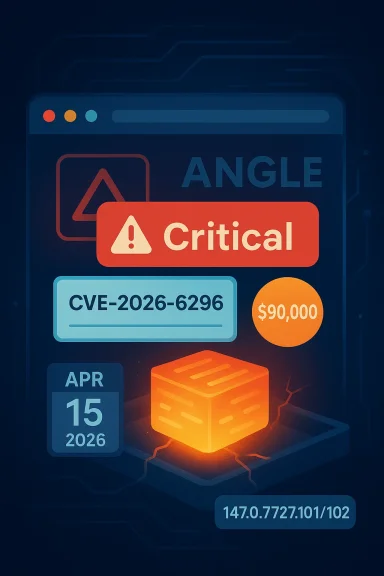
Chromium’s **CVE-2026-6296** is one of those browser bugs that looks routine on paper and alarming in practice: a **heap buffer overflow in ANGLE** that Google rated **Critical** and fixed in Chrome **147.0.7727.101** on April 15, 2026. The public description says a crafted HTML page could let a remote attacker potentially perform a **sandbox escape**, which immediately elevates the issue from a niche graphics-engine crash to a high-value exploitation path. Microsoft’s Security Update Guide is now tracking the CVE as part of the downstream Chromium ecosystem, which is exactly the kind of signal enterprise defenders watch when browser and web-runtime code needs urgent patching. has been part of Chromium’s security story for years, but it rarely gets the kind of mainstream attention that JavaScript engine flaws or UI spoofing bugs attract. That is partly because ANGLE sits lower in the stack, translating browser graphics calls into platform-native APIs, and partly because its failures often manifest as instability before they become obvious security headlines. Yet the April 2026 Chrome release shows that graphics-adjacent code can be every bit as dangerous as more visible browser components when attacker-controlled content can drive it into memory corruption.

The timing matters.nel update for desktop on April 15, 2026 shipped version **147.0.7727.101/102** for Windows and Mac and **147.0.7727.101** for Linux, with **31 security fixes** in the package. Among them, CVE-2026-6296 was singled out as the most expensive bounty item in the release notes, carrying a **$90,000** reward and a critical label. That combination usually tells security teams two things at once: the bug is both technically serious and likely difficult enough to exploit that Google wanted to encourage responsible reporting and rapid remediation. ([chromereleases.googleblog.com](https://chromereleases.googleblog.com/2026/04/stable-channel-update-for-desktop_15.html)

The broader context is the ongoing modernization of browser risk. Chromium is not just a web page renderer anymore; it is a sprawling platform layer that handles graphics, media, sandboxing, process isolation, JavaScript execution, and a long tail of web APIs. When a bug in ANGLE can be triggered through a crafted page and potentially be turned into sandbox escape, the fault line is no longer “just graphics.” It becomes a trust-boundary problem in a codebase that millions of desktops and enterprise environments depend on every day. ([chromereleases.googleblog.com](https://chromereleases.googleblog.com/2026/04/stable-channel-update-for-desktop_15.html)

Microsoft’s role is not incidental. The company has spent years formalizing the Security Update Guide as a place to track CVEs assigned by third parties and to help customers understand when a downstream product such as Edge inherits or resolves an upstream Chromium fix. Microsoft’s own guidance on the Security Update Guide emphasizes that it serves as a unified source for public security information and that industry-partner CVEs are part of the platform’s normal reporting flow. In practice, that makes the Microsoft entry less a separate vulnerability disclosure and more a patch-status beacon for Chromium-based consumers. ([msrc.microsoft.com](https://msrc.microsoft.com/blog/2024/02/new-security-advisory-tab-added-to-the-microsoft-security-update-guide/)

## What CVE-2026-6296 Means

The headline description is short, but it packs several important technical implications. A **heap buffer overflow** means attacker-controlled data can be written beyond an allocated memory boundary, which is exactly the kind of primitive that can enable corruption, process compromise, or chained exploitation. In Chrome’s own wording, the issue lives in ANGLE, is reaafted HTML page**, and may allow a **remote attacker** to “potentially perform a sandbox escape.” That last phrase is the real alarm bell, because browser sandbox escapes are the kind of post-exploitation step that can turn a contained browser compromise into a broader system threat.

### Why ANGLE matters

ANGLE is the abstraction layer Chromium uses to translate graphics operations into platform graphics APIs. That makes it a bridge between web content and local GPU handling, which is powerful but also risky because the browser must process untrusted input while maintaining strict memory and privilege boundaries. A bug here is not merely a rendering glitch; it is a memory-safety problem in a component that can be exercised by ordinary web content. ([chromereleases.googleblog.com](https://chromereleases.googleblog.com/2026/04/stable-channel-update-for-desktop_15.html)

A browser exploit chain often needs multiple stages, and ANGLE can be a useful stage if it provides memory corruption in a process already interacting with complex GPU or rendering state. Even if the bug is not independently sufficient for full code execution, a heap overflow can still become the foothold that attackers need to defeat mitigations. That is why criticality labels in browser advisories often reflect not just the defect type, but the exploitability landscape around it. ([chromereleases.googleblog.com](https://chromereleases.googleblog.com/2026/04/stable-channel-update-for-desktop_15.html)

### The sandbox-escape angle

The phrase *sandbox escape* changes the operational meaning of the CVE. Browsers are designed so that a compromise in the renderer or related subcomponents does not immediately grant broad system access, but bugs that cross process or sandbox boundaries can defeat that design. A memory-corruption flaw in a component that sits close to rendering and GPU pathways is exactly the sort of issue threat actors may try to chain with a separate logic bug or renderer exploit. ([chromereleases.googleblog.com](https://chromereleases.googleblog.com/2026/04/stable-channel-update-for-desktop_15.html)

That does not mean exploitation is trivial, and Google’s disclosure does not claim active exploitation in the public note. But the security model takeaway is clear: if a crafted page can trigger memory corruption in a browser component with a path to sandbox escape, defenders should treat the bug as a high-priority patch item, not as an isolated graphics defect. ([chromereleases.googleblog.com](https://chromereleases.googleblog.com/2026/04/stable-channel-update-for-desktop_15.html)

## The Patch and the Release Cadence

Google fixed CVE-2026-6296 in the April 15, 2026 desktop stable release, and that patch went out with Chrome **147.0.7727.101/102** on Windows and Mac and **147.0.7727.101** on Linux. The release note states that the update includes 31 security fixes, and the CVE was assigned a reward of **$90,000**, suggesting either substantial severity, exploitability concerns, or both. For administrators, this means the browser patch train itself is the primary mitigation path rather than any exotic workaround. ([chromereleases.googleblog.com](https://chromereleases.googleblog.com/2026/04/stable-channel-update-for-desktop_15.html)

### Release-note signals defenders should notice

Release notes are often the first and best signal for browser risk triage. The Chrome team explicitly notes that bug details may remain restricted until a majority of users are updated, and the company also says restrictions can remain in place when a flaw exists in a third-party library that other projects depend on. That language is especially relevant for ANGLE, because graphics layers often ripple across downstream projects and embedded browser integrations. ([chromereleases.googleblog.com](https://chromereleases.googleblog.com/2026/04/stable-channel-update-for-desktop_15.html)

The fact that this vulnerability appears alongside another critical ANGLE-related entry in the same April cycle only underscores the pressure points in that subsystem. Even if each issue has a different trigger or exploit path, repeated critical findings in the same component family should make defenders think in terms of *systemic hardening*, not just single-CVE remediation. In browser security, clustering is often a sign of a hot attack surface. ([chromereleases.googleblog.com](https://chromereleases.googleblog.com/2026/04/stable-channel-update-for-desktop.html)

### What the version number implies

Version **147.0.7727.101** is not just a string for changelogs. It identifies a specific security state of the browser, and for enterprises it becomes the compliance anchor for patch validation, asset inventory checks, and browser auto-update auditing. If a device is still on an earlier 147 build, it should be treated as unresolved until policy, telemetry, or direct version checks confirm otherwise. ([chromereleases.googleblog.com](https://chromereleases.googleblog.com/2026/04/stable-channel-update-for-desktop_15.html)

This matters because Chrome’s update cadence is deliberately fast. Security fixes often arrive before public exploit discourse matures, and that leaves a narrow window where defenders can still get ahead of attackers if their patching and browser-management systems are disciplined. The April release is a good reminder that browser patch SLAs should be measured in days, not weeks, for critical engine-level issues. ([chromereleases.googleblog.com](https://chromereleases.googleblog.com/2026/04/stable-channel-update-for-desktop_15.html)

## Why This Is More Than a Chrome Bug

Because Chromium sits underneath so many browsers and web runtimes, a Chrome CVE is often really an ecosystem event. Google’s upstream fix is the first move, but downstream consumers need to ingest it, validate it, and distribute it in their own release channels. Microsoft’s Security Update Guide exists partly to make that downstream visibility easier, especially for products like Edge that ride Chromium’s codebase. ([msrc.microsoft.com](https://msrc.microsoft.com/blog/2021/01/security-update-guide-supports-cves-assigned-by-industry-partners/)

### Downstream browsers inherit the risk

Microsoft has documented for years that the Security Update Guide includes CVEs assigned by industry partners and that it uses those entries to help customers understand vulnerability status for Microsoft products and bundled open-source components. In Chromium’s case, that means Edge users do not wait for Microsoft to “fix” Chrome’s bug in the abstract; they wait for the Edge channel to ingest the upstream Chromium change and publish a version with the vulnerability closed. ([msrc.microsoft.com](https://msrc.microsoft.com/blog/2021/01/security-update-guide-supports-cves-assigned-by-industry-partners/)

That distinction is subtle but operationally important. Security teams sometimes misread an MSRC listing as a Microsoft-authored bug when, in reality, it can be a tracking artifact for upstream code consumed by a Microsoft product. In this case, that downstream visibility is useful precisely because it aligns patch verification across vendors rather than duplicating disclosure work. ([msrc.microsoft.com](https://msrc.microsoft.com/blog/2021/01/security-update-guide-supports-cves-assigned-by-industry-partners/)

### The browser monoculture problem

The more Chromium dominates the desktop browsing market, the more a single upstream memory-safety bug can shape the exposure profile of the whole web stack. That does not mean all browsers are equally affected in practice, but it does mean the same code family can reach a huge installed base through multiple branded products. A defect in ANGLE therefore becomes a platform-wide concern, not a one-browser annoyance. ([chromereleases.googleblog.com](https://chromereleases.googleblog.com/2026/04/stable-channel-update-for-desktop_15.html)

This is why browser diversity still matters as a resilience strategy. Even where users do not deliberately install multiple browsers, the ecosystem’s dependence on Chromium means the same vulnerability can have implications for embedded web views, desktop clients, and enterprise software that reuses browser components. The patch payload may be simple; the blast radius is not. ([msrc.microsoft.com](https://msrc.microsoft.com/blog/2021/01/security-update-guide-supports-cves-assigned-by-industry-partners/)

## Enterprise Exposure and Patch Prioritization

Enterprises should treat CVE-2026-6296 as a **priority browser patch** because it combines remote reachability, memory corruption, and a possible sandbox escape. Those three factors together make it the kind of issue that security operations teams should move toward accelerated remediation, especially on systems with heavy web-app usage, privileged browser workflows, or sensitive identity sessions. ([chromereleases.googleblog.com](https://chromereleases.googleblog.com/2026/04/stable-channel-update-for-desktop_15.html)

### What defenders should do first

The first step is straightforward: verify that managed Chrome endpoints are on **147.0.7727.101 or later** and that any downstream Chromium-based browsers have absorbed the equivalent fix in their own release channel. Enterprises should not assume that one browser’s update cadence covers another’s, even if both are Chromium-based. ([chromereleases.googleblog.com](https://chromereleases.googleblog.com/2026/04/stable-channel-update-for-desktop_15.html)

A second step is to check for browser version drift in remote fleets, VDI environments, kiosk deployments, and devices with postponed auto-update behavior. The very environments that are easiest to overlook are often the ones where an exploit can be most valuable, because users tend to have persistent sessions, broad access, or weak endpoint visibility. *Lagging patch channels* are a recurring problem in browser security, and this CVE is exactly the kind of issue that exploits that lag. ([chromereleases.googleblog.com](https://chromereleases.googleblog.com/2026/04/stable-channel-update-for-desktop_15.html)

A third step is to ensure endpoint detection and response tooling is tuned to browser process anomalies. Even if the exploit path remains unpublished, memory-corruption bugs in graphics and rendering code often show up through unusual crashes, renderer instability, or suspicious child-process behavior before they become fully weaponized. That does not replace patching, but it helps narrow the window if a proof-of-concept emerges. ([chromereleases.googleblog.com](https://chromereleases.googleblog.com/2026/04/stable-channel-update-for-desktop_15.html)

### Enterprise vs. consumer impact

For consumers, the message is simple: update Chrome promptly, and if you use a Chromium-based browser, check its version history. Chrome’s automatic update machinery will help most people, but delays still happen, especially on managed devices or browsers that are not the user’s default. ([chromereleases.googleblog.com](https://chromereleases.googleblog.com/2026/04/stable-channel-update-for-desktop_15.html)

For enterprises, the issue is more complex because browser patching often intersects with app compatibility, extension management, policy enforcement, and change-control windows. That means security teams may need to balance urgent deployment with validation in mission-critical web apps. The danger is that the very controls used to reduce risk can slow the patch rollout enough to widen exposure. ([msrc.microsoft.com](https://msrc.microsoft.com/blog/2021/01/security-update-guide-supports-cves-assigned-by-industry-partners/)

## How CVE Tracking Works Across Google and Microsoft

The Chrome release note and the Microsoft Security Update Guide are two sides of the same remediation story. Google discloses the upstream vulnerability and ships the fix; Microsoft, as an ecosystem consumer of Chromium, helps customers understand when downstream products such as Edge have inherited the fix and no longer share the exposure. That division of labor is healthy, but it can also confuse readers who expect a one-to-one mapping between disclosure and vendor ownership. ([chromereleases.googleblog.com](https://chromereleases.googleblog.com/2026/04/stable-channel-update-for-desktop_15.html)

### Why Microsoft lists Chromium CVEs

Microsoft has explicitly said the Security Update Guide supports CVEs assigned by industry partners and that it uses those entries to describe vulnerabilities in open-source libraries bundled in Microsoft products. In other words, an MSRC listing for a Chromium CVE is often a transparency mechanism, not a duplicate bug report. That is especially helpful for administrators who need a single place to confirm whether an Edge build is still vulnerable. ([msrc.microsoft.com](https://msrc.microsoft.com/blog/2021/01/security-update-guide-supports-cves-assigned-by-industry-partners/)

That model is also part of Microsoft’s broader push toward machine-readable security advisories and more transparent vulnerability data. Over time, the company has positioned the Security Update Guide as a more authoritative, programmatic source for customers who need to ingest patch metadata into their own systems. For defenders, that is less glamorous than a flashy exploit write-up, but often more useful. ([msrc.microsoft.com](https://msrc.microsoft.com/blog/2024/11/toward-greater-transparency-publishing-machine-readable-csaf-files/)

### A practical takeaway for Edge users

If you are running Microsoft Edge, the key question is not whether the CVE appears in Google’s release notes or Microsoft’s advisory catalog. The key question is whether your installed Edge version has already absorbed the upstream Chromium fix. The same logic applies to any other Chromium-based browser or application that embeds the engine. ([msrc.microsoft.com](https://msrc.microsoft.com/blog/2021/01/security-update-guide-supports-cves-assigned-by-industry-partners/)

That is why patch verification should be version-based, not assumption-based. In the browser world, branding tells you very little about actual vulnerability state; build number and channel tell you far more. The more enterprise software relies on embedded Chromium, the more this distinction will matter. ([msrc.microsoft.com](https://msrc.microsoft.com/blog/2021/01/security-update-guide-supports-cves-assigned-by-industry-partners/)

## The Security Economics of a Critical ANGLE Bug

The **$90,000** bounty attached to CVE-2026-6296 is more than a vanity number. In browser vulnerability economics, bounty size tends to reflect the perceived severity, depth of exploitation research required, and strategic importance of the bug class. A large reward in a graphics subsystem suggests Google viewed the report as both valuable and difficult to find. ([chromereleases.googleblog.com](https://chromereleases.googleblog.com/2026/04/stable-channel-update-for-desktop_15.html)

### Why bug bounties matter here

High rewards incentivize researchers to keep digging into memory-safety bugs in complex components rather than focusing only on the most obvious surfaces. That is especially important for subsystems like ANGLE, where graphics abstractions and platform-specific code paths can hide subtle boundary errors. A large bounty also helps keep disclosure within the responsible-reporting channel rather than pushing findings toward underground markets. ([chromereleases.googleblog.com](https://chromereleases.googleblog.com/2026/04/stable-channel-update-for-desktop_15.html)

The other economic signal is the label **Critical**. Google does not hand out that classification casually, and the combination of a heap overflow plus sandbox escape language gives the bug the sort of severity profile that attracts both researchers and attackers. In that sense, the bounty is a marketplace signal that the defensive value of the patch is high. ([chromereleases.googleblog.com](https://chromereleases.googleblog.com/2026/04/stable-channel-update-for-desktop_15.html)

### What this means for the broader browser market

For rival browser vendors, these Chrome release cycles are not just news items; they are engineering inputs. Any browser built on Chromium inherits the same core risk, while independent engines can still learn from the class of bug and harden similar pathways. The market impact is therefore asymmetric: Chromium-based browsers can move quickly by importing the fix, but they are also tied to the same upstream attack surface. ([msrc.microsoft.com](https://msrc.microsoft.com/blog/2021/01/security-update-guide-supports-cves-assigned-by-industry-partners/)

That creates a feedback loop in which upstream engineering quality becomes a competitive differentiator. Browsers with better update velocity, stronger sandboxing, and tighter component isolation can turn security responsiveness into a product advantage. In 2026, that is no longer a niche enterprise concern; it is a mainstream user trust issue. ([msrc.microsoft.com](https://msrc.microsoft.com/blog/2021/01/security-update-guide-supports-cves-assigned-by-industry-partners/)

## Related Signals and Pattern Recognition

CVE-2026-6296 is not an isolated reminder that ANGLE is under pressure. Chrome’s April 2026 update page also includes a separate ANGLE-related entry, **CVE-2026-5879**, described as insufficient validation of untrusted input in ANGLE. Even without overreading the relationship between the two issues, that clustering suggests the graphics translation layer remains a lively target surface for memory-safety and input-validation bugs. ([chromereleases.googleblog.com](https://chromereleases.googleblog.com/2026/04/stable-channel-update-for-desktop.html)

### What clustering tells us

When the same component family shows multiple issues in adjacent release cycles, defenders should infer that the subsystem is hard to secure under real-world constraints. Graphics code is notoriously complicated, and browser engines must interact with hardware, drivers, and platform APIs that vary widely across devices. That complexity does not excuse bugs, but it explains why even mature codebases continue to produce critical CVEs. ([chromereleases.googleblog.com](https://chromereleases.googleblog.com/2026/04/stable-channel-update-for-desktop_15.html)

The right operational response is to assume that a single fix may not be the last fix. Security teams should monitor the component, not just the CVE, and maintain a policy of fast browser updates even after one issue appears resolved. The pattern here is a reminder that *patch complacency* is the enemy of browser security. ([chromereleases.googleblog.com](https://chromereleases.googleblog.com/2026/04/stable-channel-update-for-desktop_15.html)

### Bullet takeaways

- **ANGLE remains a sensitive attack surface** because it sits close to browser graphics translation and untrusted content handling. ([chromereleases.googleblog.com](https://chromereleases.googleblog.com/2026/04/stable-channel-update-for-desktop_15.html)
- **Critical memory-safety bugs** in this layer can plausibly support broader exploit chains. ([chromereleases.googleblog.com](https://chromereleases.googleblog.com/2026/04/stable-channel-update-for-desktop_15.html)
- **Downstream browsers inherit the urgency**, even when the upstream fix originates at Google. ([msrc.microsoft.com](https://msrc.microsoft.com/blog/2021/01/security-update-guide-supports-cves-assigned-by-industry-partners/)
- **Version checks matter more than assumptions** in Chromium-based environments. ([chromereleases.googleblog.com](https://chromereleases.googleblog.com/2026/04/stable-channel-update-for-desktop_15.html)

## Strengths and Opportunities

The good news is that this vulnerability fits a patchable pattern. Google has already shipped the fix, Microsoft is tracking Chromium-origin issues in its advisory ecosystem, and administrators have clear version markers to verify. That gives security teams a narrow but workable window to reduce risk quickly, provided they act with discipline rather than waiting for a convenient maintenance cycle. ([chromereleases.googleblog.com](https://chromereleases.googleblog.com/2026/04/stable-channel-update-for-desktop_15.html)

- **Clear fixed version**: Chrome **147.0.7727.101** provides a concrete remediation target. ([chromereleases.googleblog.com](https://chromereleases.googleblog.com/2026/04/stable-channel-update-for-desktop_15.html)
- **Strong vendor signaling**: The **Critical** label and large bounty help prioritize response. ([chromereleases.googleblog.com](https://chromereleases.googleblog.com/2026/04/stable-channel-update-for-desktop_15.html)
- **Cross-vendor visibility**: Microsoft’s Security Update Guide helps Edge customers track upstream Chromium fixes. ([msrc.microsoft.com](https://msrc.microsoft.com/blog/2024/02/new-security-advisory-tab-added-to-the-microsoft-security-update-guide/)
- **Actionable version checks**: Endpoint teams can validate exposure with browser build numbers. ([chromereleases.googleblog.com](https://chromereleases.googleblog.com/2026/04/stable-channel-update-for-desktop_15.html)
- **Rapid update pipeline**: Chromium’s release cadence helps compress the vulnerable window. ([chromereleases.googleblog.com](https://chromereleases.googleblog.com/2026/04/stable-channel-update-for-desktop_15.html)
- **Opportunity for hardening**: The bug reinforces the case for stricter sandboxing and memory-safety work in graphics code. ([chromereleases.googleblog.com](https://chromereleases.googleblog.com/2026/04/stable-channel-update-for-desktop.html)

## Risks and Concerns

The main concern is that the public description already points to a potentially high-value exploit primitive: a remote, page-triggerable heap overflow with sandbox-escape language attached. That means the issue is not just about browser stability, but about the possibility of chained compromise in environments that assume the browser sandbox is enough to contain web attacks. *That assumption is exactly what attackers love to test.* ([chromereleases.googleblog.com](https://chromereleases.googleblog.com/2026/04/stable-channel-update-for-desktop_15.html)

Another concern is lag in downstream adoption. Even when Google publishes a fix quickly, enterprise deployment realities can leave many machines on older builds for days or longer, especially in managed environments with staged rollouts. If a proof of concept emerges during that lag, the exposed population can be large enough to matter operationally. ([chromereleases.googleblog.com](https://chromereleases.googleblog.com/2026/04/stable-channel-update-for-desktop_15.html)

- **Potential sandbox escape** raises the stakes beyond a normal browser crash. ([chromereleases.googleblog.com](https://chromereleases.googleblog.com/2026/04/stable-channel-update-for-desktop_15.html)
- **Delayed enterprise rollout** can prolong exposure even after patch availability. ([msrc.microsoft.com](https://msrc.microsoft.com/blog/2021/01/security-update-guide-supports-cves-assigned-by-industry-partners/)
- **Chromium dependency spread** means multiple products may share the same vulnerable code. ([msrc.microsoft.com](https://msrc.microsoft.com/blog/2021/01/security-update-guide-supports-cves-assigned-by-industry-partners/)
- **Graphics subsystem complexity** increases the chance of additional related findings. ([chromereleases.googleblog.com](https://chromereleases.googleblog.com/2026/04/stable-channel-update-for-desktop.html)
- **Version confusion** can leave teams believing they are patched when they are not. ([msrc.microsoft.com](https://msrc.microsoft.com/blog/2021/01/security-update-guide-supports-cves-assigned-by-industry-partners/)
- **Exploit chaining risk** remains significant even if the bug is not independently sufficient for full compromise. ([chromereleases.googleblog.com](https://chromereleases.googleblog.com/2026/04/stable-channel-update-for-desktop_15.html)

## Looking Ahead

The immediate question is less whether the bug is serious and more how quickly the ecosystem can converge on the fixed build. Google has already done the first part by shipping the April 15 stable update, and Microsoft’s advisory framework is doing its usual job of mapping upstream Chromium security work into downstream product visibility. The next phase is patch adoption, and that is where the real operational variance will show up. ([chromereleases.googleblog.com](https://chromereleases.googleblog.com/2026/04/stable-channel-update-for-desktop_15.html)

Longer term, CVE-2026-6296 reinforces a familiar but uncomfortable lesson: browser security lives and dies on memory safety, sandbox boundaries, and fast release engineering. As Chromium continues to expand its reach across desktop browsers, embedded apps, and enterprise workflows, the importance of patch transparency and update discipline will only grow. *The bug may be specific; the lesson is universal.* ([chromereleases.googleblog.com](https://chromereleases.googleblog.com/2026/04/stable-channel-update-for-desktop_15.html)

- Track Chrome and Chromium-based browser versions against **147.0.7727.101** or later. ([chromereleases.googleblog.com](https://chromereleases.googleblog.com/2026/04/stable-channel-update-for-desktop_15.html)
- Confirm downstream browsers and embedded runtimes have ingested the upstream fix. ([msrc.microsoft.com](https://msrc.microsoft.com/blog/2021/01/security-update-guide-supports-cves-assigned-by-industry-partners/)
- Watch for related ANGLE disclosures and nearby graphics-surface CVEs. ([chromereleases.googleblog.com](https://chromereleases.googleblog.com/2026/04/stable-channel-update-for-desktop.html)
- Prioritize high-risk endpoints with privileged browser use or sensitive web workflows. ([chromereleases.googleblog.com](https://chromereleases.googleblog.com/2026/04/stable-channel-update-for-desktop_15.html)
- Expect more scrutiny of memory-safe alternatives and sandbox hardening across browser engines. ([msrc.microsoft.com](https://msrc.microsoft.com/blog/2021/01/security-update-guide-supports-cves-assigned-by-industry-partners/)

CVE-2026-6296 is the kind of Chromium issue that makes the case for aggressive browser patching without needing much rhetorical flourish. A critical heap overflow in ANGLE, a release note that explicitly mentions sandbox escape, and a downstream advisory ecosystem all point in the same direction: this is a vulnerability category that defenders should move on quickly and verify carefully. In a world where the browser is effectively the front door to identity, collaboration, and cloud work, speed and certainty are no longer optional security habits; they are the difference between a patched desktop and a breach waiting for an opportunity. ([chromereleases.googleblog.com](https://chromereleases.googleblog.com/2026/04/stable-channel-update-for-desktop_15.html)
Source: NVD / Chromium Security Update Guide - Microsoft Security Response Center
