

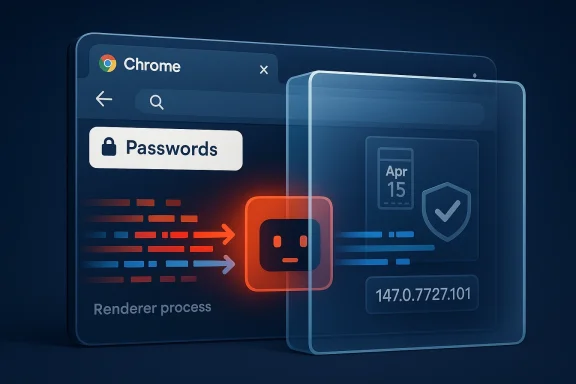
Insufficient policy enforcement bugs in Chromium continue to be a reminder that browser security is often won or lost at the seams between isolation boundaries, not just in the core rendering engine. CVE-2026-6312 fits that pattern: Google says a remote attacker who had already compromised the renderer process could use a crafted HTML page to leak cross-origin data through the Passwords feature in Chrome prior to 147.0.7727.101. Google classifies the issue as High, and the stable-channel fix landed on April 15, 2026.
Chromium’s security model is built around the assumption that the browser process, renderer process, and site isolation barriers do not all fail at once. That is why vulnerabilities described as “insufficient policy enforcement” matter so much: they do not usually hand an attacker full control by themselves, but they can turn a limited foothold into a meaningful data exposure event. In this case, the sensitive surface is the Passwords component, which strongly suggests the bug involved a trust decision that was meant to keep one origin from reading data belonging to another.
The wording of the advisory matters. Google did not say this was a one-click drive-by compromise of a fully patched browser from the open web. Instead, the description says the attacker had already compromised the renderer process, which means CVE-2026-6312 is best understood as a post-exploitation privilege boundary failure. That distinction lowers the likely attack surface, but it also raises the urgency for defenders, because renderer compromise is exactly the sort of foothold an attacker can gain through a separate Chromium bug chain.
This is also not an isolated pattern. Chrome’s recent stable-channel notes have repeatedly included insufficient policy enforcement vulnerabilities across different features, including PDF, DevTools, WebUSB, ChromeDriver, and CORS-adjacent components. The recurring theme is that modern browsers expose many specialized subsystems that are individually useful and collectively risky if policy checks are too permissive, incomplete, or applied at the wrong layer.
For Microsoft customers, the issue matters because the Microsoft Security Response Center is tracking the CVE in its update guide, which is a strong signal that enterprise vulnerability management teams will see it in their dashboards and patch planning workflows. Even when the vulnerable code lives in a third-party browser, the operational burden still lands on Windows administrators, endpoint managers, and security teams who need to assess exposure, update channels, and managed-browser rollouts.
The Passwords subsystem is especially sensitive because it sits close to credential handling, autofill flows, and origin-based access decisions. A vulnerability there is not just another browser bug; it potentially becomes a pathway into stored secrets, session-adjacent information, or other cross-origin material a user never intended to expose. Even though the advisory is short on implementation detail, the phrase “leak cross-origin data” is enough to show that the security boundary under discussion is the same one browsers use to keep the web from becoming a free-for-all data pool.
There is also a historical echo here. Microsoft has issued earlier advisories for browser information-disclosure issues that allowed attackers to learn data they should not have been able to access, and those advisories repeatedly emphasized that such bugs rarely enable code execution directly but can still contribute to deeper compromise. That old lesson remains current: information disclosure is often the quiet first step in a longer intrusion chain, not the final objective.
The CVE metadata reinforces the same picture. NVD’s record shows the item as newly received from Chrome on April 15, 2026, with the description carrying Chrome’s severity classification of High and the stable-release reference pointing to the desktop update page. At the time of this writing, NVD’s assessment remains in enrichment and does not yet supply its own base score, which is common while a record is being normalized from vendor data.
A subtle but important detail is that the stable-channel note lists the issue as reported by Google on 2026-03-31, even though the public release came later. That lag is standard in Chrome’s disclosure model: fixes are often staged internally, then publicly documented once the rollout threshold is acceptable. For defenders, the practical takeaway is simple: the patch date, not the disclosure date, is the date that should drive remediation urgency.
That is the kind of issue security teams should treat as a chain multiplier. A renderer compromise paired with a policy bypass can turn an otherwise limited browser exploit into credential harvesting, data collection, or session reconnaissance. In modern threat modeling, that is often enough to justify rapid patching, even when the initial bug does not look like classic remote code execution.
That matters because browser security updates are often misread as a single event. They are not. There is the day the vendor posts the fix, the days when binaries begin arriving on endpoints, the days when administrators approve deployment, and the days when lagging devices finally reconnect and update. For a browser issue that may touch credential data, those extra days can be the difference between a contained event and a broadly exploited one.
The presence of the CVE in Microsoft’s update guide makes it easier to align browser remediation with broader Windows vulnerability management. That does not mean Microsoft is responsible for fixing Chrome, but it does mean the issue is now visible within the same operational ecosystem as OS patches, endpoint protection, and enterprise reporting. For large environments, that visibility is often what turns a browser flaw into a ticket, a deadline, and a compliance artifact.
This matters because browser attack chains do not need novelty at every step. A single renderer-side exploit can become much more useful if it lands in a browser family where multiple privileged components have recently shown policy enforcement weaknesses. That does not prove a shared root cause, but it does indicate that the browser’s perimeter is under constant pressure from bugs that look more like authorization failures than classic memory corruption.
Administrators should also think about telemetry. If Chrome or EDR tooling can log unusual renderer crashes, odd origin transitions, or suspicious password-manager access patterns, those signals may matter during incident triage. Even if CVE-2026-6312 has not been publicly tied to active exploitation, the combination of a high-severity browser flaw and a renderer prerequisite is exactly the sort of scenario where proactive hunting can pay off. Waiting for confirmed exploitation is usually too late.
The good news is that Chrome’s auto-update system usually makes consumer remediation relatively painless. The bad news is that many users ignore browser restarts, run multiple profiles, or keep old machines online long after updates are available. In other words, the patch exists, but the protection only matters once it is actually installed and the browser has relaunched.
This is exactly why defenders should resist treating severity scores as the whole story. A low-to-moderate score can still become operationally severe if it provides access to data that enables theft, impersonation, or lateral movement. In browser-land, data exposure is often the fuel that powers the next exploit.
The longer-term question is more structural. If Chromium continues to generate policy-enforcement CVEs in feature after feature, then the browser ecosystem may need more systematic hardening around origin checks, process boundaries, and privileged UI surfaces. That does not mean Chrome is uniquely weak; it means modern browsers have become so capable that their attack surface has grown in proportion to their usefulness. Capability is the very thing that creates exposure.
What to watch next:
Source: NVD / Chromium Security Update Guide - Microsoft Security Response Center
 Overview
Chromium’s security model is built around the assumption that the browser process, renderer process, and site isolation barriers do not all fail at once. That is why vulnerabilities described as “insufficient policy enforcement” matter so much: they do not usually hand an attacker full control by themselves, but they can turn a limited foothold into a meaningful data exposure event. In this case, the sensitive surface is the Passwords component, which strongly suggests the bug involved a trust decision that was meant to keep one origin from reading data belonging to another.The wording of the advisory matters. Google did not say this was a one-click drive-by compromise of a fully patched browser from the open web. Instead, the description says the attacker had already compromised the renderer process, which means CVE-2026-6312 is best understood as a post-exploitation privilege boundary failure. That distinction lowers the likely attack surface, but it also raises the urgency for defenders, because renderer compromise is exactly the sort of foothold an attacker can gain through a separate Chromium bug chain.
This is also not an isolated pattern. Chrome’s recent stable-channel notes have repeatedly included insufficient policy enforcement vulnerabilities across different features, including PDF, DevTools, WebUSB, ChromeDriver, and CORS-adjacent components. The recurring theme is that modern browsers expose many specialized subsystems that are individually useful and collectively risky if policy checks are too permissive, incomplete, or applied at the wrong layer.
For Microsoft customers, the issue matters because the Microsoft Security Response Center is tracking the CVE in its update guide, which is a strong signal that enterprise vulnerability management teams will see it in their dashboards and patch planning workflows. Even when the vulnerable code lives in a third-party browser, the operational burden still lands on Windows administrators, endpoint managers, and security teams who need to assess exposure, update channels, and managed-browser rollouts.
Background
Chrome’s release process gives a useful window into how browser vendors handle serious but not immediately weaponized flaws. Google’s stable-channel update for April 15, 2026 shipped 31 security fixes, including CVE-2026-6312, and the note explicitly warns that bug details may be restricted until the majority of users are updated. That kind of staged disclosure is a familiar Chrome pattern, and it reflects the practical tension between transparency and the risk of enabling exploit development too early.The Passwords subsystem is especially sensitive because it sits close to credential handling, autofill flows, and origin-based access decisions. A vulnerability there is not just another browser bug; it potentially becomes a pathway into stored secrets, session-adjacent information, or other cross-origin material a user never intended to expose. Even though the advisory is short on implementation detail, the phrase “leak cross-origin data” is enough to show that the security boundary under discussion is the same one browsers use to keep the web from becoming a free-for-all data pool.
There is also a historical echo here. Microsoft has issued earlier advisories for browser information-disclosure issues that allowed attackers to learn data they should not have been able to access, and those advisories repeatedly emphasized that such bugs rarely enable code execution directly but can still contribute to deeper compromise. That old lesson remains current: information disclosure is often the quiet first step in a longer intrusion chain, not the final objective.
The CVE metadata reinforces the same picture. NVD’s record shows the item as newly received from Chrome on April 15, 2026, with the description carrying Chrome’s severity classification of High and the stable-release reference pointing to the desktop update page. At the time of this writing, NVD’s assessment remains in enrichment and does not yet supply its own base score, which is common while a record is being normalized from vendor data.
A subtle but important detail is that the stable-channel note lists the issue as reported by Google on 2026-03-31, even though the public release came later. That lag is standard in Chrome’s disclosure model: fixes are often staged internally, then publicly documented once the rollout threshold is acceptable. For defenders, the practical takeaway is simple: the patch date, not the disclosure date, is the date that should drive remediation urgency.
What the Vulnerability Likely Means
The bug description does not disclose exploit mechanics, but its language suggests a failure in how Chrome enforced a policy or permission boundary around password-related data. In browser terms, that usually means a check that should have limited access by origin, frame context, or renderer trust state did not fire reliably. That kind of issue is dangerous because policy mistakes are frequently more scalable than memory corruption: once the wrong decision is made, the browser may faithfully hand over data the attacker should never see.Renderer compromise changes the threat model
The advisory’s prerequisite is a major clue. If the attacker already controls the renderer, they are not starting from zero; they have already won the content-isolation battle and are now trying to escalate into something more valuable. CVE-2026-6312 therefore looks like a sandbox escape enabler in practical terms, even if Google did not label it that way. The exploit would not need to crash the browser or break the whole security model in one shot; it only needs to break the last rule that keeps privileged cross-origin data out of reach.That is the kind of issue security teams should treat as a chain multiplier. A renderer compromise paired with a policy bypass can turn an otherwise limited browser exploit into credential harvesting, data collection, or session reconnaissance. In modern threat modeling, that is often enough to justify rapid patching, even when the initial bug does not look like classic remote code execution.
Why “Passwords” is a high-value target
Passwords-related functionality in a browser usually sits near some combination of saved credentials, origin matching, auto-fill logic, and access mediation. If policy enforcement is imperfect, an attacker may be able to trick the browser into revealing state associated with a different site or frame context. The immediate impact may be limited to cross-origin data leakage, but the downstream effect can be much broader if that data is enough to stage account takeover or profile a target for follow-on intrusion.- The bug sits in a feature area tied to credential safety.
- The attacker prerequisite suggests a post-compromise escalation path.
- The likely outcome is data exposure, not direct code execution.
- The business risk is often larger than the CVSS number suggests.
- The real-world danger depends on what data the browser would leak.
Patch and Release Context
Google shipped the fix in Chrome 147.0.7727.101/102 for Windows and Mac and 147.0.7727.101 for Linux on April 15, 2026. The release note says the update would roll out over the coming days and weeks, which is the normal Chromium phased-distribution approach. In practice, that means enterprises should not assume all endpoints became safe immediately on the announcement date; managed environments often trail public release by policy, maintenance windows, or staged rollout design.Reading the stable-channel note correctly
The stable-channel advisory is more than a patch list. It is also Google’s signal that disclosure is now public enough for defenders to operationalize, but not necessarily detailed enough for attackers to reverse-engineer the bug easily. The note’s explicit reminder about restricted bug details is a standard Chrome safeguard, and it is meant to give defenders a short head start while patch adoption scales.That matters because browser security updates are often misread as a single event. They are not. There is the day the vendor posts the fix, the days when binaries begin arriving on endpoints, the days when administrators approve deployment, and the days when lagging devices finally reconnect and update. For a browser issue that may touch credential data, those extra days can be the difference between a contained event and a broadly exploited one.
Enterprise deployment implications
For enterprises, the update should be handled as a priority browser patch rather than folded into a routine monthly cycle. Chrome is often updated automatically, but managed fleets can have extension dependencies, policy gates, or ring-based rollout controls that delay adoption. Security teams should review whether their fleet is actually on 147.0.7727.101 or later, not merely whether Chrome has “recently updated.”The presence of the CVE in Microsoft’s update guide makes it easier to align browser remediation with broader Windows vulnerability management. That does not mean Microsoft is responsible for fixing Chrome, but it does mean the issue is now visible within the same operational ecosystem as OS patches, endpoint protection, and enterprise reporting. For large environments, that visibility is often what turns a browser flaw into a ticket, a deadline, and a compliance artifact.
- Patch to Chrome 147.0.7727.101 or newer.
- Verify both Windows/Mac and Linux fleets.
- Confirm rollout completion, not just policy approval.
- Check remote and unmanaged devices separately.
- Treat the issue as a browser security priority.
Similar Chrome Vulnerabilities Tell a Story
CVE-2026-6312 is easier to understand when viewed beside the other Chrome bugs disclosed around it. In the same April 15 release, Google also listed CVE-2026-6313: Insufficient policy enforcement in CORS, along with other high-severity issues in GPU, Permissions, Forms, and Dawn. That cluster suggests policy enforcement mistakes remain one of Chromium’s most persistent classes of defects, even as memory-safety bugs still dominate headlines.A recurring browser pattern
Earlier 2026 releases show the same motif. Chrome flagged insufficient policy enforcement in DevTools, PDF, ChromeDriver, and WebUSB, and NVD records for those CVEs repeat the same general story: a crafted HTML page or file could cause the browser to bypass the intended same-origin or navigation restrictions. The common thread is not the subsystem name, but the fact that policy boundaries are easy to get wrong when a product exposes many feature-rich APIs to the web.This matters because browser attack chains do not need novelty at every step. A single renderer-side exploit can become much more useful if it lands in a browser family where multiple privileged components have recently shown policy enforcement weaknesses. That does not prove a shared root cause, but it does indicate that the browser’s perimeter is under constant pressure from bugs that look more like authorization failures than classic memory corruption.
Why policy bugs are hard to eliminate
Policy bugs are difficult because they are about correctness across diverse contexts. The code must know not only who is asking, but from where, in what process, under what state, and through which UI or API path. The result is that small inconsistencies can become big security failures, especially in a browser where a single page can trigger dozens of subsystems that were never designed to trust one another implicitly.- They are often subsystem-specific.
- They can hide behind legitimate user flows.
- They may require a companion exploit to matter.
- They frequently expose cross-origin or privileged state.
- They can persist even when major memory-safety work improves.
Enterprise Impact
For enterprise administrators, CVE-2026-6312 should be treated as a browser data-exposure risk with potentially outsized operational implications. Even if the attacker must already have renderer access, that is still a realistic situation in the modern web threat model, especially for users who browse untrusted content, open malicious documents, or run extension-heavy browser profiles. The risk is highest on endpoints that also store corporate credentials, single sign-on material, or sensitive internal web application data in the browser.What security teams should check
The first question is obvious: are endpoints actually on the fixed version? But the second question is often more important: what other protections surround the browser? A fully patched Chrome build helps, but so do endpoint detection, isolation policies, extension controls, and restrictions on browser-based password storage for high-risk roles. The bug is a reminder that browser compromise often starts with a content channel, not a device-level exploit.Administrators should also think about telemetry. If Chrome or EDR tooling can log unusual renderer crashes, odd origin transitions, or suspicious password-manager access patterns, those signals may matter during incident triage. Even if CVE-2026-6312 has not been publicly tied to active exploitation, the combination of a high-severity browser flaw and a renderer prerequisite is exactly the sort of scenario where proactive hunting can pay off. Waiting for confirmed exploitation is usually too late.
Operational questions to ask
- Are all managed endpoints on 147.0.7727.101+?
- Are any devices pinned to old channels or deferred update rings?
- Do security policies allow users to store business credentials in Chrome?
- Are extension and site-isolation settings aligned with current risk?
- Is browser update compliance monitored separately from OS patching?
Consumer Impact
For home users, the vulnerability is less abstract than it sounds. Most people will never think about renderer compromise or cross-origin leakage, but they will care if a malicious page can reach data that belongs to another site or account. The fix already arrived in Chrome Stable, so the practical advice for consumers is straightforward: update Chrome immediately and let automatic updating finish its job.Why this matters even without “zero-click” drama
Consumers often underestimate browser bugs that do not come with dramatic exploit headlines. A data leak in a password-related path can still be serious if it reveals snippets of site state, account context, or credential-adjacent information. That kind of leakage may not look like a blockbuster on paper, but it can still help an attacker build a more targeted phishing campaign, infer account relationships, or move toward session theft.The good news is that Chrome’s auto-update system usually makes consumer remediation relatively painless. The bad news is that many users ignore browser restarts, run multiple profiles, or keep old machines online long after updates are available. In other words, the patch exists, but the protection only matters once it is actually installed and the browser has relaunched.
Practical consumer steps
- Restart Chrome after updating.
- Confirm the version is 147.0.7727.101 or later.
- Avoid saving sensitive credentials on shared devices.
- Keep extensions trimmed to the minimum you trust.
- Treat unexpected browser prompts as suspicious.
Risk Analysis
CVE-2026-6312 should not be overstated as a full browser takeover flaw, but it also should not be minimized because it is “only” a policy enforcement issue. In Chromium, the difference between a renderer-only compromise and a cross-origin data leak can be the difference between a contained incident and a meaningful breach path. The risk is therefore conditional but real: if an attacker has already broken into the renderer, this CVE can provide the next rung on the ladder.Why the CVSS framing can mislead
The NVD enrichment shown so far includes an ADP vector of CVSS 3.1 3.1 LOW, but that should be read cautiously because NVD’s own assessment is still pending and Chrome has labeled the issue High. That gap is not unusual during the enrichment window, and it is a reminder that early CVSS snapshots can understate real-world browser-chain risk, especially when the vulnerability’s significance depends on how it is chained with other bugs.This is exactly why defenders should resist treating severity scores as the whole story. A low-to-moderate score can still become operationally severe if it provides access to data that enables theft, impersonation, or lateral movement. In browser-land, data exposure is often the fuel that powers the next exploit.
Technical and business risks
A renderer prerequisite also suggests that the exploit is not equally useful against every target. Some environments have stronger sandboxing, fewer risky sites, fewer extensions, or better separation between work and personal browsing. But that variability cuts both ways: the more user-controlled the browser is, the more likely some endpoint will be exposed to a suitable attacker path. That is why broad remediation still matters even when only a subset of users appears immediately at risk.- The bug may be chain-dependent, not standalone.
- Its value rises sharply when paired with another Chromium flaw.
- Mixed CVSS signals can obscure practical severity.
- Endpoint diversity makes fleet-wide rollout important.
- Browser data leaks can drive credential theft and targeted intrusion.
Strengths and Opportunities
Chrome’s response demonstrates several strengths that matter in the real world. The vendor moved quickly enough to place the fix in Stable on April 15, 2026, the disclosure references were linked from both Chrome and NVD, and the issue is now visible through Microsoft’s security ecosystem as well. That combination helps defenders move from vague concern to concrete remediation without having to assemble the story from scratch.- Rapid stable-channel remediation.
- Clear version threshold for mitigation.
- Broad visibility across vendor and NVD channels.
- Enterprise patch tooling can key off a named CVE.
- The browser update model supports staged rollout.
- Security teams can align browser and endpoint controls.
- The issue is described plainly enough for operational action.
Risks and Concerns
The bigger concern is that this is yet another policy-enforcement flaw in a Chromium release cycle already crowded with high-severity issues. That pattern raises uncomfortable questions about the complexity of the browser’s trust boundaries, the test coverage around those boundaries, and how many more similar bugs may still be waiting in less scrutinized code paths. The fact that the bug involves passwords makes the risk especially sensitive, because users and administrators both tend to assume that credential-adjacent features are among the most hardened parts of the browser.- Policy checks are still a recurring weak spot.
- Credential-adjacent features carry amplified impact.
- Exploit chaining can transform a narrow bug into a major incident.
- Managed-device rollout delays can leave exposure windows open.
- Users often underestimate browser update urgency.
- The short public description leaves room for uncertainty.
- Mixed severity signals can slow response if teams are not disciplined.
Looking Ahead
The near-term question is not whether Chrome fixed CVE-2026-6312 — it did — but how quickly the patch reaches the real-world endpoints that matter. Browser releases often look instantaneous on paper and gradual in the field, and that lag is where attackers tend to look for opportunity. Security teams should expect the broader April 2026 Chrome patch cycle to remain relevant for several weeks as fleets finish rolling forward.The longer-term question is more structural. If Chromium continues to generate policy-enforcement CVEs in feature after feature, then the browser ecosystem may need more systematic hardening around origin checks, process boundaries, and privileged UI surfaces. That does not mean Chrome is uniquely weak; it means modern browsers have become so capable that their attack surface has grown in proportion to their usefulness. Capability is the very thing that creates exposure.
What to watch next:
- Whether NVD assigns a full assessment and CWE classification.
- Whether Google publishes any additional technical context later.
- Whether managed Chrome fleets show delayed adoption patterns.
- Whether related Chromium bugs emerge in adjacent policy surfaces.
- Whether attackers begin chaining renderer flaws with data-exposure bugs.
Source: NVD / Chromium Security Update Guide - Microsoft Security Response Center
Last edited:
